
At 3 a.m., the nursery is quiet except for the hum of a monitor. You've fed the baby, changed the diaper, and settled them back into the crib, but you're still sitting in the chair, exhausted and strangely far away from the joy you expected to feel. You may be wondering why everyone else seems to be coping, or why you can't just be grateful and get on with it. For more information, see our Vernon depression counselling.
That experience deserves compassion, not criticism. Postpartum counselling in Vernon can give new parents a place to talk openly about fear, sadness, anger, disconnection, birth trauma, relationship strain, and the exhausting identity changes that arrive with a baby. Support isn't a sign that you've failed. It's a practical form of healthcare during a demanding transition. For more information, see our counselling in Vernon.
Why Postpartum Support Matters More Than You Think
The postpartum period, sometimes called the fourth trimester, brings major changes to your body, sleep, relationships, routines, and sense of self. You may be recovering from birth while learning how to feed, soothe, and care for an infant whose needs change from day to day. Even when the birth went smoothly and the baby is healthy, the adjustment can feel destabilizing. For more information, see our depression counselling.
Postpartum counselling is similar in spirit to seeing a physiotherapist after delivery. You wouldn't interpret physical pain as proof that you're a bad parent. Emotional pain deserves the same practical response. A counsellor can help you understand what's happening, identify what needs attention, and develop manageable ways to cope.

Support is relevant even when you're functioning
Many parents wait because they're still completing basic tasks. The laundry is getting done. The baby is fed. You're answering messages, attending appointments, and smiling when people visit. Yet you may feel persistently anxious, numb, irritable, or unlike yourself.
Functioning doesn't mean you're comfortable. It often means you're using every available resource to keep going. Counselling can begin before a crisis, while you still have enough energy to participate in deciding what kind of help would be useful.
Canadian data show that 23% of mothers who recently gave birth reported feelings consistent with postpartum depression or an anxiety disorder, matching the national average, according to Statistics Canada's maternal mental health data. Among those mothers, 32% received some form of treatment, and counselling was the most common single treatment type among those treated, at 39%.
You don't have to cope instinctively
New parents often hear that caring for a baby should come naturally. Feeding, bonding, sleeping, setting boundaries, asking for help, and managing a changed relationship can all take learning. Counselling offers a confidential space where you can say the parts that feel unacceptable elsewhere, including “I don't feel connected,” “I'm frightened by my thoughts,” or “I'm angry all the time.”
This guide will help you recognise signs of postpartum distress, understand common therapies, compare counsellor options in Vernon, and find lower-barrier ways to access support when time and energy are scarce.
A useful starting point: You don't need to prove that your distress is severe enough. If something feels wrong, confusing, or increasingly difficult to manage, it's reasonable to ask for help.
Recognizing the Signs of Postpartum Distress
Postpartum distress exists on a spectrum. Some emotional turbulence is part of adjusting to birth and new parenthood, while persistent or escalating symptoms may point to depression, anxiety, trauma, obsessive-compulsive symptoms, or another condition requiring professional assessment.
The baby blues often involve tearfulness, mood changes, sensitivity, and feeling overwhelmed. They're usually temporary. If sadness, fear, irritability, or disconnection continues, worsens, or interferes with daily life, speak with a healthcare or mental health professional rather than waiting for it to disappear.
The need is substantial in British Columbia. A Canadian epidemiology study found that about 8% of women had depressive symptoms lasting beyond 12 weeks postpartum, while a BC women's health source estimates that almost one quarter of new mothers experience postpartum depression, postpartum anxiety, or another reproductive mental health concern, as outlined by the BC Women's Foundation's reproductive mental health facts. National guidance reports that clinically significant postpartum depressive symptoms can reach up to 19%, with about 7% meeting criteria for a major depressive episode, according to that same source.
Notice patterns, not just isolated moments
Emotional signs can include persistent sadness, irritability, anger, guilt, shame, emotional numbness, or loss of pleasure. Cognitive signs may include racing thoughts, difficulty concentrating, constant worry, intrusive thoughts, or a sense that you can't trust yourself.
Physical symptoms can include appetite changes, exhaustion that feels disproportionate, or difficulty sleeping even when the baby is asleep and you have an opportunity to rest. Relational signs may involve withdrawing from your partner, feeling detached from your baby, avoiding visitors, or believing that nobody understands.
Intrusive thoughts can be frightening. Having an unwanted image or thought doesn't automatically mean you intend to act on it, but it's still worth discussing with a qualified professional, especially if you're avoiding the baby, performing repeated checking rituals, or feeling increasingly distressed.
Postpartum psychosis is rare but urgent. Confusion, hallucinations, extreme agitation, markedly unusual beliefs, or a loss of contact with reality require immediate emergency support. If you believe you or someone else may be in immediate danger, call emergency services or go to the nearest emergency department.
A practical comparison
| Condition | Key symptoms | Typical onset | Recommended action |
|---|---|---|---|
| Baby blues | Tearfulness, sensitivity, mood changes, feeling overwhelmed | Early after birth | Rest where possible, accept practical help, and contact a provider if symptoms persist or intensify |
| Postpartum depression | Persistent low mood, guilt, hopelessness, loss of interest, disconnection, concentration changes | Can develop during the postpartum period | Arrange counselling and medical assessment |
| Postpartum anxiety | Excessive worry, panic, physical tension, repeated reassurance-seeking, difficulty settling | Can develop during pregnancy or after birth | Seek professional support, particularly when worry limits daily life |
| Postpartum OCD | Unwanted intrusive thoughts, mental distress, avoidance, or repetitive checking | Can develop after birth | Contact a clinician familiar with perinatal mental health |
| Postpartum psychosis | Confusion, hallucinations, extreme agitation, or loss of contact with reality | Urgent symptoms can emerge after birth | Seek emergency help immediately |
Partners and non-birthing parents can also struggle. Sleep disruption, role changes, financial or relationship pressure, previous mental health concerns, and witnessing a difficult birth can affect anyone in the household.
Evidence-Based Therapies That Actually Help
Good postpartum counselling isn't a lecture about being more positive. It's collaborative work that connects your symptoms with practical tools and a treatment plan suited to your needs.
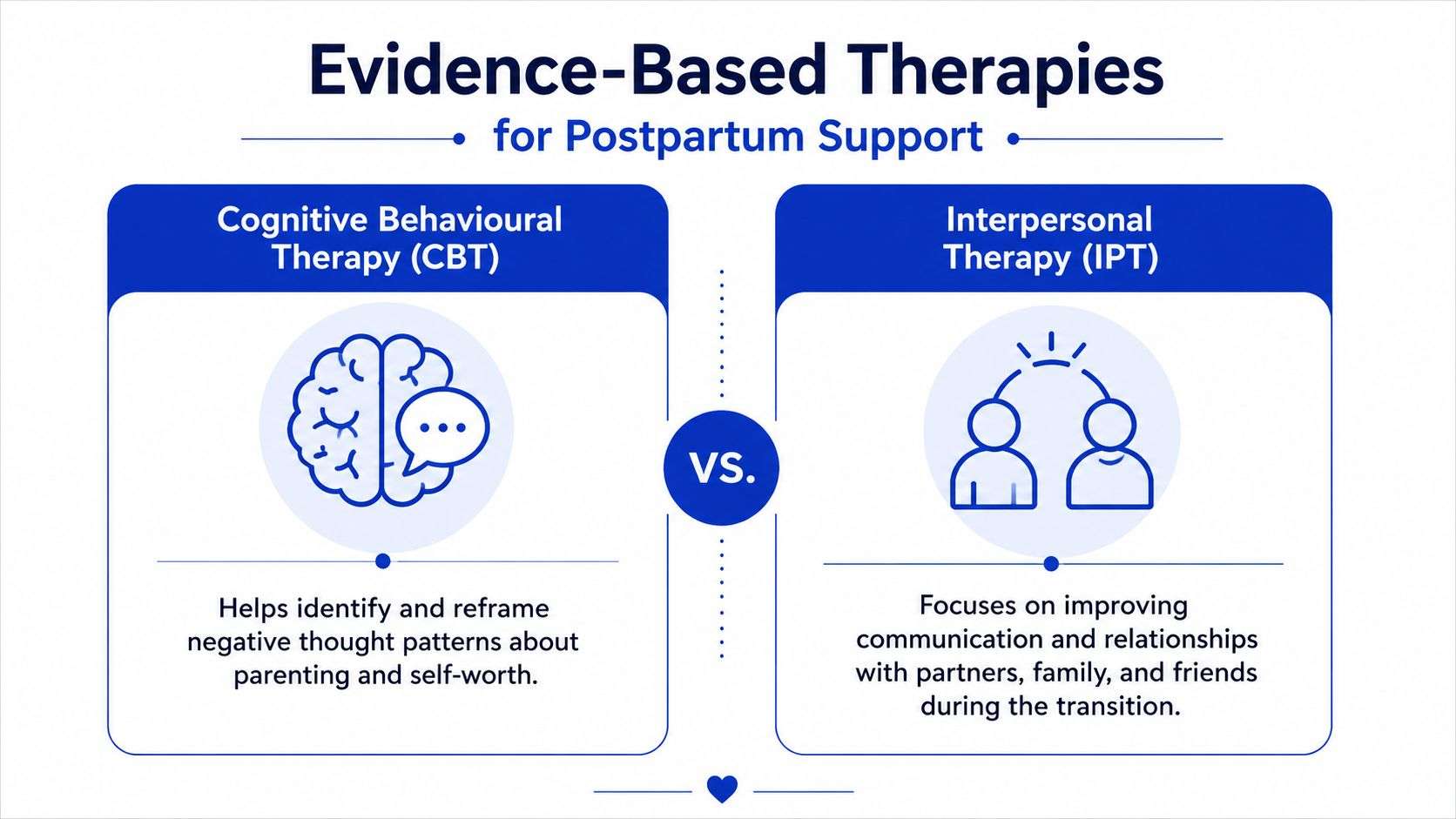
Canadian perinatal mental health guidance identifies Cognitive Behavioural Therapy and Interpersonal Psychotherapy as first-line treatments for perinatal depression and anxiety. The Perinatal Mental Health Guidance Document also supports repeated identification of symptoms, coordinated care, and medication discussions when clinically indicated.
Cognitive Behavioural Therapy
CBT helps you identify the relationship between thoughts, feelings, body sensations, and actions. A parent might keep a brief record of a difficult moment:
- Situation: The baby cries after feeding.
- Automatic thought: “I'm failing and something is seriously wrong.”
- Feeling: Panic and shame.
- Alternative response: “Crying can have many causes. I can check the basics and ask for help if I need it.”
The purpose isn't to dismiss legitimate concerns. It's to reduce the extra layer of self-attack and catastrophic thinking that can make a difficult moment feel impossible.
Acceptance and Commitment Therapy
ACT focuses on making room for painful emotions without allowing them to dictate every decision. In a session, you might practise grounding while noticing anxiety, then identify a value such as patience, honesty, or connection. The next step could be a small action, like telling your partner what you need instead of hiding your distress.
Interpersonal Therapy
IPT addresses changes in relationships and roles. You might map who can provide emotional or practical support, rehearse a conversation about night duties, or explore grief for your pre-parenthood identity. This approach recognises that postpartum distress often develops within changing relationships, not only inside one person.
Trauma-focused approaches
EMDR may be considered when a parent is experiencing birth-related trauma, flashbacks, intense physical reactions, or avoidance connected with a frightening medical experience. Trauma-informed counselling moves at a pace that respects your sense of control. Your counsellor should explain the approach and invite your consent rather than pushing you into details before you're ready.
Many counsellors blend approaches. The Hiccapop new parent wellness tips may be useful for everyday coping between appointments, while therapy provides individualised assessment and support. Some of these modalities may be eligible for coverage through extended health benefits, depending on your plan and the provider's designation.
How to Choose the Right Counsellor in Vernon
Availability matters, but it shouldn't be the only factor. A counsellor may have an open appointment and still not be the right person for your needs. A brief introductory call or email can help you ask whether they work with postpartum depression, anxiety, birth trauma, intrusive thoughts, identity changes, or relationship strain.
Look for a regulated professional designation that your benefits plan recognises, such as RCC, RSW, or RP, and ask about training in perinatal mental health. Credentials don't guarantee a personal fit, but they help you understand the practitioner's scope and professional accountability.
Compare the factors that affect real-life fit
| Factor | What to look for | Why it matters |
|---|---|---|
| Perinatal experience | Familiarity with postpartum mood concerns, birth trauma, feeding stress, and bonding worries | You won't need to spend your limited energy explaining why ordinary tasks feel unusually difficult |
| Therapeutic approach | CBT, IPT, EMDR, attachment-based, emotion-focused, or trauma-informed care | The approach should match your symptoms and your comfort with different forms of therapy |
| Professional designation | RCC, RSW, RP, or another designation recognised by your plan | This can affect scope of practice and extended health reimbursement |
| Format | In-person, secure virtual, phone, or hybrid sessions | The best format is the one you can realistically attend |
| Scheduling | Daytime, evening, weekend, or flexible appointment options | Newborn routines rarely follow a predictable timetable |
| Inclusivity | Respectful care for LGBTQ+ parents, diverse family structures, cultures, and faiths | You should not have to educate your counsellor about your family before receiving support |
| Collaboration | Willingness to coordinate with your physician, midwife, obstetric provider, or other professionals with consent | Coordinated care can be important when symptoms are severe or medication may be considered |
Ask direct questions
You can ask, “How do you support a parent who feels detached from their baby?” or “What happens if I need psychiatric assessment?” You can also ask how they handle a crying infant during a virtual appointment, whether a partner can join part of a session, and what their cancellation policy is when newborn needs change suddenly.
Pay attention to how the response feels. You're looking for warmth, clarity, respect, and an absence of judgment. If the first counsellor isn't a fit, that doesn't mean counselling won't help.
Overcoming Barriers to Getting Help Fast
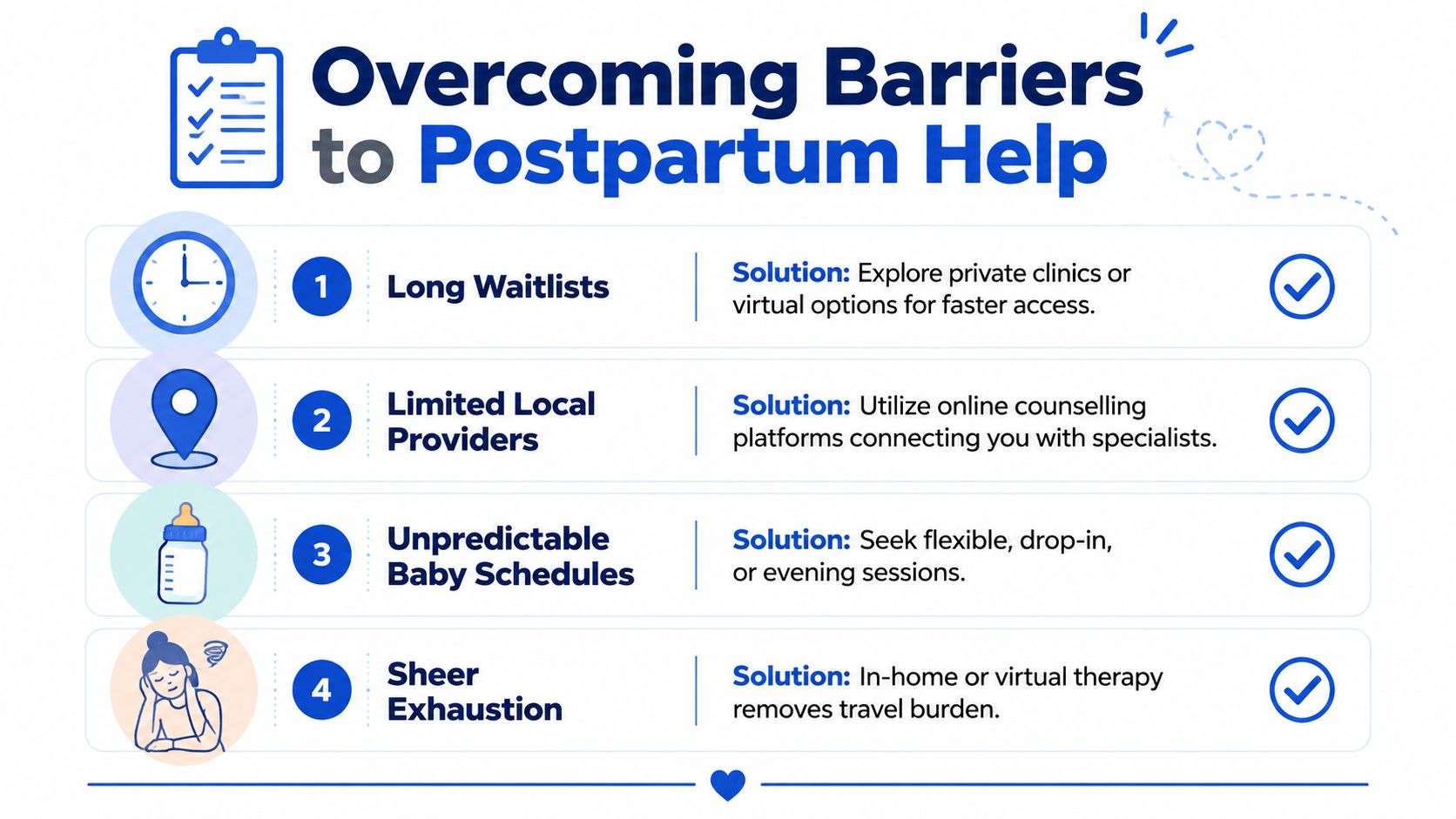
New parents often face a frustrating contradiction. They may need support urgently, but they have little time to search, appointments may be unavailable, and the baby's schedule can change without notice. Statistics Canada reported that 49% of mothers and birthing parents experienced emotional or mental health challenges after birth, while 20% needed mental health care but didn't receive it. The 2024 Statistics Canada report identifies being too busy as the most common barrier, at 41%, followed by unavailable appointments or long wait times, at 32%.
Use more than one doorway
You don't have to wait for a single referral route to work. Contact your family doctor, midwife, public health nurse, or primary care provider and describe the symptoms plainly. Ask what can happen while you're waiting, not only for the eventual counselling appointment.
Provincial and community pathways may include HealthLink BC through 811, local community health services in Vernon and the North Okanagan, peer support through the Pacific Post Partum Support Society, and regional crisis services. Confirm current hours and eligibility directly, since services can change.
Build a temporary plan around the baby
While you're waiting, choose support that removes steps rather than adding homework.
- Virtual sessions: Attend from home during a nap, a partner's shift, or a time when the baby can safely be nearby.
- Phone support: Use a phone appointment when video feels too demanding or your internet connection is unreliable.
- Practical childcare: Ask someone to hold the baby, prepare food, or manage a feed while you attend.
- Peer connection: A parent support group can reduce isolation while you arrange individual care.
- Crisis pathways: If safety concerns arise, use a crisis line or emergency service rather than waiting for a routine appointment.
Talk openly about scheduling. Some counsellors offer phone or virtual care, appointment times outside conventional hours, or policies that account for infant unpredictability. You may also check whether your extended health plan covers the provider's designation and whether an employer assistance program can offer interim counselling.
Practical rule: Make the first request as specific as possible. “I'm having panic symptoms and can't sleep even when the baby sleeps” gives a provider more useful information than “I'm not doing well.”
British Columbia's postpartum psychiatric admission data reinforce why follow-up shouldn't end at the routine early check. Admissions occur at about 4 per 1,000 deliveries, and the median admission occurred 5.5 months after birth, according to a BC population-based study. That timing supports continued attention through the first postpartum year, especially when symptoms return or intensify.
What Interactive Counselling Offers New Parents
Interactive Counselling offers postpartum-related support through its Vernon service, including counselling for postpartum depression using evidence-informed approaches such as CBT, Internal Family Systems, and behavioural activation. Depending on your needs, sessions may also draw on emotion-focused and trauma-informed work.
A first appointment typically gives you room to explain what has changed, what feels hardest, and what you hope will be different. You may discuss sleep, mood, anxiety, birth experiences, feeding pressure, relationships, identity, or frightening thoughts. The counsellor can help clarify whether supportive counselling is appropriate or whether you need coordinated medical or psychiatric care.
Care that fits an unpredictable routine
Interactive Counselling provides in-person, online, and phone counselling options. That flexibility can matter when leaving home feels difficult, the baby's routine is unpredictable, or travel adds another task to an already crowded day.
You're also allowed to have an imperfect session. You might cry, pause to feed the baby, or lose your train of thought. Therapy can still be useful when the appointment doesn't look polished. Counselling may include individual work, relationship support, or coordination with physicians, midwives, and other providers when you consent and shared care would be helpful.
The right process should feel collaborative. You can ask why a particular approach is being suggested, say when something feels too fast, and help decide what to work on first.
Common Questions About Postpartum Counselling
Am I a bad parent if I need help?
No. Asking for support shows that you're paying attention to your wellbeing and your family's needs. Parents seek counselling because they want to feel steadier, reconnect with themselves, communicate more effectively, or understand symptoms that have become difficult to manage.
Will my baby be taken away if I admit I'm struggling?
Counsellors don't report ordinary feelings of sadness, anxiety, anger, or overwhelm because you disclosed them. Counselling is confidential, with limits related to immediate safety concerns, serious risk of harm, or situations where a child may be in danger. Your counsellor should explain these limits clearly at the beginning of care.
Being honest about distress usually helps a clinician understand what support would keep you and your baby safer. If you're worried about confidentiality, ask directly before sharing details.
What if I cry through the whole session?
Then you cry. You don't need to arrive with a tidy explanation or a prepared story. A counsellor can slow the conversation, help you regulate, and begin with what feels most urgent.
You may bring the baby, pause for feeding, or take a break if the format allows. Ask about these arrangements when booking so you don't have to solve them while distressed. Reading practical resources, such as these top parenting books for 2026, can complement care, but books can't replace assessment when symptoms are persistent or severe.
How do I know whether I need counselling?
You don't have to wait for a diagnosis. Consider reaching out when distress is lasting, worsening, affecting your relationships, interfering with daily functioning, or making it difficult to care for yourself. A counsellor can help distinguish ordinary adjustment from a condition that needs structured treatment.
If you're experiencing hallucinations, severe confusion, or immediate thoughts of harming yourself or someone else, seek emergency help rather than waiting for a counselling appointment.
Can my partner attend?
Often, yes, if that fits the treatment plan and your consent. Partners can help describe changes they've noticed, learn how to respond to distress, and work through conflict about care responsibilities. You can also have individual sessions when you need private space.
Reaching out isn't a failure of parenting. It's one way of creating more safety, steadiness, and connection for the whole family.
Interactive Counselling offers in-person, online, and phone counselling for new parents navigating postpartum depression, anxiety, trauma, identity changes, and relationship strain. Visit Interactive Counselling to learn about the available options and consider what kind of support could fit your life in Vernon.
Clinically Reviewed By
Amy Mosset, MCP, RCC-S
Amy Mosset is a Master Practitioner in Clinical Counselling, Clinical Supervisor, and the owner of Interactive Counselling. She provides trauma-informed, evidence-based care and clinical supervision to registered therapists, with a focus on ethical practice, client safety, and high-quality therapeutic outcomes.