If you and your partner have been having the same conversation on repeat, it can start to feel less like a relationship and more like careful timing around each other's bad days. One of you brings up the bill, the kids, the distance, or that thing that never really got resolved, and the other person goes quiet, gets defensive, or leaves the room emotionally before dinner is even over. For more information, see our Kelowna couples counselling.
That kind of exhaustion is a common reason couples start looking for Marriage Counselling in Kelowna. It's not a sign that you've failed. It usually means the two of you have been carrying more stress than your connection can comfortably hold, and the way back is often a matter of rebuilding safety, clarity, and trust in small, workable steps. For more information, see our counselling in Kelowna.
What Marriage Counselling Really Looks Like Today
A couple from Kelowna might sit down after months of trying to “just talk it out” at home. One partner feels dismissed, the other feels nagged, and both are tired of ending the night upset. Neither person needs to be the villain for the relationship to feel stuck. For more information, see our couples counselling.
That's where counselling often starts, not with blame, but with the pattern. A good therapist listens for what happens between you, not just what each person says happened.
Rebuilding connection instead of assigning fault
Marriage counselling today is usually less about deciding who is right and more about helping both people understand what keeps the same painful loop going. For many couples, that loop includes one person reaching harder and the other pulling back, or both people escalating because neither feels heard.
Practical rule: if the same fight keeps returning in a new outfit, the issue is probably the cycle, not the topic.
That shift matters because daily stress can erode even a solid partnership. Counselling gives that connection a place to be repaired with more intention than a rushed conversation between errands, work, and bedtime routines.
What couples usually want most
Most couples don't walk in saying they want a perfect relationship. They want relief. They want less tension at home, fewer misunderstandings, and a way to speak without things spiralling.
They also want hope that the relationship is still workable. That hope is often what makes the first call so important. If you're reading this, you're already doing something brave by trying to understand the relationship instead of just reacting to it.
Signs It May Be Time to Reach Out for Support
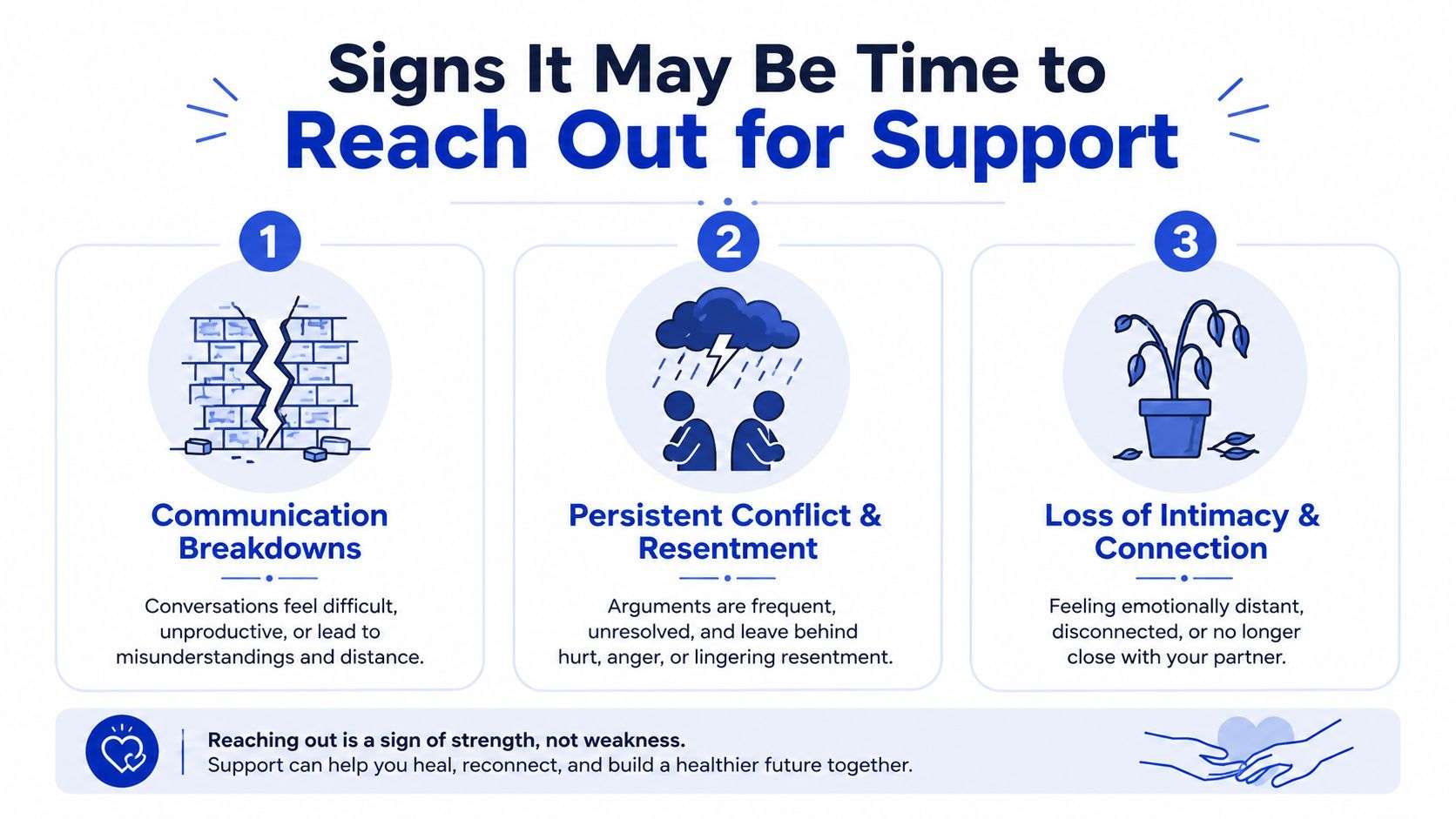
The clearest sign is rarely one dramatic event. More often, couples notice that the relationship feels harder to live inside than it used to. The conversations are thinner, the goodwill is lower, and small things now carry a lot of weight.
A helpful way to sort that experience is by looking at three broad categories.
Communication breakdowns
This shows up when one person starts a conversation and the other shuts down, gets sharp, or changes the subject. It can look like “We never talk anymore,” but underneath that sentence is usually a deeper fear, something like, “I don't think I matter here,” or “If I say this badly, it'll become a fight.” When couples get trapped in protest-withdraw habits, the words on the surface may sound ordinary while the emotional message underneath feels urgent.
Persistent conflict and resentment
Some couples argue often, but the pain is the residue after the argument ends. The disagreement may be about parenting, money, chores, trust, or how a new life stage has changed the relationship, yet the longer pattern is what wears people down. A neutral overview of relationship alternatives during a marriage crisis can be useful here, and the Law Office of Bryan Fagan, PLLC resource offers one example of how couples sometimes think through next steps when the relationship feels unstable.
Loss of intimacy and connection
Sometimes there isn't much open fighting at all. The bedroom is quieter, affection is rarer, and the two of you function more like co-managers than partners. That distance can feel safer than conflict, but it often carries grief with it. Emotional distance doesn't always mean a lack of love, it can mean both people are protecting themselves from more disappointment.
When couples wait until they feel completely overwhelmed, the relationship has usually been carrying the load for a long time already.
The good news is that noticing these patterns early is useful. You don't need to wait until everything is unbearable to ask for help.
How Emotionally Focused Couples Therapy Actually Works
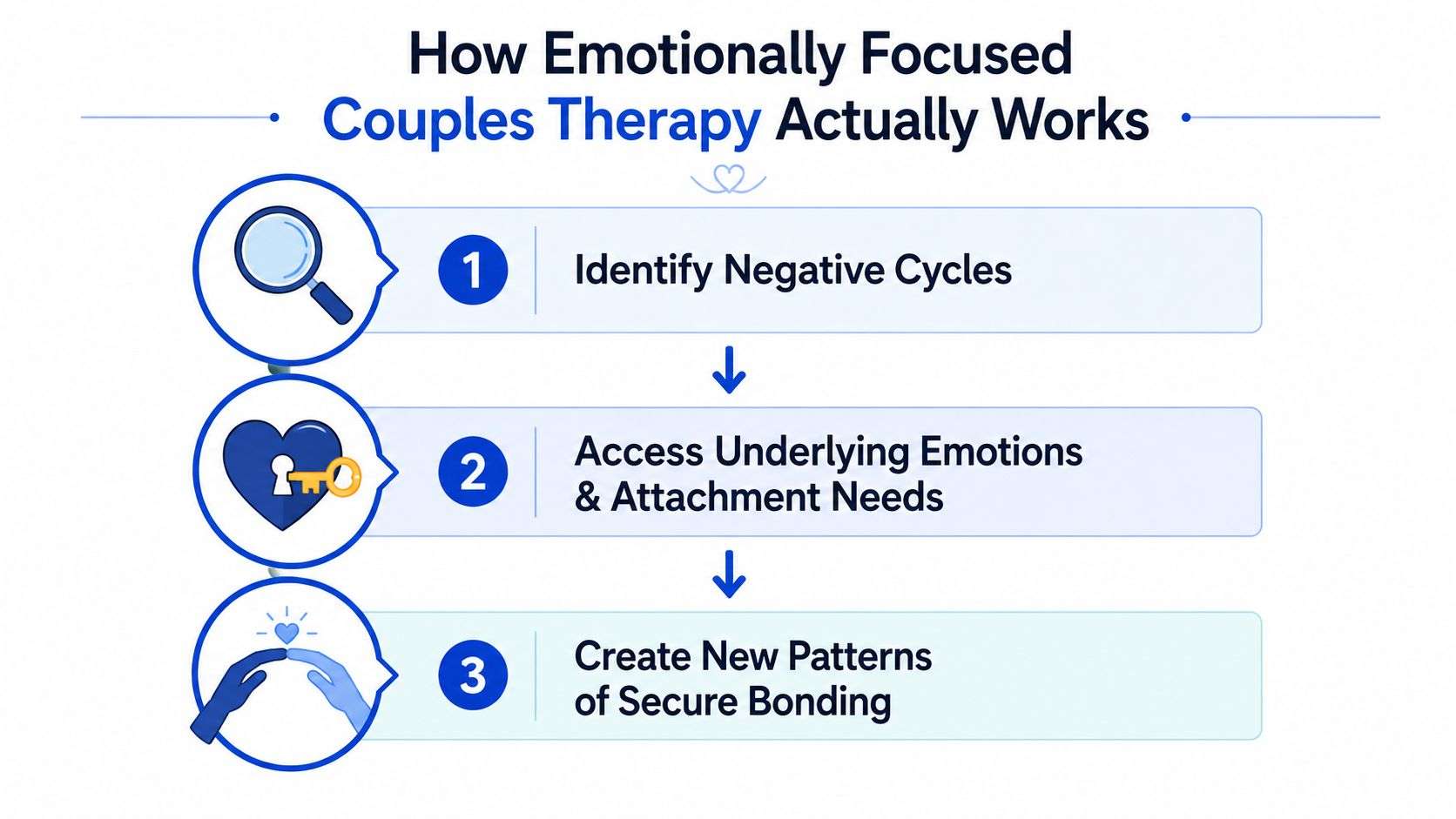
A lot of people expect couples therapy to feel like a debate with a professional referee in the room. Emotionally Focused Couples Therapy, or EFT, works differently. It pays close attention to what's happening emotionally between partners, because that's where most of the repeat pain lives.
Step 1, notice the cycle
The therapist helps the couple name the negative loop. Maybe one partner pushes for answers, the other gets quiet, and then the first partner pushes harder because the silence feels like rejection. Once that cycle is visible, it becomes easier to work on the problem without treating each other as the problem.
Step 2, map the attachment needs underneath
Beneath the anger, most couples are trying to protect something tender. One person may be asking for reassurance, another for space, another for respect, another for evidence that they still matter. EFT makes room for those needs to be spoken more clearly, without turning them into accusations.
Step 3, practise new responses
The work starts to feel different. Partners try new ways of responding in the room, then carry those changes home. Over time, the goal is not to win a conversation. It's to make it easier to reach for each other instead of retreating or attacking.
The model is especially relevant because Canadian-facing summaries associated with EFT describe strong outcomes for distressed couples, with lasting improvement more likely when both people stay engaged and follow the structure of the work. A practical course for defined conflicts often runs about 8 to 12 sessions, while more complex attachment injuries may take longer. The beginning severity of the problem matters less than many people think, because what changes the process most is the willingness to show up and practise something new.
What to remember
Cycle first. Content second. Once the pattern is clear, the topic usually becomes more manageable.
In-Person, Video, or Phone Sessions in Kelowna
For many couples, the hardest part isn't deciding to get help. It's finding a format that fits a week full of work, school runs, commuting, and tired evenings.
Kelowna couples usually choose among three session styles, and the best one is the one you can keep doing consistently.
| Session formats at a glance | ||
|---|---|---|
| Format | Best fit | What stays the same |
| In-person | Couples who want face-to-face support and a room that feels set apart from home life | The therapist still helps you identify the pattern, slow things down, and practise new responses |
| Secure video | Couples balancing childcare, commuting, or different locations | The work, goals, and pacing stay therapeutic and structured |
| Phone | Couples who want privacy, simplicity, or a lower-tech option | The session still focuses on the relationship cycle and repair skills |
The first session is usually about understanding what brought you in, what each person hopes will be different, and how the two of you tend to get stuck. Mid-course sessions often move into guided conversation, repair practice, and between-session tasks that keep the work alive between appointments.
Many Kelowna-area clinics offer daytime, evening, and weekend availability, and some provide secure virtual sessions for couples who live outside the city core or need more flexibility. That matters in a region where practical barriers can keep people from starting therapy even when they're ready.
If you and your partner are choosing a local provider, the format should support the work, not complicate it.
When Individual Therapy Should Come First
A question couples often whisper, rather than say out loud, is whether joint counselling is the right first move at all. That hesitation is wise. Sometimes the relationship does need couples work, but sometimes one partner needs individual support first so the couple work has a safer footing.
When private work may need to lead
If one partner is dealing with active substance use, unmanaged trauma, severe depression, postpartum distress, or a mental health crisis, individual care may need to come first or run alongside couples therapy. The reason is simple. Untreated pain can hijack the couple session and turn every discussion into damage control.
A relationship can't do the stabilising work of individual treatment on its own.
This doesn't mean the partnership should be ignored. It means the sequencing matters. A skilled counsellor will usually think about safety, readiness, and coordination rather than forcing the couple into a format that can't hold the current level of distress.
What good sequencing looks like
Sometimes the couple starts with one partner in individual therapy and later adds joint sessions. Sometimes both partners do some individual work while also attending couples counselling. The right sequence depends on what's most urgent, what's most destabilising, and what each person can participate in right now.
This is also where careful assessment protects the relationship. If one partner is in the middle of a major mental health or substance-use issue, trying to “communicate better” without addressing the underlying problem can feel like putting a fresh coat of paint on a cracked wall.
Why this choice is a strength
Choosing the right starting point isn't avoidance. It's a sign that both partners care enough to do the work in the order that gives it the best chance of landing.
Skills and Exercises You Can Begin at Home

You do not need to wait for a therapy session to start changing the feel of the relationship at home. Small, repeatable habits work like steady hands on a wobbly table, they do not solve every problem, but they make it easier to keep the conversation from tipping over.
Try one weekly check-in
Set aside a short time that is predictable and unhurried. Each person answers three questions without interruption, “What felt good this week?”, “What felt hard?”, and “What do you need from me next week?” Keeping it brief matters, because once a talk runs too long, old grievances often take over and the original point gets lost.
Use a softer start
Start with your own experience and the specific request. “I'm feeling overloaded and I need us to talk about how we're handling this” gives the other person a better chance to stay engaged than a sentence that sounds like a verdict.
A softer start is not about being polite for the sake of it. It lowers the chances that either partner slips into defence before the issue has even been named.
Name the cycle, not the character
Say, “We're in the chase-and-shut-down pattern again,” instead of, “You're impossible.” That wording puts the focus on the pattern between you, where it can be examined and changed.
It also protects the relationship from one hard moment turning into a global label.
Keep a repair attempt menu
A repair attempt is a small move that says, “I want to come back to you.” It might sound like, “Can we pause and try that again?”, “I'm getting flooded, but I'm not leaving this conversation,” or “I hear that I missed your point.” These lines will not fix every argument, but they can keep a disagreement from hardening into contempt.
The point is not to sound scripted. The point is to have a few ready words when emotions are running high and both people need a way back in.
If you are looking for a local service that offers relationship and marriage counselling in a flexible format, Interactive Counselling is one option in Kelowna that provides in-person, phone, and secure virtual sessions. Tools like these work best when they sit inside a larger therapeutic plan, not when they are treated as a stand-in for one.
Choosing the Right Kelowna Counsellor for Your Relationship
A couple can walk into counselling carrying the same argument and leave with very different experiences depending on who sits across from them. One counsellor may hear two people blaming each other. Another hears a pattern that can be studied, named, and worked on together. That difference matters. Couples usually do better with someone who knows how to hold two nervous systems in the room, not just one person's account of the other.
What to look for first
Start with training and experience in couples work. Then listen for how the counsellor describes the process. If they talk about helping you understand the pattern between you, keeping the conversation balanced, and coordinating with individual care when needed, they likely understand the difference between individual therapy and relationship therapy.
In Kelowna, couples also have room to choose based on fit and access. Independent directories list providers across neighbourhoods and streets such as Downtown Kelowna, Glenmore, Rutland, Dickson Avenue, Spall Road, Enterprise Way, Leon Avenue, and Tutt Street, so the search does not have to feel like a scramble for the only option in town.
Questions worth asking before booking
- How do you work with couples when there's a lot of tension? You want to hear whether the counsellor can stay fair when both partners are activated.
- Do both partners attend the first session, and do you ever meet individually as part of the process? This helps you understand how intake is handled and whether the structure fits your situation.
- What approach do you use with couples? A clear answer usually tells you the work is organized, while a vague answer can leave you guessing.
- How do you handle it if one partner dominates or shuts down? Many couples worry about exactly this, so the answer can tell you a lot about the counsellor's steadiness.
- Can you coordinate with individual therapists if one of us needs that as well? That question matters when trauma, depression, or substance use is part of the picture.
Practical rule: a short consult call is normal. It should feel like a two-way check for fit, not a test you have to pass.
How to read the first call
Pay attention to whether the counsellor sounds calm, direct, and respectful. You should leave the conversation with a clearer sense of what to expect, not more confusion. If the person can explain the process plainly and help you decide whether the timing is right, that is often a better sign than polished marketing language.
Choosing help is about finding a steady counsellor who can support your relationship consistently.
If your relationship feels stuck, you do not have to sort it out alone before asking for support. Interactive Counselling offers marriage counselling, couples work, and flexible session options that can fit the realities of life in Kelowna, including in-person, phone, and secure virtual appointments. A calm next step can make room for repair without adding more pressure.
FAQ
How do I know whether we need marriage counselling or just a better conversation?
If the same issue keeps returning, the talks end in disconnection, or one or both of you feel stuck rather than understood, counselling can help. A stronger conversation is useful, but repeated patterns usually need more than better wording.
How long does couples counselling usually take?
It depends on what you are working on and how established the pattern is. A structured course often takes several sessions, while deeper injuries usually need more time.
Can we do counselling online if our schedules are difficult?
Yes. Secure video and phone sessions can work well for couples who commute, manage childcare, or need more flexibility. The therapeutic work stays focused on the relationship either way.
What if only one of us wants to go?
That happens often. One willing partner can still begin, and a counsellor can help with the next best step without forcing a false choice between doing nothing and doing everything at once.
Should we start with individual therapy if one partner is dealing with trauma or substance use?
Sometimes, yes. If individual distress is taking over the relationship, individual therapy first, or alongside couples work, can create a safer foundation for joint sessions.
Clinically Reviewed By
Amy Mosset, MCP, RCC-S
Amy Mosset is a Master Practitioner in Clinical Counselling, Clinical Supervisor, and the owner of Interactive Counselling. She provides trauma-informed, evidence-based care and clinical supervision to registered therapists, with a focus on ethical practice, client safety, and high-quality therapeutic outcomes.