
You're probably doing what a lot of people in Grande Prairie do when they've finally decided to book therapy, you're comparing names, reading bios, and trying to figure out who feels safe to talk to. You want a therapist in Grande Prairie who understands real life here, shift work, long drives, winter roads, family pressure, and the fact that you don't always have time for a bunch of phone calls before you even start. A good Grande Prairie therapist should make the process feel clearer, not more confusing. For more information, see our Grande Prairie family counselling.
The smart move is to choose with intention. Don't just book the first listing that looks polished, and don't overthink every detail until you never decide. Look for the mix that matters most, proper credentials, a style you can work with, and practical access that fits your week. For more information, see our counselling in Grande Prairie.
Finding the Right Therapist in Grande Prairie
A lot of people start with a simple question, who can I see without making my life harder? In Grande Prairie, that question matters more than it does in many cities. Shift work, time on the road, weather, and the sheer size of the region all affect whether therapy becomes a steady support or one more appointment you keep postponing. For more information, see our family counselling.
A friend of mine once described the search this way. “I don't need a perfect therapist, I need one I can realistically get to, and one who won't make me explain everything from scratch every time.” That's the right mindset. You're not shopping for a personality match alone, you're choosing someone who can keep up with your life and help you stay engaged long enough for therapy to work.
The public system gives you one picture of local access. Alberta Health Services' Grande Prairie Aberdeen Centre offers weekday walk-in counselling, over-the-phone support through ICAT, and referral-based access, with office hours Monday to Friday from 9:00 am to 4:00 pm and a limited walk-in schedule that, in 2024, ran on selected Wednesdays between April and September. That tells you something important about the market, public access is structured around standard hours, so private practice often fills the gaps with evening, weekend, phone, and virtual appointments. You can see that same local reality in the Grande Prairie therapist search space, where flexibility often matters as much as specialisation.
Practical rule: choose the therapist you can keep seeing, not just the one who looks ideal on paper.
What the local market tells you
Grande Prairie doesn't operate like a tiny one-clinic town. Psychology Today lists at least 10 in-person therapist profiles in the city, and AHS also runs a walk-in counselling option at the Aberdeen Centre for single-session support and referral. That hybrid structure is useful because it gives you two different entry points.
If you need immediate triage, start with short-term public support. If you need ongoing therapy, book a private therapist who can see you regularly and adjust to your schedule. That's the local logic I'd use every time.
Understanding Therapist Credentials in Alberta
Credentials are where people get stuck. The alphabet soup can look intimidating, but it's not meant to be a mystery. You just need to know what each title says about training, supervision, and scope.
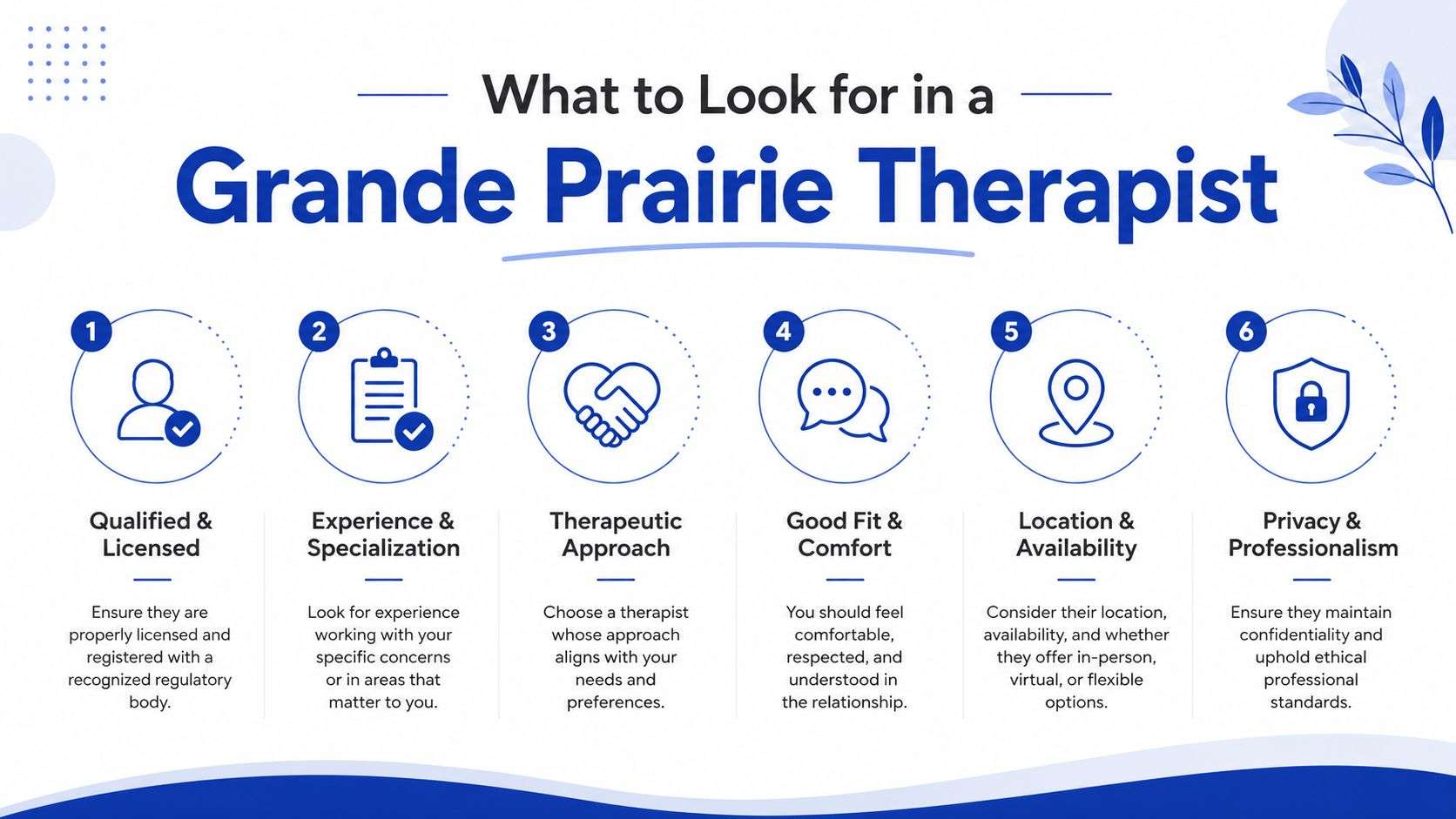
A Registered Clinical Counsellor (RCC) has completed professional counselling training and works within a regulated professional framework. A Master Practitioner in Clinical Counselling (MPCC) signals advanced counselling education and supervised practice. A Registered Professional Counsellor (RPC) is also a counselling designation that tells you the practitioner has completed formal training and professional requirements. A Registered Social Worker (RSW) is trained in social work and may provide therapy within that scope, often with a broader view of family systems, community supports, and life stressors.
What matters to you as a client is not the letter combination alone, it's the competence behind it. You want to know whether the person has training in the issue you're bringing in, whether they practise within a professional standard, and whether they can explain their approach in plain language. If a listing can't tell you that clearly, keep looking.
Credentials are not the same as a psychologist
People often get mixed up. A therapist with counselling or social work credentials is not the same thing as a psychologist, and that distinction matters because the work, training, and services differ. Interactive Counselling's team is built around RCC, MPCC, RPC, and RSW practitioners, not psychologists, so if you're reading a profile there, look for those titles and what they mean for your care.
The cleanest way to evaluate a credential is to ask three questions.
- What training did you complete? You want a clear answer, not vague marketing language.
- What kinds of concerns do you regularly help with? Anxiety, grief, trauma, relationship stress, parenting, and life transitions all call for different strengths.
- How do you keep your practice accountable? Registration, supervision, and ethical standards matter because they protect you.
Bottom line: credentials should make you more confident, not more confused. If they don't, the listing isn't doing its job.
What to Look for in a Grande Prairie Therapist
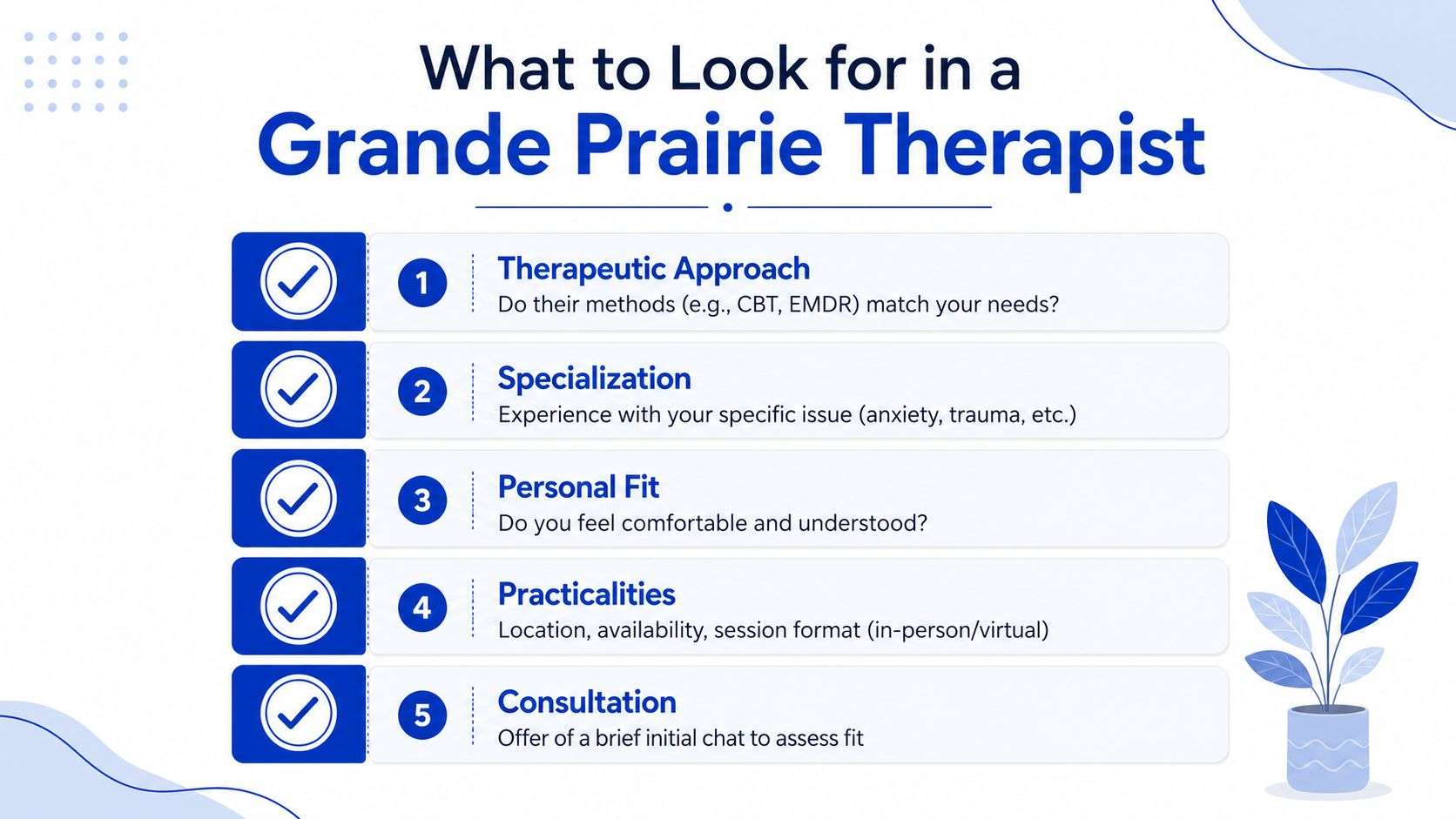
Once you understand the title, start looking at the actual fit. A Grande Prairie therapist should be more than qualified, they should be usable in real life. The best profile on paper can still be a poor match if the therapist's style, availability, or approach doesn't work for you.
Start with the issue you're bringing in
If you're dealing with anxiety, depression, trauma, grief, relationship conflict, parenting strain, or burnout, look for direct experience with that concern. A therapist doesn't need to specialise in everything, but they should be able to speak clearly about the kind of help they offer. If a therapist has no obvious connection to your issue, keep searching.
Then check the practical fit
Grande Prairie and the surrounding communities have real access barriers. Long drives, changing shifts, winter roads, and isolation make consistency hard. That's why evening, weekend, phone, and secure virtual sessions aren't a bonus, they're often the difference between staying in therapy and dropping out.
A strong listing answers practical questions before you even ask them:
- Availability: Can they see you at a time you'll keep?
- Session format: Do they offer in-person, phone, and virtual care?
- Location: Is the office realistic for your routine, or a detour you'll resent?
- Communication style: Do they sound direct, warm, structured, or reflective, and does that suit you?
- Community trust: Have they earned visible recognition from local clients or peers?
Community-voted awards can be a helpful signal when they're consistent over time. Interactive Counselling, for example, has received community recognition across its wider practice, including 2026 Gold awards for Best Psychology Clinic, Best Counsellor, Best Life Coach, and Best Therapist, plus Three Best Rated recognition for marriage counselling. Those awards are Kelowna-based recognition for the wider practice, not Grande Prairie-specific, but they still tell you something about repeated client trust.
If you want a simple rule, use this one. Pick the therapist who can work with your issue, on your schedule, in the format you'll use. Everything else is secondary.
What Your First Therapy Session Involves
The first session usually feels bigger than it is. You've probably spent days building it up in your head, then you worry you won't know what to say. A good therapist knows that, and they won't expect you to arrive with perfect wording or a polished life story.

A typical first appointment starts with intake. The therapist will ask why you reached out, what's been happening lately, and what you hope changes. You may also be asked about past counselling, family context, current stressors, and any safety concerns. That isn't interrogation, it's the foundation for a plan that fits your situation.
The format can be in person, by phone, or through secure video. That flexibility matters in northern Alberta because not everyone can drive in after work, arrange childcare, or make it through a storm for a 50-minute appointment. In the Grande Prairie market, that flexibility is often the reason people stay engaged.
The first session is not a test. It's a conversation about whether the therapist can help you move forward.
After that first meeting, the therapist should give you some sense of direction. You might hear how they approach the work, what the next few sessions could focus on, and what progress might look like. If you're also managing medication, it can be useful to compare notes with other supports, including resources such as optimizing your psychiatric treatment, so your care stays coordinated rather than fragmented.
You don't need to leave session one transformed. You just need to leave with a clearer sense of whether this person can help.
How to Know If Your Therapist Is the Right Fit
Good therapy feels steady, not theatrical. You should feel heard, respected, and gently challenged. If the therapist listens well, remembers what matters, and helps you make sense of patterns without talking over you, that's a strong sign you're in the right room.
The fit usually becomes clearer over a few sessions. Some discomfort is normal, especially if you're talking about trauma, grief, or conflict you've avoided for years. But there's a difference between useful discomfort and poor fit. Useful discomfort feels like honest work. Poor fit feels confusing, dismissive, rushed, or oddly performative.
Signs to stay
- You feel understood: Even when the topic is hard, the therapist tracks what you mean.
- You leave with something usable: A new perspective, a strategy, or a clearer next step.
- The pace makes sense: They don't push too fast or drift so slowly that nothing changes.
- You can be honest: You don't feel like you need to edit yourself to keep the relationship smooth.
Signs to reconsider
- You feel chronically unseen: Not just nervous, but consistently misunderstood.
- You keep leaving more confused: Clarity should increase, not disappear.
- The therapist talks more than listens: Therapy isn't a lecture.
- Concerns get brushed off: If you raise a problem and it's ignored, that matters.
If something feels off, say so. A competent therapist can handle feedback. If the response is defensive or vague, that tells you more than the original issue did. Switching therapists is not failure, it's good self-advocacy.
Progress also doesn't have to look dramatic. Sometimes it shows up as better sleep, less avoidance, a steadier mood, or the ability to have one honest conversation you used to avoid. Those are real markers of change, and they count.
Alberta Funding and Insurance Options for Therapy
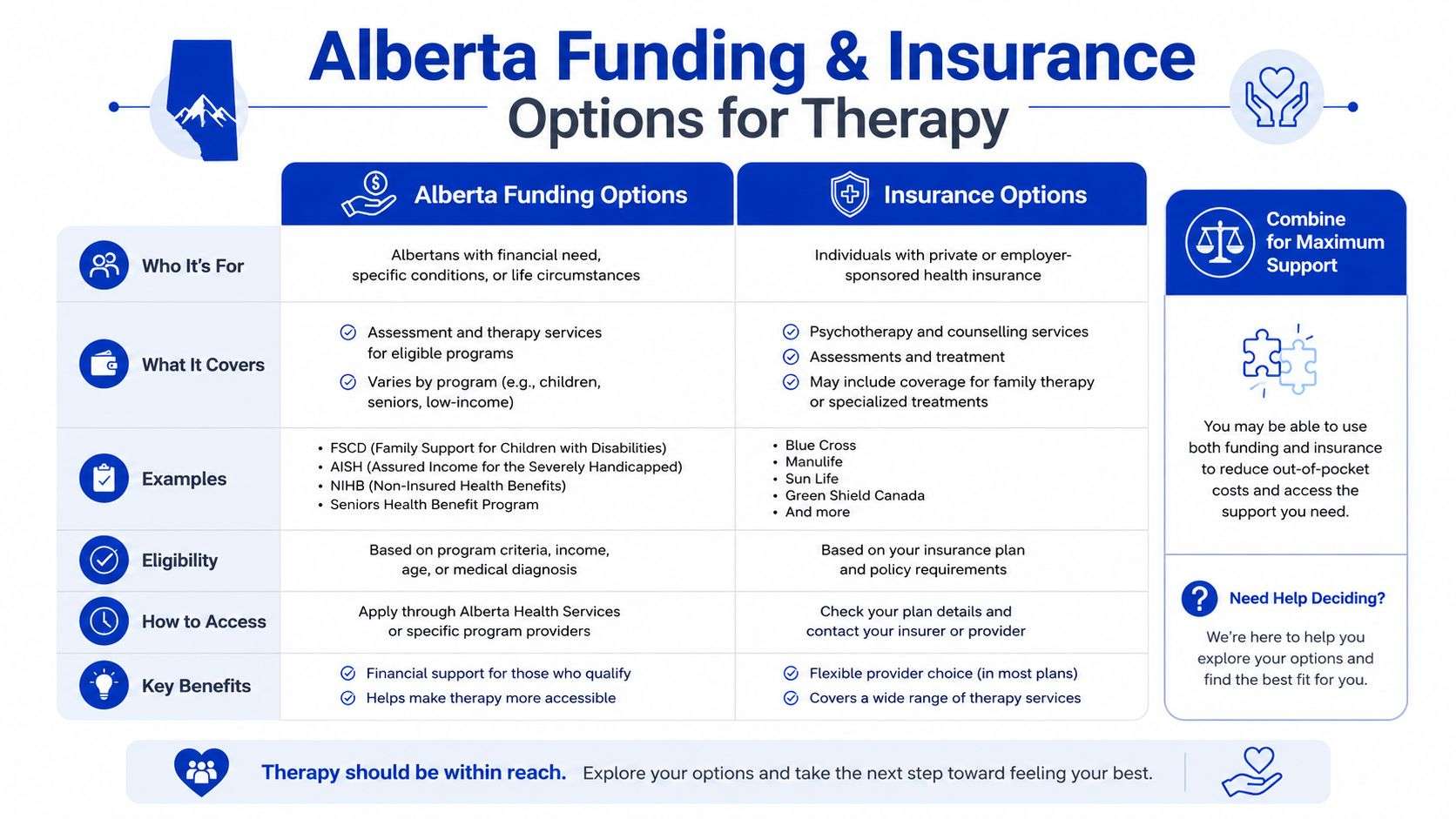
Money is part of the decision, so be straight with yourself about it. In Alberta, many people use extended health benefits through providers like Alberta Blue Cross, ASEBP, ABEFAP, or employer benefit plans, and families may also look at Family Support for Children with Disabilities (FSCD) where it applies. The key is to check your own plan before you book, because coverage details vary and receipts are often what you submit for reimbursement.
That matters because private therapy is still largely fee-for-service in Canada, and many insurance plans only cover a limited number of sessions. Nearly 30% of Canadians lack private insurance altogether as reported in the peer-reviewed analysis on Canadian psychotherapy coverage. The same analysis notes that non-physician mental health coverage is often limited to about two to eight sessions through private insurance, which is exactly why people end up weighing short-term public options against longer private care.
Alberta Health Services can be the right first stop when you need brief support or referral help. The Grande Prairie Aberdeen Centre's walk-in counselling and ICAT access are built for that kind of short-term entry point. Private therapy makes more sense when you want continuity, a specific clinician, or a format that works around shift work and family life.
Interactive Counselling lists a fixed private-pay structure of $165 for a 50-minute individual session and $175 for couples or family sessions, with the same rate across in-person, phone, and secure virtual care. If you're budgeting, that kind of predictable structure makes planning much easier than guessing how delivery format will affect the bill.
Practical move: before you book, call your insurer or check your benefits booklet and confirm the practitioner designation they reimburse, the per-session maximum, and whether they need a receipt or pre-approval.
Taking the Next Step Toward Support
Choosing a therapist gets easier when you stop treating it like a mystery. Check the credentials. Check the fit. Check the access. Check the cost. If all four line up, you've probably found someone worth booking with.
That's the kind of decision people in Grande Prairie need, especially when life is busy, the weather is rough, and getting help has to fit around real responsibilities. If you've been carrying anxiety, grief, trauma, relationship strain, or the fallout from a difficult event like a collision, support is available, and you don't need to have the whole story figured out before you start. If you're looking for a broader perspective on emotional distress from auto accidents, that can also help you understand why symptoms sometimes linger after the event itself.
Interactive Counselling has been recognised by the wider practice's community-voted Gold awards for Best Psychology Clinic, Best Counsellor, Best Life Coach, and Best Therapist, along with Three Best Rated recognition for marriage counselling. Those awards are not a substitute for fit, but they do reflect steady client trust over time.
If you're ready to choose, start with the clinician whose availability, approach, and credentials match your needs best. Then book the first appointment and let the relationship prove itself in real conversation.
If you want a Grande Prairie therapist who offers in-person, phone, and secure virtual sessions with flexible scheduling, visit Interactive Counselling to learn more about the team and find the right starting point for your care.
Clinically Reviewed By
Amy Mosset, MCP, RCC-S
Amy Mosset is a Master Practitioner in Clinical Counselling, Clinical Supervisor, and the owner of Interactive Counselling. She provides trauma-informed, evidence-based care and clinical supervision to registered therapists, with a focus on ethical practice, client safety, and high-quality therapeutic outcomes.