
Postpartum doula services in Canada typically range from about $25 to $75 per hour, and most families budgeting for a multi-visit package should plan for roughly $1,000 to $3,500 out of pocket depending on region and hours needed. That range can feel surprisingly wide when you're already sleep-deprived, but it makes more sense once you see how hours, timing, and add-ons change the final bill. For more information, see our depression counselling.
The first weeks at home can blur together. One day you're thinking about feeding, the next you're wondering how anyone is supposed to shower, nap, and eat while caring for a newborn, and the idea of bringing in support can feel both helpful and complicated. Knowing what postpartum doula cost really covers helps you make a calmer, more informed choice about the kind of care you want in your home.
Table of Contents
- Why Postpartum Doula Cost Is Worth Understanding Early
- What a Postpartum Doula Provides
- Key Factors That Shape Postpartum Doula Cost
- Sample Pricing Scenarios for Real Families
- How Bornbir Can Help
- Coverage, Subsidies, and Affordable Care Options
- Smart Questions to Ask Before You Book
- Connecting Postpartum Doula Support to Mental Wellbeing
- Frequently Asked Questions About Postpartum Doula Cost
Why Postpartum Doula Cost Is Worth Understanding Early
The first days after birth can blur together. A parent may be healing, trying to feed a baby, and reaching for support between naps, all while making decisions that would normally feel simple. Cost feels easier to put off in that moment, yet a clear plan before the baby arrives can prevent last-minute stress when rest and reassurance matter most.
Postpartum doula cost is more than a line item. It helps families see what kind of help they can afford, whether they need a few daytime visits, overnight care, or a brief stretch of more hands-on support. California's public reimbursement standards offer one reference point, with Medi-Cal listing $162.11 for a standard postpartum visit, $486.36 for a three-hour extended support visit, and $197.98 for an initial 90-minute visit, while private care can cost more depending on the provider and the arrangement (DHCS).
Why the price question can feel confusing
A posted hourly rate rarely shows the full bill. Families often compare the first number they see, then discover minimum booking windows, travel charges, or overnight premiums that change the final total. That confusion is easy to understand, because postpartum support is personal care, and the pricing often does not mirror the way new parents budget.
Practical rule: if the quote does not spell out visit length, timing, and extras, the full price is still unclear.
California families also face a higher-cost market, so planning early matters even more there. Consumer guidance for the state places postpartum doula rates around $55 to $75 per hour, and many families budget $2,000 to $6,000 for a package of several visits. That does not mean every family pays that amount, but it does explain why the cost can feel larger than the first quote. Understanding the structure of the bill helps families compare support options with less pressure and more confidence.
What a Postpartum Doula Provides
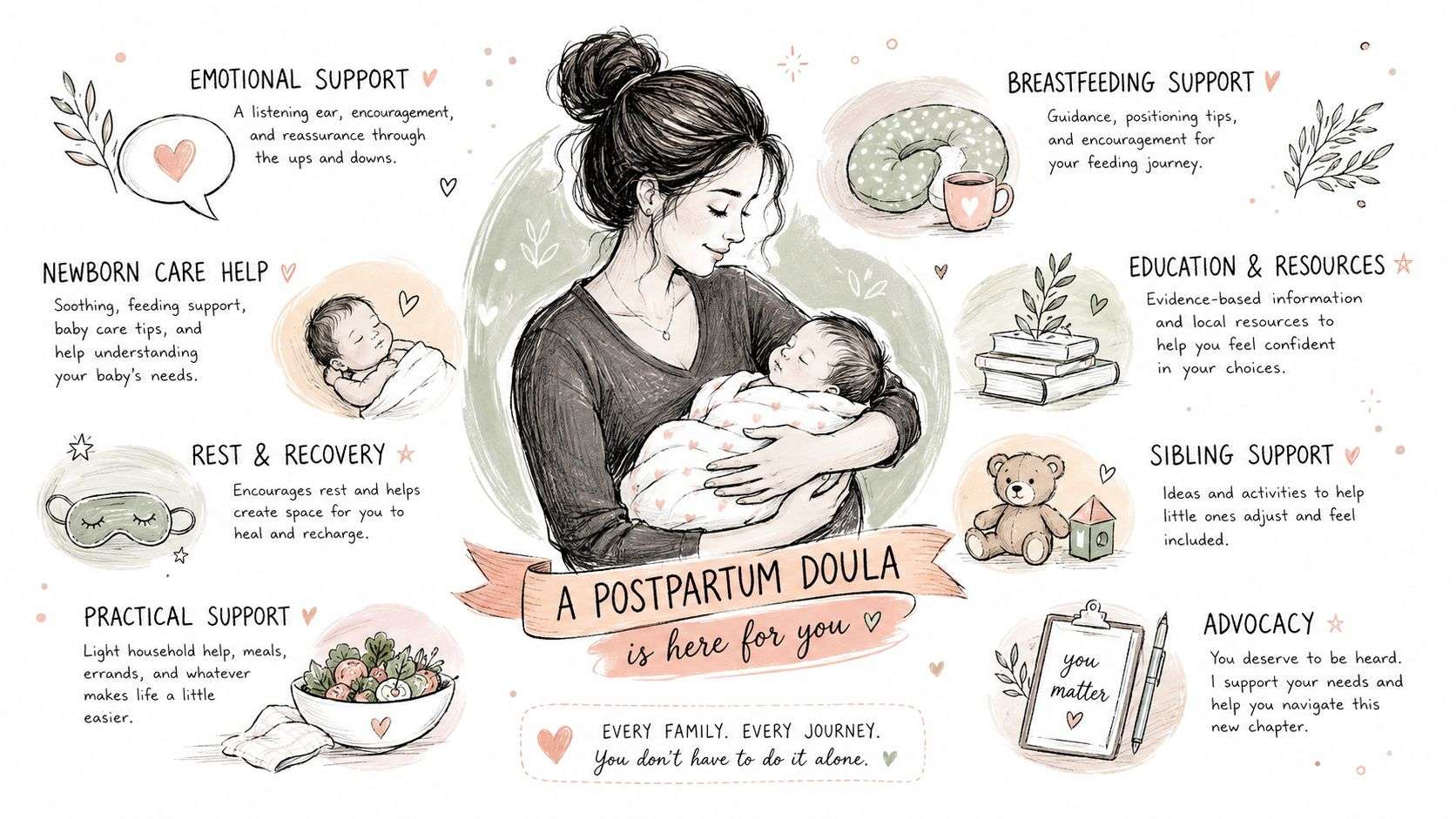
A postpartum doula supports the family's transition home through practical and emotional care. The role often includes newborn-care guidance, feeding support, reassurance, and hands-on help that gives parents room to rest and recover. Because every household needs something a little different, the work can look very different from one family to the next, and that variation is one reason pricing can vary so much.
The role also needs to be separated from other kinds of care. A birth doula focuses on labour and delivery support, while a postpartum doula steps in after birth to help with the rhythm of daily life once the baby is home and everyone is adjusting. A nanny's main job is childcare, and a night nurse's support is usually centered on overnight infant care, so families do best when they compare the exact service they need rather than relying on the title alone.
A simple day in the home
A typical visit may begin with the doula checking how the parents slept, talking through the previous feed, and helping organize the day. She may help with a feeding session, settle the baby, fold a load of laundry, or offer a calm voice when the parent feels unsure about what the baby needs. If the shift is overnight, the focus may shift toward helping the family get real rest while the baby is monitored and soothed.
That mix of emotional and practical care is what families are paying for. The value is not only in holding the baby, it is also in reducing the load around the baby. Research on doula care notes that these services are often used to support families through feeding, recovery, and adjustment at home, especially when regular support from insurance or public coverage is limited (NIH).
When people ask why rates vary, the answer usually comes down to the scope of the visit. A short daytime check-in, a multi-hour block, and a long overnight shift are different services, even when they all fall under the same job title. Once the role is clear, the quote becomes much easier to evaluate.
Key Factors That Shape Postpartum Doula Cost
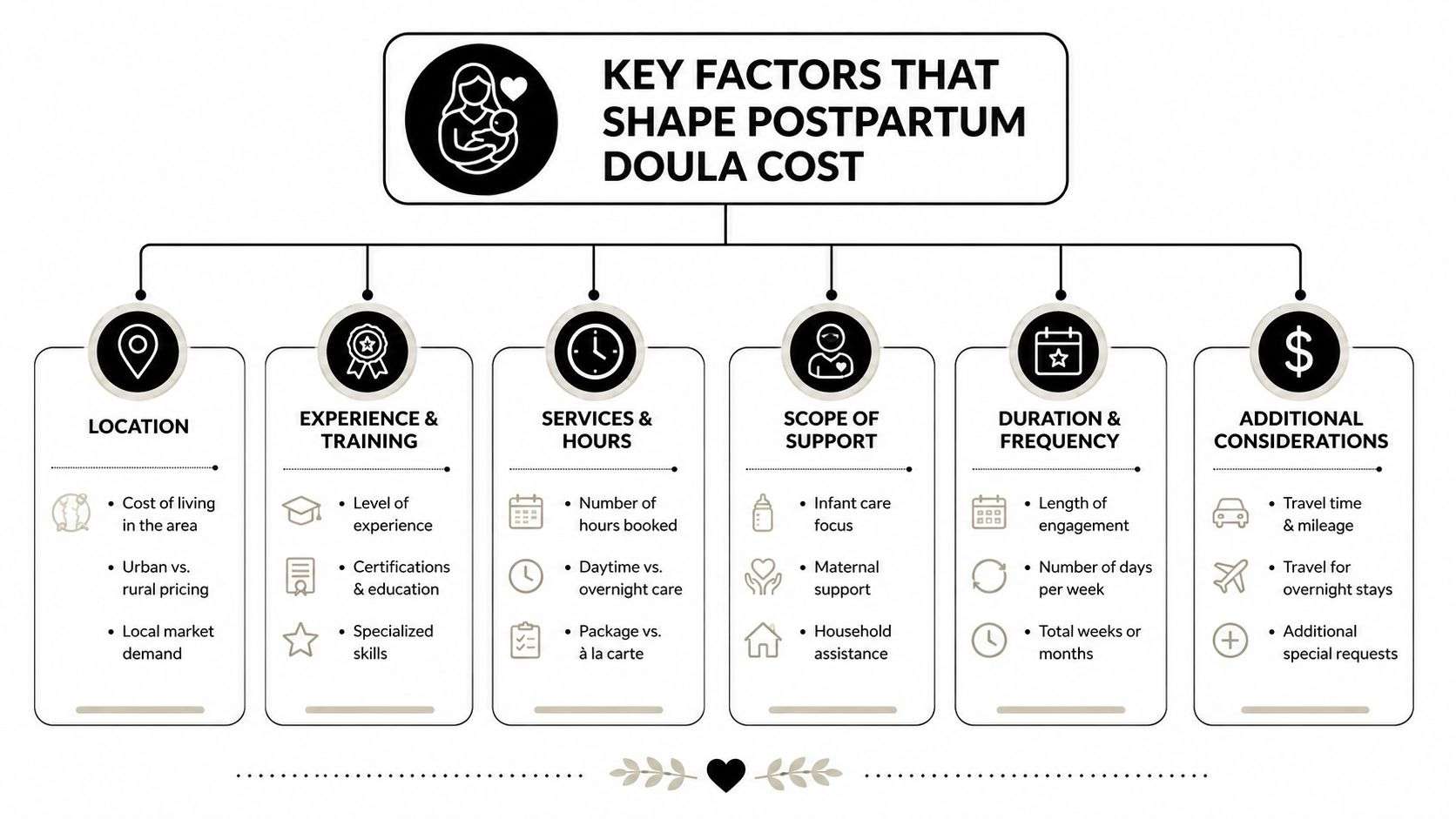
A quoted rate can look simple on paper, but the final bill often grows from several small choices. The kind of shift, the length of the visit, the doula's background, and the local market all shape what families pay.
Hourly rates and package pricing
Some doulas charge by the hour. Others sell packages that bundle a set number of visits or overnight blocks, which can make budgeting easier at first glance. The part that often surprises families is the minimum. A package may look affordable until the required hours, included add-ons, or the number of sessions raise the hourly cost. Peer-reviewed and federal sources show that doula pricing can range widely, with services varying by geography and experience, and Medicaid models can be structured as a single global payment or as fee-for-service totals that differ by state (NIH, MACPAC).
Overnight shifts, travel, and experience
Timing changes the bill. Night support usually costs more than daytime care because it requires a different schedule and a different level of stamina from the provider. Travel fees may also appear when a family lives far from the doula's base, and experienced doulas often charge more because families are also paying for judgment, calm under pressure, and a wider range of hands-on skills.
Location matters more than many parents realise
Local market conditions can shift the price more than families expect. In higher-cost areas, the same service often starts from a higher baseline, and California is a clear example of that pattern. GoodRx's analysis of DoulaMatch data found higher average minimum fees in California than in many other states, which helps explain why families there often see larger starting quotes (GoodRx). California consumer guidance also places postpartum rates at $55 to $75 per hour, so even a short four-hour visit can translate into a few hundred dollars before travel, parking, or other add-ons are included.
A quoted hourly rate tells you what one hour costs. It does not yet tell you what one week of support will cost.
That distinction matters. A family comparing doulas should ask whether the quote includes minimum hours, night premiums, and travel, because those pieces determine whether the final total stays close to the estimate or grows well beyond it.
Sample Pricing Scenarios for Real Families
The clearest way to understand postpartum doula cost is to turn an hourly quote into an actual family schedule. Parents do not usually buy a single rate, they buy blocks of care, and the final bill depends on how many hours are needed, whether there is a minimum shift, and whether the support happens during the day or overnight. The examples below show how a quote can become a real total in California-style pricing, where base hourly rates often sit in the $55 to $75 range.
Three common budgets
| Scenario | Hours per Week | Minimum or Premium | Typical Rate | Estimated Total |
|---|---|---|---|---|
| First-time parent, daytime support for two weeks | 8 | Standard daytime visit | $55 to $75 per hour | $880 to $1,200 |
| Overnight help after a Cesarean birth, three nights | 10 per night | Overnight premium | $55 to $75 per hour | $1,650 to $2,250 |
| Short intensive newborn package, four visits in the first week | 4 per visit | Minimum visit fee | $55 to $75 per hour | $880 to $1,200 |
What each scenario really means
The first-time parent often wants feeding help, reassurance, and a few hours of breathing room during the day. A steady daytime schedule can feel easier to plan for because the support is spread across short visits, even though the total still climbs once the hours are added together. Families often find it easier to budget for this kind of care when they can see the visit pattern clearly, rather than just hearing an hourly number.
The overnight scenario works differently because nighttime care changes the whole rhythm of the home. Families recovering from a Cesarean birth or trying to protect sleep may choose fewer but longer shifts, and overnight care often carries a premium because the provider is working through the night. A short intensive package is often chosen by parents who want concentrated help during the fragile first days, then plan to lean on family, peer support, or their own routine after that.
A quote that sounds manageable can still grow once minimum hours or overnight premiums are included.
If you are deciding where to begin, list your must-have hours first. Then ask which parts of the quote are fixed and which parts change with timing, because that is what usually determines whether the final bill stays close to the estimate or moves beyond it.
How Bornbir Can Help
Bornbir is a marketplace that connects expecting and new parents with vetted perinatal providers across pregnancy, childbirth, and postpartum care. For families trying to understand postpartum doula cost, that matters because the search often becomes a comparison problem, and comparison is hard when you're exhausted and every provider describes services differently.
In under 30 seconds, parents can share what they need and get matched to doulas, midwives, lactation consultants, night nannies, and sleep coaches for in-person or virtual care. That makes it easier to compare availability, services, and pricing side by side, instead of opening a dozen tabs and trying to decode each provider's package language. If you're ready to start narrowing the field, you can find a postpartum doula and look at options that fit your location and timeline.
Bornbir also gives parents a place to read real reviews from other families and message matched providers securely. That can be especially useful when you're deciding between a few providers who seem similar on paper but offer different levels of overnight care, feeding support, or scheduling flexibility.
For professionals, the platform offers a free profile so they can show services, credentials, reviews, and pricing without paying to join. That doesn't replace your own judgement, and it doesn't remove the need to verify fit or licensure, but it does make the first step less time-consuming for families who are already carrying a lot.
Coverage, Subsidies, and Affordable Care Options
A family may face a smaller bill when support is built from several sources instead of paid for all at once. One parent might use employer wellness funds, another might ask whether private benefits cover any part of postpartum support, and another might receive help from relatives who would rather contribute to care than buy another baby item. Some families also choose community doula collectives, training-doula rates, or a shorter booking plan that covers the hardest stretch after birth.
Where families sometimes find help
The most common options are straightforward, even if each one comes with its own rules:
- Employer benefits: some workplaces offer family wellness spending or reimbursement programs.
- Insurance reimbursement: some plans may reimburse part of the cost if the provider can supply an itemised receipt.
- Community support: doula collectives and local maternal-health groups sometimes offer lower-cost access or referral pathways.
- Gift contributions: relatives may prefer contributing to care instead of another baby item.
- Shorter booking blocks: a few high-impact visits can be easier to fund than a long package.
Canada's public coverage can vary by province, so families often need to ask whether any local program helps with postpartum doula care before assuming the full cost will stay private. In the United States, coverage depends heavily on state design. Federal analysis has shown that some states have created Medicaid pathways for doula services, while others have also tied coverage to private insurance rules. Rhode Island, for example, uses a model that reimburses community-based doula services for both Medicaid and private insurance up to $1,500 per pregnancy (ASPE). That kind of structure matters because it turns care into a reimbursable service rather than a hidden out-of-pocket expense.
Questions worth asking before you book
- What is the minimum number of hours you require?
- Are overnight visits priced differently from daytime visits?
- Do you charge for travel, parking, or holiday shifts?
- Can you provide an itemised receipt for reimbursement?
- What exactly is included in the scope of work?
Those questions do more than protect your wallet. They show whether the care plan fits your family's rhythm, your recovery needs, and the amount you can realistically keep paying for once the first wave of newborn expenses settles in.
Smart Questions to Ask Before You Book
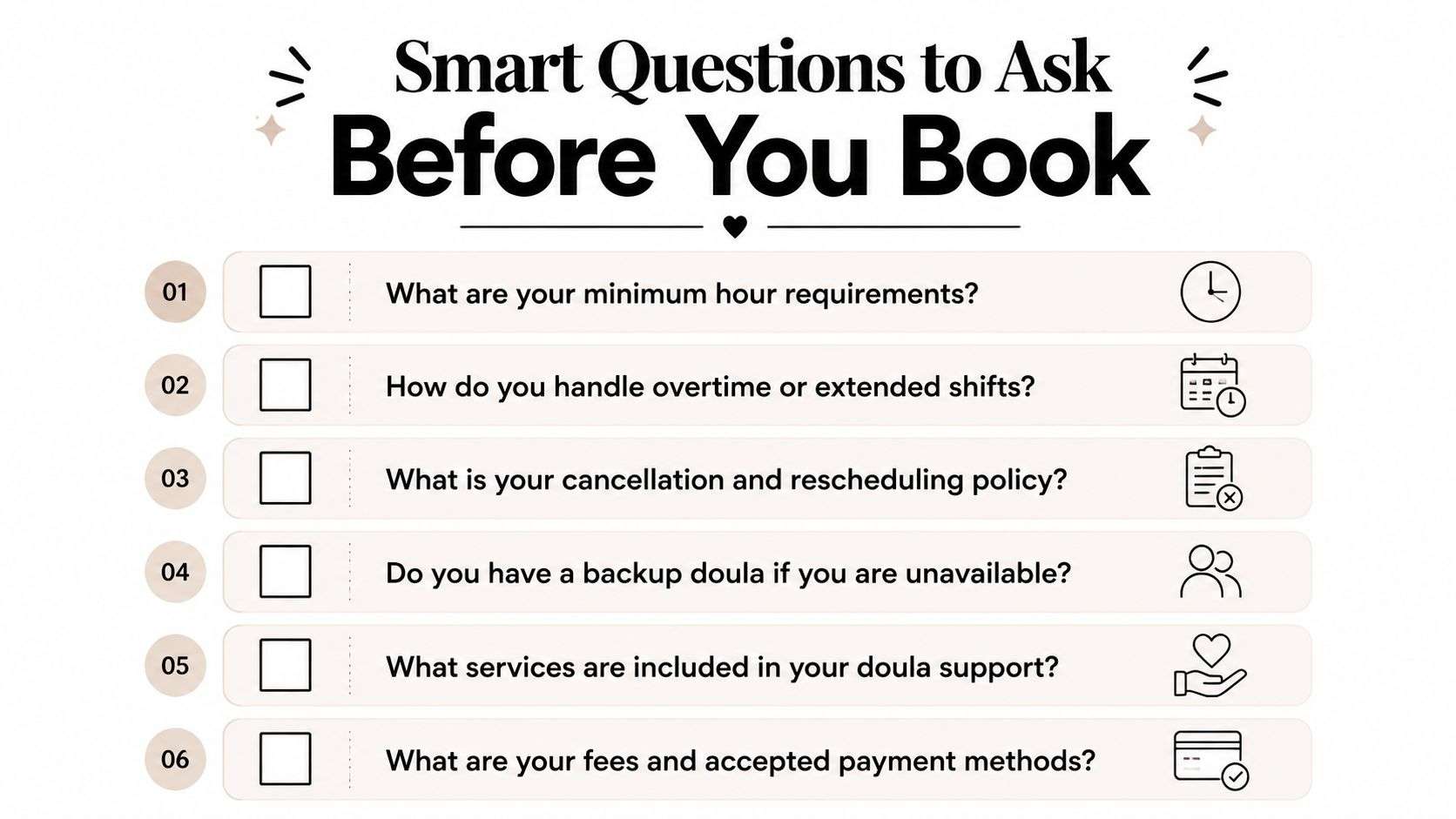
A transparent conversation before booking can save a lot of stress later. Families don't need to interrogate a doula, but they do need enough detail to understand what the final invoice will look like and whether the care matches their actual postpartum needs.
Questions that protect you from surprises
- How many hours do I need to book at minimum?
- What happens if I need more time than we planned?
- How do you handle cancellations or rescheduling?
- Do you have a backup if you're unavailable?
- What parts of care are included, and what's outside your scope?
- Do you carry liability insurance?
A written agreement matters because it turns an informal conversation into something both sides can refer back to. Ask for the visit length, any overnight premiums, and any travel or holiday fees to be written down clearly. If you're comparing providers, this is also the point where you can separate practical support from counselling support if you realise you need both.
Interactive Counselling offers parenting counselling within a broader Canadian counselling practice, which can be helpful when the stress is less about logistics and more about overwhelm, anxiety, or relationship strain. That kind of support doesn't replace a doula, and a doula doesn't replace therapy, but they can work well together when postpartum feels bigger than one person can hold alone.
Connecting Postpartum Doula Support to Mental Wellbeing
Postpartum help works best when it sits inside a wider support plan. A doula can soothe the practical chaos of the day, but emotional strain, fear, or persistent sadness may need another layer of care. Families do themselves a favour when they stop treating those needs as competing options.
A lot of parents assume they need to choose between a full package, a few overnight shifts, or no support at all. That's a false choice. A family can build support out of short daytime visits, a couple of essential nights, a postpartum circle, and targeted help during feeding or sleep challenges, and that layered approach often fits real life better than a big all-or-nothing plan.
Support can be flexible without being fragmented
Some parents want help only at the hardest times of day. Others need emotional steadiness more than task help, especially if birth was difficult or recovery feels slower than expected. When the support is chosen carefully, even a modest amount of doula time can reduce the sense that every task is falling on one exhausted person.
Research on doula use has also pointed to access problems that go beyond price, including lack of information and limited availability, especially for lower-income families and underserved communities (PMC). That matters because affordability isn't only about the invoice. It's also about whether a family can find someone nearby, book a workable schedule, and feel safe with the person coming into their home.
Gentle truth: asking for counselling early doesn't mean you're failing. It means you're protecting your recovery and your relationships.
When to consider counselling alongside doula care? If fear feels constant, if sadness is sticking around, if sleep deprivation is making everything feel bigger, or if you and your partner keep missing each other in the stress of the day. A trauma-informed counsellor can help process what's happening while a postpartum doula handles the immediate daily load, and that combination can be stabilising for many families.
The best support is the support a family will use consistently, whether that's a few daytime hours, periodic overnight help, community resources, or therapy alongside practical care. Consistency matters more than the appearance of doing it perfectly.
Frequently Asked Questions About Postpartum Doula Cost
Are postpartum doula fees tax-deductible?
That depends on the exact service, your location, and how your finances are set up. In Canada, families should check with a qualified tax professional or the Canada Revenue Agency for current rules before assuming the cost can be claimed.
Can family members help pay for postpartum doula care?
Yes, and many families find this easier than asking for baby gear. A relative can contribute toward a few visits, an overnight block, or a registry-style fund that supports recovery and feeding help instead of another physical gift.
What if the quote is higher than we can afford?
Ask whether the provider offers shorter blocks, a reduced number of visits, or a package focused only on your highest-need times. If the rate still doesn't fit, look for community-based options, employer benefits, or a smaller support plan combined with peer and counselling resources.
Is it okay to choose a doula mainly for emotional support?
Yes, as long as the scope of care matches what you're looking for. Some families need practical help with feeding, settling, and rest, while others want a calm, informed presence in the home and already have other help for chores or childcare.
How do I know if a higher price is worth it?
Look at what the quote includes, not just the number itself. Experience, availability, overnight coverage, clarity around policies, and the quality of communication all affect whether the support will feel worth the cost in real life.
Choosing postpartum support is personal, and there isn't one correct way to do it. If you're still sorting out what feels affordable or what kind of help would make life easier, that's a normal place to be. Taking the time to ask questions and learn what's available is already a meaningful step, and support is available whenever you're ready to keep exploring.
Clinically Reviewed By
Amy Mosset, MCP, RCC-S
Amy Mosset is a Master Practitioner in Clinical Counselling, Clinical Supervisor, and the owner of Interactive Counselling. She provides trauma-informed, evidence-based care and clinical supervision to registered therapists, with a focus on ethical practice, client safety, and high-quality therapeutic outcomes.