Some days, stress leaves you feeling stuck in old patterns that sabotage your closest connections. For many Canadian adults, developing emotional maturity is a constant challenge, especially as life transitions test your patience and impact your relationships. Understanding how to recognize and manage emotions can help you build resilience, deepen intimacy, and experience the kind of self-awareness that transforms daily life. This article explores the dynamic process of emotional maturity and offers practical strategies to guide your growth.
Table of Contents
- Understanding Emotional Maturity in Adulthood
- Common Misconceptions About Emotional Growth
- Core Traits and Real-Life Behaviours
- Barriers to Developing Emotional Maturity
- Benefits for Relationships and Personal Wellbeing
Key Takeaways
| Point | Details |
|---|---|
| Emotional Maturity is a Learnable Skill | It can be developed at any age through practice and self-awareness, not limited to a certain timeframe. |
| Self-Awareness and Accountability are Essential | Recognizing and owning your emotions and mistakes is crucial for healthy relationships and personal growth. |
| Effective Emotional Regulation Leads to Resilience | Managing feelings thoughtfully contributes to stronger mental health and relationships, especially during life transitions. |
| Supportive Environments Foster Growth | Building emotional maturity often requires professional support and healthy relationships to thrive and progress. |
Understanding Emotional Maturity in Adulthood
Emotional maturity is not about having it all figured out by age 30. It’s about recognizing your emotions, understanding why you feel them, and responding thoughtfully instead of reacting impulsively.
As an adult, emotional maturity shows up in how you handle conflict, manage stress, and relate to others. It’s a skill you develop over time, not something you inherit or suddenly acquire.
Most people think emotional maturity means never feeling angry, sad, or frustrated. That’s the opposite of what it actually means. Emotionally mature adults feel the full range of human emotions.
The real measure is what you do with those feelings.
What Makes Emotional Maturity Different From Other Traits
Emotional maturity sits at the intersection of self-awareness and self-regulation. You cannot be emotionally mature without both working together.
Research on emerging adults shows that emotional regulation and managing emotions directly impact mental health and well-being during life transitions. When you can regulate your emotions effectively, you build resilience and stronger relationships.
Here’s what separates emotionally mature adults from the rest:
- Self-awareness: You recognize your emotions as they happen, not hours later when you’ve replayed the conversation ten times.
- Accountability: You own your mistakes without defensiveness or excessive self-criticism.
- Boundary-setting: You communicate your limits clearly, even when it’s uncomfortable.
- Perspective-taking: You can understand someone else’s viewpoint without abandoning your own.
- Delayed gratification: You resist impulsive reactions that serve your emotions in the moment but damage your life long-term.
Emotional maturity is messy and ongoing. You will regress under stress. You will lose your temper. The difference is that mature adults repair these moments quickly and learn from them.
Why This Matters in Your 25–40 Age Range
Your twenties and thirties are when you’re building adult relationships, careers, and perhaps families. These years test your emotional capacity in ways your teens never did.
A breakup at 28 hits differently than a breakup at 18. You have more to lose. Your nervous system is more developed, but so are your expectations and responsibilities.
Emotional immaturity during this phase shows up as:
- Ghosting or creating drama instead of having direct conversations
- Blaming others for your feelings or circumstances
- Difficulty asking for help or admitting when you’re struggling
- Withdrawing or exploding when stressed, with little middle ground
- Repeating the same relationship or work patterns that hurt you
Emotionally mature adults in this age range handle these situations differently. They address problems when they’re small, not after resentment builds.
Emotional maturity is the foundation for everything else in adult life—your career success, relationship satisfaction, and mental health all depend on it.
The good news? You can develop emotional maturity at any age. It’s not fixed by 25 or locked in by 30. It’s a learnable skill.
Many Canadian adults find that working with a therapist or counsellor accelerates this growth. Having a trained professional help you identify patterns and build new responses creates real change faster than trying to figure it out alone.
Pro tip: Notice one emotion today without acting on it immediately—just observe it, name it, and wait 10 minutes before responding. This tiny pause is where emotional maturity begins.
Common Misconceptions About Emotional Growth
You’ve probably heard that emotional maturity follows a straight line. You grow up, you get better at handling emotions, and by 30 you’ve got it figured out. That’s not how it actually works.
The transition from your teens to adulthood involves complex biological, social, and psychological changes that don’t happen in a predictable order. Your emotional development isn’t linear. It loops, dips, and sometimes surprises you.
Understanding what emotional growth actually looks like helps you stop judging yourself for struggling. Here are the misconceptions that trip up most Canadian adults.
Misconception 1: Emotional Maturity Means You Stop Having Big Feelings
This one’s deeply embedded in Canadian culture. We value restraint, calm, and keeping things together. So many people believe maturity means feeling less.
Actually, emotionally mature people feel more, not less. They notice subtler emotions. They sit with discomfort instead of numbing it.
The difference is that mature adults don’t let their feelings drive every decision. You can feel rage and still respond with kindness. You can feel fear and still take action.
Misconception 2: Growth Should Be Steady and Predictable
Research shows that emotional development varies widely and fluctuates during emerging adulthood, influenced by relationships, experiences, and your circumstances.
You might feel incredibly mature handling a work conflict, then regress to old patterns when stressed at home. Both things are normal.
Some seasons of life push your emotional growth forward. Other seasons feel like you’re treading water. This isn’t failure.
Misconception 3: Emotional Maturity Is About Independence
Many adults believe that being emotionally mature means needing no one and handling everything alone. This is backwards.
Emotionally mature adults ask for help. They admit vulnerability. They recognize that self-awareness and understanding your emotional patterns requires outside perspective sometimes.
In fact, isolation is often a sign of emotional immaturity, not growth.
Misconception 4: If You’re Not “Fixed” by Your Thirties, Something’s Wrong
Many life challenges onset during the twenties and thirties. Anxiety, depression, relationship struggles—these aren’t signs you failed. They’re part of becoming an adult.
Emotional maturity isn’t a destination where you arrive and stay. It’s a skill you keep practising, especially when life gets harder.
Here’s what actually matters:
- You notice when you’re struggling (self-awareness)
- You reach out for support when you need it
- You learn from painful experiences instead of repeating them
- You own your growth timeline, not someone else’s
Emotional maturity looks less like perfection and more like honest self-assessment paired with genuine effort to do better.
Pro tip: When you feel stuck emotionally, ask yourself whether you’re actually regressing or simply facing a new level of complexity. Most “setbacks” are actually invitations to develop deeper skills.
Core Traits and Real-Life Behaviours
Emotional maturity isn’t abstract. You can see it in how someone actually behaves when things get messy. It shows up in conversations, conflicts, and how they treat people when nobody’s watching.
Emotionally mature adults demonstrate effective emotional management and resilience when facing challenges. They don’t just feel differently—they act differently.

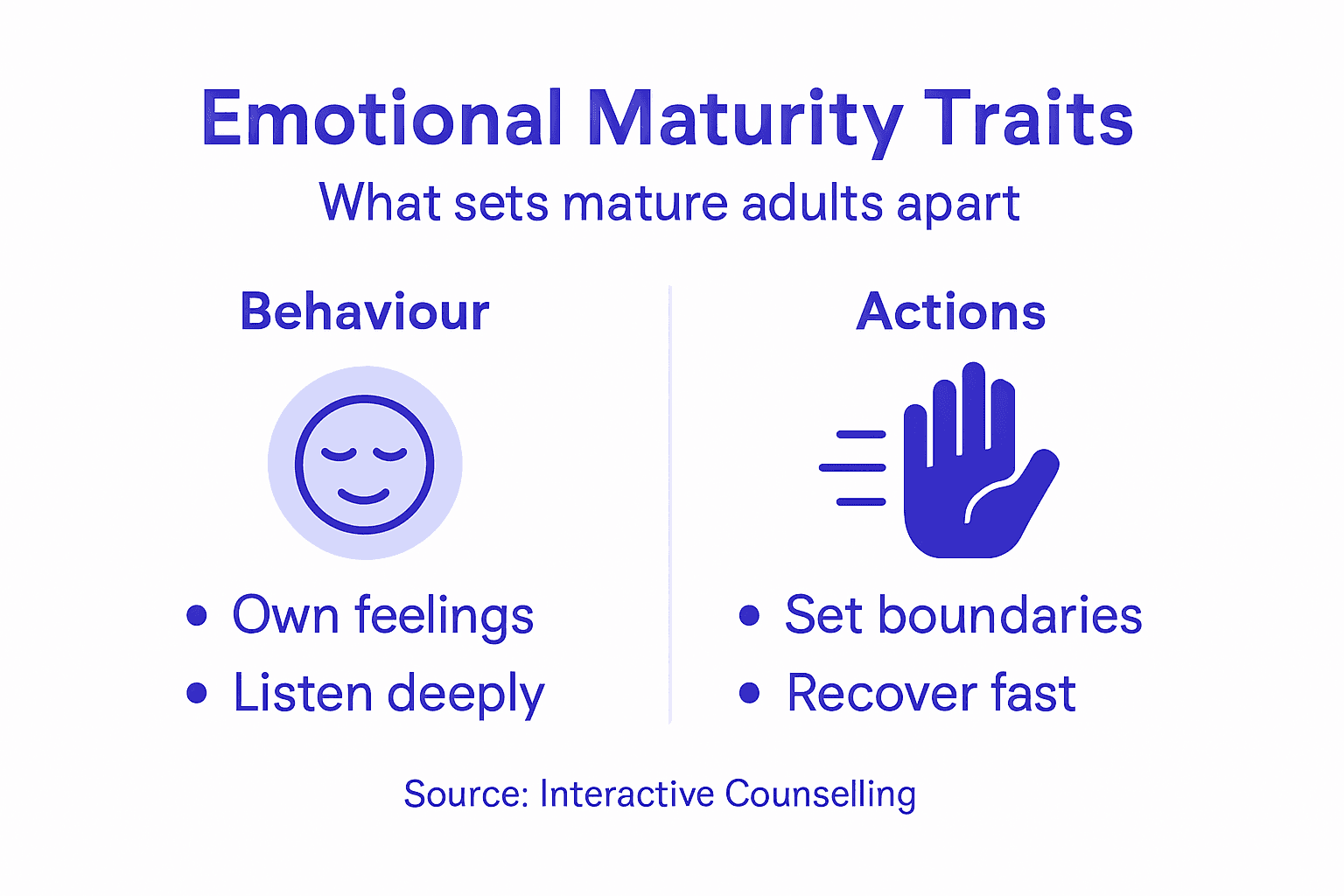
Here are the traits that separate emotionally mature adults from everyone else.
They Express Emotions Without Dumping Them on Others
There’s a massive difference between sharing and venting. Emotionally mature people know the distinction.
They say, “I’m really frustrated right now and I need to talk about it,” not “You always ruin everything and make me feel terrible.” The first invites connection. The second creates defensiveness.
Mature adults express what they feel and take responsibility for their feelings at the same time. That’s the balance.
They Can Apologise Without Defending
Watch how someone apologises. If they explain why they did it, minimize the harm, or shift blame—that’s not an apology. That’s a justification wearing an apology costume.
Emotionally mature adults say, “I was wrong. Here’s what I’m going to do differently.” Then they actually change.
They don’t need you to comfort them after they hurt you. They sit with the discomfort of knowing they caused harm.
They Listen Without Planning Their Response
Most people listen while mentally preparing their reply. Emotionally mature adults actually hear what someone is saying.
They ask clarifying questions. They notice tone and body language. They reflect back what they heard to make sure they understand correctly.
This trait transforms relationships. When people feel genuinely heard, everything shifts.
They Set Boundaries and Enforce Them
Boundaries without consequences are just suggestions. Emotionally mature adults follow through.
If they say “I can’t take late-night calls,” they don’t answer at 11 PM then feel guilty. If they say “I need space after conflict,” they actually take it without reassurance-seeking.
They respect their own limits the same way they respect others’.
They Recover From Mistakes Quickly
Everyone messes up. Emotionally mature adults don’t spiral into shame or blame. They notice the mistake, adjust, and move forward.
They can laugh at themselves. They learn without self-flagellation. Most importantly, they don’t repeat the same patterns hoping for different results.
Real-Life Examples in Your Daily Life
Emotional maturity shows up everywhere:
Here’s a summary contrasting emotionally mature and immature responses in adult situations:
| Scenario | Emotionally Mature Response | Emotionally Immature Response |
|---|---|---|
| Work conflict | Direct conversation for resolution | Venting to colleagues without addressing issue |
| Romantic disappointment | Acknowledges feelings and moves forward | Feels unlovable and withdraws |
| Family boundaries | Sets limits respectfully | Communicates boundaries with aggression or avoids them |
| Stressful times | Seeks support and adapts | Explodes or isolates with little middle ground |
- A disagreement with a partner about household chores gets resolved through conversation, not silent resentment
- A difficult work situation gets addressed directly instead of venting to colleagues
- Feeling rejected doesn’t mean you’re unlovable—it just means that situation didn’t work out
- Setting limits with family members happens with kindness, not aggression
- Understanding what triggers your reactions helps you respond consciously instead of automatically
Emotionally mature adults aren’t perfect. They’re just willing to look at themselves honestly and change when they see they’re causing harm.
Pro tip: The next time you react strongly to something, pause and ask: “Am I responding to what’s actually happening, or to what I’m afraid might happen?” This single question builds emotional maturity faster than almost anything else.
Barriers to Developing Emotional Maturity
Emotional maturity doesn’t develop in a vacuum. Real obstacles stand in the way—some from your past, some from your present circumstances, and some from how your brain is wired.
Understanding these barriers helps you stop blaming yourself for struggling. You’re not broken. You’re dealing with legitimate challenges that require real strategies to overcome.
Unresolved Trauma and Past Pain
Trauma doesn’t just disappear. It lives in your nervous system, influencing how you interpret every situation.
When you’ve experienced abuse, loss, or betrayal, your emotional development can get stuck at the age you were when it happened. A 35-year-old might react to criticism like a wounded seven-year-old because that’s where the pain froze.
Healing requires more than willpower. It often requires professional support to process what happened and rewire your responses.
Limited Self-Awareness
You cannot regulate what you cannot recognise. Limited self-awareness and poor emotional regulation skills directly hinder emotional growth and your ability to manage relationships.
Many people operate on autopilot, reacting without understanding why. They feel angry but can’t identify what triggered it. They withdraw but don’t recognise the pattern.
Emotional awareness is foundational to well-being, yet it doesn’t come naturally to everyone, especially if your family never talked about feelings.
Stress and Life Instability
Emotional maturity requires mental resources. When you’re in survival mode—facing financial stress, housing instability, or overwhelming work—your brain prioritises immediate survival over emotional development.
Key barriers include stress, trauma, and biological vulnerabilities during life transitions that complicate emotional growth. Your nervous system can’t learn new patterns when it’s constantly activated.
This is why emotional development often accelerates once basic stability improves.
Lack of Supportive Relationships
You develop emotional maturity in relationship. If your family modelled poor emotional skills, if you experienced isolation, or if you’re surrounded by people who dismiss your feelings—growth becomes exponentially harder.
Emotionally immature people often attract each other. You reinforce each other’s patterns instead of challenging them.
This is a real barrier, not a personal failing.
Common Obstacles You Might Face
Recognising your specific barriers helps you address them:
- Shame about struggling: Believing emotional difficulty means you’re weak or broken
- Fear of change: Familiar patterns feel safer than growth, even when they hurt
- Perfectionism: Believing you should already know how to handle everything
- People-pleasing patterns: Prioritising others’ comfort over your own emotional needs
- Avoidance: Not wanting to feel difficult emotions, so you numb or distract
Barriers to emotional maturity are real, legitimate obstacles—not character flaws or signs you’re failing.
The fact that you’re reading this means you’re already working to overcome them.
Pro tip: Identify one specific barrier that resonates with you, then get support addressing it—whether through therapy, a trusted mentor, or a community of people working on similar challenges. You don’t have to figure this out alone.
Benefits for Relationships and Personal Wellbeing
Emotional maturity doesn’t just make you feel better. It transforms your relationships and creates a foundation for lasting happiness.
When you develop emotional maturity, everything shifts. Your career stabilizes. Your relationships deepen. Your mental health improves. These aren’t separate outcomes—they’re connected.
Better Relationship Quality and Connection
Relationships thrive on emotional maturity. When both partners can communicate honestly, take responsibility, and repair conflicts, the relationship becomes a source of genuine support instead of constant stress.
Emotionally mature partners don’t need constant reassurance. They don’t weaponise silence or create drama. They show up consistently and handle conflict with kindness.
This transforms everything. Disagreements become opportunities to understand each other better. Stress brings you closer instead of driving you apart.
Improved Mental Health and Resilience
Adaptive emotion regulation strategies linked to emotional maturity increase psychological well-being, optimism, and self-esteem significantly among adults.
When you can regulate your emotions, anxiety decreases. You’re less reactive to small setbacks. You recover faster from disappointment. Your nervous system settles more easily.
This doesn’t mean problems disappear. It means you handle them without spiralling into despair or shame.
Greater Authenticity and Self-Acceptance
Emotionally immature people spend enormous energy managing their image. They worry what others think. They hide parts of themselves that feel unacceptable.
Emotionally mature adults get tired of pretending. They show up as themselves. They share their struggles without shame. They let people see their imperfections.
Paradoxically, this makes them more likeable, not less. People trust authenticity far more than perfection.
Stronger Professional Performance
Your emotional maturity directly affects your career. You handle criticism without defensiveness. You collaborate instead of competing. You lead others with confidence and humility.
Managers notice these qualities. Colleagues want to work with you. Your professional network grows because people trust you.
Key Benefits You’ll Experience
Here’s what changes when you develop emotional maturity:
To help clarify the impact of emotional maturity, here’s a quick reference on its benefits for relationships and wellbeing:
| Benefit Area | Emotional Maturity Impact | Long-Term Outcome |
|---|---|---|
| Relationships | Builds trust and honest communication | Safer, deeper connections |
| Mental health | Enhances resilience, reduces anxiety | Faster recovery from setbacks |
| Self-acceptance | Encourages authenticity | Greater confidence and acceptance |
| Career | Promotes collaboration and adaptability | Improved job satisfaction and growth |
- Relationships feel safer and more connected
- Conflicts resolve faster without lingering resentment
- You sleep better and feel less anxious overall
- You make better decisions from a calm, clear place
- Emotional safety in relationships deepens trust and vulnerability
- You can be yourself without performing or people-pleasing
- Others naturally respect and trust you more
- You recover faster from setbacks and disappointment
The Ripple Effect
Your emotional maturity affects everyone around you. Your partner feels safer. Your children learn healthier patterns. Your friends benefit from your stability.
You become someone people lean on. Not because you have all the answers, but because you’re genuinely present and honest.
Emotional maturity creates a life where you feel less like you’re surviving and more like you’re actually living.
Pro tip: Start noticing one positive result from your increased emotional maturity—maybe a conversation that went better than expected or a conflict you handled calmly. Celebrate these small wins; they compound into lasting change.
Develop Emotional Maturity With Professional Support
If you find yourself struggling with recognizing and managing your emotions or repeatedly facing challenges that impact your relationships and wellbeing, you are not alone. This article highlights how emotional maturity involves self-awareness, accountability, setting boundaries, and recovering from mistakes. Many Canadian adults experience barriers such as unresolved trauma, stress, or limited support that make growth difficult. Understanding these challenges is the first step toward building the emotional skills that truly transform your life.
Interactive Counselling offers personalized therapy solutions designed to help you strengthen emotional regulation, increase resilience, and improve your connections with others. Our licensed therapists provide compassionate, non-judgmental support through flexible in-person and online sessions across Kelowna, Vernon, Grande Prairie, Penticton, and nationwide. Discover how professional guidance can accelerate your emotional growth by visiting Interactive Counselling, explore our therapy offerings, and start your journey to emotional maturity today with accessible support tailored to your unique needs.
Frequently Asked Questions
What is emotional maturity in adults?
Emotional maturity in adults refers to the ability to recognize, understand, and appropriately respond to their emotions. It involves self-awareness, accountability, and the ability to manage emotions rather than react impulsively.
How can I develop emotional maturity?
You can develop emotional maturity through practices like self-reflection, seeking therapy or counseling, setting clear boundaries, and learning to respond to emotions with thoughtfulness instead of impulse. Consistent effort and time are key to this growth.
What are the signs of emotional immaturity?
Signs of emotional immaturity include blaming others for feelings, difficulty dealing with stress, avoiding direct communication, and repeating unhealthy relationship patterns. An inability to apologize without defensiveness is another common indicator.
Why is emotional maturity important for relationships?
Emotional maturity is crucial for relationships as it fosters honest communication, builds trust, and allows for the constructive resolution of conflicts. This leads to deeper connections and a more supportive relationship environment.
Recommended
- Common Emotional Triggers – How They Affect Reactions
- Supporting Emotional Growth—Why Validation Matters
- Big Emotions in Childhood – How They Shape Development
- Emotional Safety Matters – How It Shapes Relationships