You're sitting at the kitchen table in Vernon, trying to have a normal evening, but the same old tension keeps circling back. One of you wants to talk it out, the other wants the room to settle first, and both of you are tired of hearing yourselves repeat the same painful loop. Marriage counselling can help couples step out of that pattern and learn how to rebuild in a steadier, more respectful way. For more information, see our Vernon couples counselling.
"Marriage counselling in Vernon can help couples reconnect by turning conflict into a learnable set of skills, not just another conversation." For more information, see our counselling in Vernon.
What Marriage Counselling Really Looks Like
A couple often reaches out after weeks or months of feeling stuck, not after one dramatic blow-up. One person may be thinking, “We can't keep doing this,” while the other is hoping things will improve on their own. In the room, the work usually begins with a calmer question than people expect, what's happening between you, and what would feel different if things started going better? For more information, see our couples counselling.
The first meeting is usually slower than people think
The counsellor normally starts by hearing a shared history, what's been hard, what still matters, and what each partner wants to protect. That first conversation is not a verdict, and it isn't a place where one person is declared right and the other wrong. It's a structured start, with room for both partners to speak without the pace getting out of hand.
Practical rule: the first goal is not to solve the marriage in one session, it's to make the pattern visible enough that both partners can work with it.
Marriage counselling is also not mediation, legal advice, or a courtroom with a therapist acting as judge. A good counsellor slows the moment down, names the cycle as it happens, and helps each partner hear what's underneath the argument.
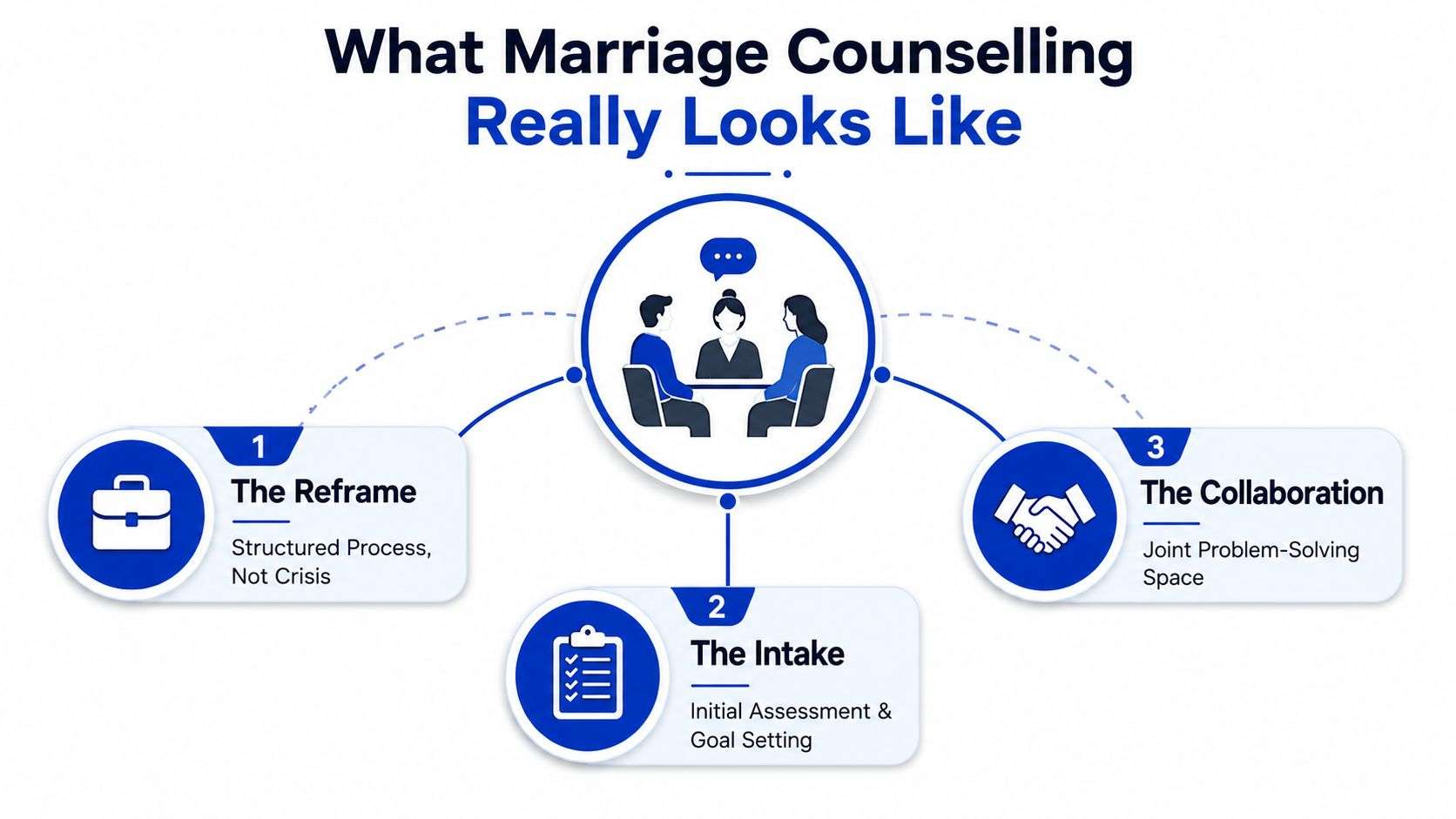
The strongest couples work is collaborative. That means both people are invited into a shared problem-solving space where the counsellor helps them notice patterns, practise repair, and build steadier ways of responding. The point is not to erase conflict. The point is to change what happens when conflict shows up.
Signs It May Be Time to Reach Out
Most couples do not wake up one morning and decide they're “in crisis.” They notice smaller things first. Conversations feel circular, repair attempts land badly, or the easy warmth between them has been replaced by tension, silence, or careful distance.
Common moments couples notice before they ask for help
A good time to reach out is often when you keep having the same argument with new details. The subject changes, but the feeling doesn't. One partner may feel unheard, the other may feel criticised, and neither leaves the discussion feeling understood.
Other couples reach out because they've stopped fighting but don't feel close anymore. That can be harder to spot, because the house is quieter, but the relationship feels thinner. Life changes can also expose the cracks, new parenting demands, health concerns, job strain, grief, or the pressure of trying to keep everything functioning at once.
Sometimes the clearest sign is not a big fight. It's the quiet sense that you're living beside each other instead of with each other.
A simple self-check
Ask yourselves these three questions:
- Do our repair attempts work, or do they just restart the same fight?
- Do we still feel like teammates when something stressful happens?
- Are we waiting for things to get worse before we ask for support?
You don't need to wait for a relationship to fall apart before getting help. In fact, earlier support often gives couples more room to practise new habits before resentment hardens. If you're unsure whether now is the right time, the safest starting point is to notice whether the same pain keeps returning in the same form.
Approaches Your Counsellor Might Use
Marriage counselling is not one single method. The best-fit approach depends on what keeps breaking down between you. Some couples need help getting underneath the emotion, others need help changing the interaction pattern, and many need both.
Emotionally Focused Therapy, behavioural work, and Gottman-informed care
Emotionally Focused Therapy, or EFT, works with the emotions underneath the argument. If one partner keeps saying, “You never listen,” and the other keeps pulling away, EFT looks for the deeper fear underneath those reactions. In practice, the counsellor helps each person slow down enough to say what they need, not just what they're fighting about.
Behavioural and cognitive-behavioural couples therapy focuses on the loop itself, what each person thinks, does, and expects when tension rises. A missed text, a late arrival, or a sharp tone can trigger a whole chain of assumptions. This kind of work helps couples spot those assumptions earlier and change the response before the cycle spirals.
Gottman-informed work pays close attention to relationship habits, friendship, and conflict repair. It's often practical and concrete. A counsellor might help a couple build better ways of starting difficult conversations, soften criticism, or create small routines that support connection in ordinary life.
If you're comparing therapy styles for a child or teen in the family, understanding therapy options for kids can also make it easier to see how different models focus on different goals.
What matters most is not the label alone, it's whether the counsellor uses a clear structure and gives you work to practise between sessions. Structured, evidence-based models give couples a better chance to change what they keep repeating, because they turn insight into repeatable action instead of hoping a good conversation will somehow fix everything.
What Happens in Sessions and Between Them
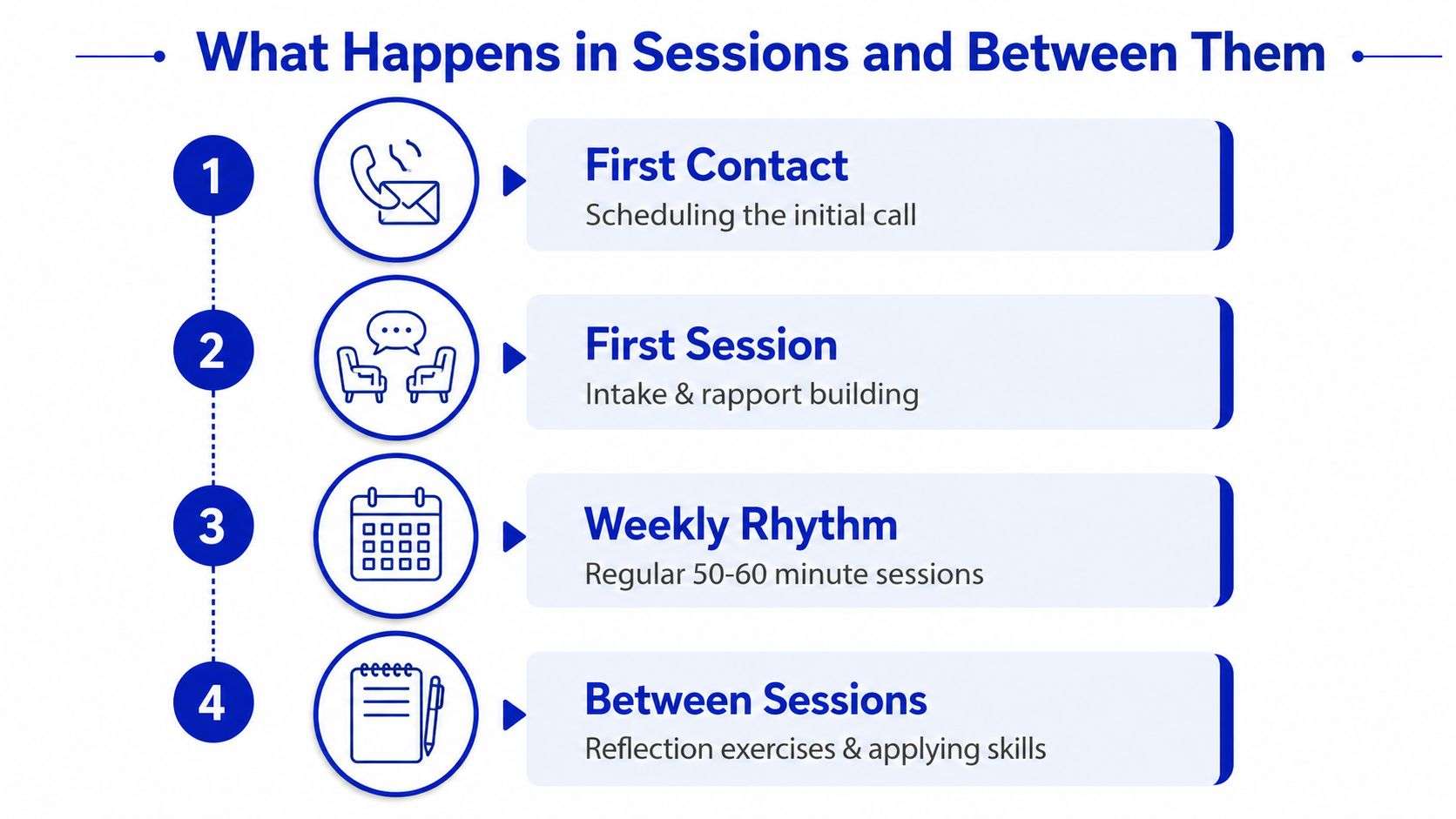
The first contact is usually simple, a call, email, or booking request. From there, the process tends to settle into a rhythm that feels more predictable than people expect. That predictability matters, because couples who live in conflict usually don't need more chaos.
What a typical session feels like
A standard session often includes a brief check-in, a focused conversation about one live issue, and a small task or experiment for the week. Early on, the counsellor spends time building a shared map of the relationship, what triggers each of you, how the cycle starts, and what each person does under stress. The room is used to slow things down enough that both partners can hear themselves more clearly.
Virtual sessions usually feel more flexible, while in-person sessions can make it easier for some couples to stay present without the distractions of home. Either format can work well when the counsellor keeps the session organised and the goals specific. The medium matters less than the structure.
Helpful rhythm: when couples know what day they'll check in, what gets discussed, and what they're practising next, the work stops feeling random.
The weekly check-in that helps many couples
A very practical micro-habit is a fixed weekly 20-minute check-in, on the same day and at the same time, with phones away and a rule that the topic gets returned to rather than abandoned. That small routine can stop everyday irritations from building into full-blown blowups. It works best when both partners treat it like a shared appointment, not an optional recap.
A good between-session task is usually small enough to do. It might be a repair attempt, a listening exercise, or a note about what went well when things were tense. The goal is to practise the skill in real life, not just understand it intellectually.
How Progress Shows Up Over Time
Progress in couples work usually looks smaller at first than people hope, and more real than dramatic promises. A couple often expects a breakthrough. What they usually get first is a little more pause, a little less heat, and a better chance of returning to the topic without losing each other.
Early signs, middle signs, later signs
Early change often shows up as shorter arguments and faster repair. The same disagreement may still appear, but it doesn't run as long, and one of you may recover your footing sooner. That matters, because less escalation gives both people room to stay engaged instead of shutting down or chasing harder.
Middle-stage change looks different. Old triggers are still there, but the response starts to change. A comment that once led to a fight might now lead to a pause, a breath, or a request for a reset. Over time, that shift builds trust because each partner starts seeing evidence that the relationship can survive tension without collapsing.
Longer-term progress is usually a rebuilt sense of teamwork. Couples start to recognise each other's stress signals sooner and repair more naturally. The relationship feels less like damage control and more like a shared system with habits that support both people.
How counsellors track whether things are shifting
Progress is often checked through repeated satisfaction conversations, reflections on conflict frequency, and follow-through on between-session work. The point is not to grade the relationship. It's to notice whether the pattern is changing in real life.
Meaningful change is usually cumulative. A couple rarely transforms through one conversation, they change through a series of small, observable adjustments that begin to add up.
That's why consistent practice matters so much. A couple who keeps showing up, keeps trying the small tasks, and keeps returning to the work usually learns more than a couple waiting for the “right” moment to arrive.
Choosing a Counsellor Who Fits Your Relationship
A good fit matters. Two capable counsellors can feel very different to the same couple, and the wrong fit can make already-hard conversations feel even heavier. The most useful question is not, “Who sounds impressive?” It's, “Who can help us work in a way we can use?”
What to look for
In British Columbia, it makes sense to check for clear professional registration and training. You want to know that the counsellor is qualified to practise and that they've had specific preparation in couples work, not just general therapy. Couples counselling asks for a different set of skills than individual support.
The method matters too. If a counsellor can't explain how they work in plain language, that's worth noticing. A strong fit usually includes concrete answers about their approach, how they handle conflict in session, and what they expect between sessions.
Questions that help you decide
- Does both of us feel heard, or does one person dominate the room?
- Does the counsellor explain the approach clearly enough for us to follow it?
- Are the tasks specific enough that we can use them at home?
- Can the appointment time survive a real week with work, school, and family demands?
Logistics matter more than people sometimes admit. In Vernon, the ability to book daytime, evening, or weekend appointments, or to choose between in-person and virtual support, can be the difference between following through and repeatedly postponing care. One practical option in the local market is Interactive Counselling, which offers couples counselling alongside multiple session formats, but the wider point is to choose a service model that fits your lives, not just your hopes.
Marriage Counselling in the Vernon Context
Seeking help in a smaller city can feel complicated in ways outsiders don't always understand. Privacy matters. So do overlapping social circles, school schedules, shift work, and the fact that both partners may already feel stretched thin. Those pressures can delay reaching out, even when both people know something needs attention.
Vernon's local reality
Vernon has an established counselling market, with multiple local listings and provider categories for couples and marriage support in the city. That matters because couples need choice when they're deciding what kind of help fits their situation. It also means local support is not limited to one office or one style of care.
The service area around Vernon extends into nearby communities such as Coldstream, BX, Foothills, Bella Vista, Okanagan Landing, and Middleton Mountain, which helps couples who live just outside the core city stay connected to care without treating distance as a barrier. For many families, phone or secure virtual sessions are also a practical way to keep the work going when schedules get crowded.
Community care and private care can both have a place
Publicly supported short-term counselling is part of the local picture too. HealthLink BC lists Vernon's counselling program as short-term, sliding-scale, wheelchair accessible, and open weekdays with a lunch closure and reduced summer Friday hours, while the Family Resource Centre says ability to pay is strictly confidential and never a barrier. That creates real options for couples who need a lower-cost entry point or a short-term place to start.
Private marriage counselling often fills a different role, especially when the relationship needs more sustained work, a specific modality, or tighter scheduling control. In practice, the right choice depends on the couple's needs, privacy concerns, and how much structure they want around the process. Vernon's broader counselling options give couples room to choose without assuming there's only one correct path.
Questions Couples Often Ask Before Booking
What does the first session feel like?
Usually calmer than people fear. The counsellor will want to understand what's been happening, what each partner hopes for, and what the main pattern looks like. It's common to leave the first meeting with more clarity, but not with every answer.
Do both of us need to attend every session?
Most marriage counselling works best when both partners attend regularly. Some counsellors may meet with one partner briefly at times, especially in the beginning, but the core work is usually done together because the relationship pattern only becomes visible when both people are in the room.
How long does counselling usually take?
There isn't one fixed timeline. It depends on what's been hurting the relationship, how long the pattern has been in place, and how consistently both partners practise between sessions. Some couples need a shorter, focused block of work, while others need more time to change deeper habits.
How do couples know when they're done?
Often, the signs are practical. The same fights lose their intensity, repair happens faster, and both people can talk about hard things without immediately spiralling. You may not feel “finished” in a dramatic sense, but you can feel steadier, clearer, and more like partners again.
Can we start even if we're not sure we'll stay together?
Yes. Counselling can still help if you're unsure, because it gives both people a respectful space to understand what's happening and what each person needs. That kind of clarity is useful whether you stay together, separate, or need a better way to talk while making decisions.
If you're looking for a local place to begin, learn more about marriage counselling at Interactive Counselling in a way that fits your pace and your situation.
Clinically Reviewed By
Amy Mosset, MCP, RCC-S
Amy Mosset is a Master Practitioner in Clinical Counselling, Clinical Supervisor, and the owner of Interactive Counselling. She provides trauma-informed, evidence-based care and clinical supervision to registered therapists, with a focus on ethical practice, client safety, and high-quality therapeutic outcomes.
If you're ready to take one careful next step, visit Interactive Counselling to learn how couples support is offered in Vernon and how the process can be customized to your relationship. The focus is on steady, practical help, so you can choose a path that feels respectful, grounded, and realistic for both of you.