You can spend a whole swing telling yourself you're fine, then one quiet drive home changes the conversation. The truck cab feels too small, the noise in your head gets louder, and the thought of sitting across from someone and saying the hard stuff can feel harder than the worksite ever did. For a lot of men in Grande Prairie's trades and oilfield circles, that's the exact moment counselling stops being an abstract idea and starts feeling real.
What makes that moment difficult isn't weakness. It's the way the work is built, long hours, physical strain, shift schedules, camp life, and the habit of getting on with it no matter what's going on underneath. In a region where the labour market stays closely tied to resource and trade work, with a 74.4% participation rate, 65.6% employment rate, and 11.9% unemployment rate in Grande Prairie's 2025 labour-force profile, counselling has to fit real working lives, not a tidy office schedule CareerBeacon.
What Life Looks Like When You Finally Book the Appointment
The booking call usually happens after the shift, not before it. Sometimes it's after a long day in the field, sometimes after a sleepless run of nights, sometimes after a fight at home that started over something small and turned into something bigger. By the time a man in trades or oilfield work reaches that point, he usually isn't looking for a speech. He's looking for something that feels workable.
A lot of first appointments begin with the same quiet tension. You sit down, or log in, and try to decide how much to say without sounding dramatic, weak, or out of control. That's normal, and it's part of why a good clinician keeps the first conversation grounded in what's happening now, what needs attention first, and what kind of pace fits your life.
The first relief is often practical
The goal isn't to unpack everything on day one. It's to get enough clarity that the next step feels possible. That might mean talking about sleep, irritability, drinking patterns, injury stress, marriage strain, or the way your mind keeps circling back to a bad incident on site.
Practical rule: If you leave the first session with one clear next step, the appointment did its job.
In Grande Prairie, that matters because a lot of men aren't dealing with a single problem. They're juggling work pressure, family expectations, pain, and the low-level worry that if they stop moving, everything gets louder. Men's counselling in Grande Prairie works best when it respects that reality instead of trying to force a polished story out of someone who's just trying to hold the week together.
What Men's Counselling in Grande Prairie Actually Looks Like
Men's counselling here isn't a separate licence or a special club. It's general counselling shaped around the way men in male-dominated work often show up, direct, guarded at first, and focused on solving what's in front of them. In practice, that usually means the work starts with intake, consent, confidentiality, and a clear sense of what you want help with before it ever gets into deeper material.
The local access model is flexible because the work demands it. At Interactive Counselling, sessions are available in-person, online, and by phone, with evenings and some weekends available, which fits the reality of shift work and rotating schedules Interactive Counselling's Grande Prairie counselling page. A first session usually focuses on what's happening, what you want to change, and how fast you want to move. It shouldn't feel like an interrogation.
Counselling is not the same as crisis care or peer support
That distinction matters. Peer support can be a good first step, and crisis services have their place when things are urgent. Counselling sits in the middle, steady, private, and structured enough to help you work on patterns before they blow up.
The local service area reflects that stepped approach. Grande Prairie has walk-in and single-session options through Alberta Health Services, peer-led men's groups, and structured counselling formats, which gives workers more than one way in 211 Alberta's Grande Prairie support record. For men who've spent years being told to handle it themselves, that mix can make the difference between delaying help and using it.
Why Trades and Oilfield Work Create Specific Counselling Needs
A weld goes bad, a rig move runs long, or a drive home on little sleep starts to blur together. For men in trades and oilfield work, stress usually arrives through the job itself, then follows them home in ways that are easy to miss until sleep, mood, conflict, or substance use starts shifting. National data help show why this matters. Statistics Canada reported that in 2007 men made up 97% of workers in the trades, and later national data showed 1,620,680 tradespeople employed in Canada in 2021, a decline of 97,940 (-5.7%) from 2016 Statistics Canada.
The job itself changes the shape of help
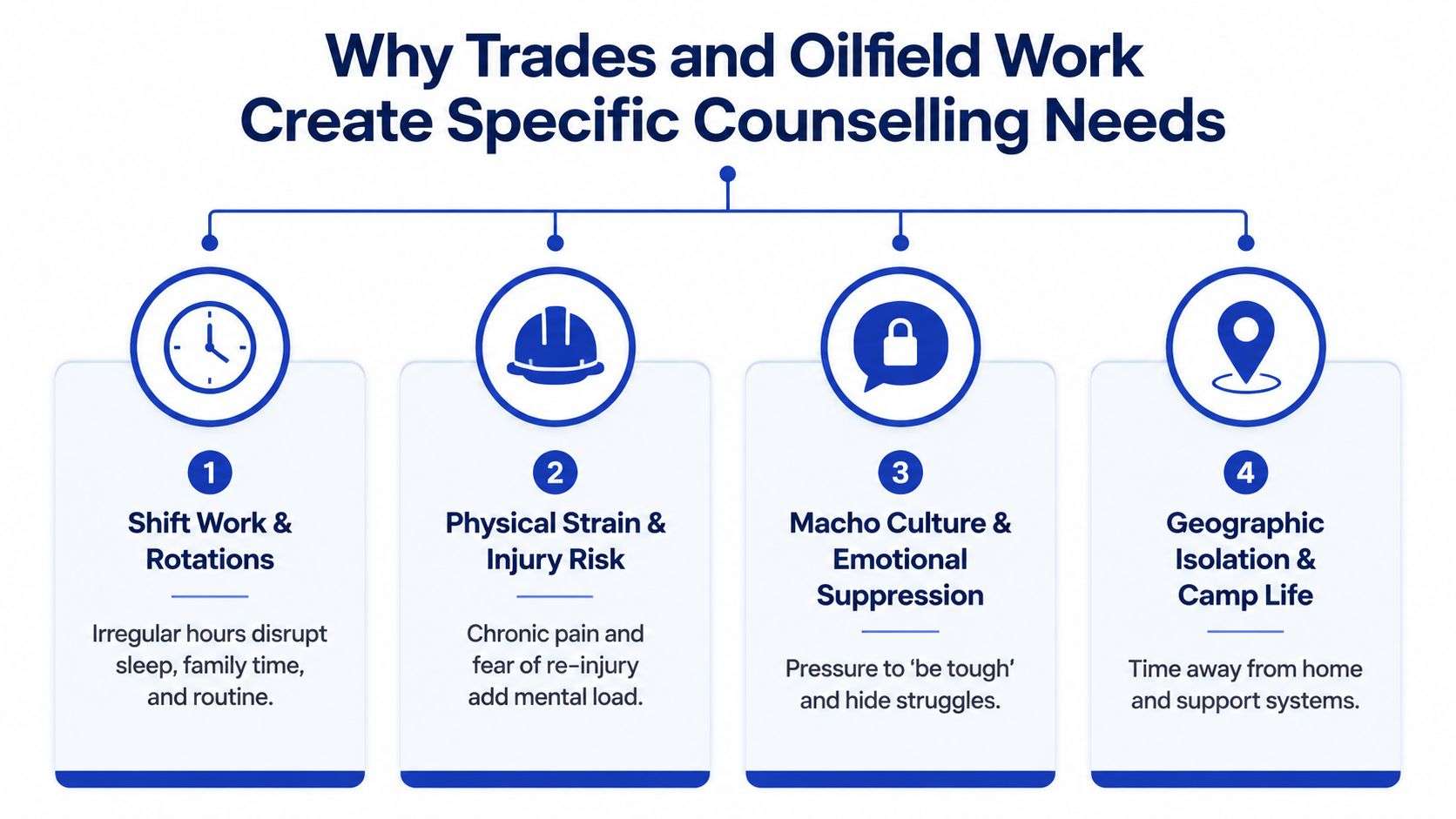
Shift work, camp schedules, and rotation fatigue can leave a man too wired to sleep and too spent to think clearly. Physical strain adds another layer, because pain changes patience, concentration, and the way a person gets through the day. Then there is the culture piece, the old message that asking for help means you cannot hack it.
Those pressures do not stay separate for long. A hard call on site, a near miss, or an injury can sit in the body long after the shift ends. If you want a plain-language overview of how accidents can lead to psychological harm from accidents, the Nares Law Group resource on PTSD and related harm gives a useful starting point, especially for people trying to make sense of symptoms after a serious event.
Men in high-reliability jobs often wait until the problem is obvious to everyone else. The better move is usually earlier, when the pattern is still manageable.
There is also a public-health reason this work cannot be treated like generic stress management. The federal government reports that since 2016, around 3 out of 4 opioid-related deaths were men, and that 30% to 50% of people employed at the time of those deaths worked in trades Government of Canada. CBC also reported Alberta analysis showing that in 2017, among opioid-related deaths with occupations listed, 53% involved employment in trades, transport or equipment operation CBC.
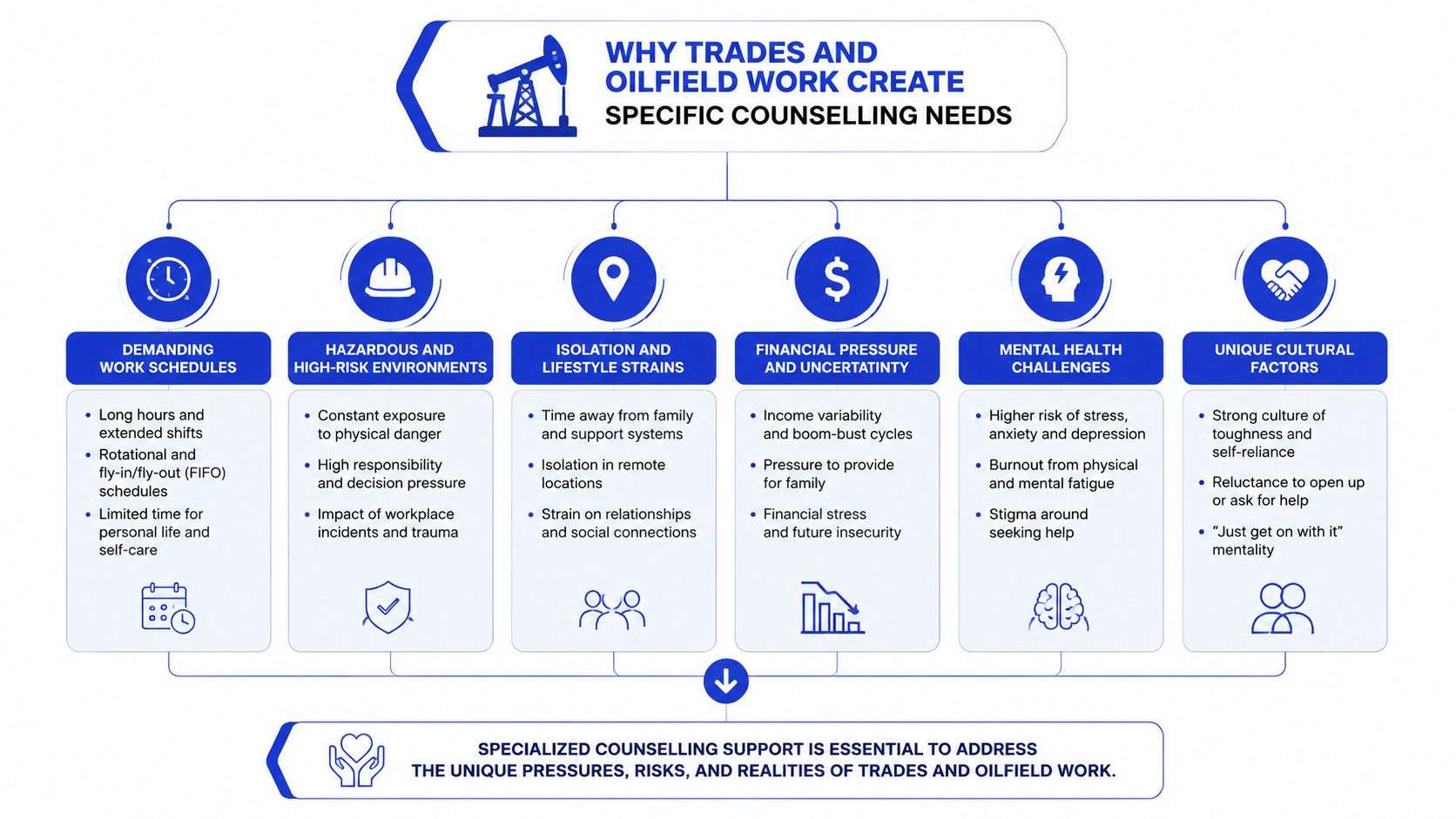
Work shapes the problem, so the counselling has to change with it. In Grande Prairie, where industrial work and social visibility overlap, a clinician has to think about privacy, timing, sleep, injury, and substance patterns from the first conversation onward.
Evidence-Informed Approaches That Fit the Work
The best-fitting approaches for men in trades and oilfield work are usually the ones that are structured, practical, and easy to act on between sessions. That doesn't mean therapy should be shallow. It means the format should respect how these men solve problems, by identifying what's broken, what's keeping it going, and what a next step looks like.
What tends to work well
- Trauma-informed counselling. This keeps the focus on safety, consent, and pacing, which matters when someone has had a bad incident, chronic stress, or years of keeping things bottled up.
- CBT. Cognitive-behavioural therapy can help with rumination, anxiety, sleep disruption, and the kind of self-talk that gets harsh after mistakes or injuries.
- EMDR. When a worker is carrying a specific incident, trauma-focused work can help the nervous system stop reacting as if the event is still happening.
- Brief solution-focused therapy. Some men don't want open-ended treatment. They want a focused plan that addresses what's urgent and what can be changed now.
- Motivational interviewing. This works well when drinking or substance use has become part of coping, but the person isn't ready for a hard sell.
A structured approach fits this population because it keeps the conversation concrete. It's easier to stay engaged when the session has a clear target, especially for someone who's used to working with checklists, safety procedures, and immediate consequences. That's not anti-depth. It's just a better entry point.
Peer connection still matters
Peer support can sit alongside individual counselling without replacing it. The Resource Centre for Suicide Prevention runs a weekly facilitator-led men's support group every Wednesday from 7:00 PM to 9:00 PM, and that kind of setting can be easier for a man who wants to test the water before booking one-to-one care Resource Centre for Suicide Prevention.
The strongest plans are usually layered. A man might start with brief counselling, add peer support, and then move into deeper trauma work once sleep, stress, or safety issues are more settled. That is often more realistic than trying to solve everything at once.
Real Barriers and Culturally Competent Ways Around Them
Four barriers come up again and again, the be tough script, small-city visibility, shift schedules, and uncertainty about whether counselling will fit the job. None of them goes away because someone is told to open up.
Practical moves that lower the friction
- Protect privacy at the door. If walking into a counselling office feels too visible, ask how arrivals work, whether there is a side entrance, and what the waiting area looks like before you book.
- Use virtual or phone sessions when you're away. A private room in camp, a parked truck, or a quiet space at home can be enough if the service is set up for it.
- Book around the swing, not against it. For rotating schedules, the day after a shift ends is often better than trying to fit in a session when you are already running on fumes.
- Ask direct questions up front. If you are worried about coverage, privacy, or whether the service fits your schedule, ask before the first appointment so there are no surprises.
A culturally competent clinician will not pathologise masculinity. They will use plain language, keep the pace steady, and avoid making you perform vulnerability on command. They also understand that reluctance is not the same as resistance.
Local services can make that easier when they offer more than one route in. The walk-in and single-session model at the Alberta Health Services Grande Prairie Aberdeen Centre gives workers a practical option, with walk-in counselling Monday to Friday from 9:00 AM to 4:00 PM, ICAT telephone counselling during the same weekday window, and a walk-in clinic generally held every other Wednesday afternoon from 1:00 PM to 3:00 PM at 9728 101 Avenue, Grande Prairie Alberta Health Services. For a man trying to fit support around a roster, a camp rotation, or the fact that everyone in town seems to know everyone else, that kind of access can reduce the waiting and overthinking that stop many men from starting.
A good first question is simple. If a service cannot explain how it handles privacy, timing, and format, it probably is not built for shift workers yet.
How to Access Interactive Counselling in Grande Prairie
A first appointment usually starts with a practical choice. Pick the format that fits your week, in-person, secure virtual, or phone. If you are local, the office at 10130 99th Ave, Suite 180, Grande Prairie, AB T8V 2V4 gives you a physical option without a long drive or a complicated setup.
For trades and oilfield workers, timing matters as much as location. Evenings and some weekends make a real difference when your schedule is built around shifts, camp rotations, late finishes, or days when you do not want to walk into a clinic and be seen by half the town. The practice also offers in-person, online, and by phone sessions, which gives you more room to choose the least disruptive option for your week.
A simple first move is enough to get started.
- Open the site. Read the service page and decide whether in-person, virtual, or phone is the least disruptive fit.
- Choose the format. Pick the one you can realistically use after a shift or during a break.
- Send a brief message. A few lines about sleep, stress, injury, drinking, anger, or relationship strain are enough to begin.
That first contact does not need to be polished. It just needs to be honest enough to tell the counsellor what kind of work you do and what kind of schedule they have to respect.
Interactive Counselling also provides ICBC-funded counselling for clients recovering from motor vehicle accidents. That can matter for workers injured on the road or on the job, since accident recovery and mental health recovery often overlap even when people try to keep them separate.
A Practical First-72-Hours Plan and Local Resources
The first three days do not need to fix your life. They need to lower the noise, make the next step easier, and stop things from getting worse. Pick one thing that settles your body, one thing that gets the appointment on the calendar, and one thing that gets the truth out of your head.
A workable 72-hour plan
- Stabilise one thing. Get one solid sleep window, eat a proper meal, or cut back on the late-night spiral that is making tomorrow harder.
- Book one appointment. Choose the format that fits your shift pattern and lock it in before the week fills up.
- Say one honest sentence. That might be to a partner, a buddy, or nobody yet. If talking feels out of reach, write down what has been building.
If you want a local entry point before or alongside counselling, Grande Prairie has a few places that can help you get started. The AHS walk-in at the Grande Prairie Aberdeen Centre gives same-day counselling access Alberta Health Services. The ICAT line is available Monday to Friday during weekday hours, and the Wednesday evening men's group through the Resource Centre for Suicide Prevention can be a low-pressure way to connect 211 Alberta.
If there is an active suicidal thought, a recent serious incident, or substance use is moving fast, do not wait for the right mood or the right wording. Get immediate help. If the situation is less urgent but still grinding you down, counselling can be the next steady move, not a last resort.
Questions Trades and Oilfield Workers Often Ask First
Will people in town find out? Counselling is confidential. If small-city visibility worries you, ask how the clinic handles arrivals, messages, and records before you book. Start with one direct question.
Do virtual sessions work for this kind of issue? They can, especially for stress, sleep, drinking, relationship strain, and follow-up after a hard event. If you need trauma work, ask how the clinician would pace it online. Try one session and judge by fit.
How do I book around a 14-on, 7-off rotation? Book for the day after you're off if that gives you more headspace. If travel or camp time makes that hard, use phone or virtual options. Choose the format that reduces friction the most.
What if my partner or boss pushed me to come? You still get to decide what you want help with. Bring your own goal into the room, even if someone else suggested the appointment. Start with what's bothering you most.
Interactive Counselling offers in-person, phone, and secure virtual counselling in Grande Prairie, with flexible hours that can fit shift work, camp schedules, and accident recovery needs. If your week is already full and the pressure's been sitting there for too long, visit Interactive Counselling and take the first step in a way that works for your life.
Clinically Reviewed By
Amy Mosset, MCP, RCC-S
Amy Mosset is a Master Practitioner in Clinical Counselling, Clinical Supervisor, and the owner of Interactive Counselling. She provides trauma-informed, evidence-based care and clinical supervision to registered therapists, with a focus on ethical practice, client safety, and high-quality therapeutic outcomes.