You leave work physically unharmed, tell everyone you're fine, and expect the feeling to pass. Then the weeks go by. Sleep becomes lighter, ordinary sounds make you jump, and the thought of returning to the workplace brings a rush of dread you can't explain. Perhaps you witnessed a serious incident, endured repeated aggression, or spent months being bullied while trying to keep functioning. For more information, see our Grande Prairie trauma counselling.
For workers in Grande Prairie and surrounding communities, trauma counselling and EMDR support for workplace PTSD can offer a structured way to understand what's happening and decide what kind of help fits. This guide explains how workplace PTSD differs from burnout and acute stress, how EMDR is planned for one event versus cumulative trauma, what early sessions feel like, and how WCB-Alberta, workplace benefits, in-person care, and secure virtual sessions may fit into the next step. For more information, see our counselling in Grande Prairie.
When Work Leaves a Mark You Didn't Expect
A hospital aide may finish a difficult shift after a patient assault, drive home, and carry on with dinner and family responsibilities. A long-haul truck dispatcher may hear about a devastating collision and keep answering calls. An office team lead may spend months managing threats, humiliation, or bullying while telling colleagues that everything is under control. For more information, see our trauma counselling.
The nervous system doesn't always react on the day itself. Sometimes symptoms emerge later, once the immediate demands have eased. You might begin having nightmares, replaying images, avoiding a particular hallway or shift, or feeling constantly alert for danger. Normal workplace sounds, a phone ringing, a vehicle approaching, or someone raising their voice can suddenly feel unsafe.
A delayed reaction is still a real reaction. Needing time before you recognise the impact doesn't mean you're exaggerating what happened.
This gap between “I'm fine” and “something is wrong” creates much of the confusion around workplace PTSD. People often expect trauma to look like an immediate breakdown. In reality, many workers continue showing up while their sleep, concentration, mood, relationships, and physical sense of safety gradually change.
The concern also isn't limited to first responders. Alberta's 2023 workplace injury summary identifies psychological injury connected with trauma exposure across the workforce, including 498 accepted cases involving exposure to a traumatic or stressful event. The report records a year-over-year change of less than 1%, which suggests a persistent occupational issue rather than a brief spike. You can review the Alberta 2023 workplace injury, illness, and fatality provincial summary for the official context.
Trauma counselling starts with curiosity rather than judgment. A clinician helps you identify what changed, what situations activate your body, and whether EMDR is appropriate now or after a period of stabilisation.
What Workplace PTSD Is and How It Develops
A warehouse worker hears a reversing alarm and suddenly feels trapped. A convenience-store supervisor feels unsafe during every late shift after an armed robbery. A worker exposed to sustained bullying starts expecting criticism from everyone, even after changing departments. These reactions can reflect workplace PTSD, a diagnosable mental health injury rather than ordinary frustration with a difficult job.
PTSD follows exposure to a traumatic event or situation that meets clinical criteria. Burnout usually develops through prolonged demands, limited recovery, and emotional exhaustion. An acute stress reaction appears soon after trauma and may settle as the nervous system recovers. Adjustment difficulties involve distress linked to a major change or stressor. These experiences can overlap, so a qualified clinician assesses the full pattern instead of relying on one symptom.
Four ways trauma symptoms can show up at work
- Intrusion: unwanted memories, nightmares, flashbacks, or distress when a smell, sound, location, or task resembles the event.
- Avoidance: staying away from a worksite, refusing certain duties, avoiding conversations, or distracting yourself to keep memories from surfacing.
- Negative changes in thinking and mood: persistent guilt, shame, numbness, mistrust, hopelessness, or the belief that you should have prevented what happened.
- Hyperarousal: an exaggerated startle response, irritability, poor sleep, concentration problems, muscle tension, or constant scanning for danger.
Symptoms do not always come from one clearly bounded incident. Healthcare aides, social workers, transit operators, retail staff, and other workers may face violence, harassment, repeated witnessing, or ongoing intimidation. Each exposure can reinforce the sense that work is unsafe. The result may resemble a single-incident injury, while the treatment plan requires a broader map.
Cumulative trauma needs a different clinical lens. A therapist may review several memories, periods of helplessness, body sensations, and negative beliefs before selecting a safe starting point. Current safety, workplace conditions, and the worker's ability to regulate distress also affect the pace. EMDR planning for repeated exposure may therefore begin with stabilisation and earlier experiences, rather than moving directly to one recent event.
Alberta's 2023 provincial summary provides context: post-traumatic stress disorders represented 31% of psychosocial hazard injury claims, while anxiety or neurotic disorders represented 29%, as noted in the provincial workplace injury data. These figures do not diagnose an individual worker. They show why a clinically assessed mental injury differs from everyday workplace stress.
Federal data recorded 3,291 accepted PTSD lost-time claims in Canada by 2022. Education, law and social, community and government services accounted for 39.0%, health occupations 23.9%, and trades, transport, and equipment operators 15.9%, according to the federal PTSD lost-time claims dashboard. The pattern includes many workers who are not first responders. The post traumatic stress disorder in firefighters overview offers a different occupational example, while repeated workplace exposure can affect workers across Grande Prairie's broader workforce.
How EMDR Works to Process Workplace Trauma
EMDR stands for Eye Movement Desensitization and Reprocessing. Alberta health guidance describes it as an evidence-based PTSD treatment using bilateral stimulation, such as eye movements, hand taps, or sounds, while the client holds a trauma memory in mind. The same guidance stresses that EMDR requires specialised training beyond general counselling training, as outlined by Alberta Health Services information on EMDR.
Consider a home-care worker who was assaulted by a client. In preparation, the therapist doesn't ask the worker to recount every detail repeatedly. Instead, they identify the memory, the worst part of it, the negative belief that feels attached to it, and the preferred belief they want to develop, such as feeling capable or safe in the present.
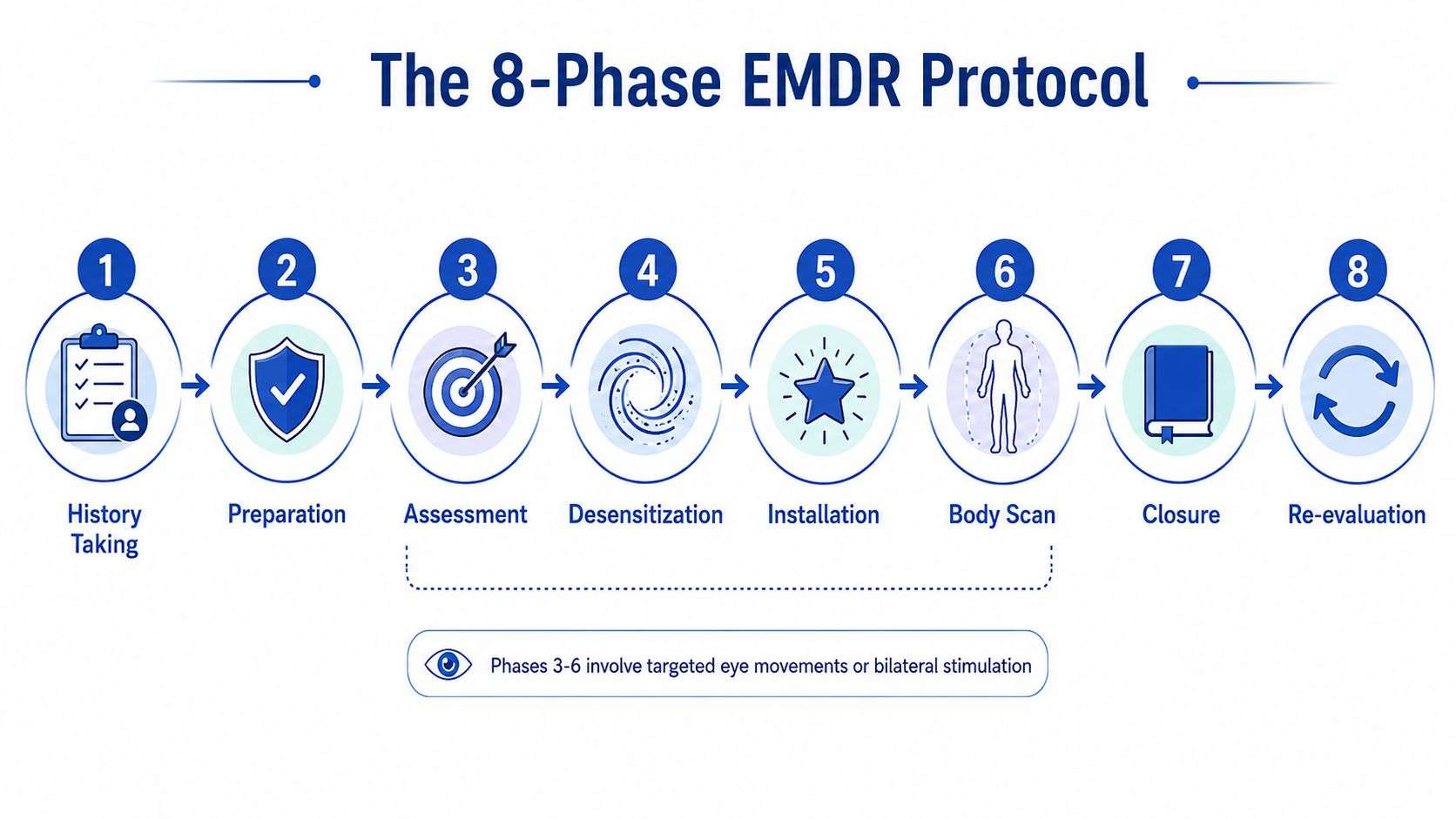
The eight phases in plain language
- History taking: You discuss your current symptoms, relevant history, strengths, goals, and workplace context.
- Preparation: You learn grounding and regulation skills, develop a calming image or resource, and agree on a signal that means stop or pause.
- Assessment: You select a target memory and identify associated thoughts, emotions, sensations, and beliefs.
- Desensitisation: You briefly hold the memory in mind while using eye movements, alternating tones, or taps, then notice what changes.
- Installation: The therapist helps strengthen a more useful and accurate belief about yourself.
- Body scan: You check whether tension or distress remains in the body when you bring up the memory.
- Closure: The session ends with grounding and a plan for managing anything that arises before the next appointment.
- Re-evaluation: At the next session, you review what shifted and decide where treatment goes next.
EMDR doesn't erase the memory. The aim is to help your brain reprocess information that still feels present, so the event can be remembered as something that happened rather than something still happening. You remain awake, aware, and able to pause.
The Adaptive Information Processing model proposes that traumatic memories can remain insufficiently integrated with present-day information. Bilateral stimulation is used during reprocessing, although researchers continue to examine the precise mechanisms involved. Clinical guidelines, including VA/DoD guidance, recommend EMDR among evidence-based PTSD treatments, and research has compared it with other trauma-focused approaches.
EMDR may suit someone who finds detailed verbal retelling overwhelming. You still identify the target, but you don't have to narrate every detail aloud for the process to begin.
Comparing EMDR With Other Trauma Therapies
No single trauma therapy is right for every worker. A Grande Prairie employee managing rotating shifts, childcare, family responsibilities, or an active WCB process may need to weigh emotional readiness alongside the therapy model.
| Therapy | Out-of-session workload | How trauma memory is worked with | Best fit for workplace PTSD | Typical session rhythm |
|---|---|---|---|---|
| EMDR | Usually lighter homework demands, though grounding practice may be recommended | Uses bilateral stimulation while you hold selected memories, beliefs, emotions, and body sensations in mind | Intrusive images, nightmares, sensory memories, or cumulative trauma that makes detailed retelling difficult | Structured sessions with preparation, processing, closure, and regular review |
| CPT | Written reflection and practice identifying unhelpful beliefs are often part of treatment | Examines beliefs about blame, safety, trust, control, and responsibility | Workers stuck in guilt, shame, self-blame, or beliefs such as “I should have stopped it” | Regular sessions with between-session cognitive work |
| Prolonged Exposure | Practice between sessions is usually important | Gradually revisits the memory and avoided situations in a planned way | Workers ready to reduce avoidance by approaching memories and safe activities they fear | Repeated, planned exposure with review and practice |
| CBT | Worksheets, behavioural experiments, or coping practice may be included | Connects thoughts, feelings, behaviours, and triggers | Broad anxiety, sleep, avoidance, and workplace confidence concerns, including PTSD symptoms | Flexible sessions based on goals and skill development |
EMDR is often attractive when the main problem is a vivid image, body reaction, or sensory memory and you have limited capacity for written work outside appointments. CPT can be especially useful when the injury has changed how you think about responsibility or trust. Prolonged Exposure may fit someone who understands avoidance is keeping fear alive and feels ready for gradual, supported practice.
Traditional CBT can also be a strong starting point, especially when sleep disruption, panic, concentration problems, and avoidance need immediate practical attention. With cumulative trauma, any approach may begin with stabilisation and a carefully organised treatment map rather than tackling every memory at once.
A practical decision rule is simple: choose the approach that matches your dominant symptoms, schedule, and readiness, with guidance from a trained clinician. You don't need to select perfectly before your first consultation.
Who Is a Good Candidate for EMDR
A healthcare aide haunted by a patient assault, a retail supervisor carrying years of customer aggression, and a forestry worker replaying a near-miss on a haul road may all be reasonable people to assess for EMDR. The common thread isn't the job title. It's the connection between specific workplace memories and present-day distress.
EMDR may be a good fit when you experience intrusive images, nightmares, strong body reactions, or automatic fear linked to identifiable workplace events. It also helps when talking about the event in detail feels less useful than noticing how the memory lives in your body and nervous system.
Readiness matters more than toughness
Before reprocessing begins, a clinician will consider whether you can return to the present after distress rises. Basic stability, a reasonably safe living situation, and enough sleep to participate in sessions matter. Sessions may be planned around the worker's ability to attend longer appointments, often 60 to 90 minutes, but the appropriate length depends on the clinician and the client.
Stabilisation usually comes first when someone is actively exposed to the traumatic environment, experiencing significant dissociation, struggling with uncontrolled substance use, or facing an acute suicidal crisis. EMDR isn't a test of endurance. Slowing down protects the work.
Cumulative trauma changes the plan. Rather than choosing one dramatic scene and moving quickly, the therapist may create a timeline of incidents, identify repeated themes such as helplessness or danger, and pace processing so earlier wounds aren't reopened faster than you can manage.
How to Access EMDR Support in Grande Prairie
Finding EMDR involves more than searching for a therapist who lists the acronym. You need to know whether the clinician has appropriate training, understands workplace trauma, and can provide care in a format that works with your location and schedule.
Start with the clinician's training
Ask whether the therapist has completed recognised EMDR training through EMDRIA, EMDR Canada, or an equivalent accredited training body. Alberta's health guidance makes clear that EMDR requires specialised training, so a general counselling qualification alone doesn't answer this question.
Then ask about workplace experience. A clinician who understands WCB documentation, return-to-work concerns, bullying, workplace violence, and cumulative exposure can help you build a treatment plan that reflects your actual situation.
Clarify the format and coverage
Grande Prairie clients may consider in-person appointments or secure virtual sessions, including options for people in Clairmont, Sexsmith, Beaverlodge, and nearby rural areas. Ask whether virtual EMDR is available, what technology is used, and whether you have a private space where you can stay grounded during and after the appointment.
For workplace injuries, WCB-Alberta's psychiatric and psychological injury entitlement guidance explains that psychological injuries, including PTSD, can be covered when they are shown to have occurred at work. The guidance also describes presumptive coverage for specified high-risk occupations after a confirmed PTSD diagnosis. Coverage depends on the claim circumstances, diagnosis, documentation, and WCB decisions, so ask the provider how claims are handled rather than assuming approval.
You can also check:
- Extended health benefits: Ask whether your plan covers the provider's registration category and whether a physician referral is required.
- Employer or union assistance: Your EAP may explain available sessions and referral steps.
- Motor-vehicle coverage: If a work-related collision caused the injury, ask your insurer or claim representative which counselling benefits may apply.
- Payment administration: Confirm whether the provider submits directly or gives you receipts for reimbursement.
Know what early sessions feel like
The first session generally focuses on consent, confidentiality, your symptoms, history, and goals. Another early appointment may focus on resourcing, grounding, and deciding whether your nervous system is ready for reprocessing. A treatment map can then identify targets, priorities, and warning signs that mean the plan needs adjusting.
Useful questions include:
- What EMDR training and supervision have you completed?
- How do you adapt EMDR for repeated workplace trauma?
- Do you offer in-person and secure virtual sessions?
- How do you support WCB documentation and communication?
- What happens if I become overwhelmed between appointments?
If there's a waitlist, you can still ask about an initial assessment, stabilisation support, or another evidence-based therapy while waiting. Taking one practical step this week, such as confirming coverage or sending a consultation question, is enough to begin.
Safety, Inclusivity, and What EMDR Cannot Do
Safe EMDR is collaborative. Before processing begins, your therapist should explain the method, possible reactions, confidentiality limits, and your right to stop. You should have grounding tools, a clear pause signal, and a plan for what to do if distress continues after the appointment.
Good treatment also uses titration, which means approaching difficult material in manageable amounts rather than forcing the full intensity of an experience all at once. If a memory destabilises you, the clinician should pause, return to the present, strengthen resources, or change the target. You retain choice about pace and modality throughout.
Cultural safety matters in Grande Prairie. Indigenous workers, LGBTQ2S+ workers, and newcomers may experience workplace trauma through both the incident itself and the response from institutions, supervisors, or colleagues. A respectful therapist asks about identity, community, spirituality, language, discrimination, and culturally grounded sources of safety before beginning reprocessing. Adaptations can be made without treating culture as an afterthought.
EMDR isn't a cure-all. It doesn't remove an unsafe workplace, stop ongoing harassment, replace medical assessment, or substitute for substance-use treatment. It also isn't appropriate to begin during an active crisis without addressing immediate safety first.
You don't need a formal PTSD diagnosis to ask for help. A clinician can assess delayed symptoms, acute stress, burnout, anxiety, adjustment difficulties, or another concern and help you choose an appropriate starting point. If you may harm yourself or someone else, seek emergency support immediately rather than waiting for a routine counselling appointment.
Common Questions About Workplace PTSD and EMDR
How does cumulative workplace trauma change EMDR planning?
With a single incident, the therapist may identify one primary memory and related triggers. Repeated bullying, violence, or witnessing distress can involve a network of memories, beliefs, and body responses, so treatment usually begins with a broader map. The clinician may process targets gradually instead of treating every incident in one sequence.
Why not reprocess everything in one appointment?
Trauma processing can activate emotions and physical sensations. Spreading targets across sessions gives you time to close safely, observe what changes, and decide whether the next target is appropriate. It also helps prevent treatment from moving faster than your capacity to stay oriented in the present.
Do delayed symptoms mean I should seek an assessment?
Yes, especially if symptoms interfere with sleep, work attendance, relationships, concentration, or your sense of safety. Alberta's workplace data identifies PTSD and exposure to traumatic or stressful events as measurable occupational health concerns, so you don't need to wait until symptoms become unbearable.
Is virtual EMDR suitable?
Virtual EMDR can be considered when the therapist is trained to deliver it securely and you have a private, stable space with a plan for grounding afterward. In-person care may feel easier for some clients, while virtual sessions may improve access for people outside Grande Prairie or those working irregular schedules. Discuss the differences with the clinician rather than assuming one format is universally better.
What if I have no WCB claim or private benefits?
You can still request an assessment. Ask about available counselling routes, employer assistance, community resources, and whether the provider can explain payment and coverage options before treatment begins. Uncertainty about symptoms, eligibility, or the right therapy is itself a valid reason to consult a clinician.
Interactive Counselling offers trauma-informed counselling and EMDR support for workplace PTSD through in-person, phone, and secure virtual appointments, with care shaped around your history, safety, and pace. Visit Interactive Counselling to learn more about trauma counselling in Grande Prairie and decide whether an initial conversation feels like the right next step.
Clinically Reviewed By
Amy Mosset, MCP, RCC-S
Amy Mosset is a Master Practitioner in Clinical Counselling, Clinical Supervisor, and the owner of Interactive Counselling. She provides trauma-informed, evidence-based care and clinical supervision to registered therapists, with a focus on ethical practice, client safety, and high-quality therapeutic outcomes.