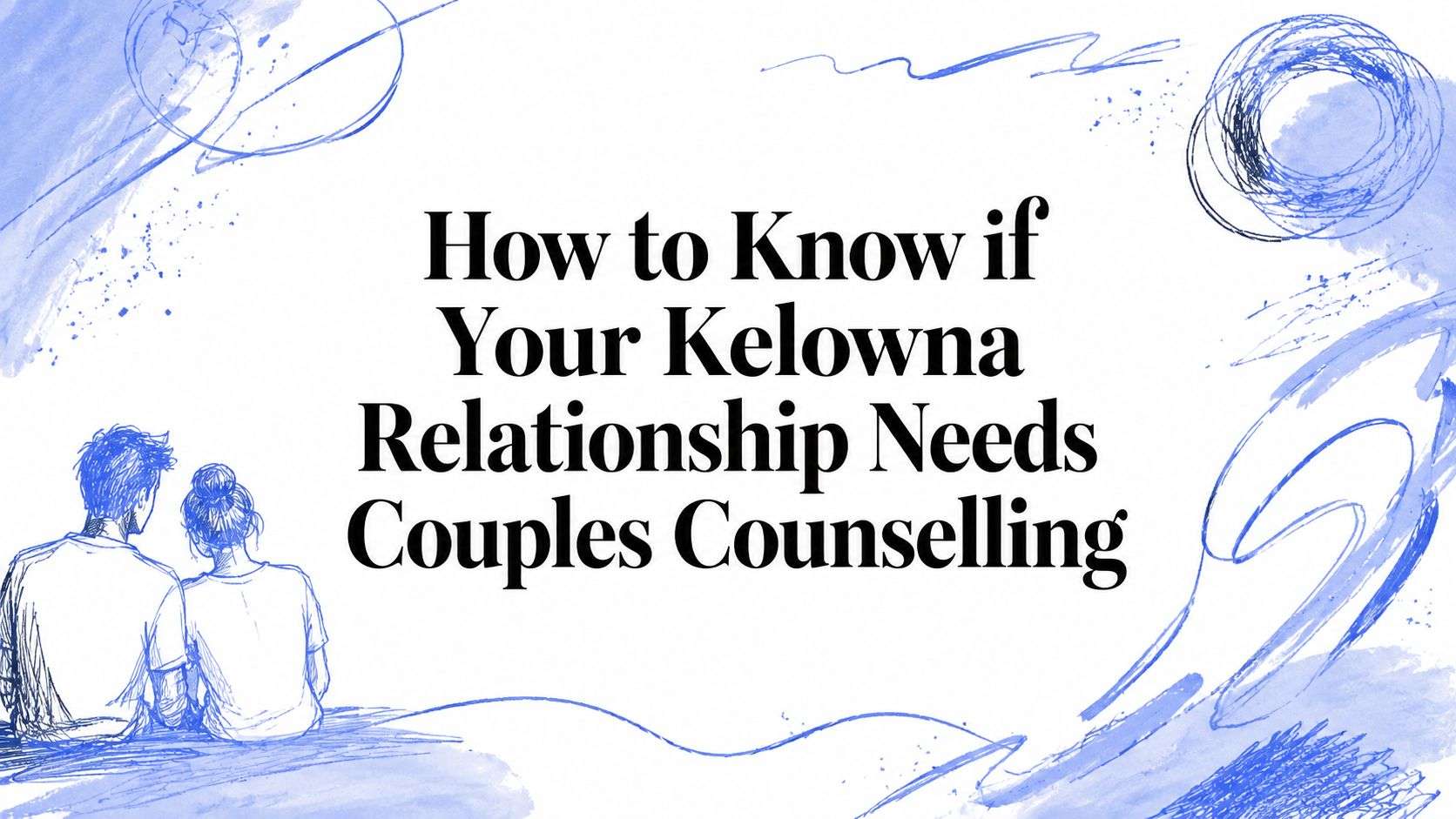
Arguments that keep repeating, communication that stays stuck, and trust that feels damaged are strong signs it's time to consider couples counselling. Couples therapy often helps, with about 70% to 75% of couples reporting improvement and clinically significant change often becoming visible within 8 to 10 sessions when the fit and timing are right. For more information, see our Kelowna couples counselling.
If you're reading this, there's a good chance something already feels off. Maybe you and your partner still function well on the surface. You get through work, errands, childcare, family plans, and weekends in the Okanagan. Maybe you still sit together at the lake or drive across town together. But underneath that ordinary life, the connection feels thinner than it used to. Conversations go in circles. Affection feels forced. You keep wondering, is this a normal rough patch, or are we sliding toward the end? For more information, see our counselling in Kelowna.
"You know your relationship needs couples counselling when you feel stuck in patterns of conflict, distance, or mistrust that you can't seem to resolve on your own." For more information, see our couples counselling.
That question is more common than people think. Many couples wait longer than they want to admit before reaching out. Survey data show 45% of couples who attended therapy said ongoing conflict was the main reason, and 43% said communication problems were the trigger. What matters most is not whether your problems look dramatic from the outside. It's whether the same issues keep returning even after sincere attempts to fix them.
Introduction
A lot of couples in Kelowna live in that confusing middle ground. Nothing is “bad enough” to justify a dramatic decision, but things also aren't good in the way they used to be. One of you feels lonely in the relationship. The other feels criticised, shut out, or exhausted. You still care about each other, which makes it even harder to know what to do next.
The emotional threshold for seeking help is often quieter than people expect. It isn't always a huge betrayal or explosive fight. Sometimes it's the sinking feeling that home no longer feels emotionally safe, easy, or warm. Sometimes it's realizing you've started censoring yourself because every honest conversation seems to go sideways.
Practical rule: If you've had the same painful conversation more than once, tried to handle it yourselves, and still feel stuck, that's usually enough reason to get support.
Couples counselling isn't only for relationships on the brink. It can also help when you're still invested, still hopeful, and don't know how to get out of the pattern you're in.
Recognizing the Subtle Drifts in Your Relationship
Not every struggling relationship looks obviously distressed. Some look organised, polite, and busy. That's part of what makes subtle disconnection so easy to miss.
The roommate phase
You live together, coordinate well enough, and keep the household running. But the relationship starts to feel more like a shared project than a shared life. You discuss groceries, logistics, appointments, and obligations, yet rarely talk about what's happening inside you.
That drift matters. Emotional closeness usually weakens gradually before couples name it out loud. One partner may feel unwanted. The other may feel pressured and pull back further. Neither person is necessarily uncaring. They're just caught in a pattern that leaves very little room for warmth.
Conversations feel like transactions
A healthy relationship doesn't require constant deep talks. But if almost every conversation is functional, corrective, or tense, that's worth noticing.
Common signs include:
- Short exchanges only: You talk about who's picking up what, when bills are due, or what the kids need, but not about fears, hopes, or hurt feelings.
- Low curiosity: You stop asking each other real questions because the answers feel predictable or loaded.
- Defensive tone: Even small requests land like criticism.
- No repair after conflict: Tension lingers for hours or days instead of softening.
Sometimes people mistake this for stress, busyness, or personality differences. Sometimes it is. But when the same distance keeps showing up, it usually needs more than another “we should communicate better” conversation.
Avoiding difficult topics
Avoidance can look peaceful from the outside. In practice, it often creates a quiet kind of loneliness.
You might avoid talking about sex, parenting disagreements, in-laws, money, or your future because every attempt turns into shutdown, blame, or silence. You may also find yourself replaying conversations in your head, trying to decide whether you're overreacting or whether something is wrong. If that sounds familiar, this guide on overthinking anxiety explained can help you sort out what anxiety does to your thinking when relationship stress is high.
Not all struggling couples fight loudly. Some stop bringing up what matters because it no longer feels useful.
When a rough patch becomes a pattern
A bad month doesn't automatically mean you need counselling. A repeating cycle often does.
Look for this distinction:
| Temporary strain | Persistent pattern |
|---|---|
| Stress linked to a clear event | Same issue keeps returning |
| Both people feel heard eventually | One or both feel chronically unheard |
| Conflict settles and repair happens | Resentment builds between conversations |
| Closeness returns naturally | Distance starts to feel normal |
If you're trying to figure out how to know if your Kelowna relationship needs couples counselling, this is one of the clearest clues. The issue isn't whether you're unhappy every day. It's whether the relationship has stopped recovering on its own.
When Disagreements Become Red Flags
Some relationship problems are subtle. Others are clearer signs that outside help would likely be useful.

The argument is no longer about the topic
At first, you may fight about dishes, texting back, spending, parenting, or sex. Over time, the conflict evolves into something deeper. One person feels unimportant. The other feels like they can never get it right. The original issue almost stops mattering because the pattern of blame, withdrawal, defensiveness, or contempt takes over.
That's often the point where couples feel especially hopeless. They say things like, “We can't talk about anything without it turning into this.” That doesn't mean the relationship is doomed. It usually means the cycle itself needs attention.
Trust has been shaken
Trust injuries can come from many places. Infidelity is one. So is repeated lying, emotional secrecy, broken promises, financial betrayal, or repeatedly dismissing a partner's pain.
When trust has been damaged, trying to “just move on” rarely works. One partner often wants reassurance. The other wants the subject to disappear. Both reactions make sense, but neither repairs the rupture by itself.
You feel smaller in the relationship
Red flags often show up in the emotional atmosphere between you.
Ask yourself:
- Do I brace before bringing things up?
- Do I feel regularly mocked, dismissed, or talked down to?
- Do apologies change anything, or do we return to the same injury quickly?
- Am I becoming someone I don't like when we argue?
Those questions matter because repeated conflict changes how partners see each other and themselves.
If your relationship leaves you feeling consistently unsafe, degraded, or shut down, that's not something to minimise.
Use a simple time test
A useful threshold is persistence. Evidence-based couples therapy research suggests clinically significant change is often observable within the first 8 to 10 sessions, while most couples complete treatment in 15 to 20 sessions, according to evidence-based guidance on marriage therapy outcomes. In plain language, that means structured help is meant to create movement. If your conflict has stayed repetitive and unresolved far beyond your own early efforts to repair it, informal self-help may not be enough.
A few signs point strongly toward counselling:
- Repeated arguments: You can almost recite each other's lines.
- Escalation: Minor disagreements become major emotional events.
- Stonewalling: One partner shuts down, leaves, or goes cold for long periods.
- Chronic criticism: Feedback comes out as character attacks instead of specific concerns.
- Post-conflict emptiness: Even when the fight ends, nothing feels repaired.
A Gentle Self-Assessment for Your Relationship
Sometimes couples don't need more advice. They need language for what they're already feeling.
This checklist isn't a test. It's a way to turn vague unease into something clearer and kinder.
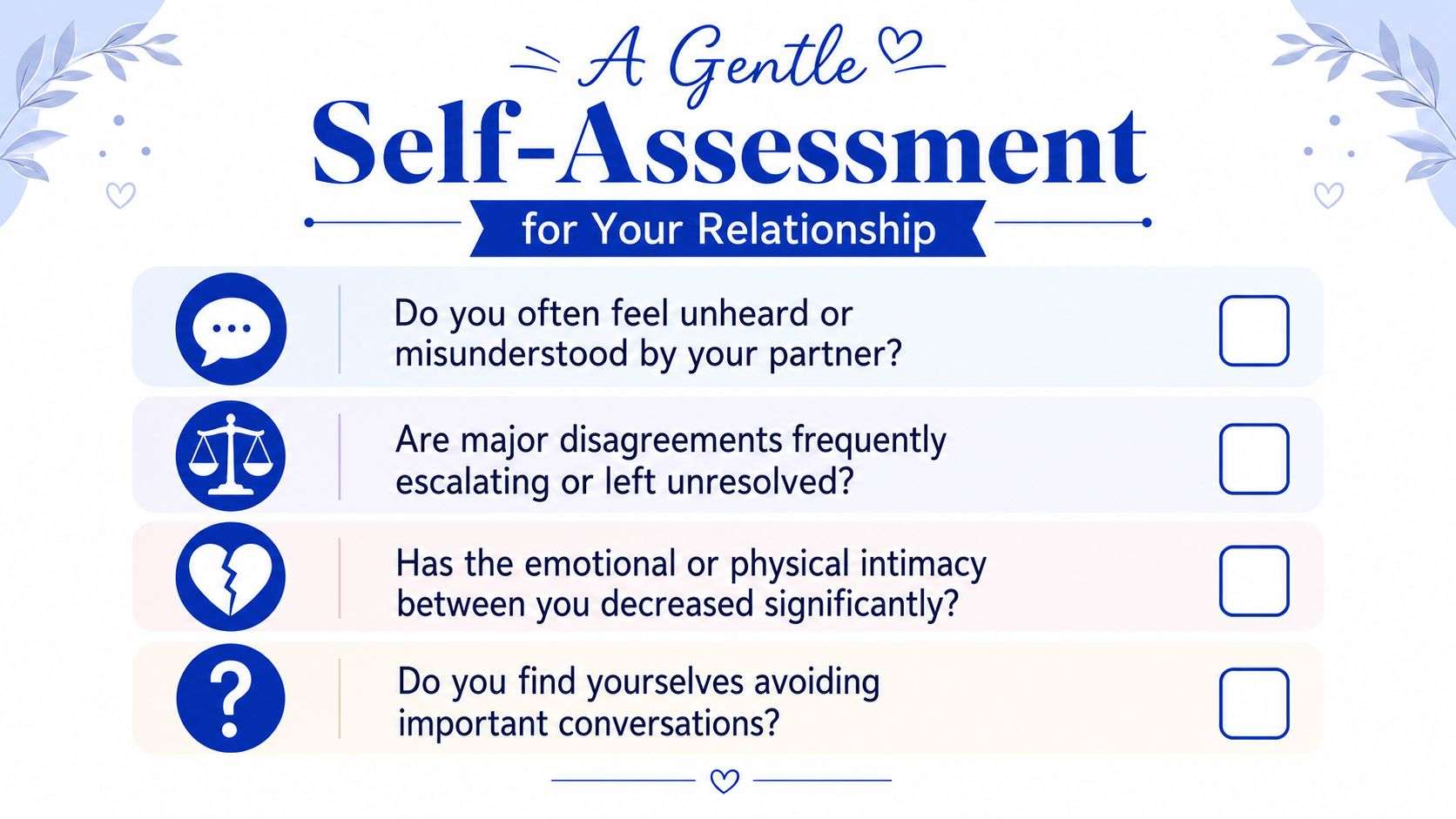
Questions worth asking yourself
- Do I feel emotionally safe here? Not perfect. Not always comfortable. Safe enough to be honest.
- Do I feel respected when we disagree? Conflict happens in every relationship. Contempt and dismissal don't have to.
- Do I still reach for my partner emotionally? Or have I gradually stopped expecting comfort, interest, or care?
- Are we avoiding important conversations? Silence can signal self-protection, not peace.
- Has intimacy changed in a way we haven't really addressed? Emotional and physical distance often travel together.
- Do I look forward to time together? If togetherness mainly feels heavy, tense, or obligatory, that matters.
If you want to bring this up gently
Try language that describes your experience without accusing your partner.
- “I've been noticing that I don't feel as close to you lately, and I miss that.”
- “I feel nervous bringing up important things because I'm afraid we'll get stuck again.”
- “I don't want to blame either of us. I just don't think what we're doing is working.”
That kind of opening lowers defensiveness. It invites a joint conversation instead of a case against the other person.
How to Talk About Counselling with Your Partner
A lot of couples reach this moment privately. You are cleaning up after dinner, driving back from the lake, or sitting beside each other on the couch in Kelowna, and one thought keeps coming up. Is this a hard season we can work through, or are we slipping into something that will be harder to repair if we wait?
That is often the critical threshold. Not “we have conflict,” because every couple does. It is the growing fear that the distance is starting to feel normal.

Bring it up when connection is still possible
Timing matters more than wording. If you raise counselling in the middle of a blowup, your partner will probably hear danger, not care. If you bring it up when one of you is distracted, exhausted, or halfway out the door, the conversation can turn defensive fast.
Choose a moment with enough space in it. A quiet walk, a slow coffee at home, or a calm evening can work well. The goal is simple. Pick a time when both of you can stay present.
Start with what feels scary, true, and shared
The strongest openings are usually honest and specific. They do not build a case. They name the emotional reality.
Try language like:
“I've been asking myself if what we're going through is a rough patch or a sign that we need help, and I don't want to ignore it.”
“I love you, and I'm worried we keep missing each other when things matter most.”
“This doesn't feel like the relationship either of us wants. I'd like us to talk to someone before we get further stuck.”
That kind of wording lowers the chance that your partner will hear, “You are the problem.” It keeps the focus on the relationship itself.
Keep the ask small
Many partners react to the idea of counselling as if they are being asked to admit failure. That is a heavy ask. A smaller ask is often easier to hear.
You are not asking them to predict the future or commit to months of work on the spot. You are asking whether they would consider one conversation, one consultation, or a few sessions to see if support helps.
A few practical ways to say it:
- Lead with care: “I want us to feel better with each other, not win an argument.”
- Name the pattern, not a character flaw: “We keep shutting down and then drifting for days.”
- Ask for openness: “Would you be open to trying a first session together?”
- Stay in the present: “I want to address this now, before more resentment builds.”
If your partner pulls back
Hesitation does not always mean refusal. Often it means fear.
Some people hear “counselling” and expect blame, exposure, or a stranger taking sides. Some worry that bringing in help means the relationship is already at the edge. Some are slower to admit that what is happening at home is affecting them.
It helps to answer the fear directly and calmly. You can say that counselling is a place to slow things down, get clearer about the pattern you are both stuck in, and have a conversation with more support than you have been able to create on your own.
If your partner says no right away, do not force a decision in that moment. Give it some room. Return to the conversation later with the same tone of care. Pressure usually hardens resistance. Steadiness gives the conversation a better chance.
If you are afraid to bring it up at all
That fear matters. In my experience, people usually hesitate for one of two reasons. They are worried the conversation will explode, or they are worried their partner will agree too quickly and confirm what they have been dreading.
Both reactions are human.
If speaking face to face feels too loaded, write down two or three sentences first. Keep them warm, brief, and grounded in your own experience. Then ask for a time to talk. You do not need a perfect script. You need a calm, honest beginning.
What Couples Counselling Can Realistically Achieve
Couples counselling helps most when people come in expecting work, honesty, and practice, not a magic fix. That's good news. It means progress doesn't depend on saying the perfect thing at home. It depends on learning a different process.
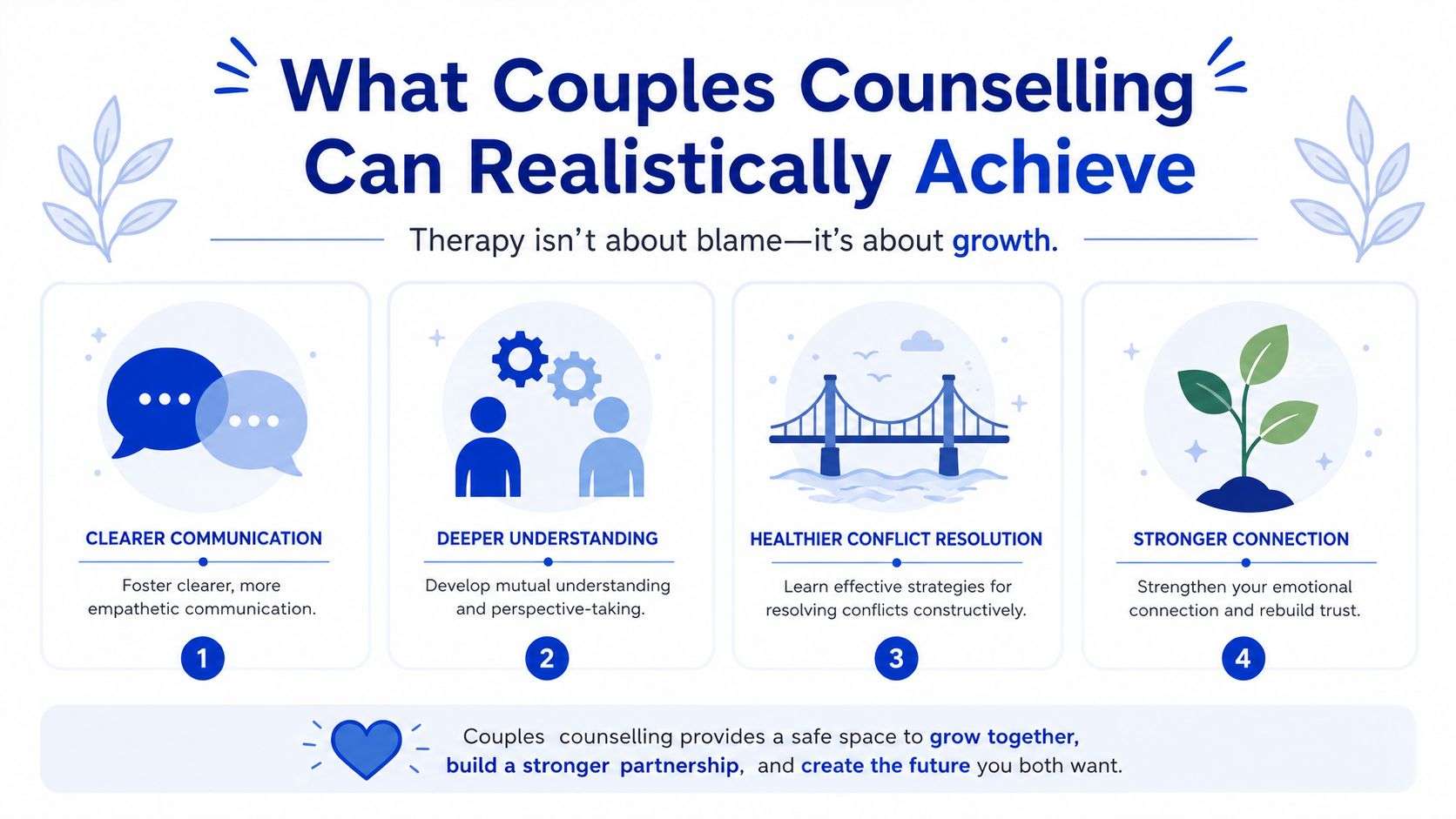
A commonly cited AAMFT-based estimate finds about 70% to 75% of couples report improvement after therapy, and Kelowna therapists commonly describe couples work as helping with communication problems, conflict resolution, trust rebuilding, and emotional disconnection in local couples counselling listings and outcome discussion. That matters because those are the exact issues most couples wrestle with before they ever book an appointment.
What therapy is good at
Good couples work often helps with:
- Seeing the cycle clearly: Many couples stop blaming the latest argument and start noticing the repeating pattern underneath it.
- Improving communication: Not in a stiff, scripted way. In a way that helps each person say what they mean and hear what the other feels.
- Repairing trust: Rebuilding trust takes more than reassurance. It usually needs structure, accountability, and repeated honest conversations.
- Restoring connection: Emotional closeness often returns when couples feel safer and more understood.
- Making decisions with clarity: Some couples use therapy to strengthen the relationship. Others use it to decide whether to continue, and if not, how to separate respectfully.
What therapy doesn't do
It doesn't make hard truths disappear. It doesn't force motivation where there is none. It doesn't work well when one or both partners come only to prove a case.
Some approaches also need to be timed carefully. For example, if betrayal is part of your story, couples work may help, but only when there is enough honesty and willingness to engage. If that's your situation, this article on the benefits of couples therapy after cheating offers a useful overview of what couples often need in that stage.
Realistic expectations help
Think of counselling as guided practice, not a one-time breakthrough.
A few grounded expectations can help:
| Unrealistic expectation | More realistic expectation |
|---|---|
| “The therapist will fix us” | The therapist helps both of you understand and change patterns |
| “We'll know everything after one session” | Clarity usually builds over repeated conversations |
| “If we still argue, therapy failed” | Progress often looks like better repair, not zero conflict |
| “Therapy proves whether we belong together” | Therapy can help you decide that more honestly |
When people ask how to know if your Kelowna relationship needs couples counselling, this is often the hidden question underneath: Can this help us? Often, yes. But usually because it gives the relationship structure that private conversations no longer have.
Finding Support and Taking the Next Step in Kelowna
Many people wait because they think they should know for sure first. In practice, certainty usually comes after a few honest conversations, not before them.
One of the most painful questions is, “Is it too late?” Sometimes it is. Often it isn't. A more useful question is whether both people are still willing to show up authentically, even if one person feels tired, doubtful, or emotionally far away. Ambivalence does not automatically mean failure. Refusal to engage meaningfully is the bigger obstacle.
When you start looking for support, focus on fit. Both partners should feel reasonably comfortable with the counsellor's style, pace, and approach. It can also help to look at practical details like scheduling, in-person versus virtual sessions, and whether the process feels manageable in real life.
If you feel overwhelmed by how to start searching, even a general article on how people find a therapist in Massachusetts can still offer a few useful questions to ask when screening for fit. The geography is different, but the basic decision-making process is similar.
The next step doesn't have to be dramatic. It may be saying, “I think we need a better conversation than the ones we've been having.”
Frequently Asked Questions
| Question | Answer |
|---|---|
| Is couples counselling only for relationships in crisis? | No. Many couples benefit before things reach a breaking point. In fact, earlier help is often more useful than waiting until resentment is deeply entrenched. |
| What if my partner isn't sure they want to go? | That doesn't automatically mean counselling is pointless. A major underserved question is whether therapy is worth trying before a breakup, especially when one partner is ambivalent. Guidance drawing on Canadian Psychological Association themes notes that outcomes depend heavily on whether both partners are willing to participate and how early problems are addressed, as outlined in this discussion of whether couples therapy is worth trying before a breakup. |
| Can counselling help us decide whether to stay together? | Yes. Couples counselling is not only for repairing a relationship. It can also help partners clarify whether to continue or to separate with more honesty, respect, and less chaos. |
| What if we don't fight much, but we feel disconnected? | That still matters. Low-conflict relationships can be deeply lonely. If affection, intimacy, honesty, or emotional engagement have faded, counselling can help you understand whether the bond is strained, avoidant, or simply neglected. |
| Should I go alone if my partner refuses? | Individual counselling can still be useful. You can sort through your own feelings, get clearer on patterns, and decide what boundaries or next steps make sense. It won't replace couples work, but it can help you move from confusion to clarity. |
If you want to explore support for your relationship, Interactive Counselling offers information about couples counselling options, including flexible formats that can fit real life. Reaching out for help doesn't mean your relationship has failed. It often means you're choosing not to stay stuck.
Clinically Reviewed By
Amy Mosset, MCP, RCC-S
Amy Mosset is a Master Practitioner in Clinical Counselling, Clinical Supervisor, and the owner of Interactive Counselling. She provides trauma-informed, evidence-based care and clinical supervision to registered therapists, with a focus on ethical practice, client safety, and high-quality therapeutic outcomes.