You've probably had the experience of telling the same story more than once, trying to make sense of why your body still reacts as if the hard thing just happened. Maybe it's a crash on Highway 97, a sudden loss, a panic spike that arrives out of nowhere, or a memory that keeps replaying long after everyone else seems to have moved on. When talking helps a little but the fear, tension, or intrusive images keep coming back, EMDR therapy can feel like a different kind of door, one that doesn't ask you to relive everything in words before you can start healing. For more information, see our Kelowna trauma counselling.
A lot of people in Kelowna come to EMDR with the same quiet question, Will this help my situation, or am I better off with something else first? That's a sensible question. Good trauma therapy starts with fit, not hype, and the most useful EMDR conversations are honest about when it tends to help and when a different approach, at least at first, makes more sense. For more information, see our counselling in Kelowna.
One simple way to understand whether a therapy is a good fit is to see how it supports the life you're already living. If you're trying to stay in touch with loved ones while managing reminders that keep hijacking your day, practical communication can matter too, which is why some people also use a guide by Call Loop to think through supportive follow-up and reminders in health care settings. For more information, see our trauma counselling.
When Talk Therapy Feels Like It Is Not Enough
A person might sit in a therapist's office in Kelowna and describe the same event for the third or fourth time. They understand it better now. They can name the triggers. They've practised breathing, grounding, and thought reframes. Yet their heart still races when a siren passes, or they still feel that familiar drop in the stomach when a certain road, smell, or tone of voice shows up.
That gap between insight and relief is often what sends people looking for EMDR Therapy in Kelowna. EMDR stands for Eye Movement Desensitization and Reprocessing, and it's an evidence-based trauma therapy that works differently from talk-only approaches. Instead of relying mainly on explanation, it helps the brain reprocess distressing memories so they don't keep landing in the present with the same force.
What it can feel like when memory stays “stuck”
People often describe the experience as if their nervous system didn't get the memo that the danger is over. A memory may show up with the same body tension, shame, panic, or numbness that came with the original event. That can happen after a car accident, an assault, childhood trauma, or even a series of smaller events that piled up over time.
Practical rule: if insight is growing but your body still reacts like it's in danger, a trauma-focused approach may be more helpful than more talking alone.
EMDR doesn't ask you to force yourself through endless detail. It's designed to help you process what's already there, in a structured and supported way. That matters for people who can talk about the past but still feel trapped by it.
Understanding How EMDR Actually Works
Think of a traumatic memory like a file that never got properly saved. It's still open, still active, and every time something similar happens, the file flashes back with the original emotional charge. EMDR aims to help the brain store that memory in a calmer, more organised way so it can be remembered without feeling as raw.
The basic mechanism
During EMDR, the therapist asks you to briefly bring a distressing memory to mind while also doing a dual-attention task, usually following side-to-side eye movements, tones, or taps. That's the bilateral stimulation part. The idea in the literature is that this uses up some of the brain's working memory, which can make the memory feel less vivid and less emotionally intense over time.
This is why EMDR isn't just “talking about the trauma with eye movements added.” It's a structured method meant to change how the memory is stored and accessed. The memory doesn't disappear. It becomes less activating, less intrusive, and easier to carry.
The goal isn't to force you back into the event. The goal is to help your brain file it differently.
For many people, that distinction matters. If a memory is still surfacing as body panic, shame, or avoidance, insight alone may not be enough. EMDR gives the memory a different route through the nervous system.
The Eight Phases of EMDR Therapy
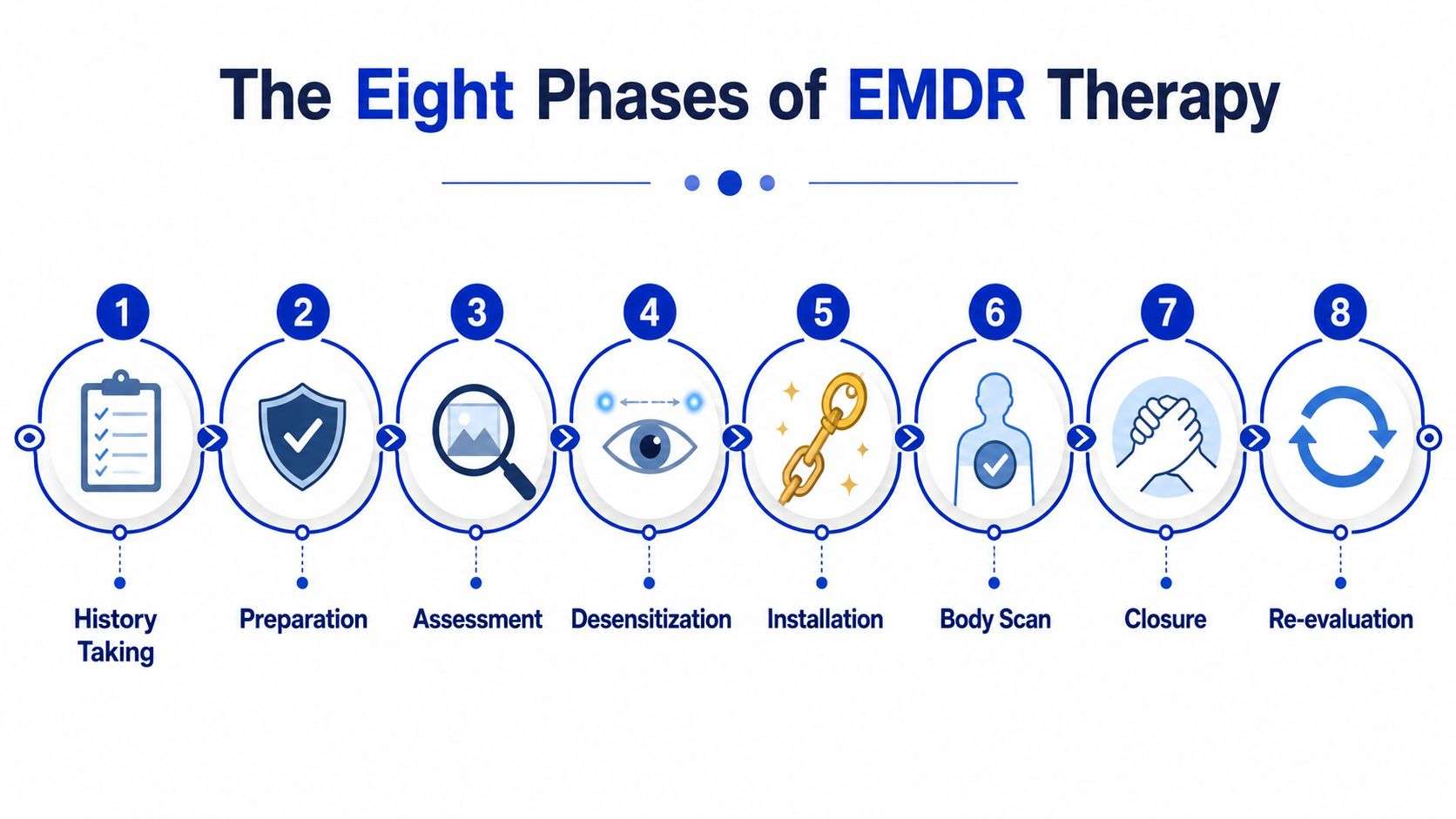
EMDR is often described as a set of eye movements, but that leaves out the core framework. The therapy is organised into eight phases, and that structure is part of what makes it feel contained and safety-focused.
What each phase feels like from the client side
History taking is where the therapist learns what happened, what still feels hard, and which memories or themes may need attention. This isn't a pressure test. It's more like mapping the terrain before anyone starts the hike.
Preparation comes next, and it matters a lot. Good EMDR work includes grounding, coping skills, and making sure you know how to steady yourself if the material gets intense.
Assessment identifies the exact memory or moment, the negative belief tied to it, and the positive belief you'd rather have. A memory like “I'm not safe” may need a very different path than “It was my fault.”
Desensitization is the core reprocessing phase. Bilateral stimulation is used while you notice what comes up.
Installation strengthens the more helpful belief once distress starts dropping.
Body scan checks whether your body still holds tension or alarm linked to the memory.
Closure helps you leave the session grounded, not flooded.
Re-evaluation happens later, when the therapist checks what shifted and what still needs work.
These phases can unfold in one session or across many. A skilled therapist won't rush the preparation stage, because stabilisation is part of the treatment, not a delay before the treatment starts.
Who Benefits Most from EMDR and Who Might Need a Different Approach
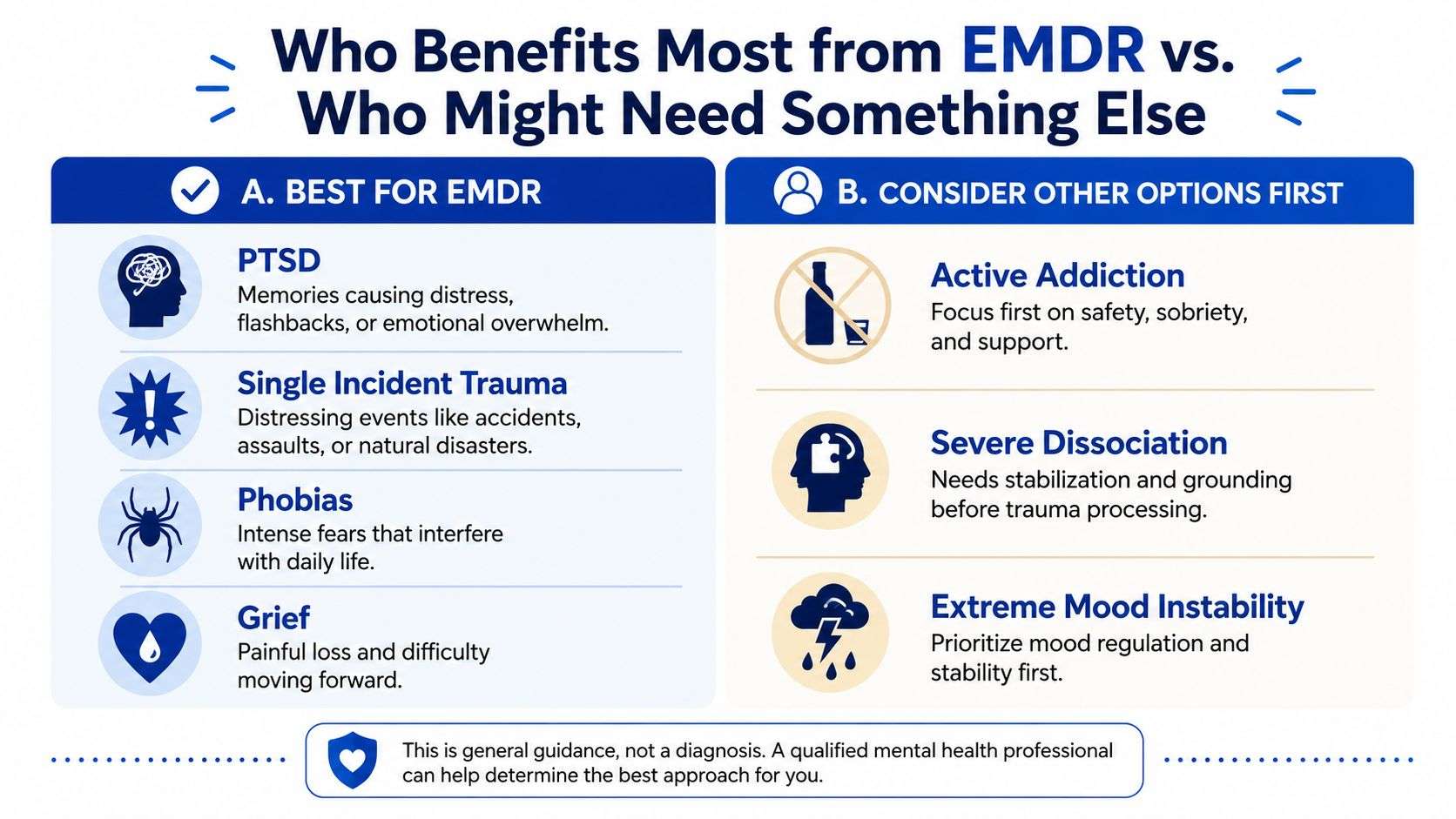
The clearest EMDR fit is usually a situation where a distressing event or set of events is driving the symptoms. That might be a single-incident trauma, like a motor-vehicle accident, a frightening medical event, or an assault. In British Columbia, accident-related recovery can be especially relevant because ICBC operates the province's universal basic auto insurance system, so trauma recovery after a crash is a practical issue for many residents.
Good fit versus possible first steps elsewhere
Often a strong fit for EMDR
- PTSD with intrusive memories and hyperarousal, especially when a specific event keeps getting reactivated.
- Single-incident trauma, including motor-vehicle accidents.
- Specific phobias tied to a past experience.
- Grief or loss when a particular memory or moment is locked in distress.
- Anxiety or depression clearly linked to trauma, where the emotional pattern seems tied to an unresolved event.
May need stabilisation or another approach first
- Severe dissociation, where the person may need careful preparation before memory work.
- Active substance use, if it's still disrupting safety, stability, or follow-through.
- Extreme mood instability, when immediate support and grounding need to come first.
- Complex trauma, where resourcing and pacing may need to happen before direct reprocessing.
- Relationship distress or general stress without a clear trauma memory, where another model may fit better at the start.
This is the part many local pages gloss over. EMDR is powerful, but power doesn't mean “best for every situation right away.” A careful assessment should help you and the therapist decide whether the work should begin with reprocessing, or with safety, stabilisation, and a broader counselling plan.
What the Research Shows About EMDR Effectiveness
A therapist might be a good fit for EMDR, yet still need to answer a practical question first. Will this approach help your specific situation, or should treatment begin with stabilisation, grounding, or a different therapy altogether? Research helps with that decision because it shows where EMDR tends to work well and where it is better used after some preparation.
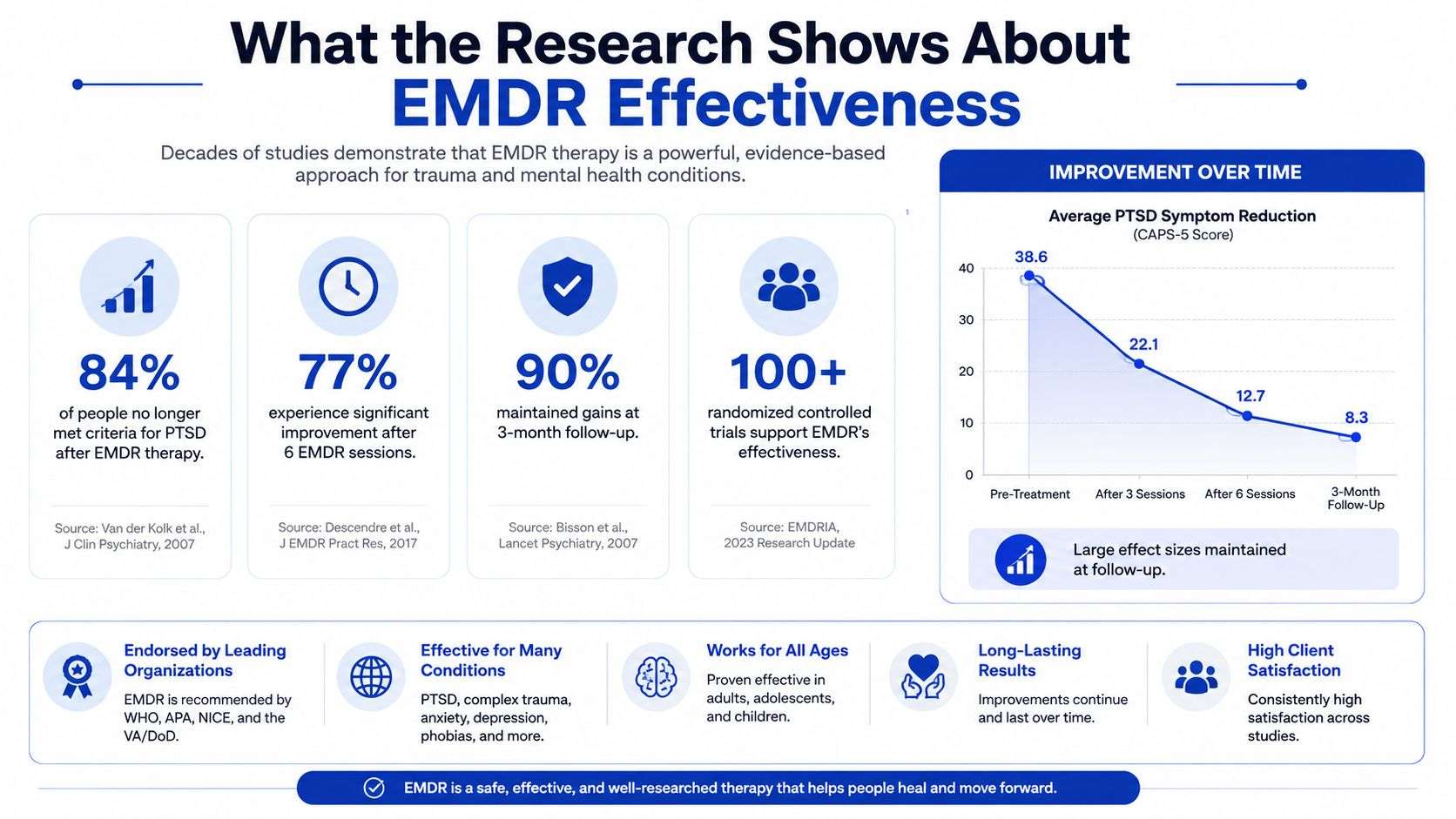
The evidence base is solid. A peer-reviewed review found 24 randomized controlled trials supporting positive effects, and a 2019 systematic review and meta-analysis reported a large overall effect versus controls of g = 0.93 with a 95% CI of 0.67 to 1.18. In some comparisons, EMDR also outperformed other therapies by g = 0.36. Another meta-analysis of randomized trials found significant reductions in PTSD symptoms, depression, anxiety, and subjective distress.
What those findings mean in plain language
The research does not say EMDR is magic. It shows that EMDR helps many people reduce trauma-related symptoms in a way that is measurable, reproducible, and clinically meaningful. A controlled-trial literature has also been associated with cases in which civilians no longer met PTSD criteria after a small number of sessions, which is part of why the method has earned so much attention.
That speed matters to people who feel worn down by talking about the same event without getting relief. When memory, body sensations, and alarm responses keep firing together, EMDR gives the brain a structured way to reprocess the material instead of only describing it.
The most useful clinical takeaway is straightforward. EMDR tends to work best when a stuck memory network is driving the symptoms, especially when trauma shows up as fear, tension, avoidance, or intrusive recall. That does not mean every person will move at the same pace, or that every problem should start with reprocessing. It does mean the method has a credible evidence base, and that a careful assessment should answer the screening question many Kelowna pages skip, whether EMDR is the right first step for you.
If you are sorting through options and trying to make your first outreach less awkward, a resource like for therapy office answering can be useful for thinking about how a practice handles first contact and follow-up.
Finding Qualified EMDR Support in Kelowna
A good EMDR therapist should be a licensed mental health professional with specialised training in the method, such as a registered clinical counsellor, psychologist, or social worker with EMDR training. Training matters because the quality of the preparation phase and the therapist's pacing can change the whole experience.
If you're screening a therapist, ask direct questions.
- Training background: What EMDR training have they completed, and how do they use it in practice?
- Trauma experience: Have they worked with your type of concern, whether that's accident trauma, childhood trauma, or panic tied to past events?
- Preparation style: How do they make sure clients are ready before processing starts?
- Session format: Do they offer in-person, phone, or secure virtual sessions?
- Session length: What does a typical appointment look like, since EMDR sessions are often longer than a quick check-in?
A simple way to think about fit is this. A therapist who can explain the process clearly, answer questions without rushing, and talk about stabilisation before memory work is usually taking the work seriously.
If you're sorting through options and trying to make your first outreach less awkward, a resource like for therapy office answering can be useful for thinking about how a practice handles first contact and follow-up. In Kelowna, many clients also look for counselling that can connect with accident recovery through ICBC-funded counselling, especially when trauma started with a crash.
Common Questions and Concerns About EMDR
A lot of hesitation around EMDR comes from not knowing what the session will feel like. That's understandable. Trauma work should feel careful, not mysterious.
Will I have to relive everything in detail
No. EMDR involves briefly activating the memory, but it's not the same as telling every graphic detail over and over. Many people are relieved to learn they don't need to narrate the trauma at length for the method to work.
Is EMDR safe if I have other mental health concerns
It can be, but that depends on assessment and pacing. If someone is dealing with severe dissociation, active addiction, or big mood swings, the therapist may focus on stabilisation first. That isn't a rejection of EMDR, it's good clinical sense.
How might I feel after a session
Some people feel tired, tender, emotionally open, or mentally “busy” after processing. Good closure matters because it helps you leave the session grounded rather than raw. A therapist should never send you out the door feeling uncontained.
What if I don't have one clear trauma memory
EMDR can still be relevant when the issue is more of a pattern than a single event, but the fit depends on the source of the distress. Sometimes the target is a memory. Sometimes it's a repeated emotional theme that traces back to earlier experiences. If there's no clear trauma link, another approach may fit better at the start.
How do I know if it's working
Progress is usually tracked by whether the memory feels less vivid, less charged, and less tied to old beliefs like “I'm not safe” or “It was my fault.” You may also notice fewer body reactions, less avoidance, or more ease when reminders show up.
If you're curious but unsure, that's a good place to be. You don't need to be certain before you ask for help, and you don't need to rush your decision to explore a therapy that feels safer than forcing yourself to keep talking in circles.
If you're looking for trauma-informed counselling that can help you sort out whether EMDR is the right next step, Interactive Counselling offers EMDR therapy alongside other evidence-informed supports for anxiety, trauma, PTSD, grief, and accident recovery. You can learn more about their approach and connect with a therapist through Interactive Counselling when you're ready to explore what fits your situation.
Clinically Reviewed By
Amy Mosset, MCP, RCC-S
Amy Mosset is a Master Practitioner in Clinical Counselling, Clinical Supervisor, and the owner of Interactive Counselling. She provides trauma-informed, evidence-based care and clinical supervision to registered therapists, with a focus on ethical practice, client safety, and high-quality therapeutic outcomes.