That nagging voice in your head—the one that whispers you're not good enough, that you’ve made a mistake, or that you’re bound to fail—has a name: the inner critic. Living with this constant internal judgment is exhausting. It can quietly chip away at your confidence, fuel anxiety, and leave you feeling completely stuck. This relentless voice is a classic example of a man vs self conflict, where the real battle is happening inside your own mind. For more information, see our couples counselling.
"Cognitive behavioural therapy helps quiet the inner critic by giving you practical tools to identify, challenge, and reframe its negative and often distorted thoughts, allowing you to build a more balanced and compassionate relationship with yourself."

Understanding Your Inner Critic and the Power of CBT
If that harsh inner voice feels intensely familiar, please know you aren’t alone. So many of us struggle with an inner critic, and understanding its roots is often the first real step toward making a change. You might find it helpful to learn more about where your inner critic comes from, as it’s often deeply connected to our past experiences and learned beliefs.
The good news is that there’s a well-researched, practical approach that can help you turn down its volume for good: Cognitive Behavioural Therapy (CBT).
What Is Cognitive Behavioural Therapy?
At its core, CBT is a structured, hands-on form of therapy that shines a light on the powerful link between what you think, how you feel, and what you do. It’s built on a simple but profound idea: it’s not the events in our lives that necessarily upset us, but the meaning our minds attach to them. Your inner critic is a master at attaching the most negative meanings possible to almost everything.
Think of CBT as a toolkit for changing this pattern. It's not about trying to delete negative thoughts or pretending to be positive all the time. Instead, it’s about building the skills to:
- Notice the automatic critical thoughts the moment they pop up.
- Challenge their accuracy with a bit of curiosity and real-world evidence.
- Reframe them into more balanced, helpful, and realistic alternatives.
Ultimately, this approach is about empowerment. In Canada, where millions of people live with mental health challenges, CBT stands out as a highly respected and effective method. One major review found that for mood and anxiety disorders, a significant number of patients using CBT experienced a considerable reduction in their symptoms over a 46-month period—a powerful improvement compared to standard care. To see the numbers for yourself, you can read more about these findings on CBT success rates and how it equips people with lasting skills.
By learning how cognitive behavioural therapy helps quiet the inner critic, you start a journey not of fighting your own mind, but of learning to work with it more skilfully and compassionately.
How to Spot Your Inner Critic’s Automatic Thoughts
Before you can start to dial down the volume on your inner critic, you first have to learn to recognize its voice. In the world of cognitive behavioural therapy, this voice often shows up as Negative Automatic Thoughts, or NATs. A good way to think of them is like mental pop-up ads—they just appear out of nowhere, can feel completely intrusive, and disrupt your train of thought without any permission.
These thoughts pack a punch because they're so quick and reflexive; they can feel like undeniable truths in the moment. The first step in CBT isn't about fighting these thoughts or trying to shove them away. It's much simpler: just start noticing them. The goal is to observe them with a gentle sense of curiosity, not judgment.
Capturing Your Thoughts with a Thought Record
One of the most powerful and foundational tools in the CBT toolkit is the thought record. It might sound a bit formal, but it’s really just a straightforward way to get your thoughts down on paper or in a note on your phone. Why? Because this simple act helps you see them more objectively and start untangling the actual event from the story your inner critic is spinning about it.
To begin, you only need to keep track of three things:
- The Situation: What was going on right before that critical thought popped up? Be specific and factual.
- Your Feelings: What emotions came up? Try to name them and maybe rate their intensity out of 10 (e.g., sadness 8/10, anxiety 7/10).
- The Automatic Thought: What was the exact phrase that ran through your head? Write it down word for word, as if you're quoting it.
Let's look at an example:
- Situation: My manager pointed out a small error in my report during our team meeting.
- Feelings: Embarrassment (9/10), Anxiety (8/10), Shame (7/10).
- Automatic Thought: "I can’t do anything right. Everyone must think I'm incompetent."
Just by writing this down, you create a little bit of distance between yourself and the thought. You can start to see it for what it is—a string of words—instead of a proven fact about who you are. To get a more detailed walkthrough of this fantastic technique, you can explore how a cognitive therapy thought record works in practice.
Common Thinking Traps Your Inner Critic Uses
Your inner critic is quite clever and tends to rely on a predictable set of tricks to make its harsh judgments feel completely believable. In CBT, we call these cognitive distortions, or "unhelpful thinking styles." Learning to spot these patterns is a game-changer. It’s like getting a look at your opponent’s playbook before the match even starts.
The table below breaks down some of the most common traps your inner critic might be setting for you.
| Cognitive Distortion | What It Means | Example Inner Critic Thought |
|---|---|---|
| All-or-Nothing Thinking | You see things in absolute, black-and-white terms. There's no room for shades of grey. | "If I don't get this promotion, my career is a complete failure." |
| Catastrophizing | You jump to the absolute worst-case scenario, even from a very minor setback. | "I made a typo in that email; now the client will lose all trust in us and cancel the contract." |
| Personalization | You automatically blame yourself for things that are not entirely your fault or within your control. | "My friend seems quiet today. I must have done something to upset her." |
| Mind Reading | You assume you know what others are thinking, and it's almost always something negative about you. | "I know everyone in that meeting thought my idea was stupid, even if they didn't say so." |
Once you learn to put a name to these thoughts—"Oh, that’s just catastrophizing again"—you start to take their power away. You're no longer caught up in believing the content of the thought; instead, you're observing the process of your thinking. This simple shift is a major step toward quieting that critical inner voice.
Rewriting Your Inner Critic's Script
So, you've started spotting those automatic thoughts from your inner critic. That’s a wonderful first step! The next step in cognitive behavioural therapy is to begin rewriting its script. This key technique is called cognitive restructuring.
Think of it like becoming a compassionate detective for your own mind. Your job is to gently examine the evidence behind those harsh, automatic statements.
This isn't about getting into a fight with that critical voice or trying to force "positive thinking." Instead, it’s about asking thoughtful, evidence-based questions to find a more balanced and realistic point of view. It’s a skill, and like any other, it gets stronger with practice and self-compassion, not perfection.
Becoming a Compassionate Detective
When a critical thought pops up, your mission is to investigate it with genuine curiosity. Rather than immediately accepting it as fact, you can pause and ask a few simple questions. This small pause creates a crucial bit of space between the thought and your emotional reaction.
Here are some questions you can use to gently challenge your inner critic:
- Is there real evidence for this thought? Or is this just a feeling?
- What's a more compassionate way of looking at this? What would I say to a friend who was thinking this about themselves?
- Could there be another explanation for what happened?
- Is this thought actually helpful right now? Is it motivating me, or just holding me back?
Asking these questions helps you shift your perspective. You go from being a prisoner of your thoughts to being an observer of them. You start to realize that a thought is just a thought—a fleeting mental event—not a proven fact about your worth or your future. That mindful distance is where your power lies.
The diagram below shows the typical flow: a situation leads to a feeling, which can then trigger a thought. This is the exact sequence you're learning to interrupt.
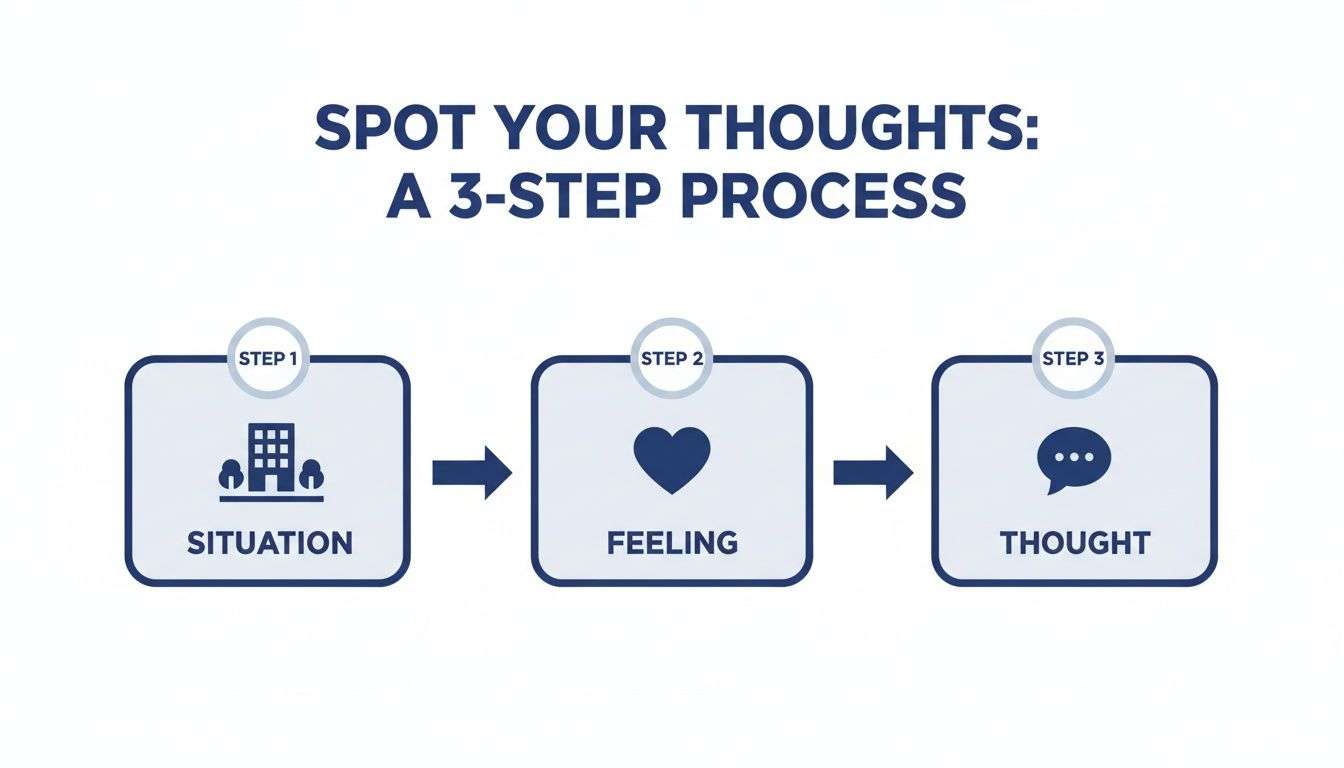
By spotting the thought that follows a situation and a feeling, you create a window of opportunity to step in and challenge its validity.
From Harsh Judgement to Balanced Perspective
Let's put this into practice with a thought record. Building on our earlier example, after you've captured the automatic thought, you add columns for "Evidence For/Against" and a "Balanced Thought."
- Automatic Thought: "I can’t do anything right. Everyone must think I'm incompetent."
- Evidence Against: "My manager praised my last project. A colleague asked for my help yesterday. The error was small and easily fixed. I usually produce high-quality work."
- Balanced Thought: "I made a small mistake, which is human. It doesn't erase all my past successes. It's an opportunity to be more careful, not proof that I'm incompetent."
See the difference? The balanced thought acknowledges the mistake without letting it define your entire identity. A huge part of this process involves challenging rigid beliefs.
Learning to spot the specific patterns your inner critic uses is also incredibly empowering. To sharpen this skill, you can learn more about https://interactivecounselling.ca/unhelpful-thinking-styles/ and how to counter them. This is how cognitive behavioural therapy helps quiet the inner critic—by replacing distorted, automatic judgements with considered, compassionate, and realistic truths.
Testing New Beliefs with Behavioural Experiments
So far, we’ve been focusing on the “cognitive” part of CBT—the work of catching and reframing your inner critic’s narrative. But thinking differently is only half the journey. Now, we can move into the “behavioural” side of things. This is where you step out into the real world and collect hard evidence to show your inner critic just how wrong it often is.
The main tool we use for this is something called a behavioural experiment. Think of yourself as a kind scientist running a test on your own thoughts. Instead of staying stuck in a mental debate with your critic, you design a small, real-world test to see which belief—the old negative one or the new balanced one—actually holds up.

Putting Your Critic to the Test
A behavioural experiment is a planned action you take to challenge a specific negative thought. It’s about deliberately disobeying your inner critic in a small, manageable way and then stepping back to observe what really happens.
Let's say your inner critic pipes up before a team meeting: "Don't you dare share that idea. Everyone will think it's stupid, and you'll just embarrass yourself." Your new, balanced thought might be, "My idea is well-researched, and it’s possible some of my colleagues will actually find it helpful."
To test this, you could design an experiment: share one small point during the meeting. The goal isn't to give a flawless presentation or win everyone over. It’s simply to gather data. Did the sky fall? Did people point and laugh? Or, more likely, did a few colleagues nod along, and maybe one even built on what you said? By taking that small step, you gather concrete, real-life proof that contradicts your critic’s dramatic predictions.
This direct action is incredibly powerful. You're not just arguing with the critical voice in your head; you're showing it firsthand that its fears are often overblown.
Breaking the Cycle with Behavioural Activation
Another crucial behavioural technique is behavioural activation. The inner critic loves it when we withdraw, isolate ourselves, and stop doing things that bring us joy or a sense of accomplishment. It thrives in that vacuum. Behavioural activation is the perfect antidote. It involves intentionally scheduling small, positive activities back into your life, especially when you don't feel like it.
This could look like:
- Going for a 10-minute walk even if your critic insists you're too exhausted.
- Sending a friend a quick text even if your critic whispers that you’re a burden.
- Spending 15 minutes on a hobby you’ve been putting off.
These aren't just random tasks to pass the time. Each one creates positive momentum. They prove that your actions can directly influence your mood, effectively breaking the cycle of negativity and avoidance your inner critic relies on to stay in charge. If you’re feeling stuck, exploring some practical cognitive behavioural therapy exercises for anxiety can be a great place to start.
The impact of these behavioural strategies can be significant, especially when the inner critic is fuelled by depression. Some research on CBT for Canadians with depression found that many patients saw a major improvement in their scores, a success rate notably higher than for patients receiving usual care. These methods can produce real results by directly challenging catastrophic thinking and encouraging positive, forward-moving actions. You can read the full research about these hopeful findings on mental health gains and see how CBT helps quiet the inner critic not just in theory, but in practice.
The Role of a Therapist in Your CBT Journey
While you can absolutely use many CBT techniques on your own, inviting a professional on board can make a world of difference. Think of a therapist less like someone with all the answers and more like a skilled, compassionate guide for your journey inward. They walk alongside you, helping you navigate the trickier parts of your own mind.
A good therapist offers a safe, structured, and completely non-judgmental space to do this important work. They’re trained to help you dig past the surface-level criticisms and unearth the core beliefs that fuel your inner critic. These are the deep, stubborn roots—fundamental assumptions like "I am unlovable" or "I am bound to fail"—that can be incredibly difficult to see, let alone challenge, by yourself.
A Collaborative and Personalized Approach
Working with a therapist is a true partnership. They bring their expertise in CBT, and you bring the invaluable expertise of your own life and experiences. Together, you can customize the tools and exercises to fit your specific struggles.
For instance, a therapist can help you:
- Pinpoint the specific triggers that awaken your inner critic with much greater accuracy.
- Design behavioural experiments that are just the right balance of challenging and manageable for you.
- Work through roadblocks when you feel stuck or when questioning your thoughts feels too overwhelming.
- Process the tough emotions that often surface when you confront those long-held negative beliefs.
A therapist provides a steadying hand, ensuring you don’t have to face your loudest and most painful thoughts all alone. Their job is to offer encouragement, help you keep perspective, and keep you moving forward, especially when the work gets hard.
This collaborative approach makes the process of quieting your inner critic not just more effective, but also safer. It ensures you have support when exploring painful memories or beliefs that might be tied to past trauma or difficult life events. For anyone curious about what this professional partnership looks like in practice, learning more about the process of counselling can offer some really helpful insight.
Ultimately, a therapist helps you build the skills and confidence to become your own best advocate. They guide you until you feel ready to continue the journey on your own, armed with a powerful toolkit to manage your inner critic for good.
Frequently Asked Questions About CBT and the Inner Critic
Starting the work to quiet your inner critic is a big step, and it's completely natural to have questions. You might be wondering what the process actually looks like and what you can expect. We’ve put together answers to some of the most common questions we hear, hopefully offering some clarity and reassurance as you get started.
How Long Does It Take for CBT to Help with the Inner Critic?
This is a very common question, and the honest answer is: it’s different for everyone. CBT is about learning a new set of skills, not flipping a switch. Because of that, there’s no fixed timeline for success. Many people begin to notice small but significant shifts in their thinking after just a few weeks of consistent practice.
For deeper, more lasting changes in your relationship with your inner critic, you’re often looking at a journey of several months. The goal isn't to silence that voice forever—that’s probably not possible or even necessary. Instead, the aim is to gradually turn down its volume, lessen its frequency, and reduce the emotional sting it carries. Your progress will depend on things like how long those critical thought patterns have been around and how consistently you practice the techniques, like keeping a thought record or trying out behavioural experiments.
Remember, every single step forward is progress, and being gentle with yourself during the process is key.
Is CBT Just About 'Positive Thinking'?
This is one of the biggest myths about CBT, and it’s really important to set the record straight. Cognitive behavioural therapy is absolutely not about forcing yourself to "think positive" or papering over difficult feelings. In many ways, it's the exact opposite. CBT is about building realistic and balanced thinking.
The process starts by encouraging you to acknowledge your negative thoughts without judging yourself for having them. From there, you learn to gently examine them for accuracy—think of yourself as a kind detective searching for hard evidence. So, instead of trying to force a thought like, "I'm a total failure," into an unbelievable statement like, "I'm a massive success," CBT guides you toward something much more balanced and true.
A more balanced thought might be something like:
"I made a mistake in this one situation, and that's okay—it's part of being human. This one event doesn't define my entire worth, and I can probably learn something from it."
This isn't about looking at the world through rose-coloured glasses. It’s about swapping the harsh exaggerations of the inner critic for clarity and a bit of self-compassion.
Can I Use These CBT Techniques on My Own?
Absolutely! Many of the foundational tools in CBT—like thought records, spotting cognitive distortions, and planning behavioural experiments—were actually designed with self-help in mind. There are some fantastic workbooks and online resources out there that can walk you through the practices step-by-step. Many people find they can make significant headway on their own using these resources.
That said, working with a trained therapist can offer some really powerful advantages. A therapist provides a safe, non-judgemental space where you can dig into the deeper core beliefs that might be fuelling your inner critic. Unpacking those beliefs can be tough and even overwhelming to do alone. A professional can also personalize the entire process, helping you design exercises that are a perfect fit for your specific challenges and goals.
Most importantly, if your inner critic is tangled up with significant anxiety, depression, or past trauma, seeking professional support is the safest path forward. A therapist can make sure you have the right guidance and a solid safety net to navigate those more painful thoughts and emotions.
What if Challenging My Inner Critic Makes It Seem Louder?
First, if this happens, please know you are not alone. This is an incredibly common—and often discouraging—experience. When you first start to push back against a pattern that’s been there for years, it’s natural for the inner critic to resist. Think of it as an old, unhelpful habit fighting to keep its place in your mind.
The trick is to try and reframe what’s happening. Instead of seeing it as a sign that you’re failing, try to see it as proof that you are making progress. This backlash can be a signal that you’re successfully disrupting an old, automatic pattern. Your inner critic might be getting louder precisely because it feels its influence starting to slip.
When this happens, the best response is gentle persistence, not an all-out fight. There's no need to get into an argument with the voice. You can simply acknowledge its presence ("Okay, I hear you, inner critic") and then calmly pivot back to the balanced, evidence-based thought you've been practicing. This is a moment for extra self-compassion, not self-criticism.
Your journey toward a quieter mind and a more compassionate relationship with yourself is a testament to your strength. The tools of CBT offer a practical, evidence-based path forward, empowering you to rewrite your inner narrative one thought at a time. This is challenging work, and it's okay to seek support along the way. If you feel that professional guidance could help you on this path, you can learn more about finding support that feels right for you.
Clinically Reviewed By
Amy Mosset, MCP, RCC-S
Amy Mosset is a Master Practitioner in Clinical Counselling, Clinical Supervisor, and the owner of Interactive Counselling. She provides trauma-informed, evidence-based care and clinical supervision to registered therapists, with a focus on ethical practice, client safety, and high-quality therapeutic outcomes.