In Kelowna, grief support is available through a real local care network, including 8-week grief groups and related services with regular hours, not just informal help. In British Columbia, practical support may also include up to three days of unpaid bereavement leave, which matters because loss often affects both your heart and your day-to-day life at the same time. For more information, see our Kelowna grief counselling.
If you've landed here, you may be trying to function while something inside you feels completely altered. You might be answering texts you don't want to answer, dealing with paperwork you never asked for, or wondering whether what you're feeling is normal. Grief can make even simple tasks feel unfamiliar, and many people in that place find themselves asking the same question: where do I even start? For more information, see our counselling in Kelowna.
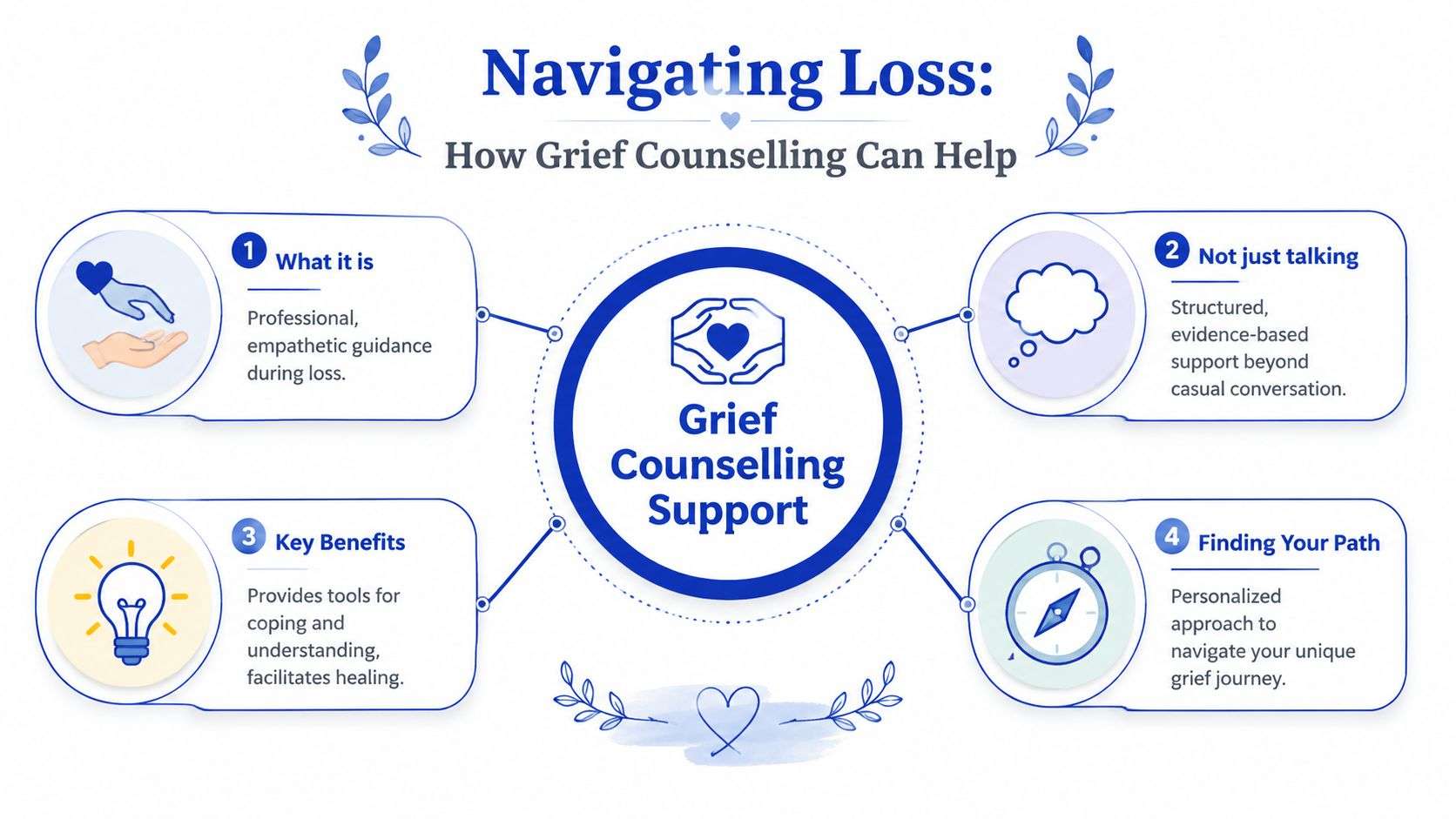
Grief counselling offers a supportive, non-judgmental space to process the complex emotions of loss with a trained professional, helping you through your unique journey of healing. For more information, see our grief counselling.
Navigating Loss How Grief Counselling Can Help
Grief counselling isn't about being told to "move on." It isn't about finding the right words, having a neat explanation, or reaching some ideal version of coping. It's a place where you don't have to protect other people from your pain for an hour.
When you're grieving, friends and family can be caring. They can also be grieving themselves, unsure what to say, or eager to make things better too quickly. A counsellor's role is different. They listen without needing you to tidy up your feelings. They help you notice what you're carrying, what feels hardest right now, and what might help you get through the next part of the day or week.
What grief counselling is really for
Many people come in expecting they should talk only about sadness. But grief often includes much more than sadness.
It can include:
- Shock and numbness that make everything feel distant
- Anger at the person who died, at yourself, at doctors, at family, or at life
- Relief if the death followed suffering or a complicated relationship
- Guilt and regret about what happened, what didn't happen, or what can never be changed
- Disorientation when routines, roles, and future plans suddenly no longer fit
A good counselling space makes room for all of that. You don't need to sort your emotions before you arrive.
Grief is not a problem to solve. It's an experience to be carried, understood, and slowly integrated.
Why professional support can feel different
One of the quiet benefits of counselling is structure. Not rigid structure, but enough steadiness that your grief has somewhere to land. That can matter when the rest of life feels chaotic.
A counsellor may help you:
- Name what you're feeling when everything seems tangled together
- Understand your reactions so you don't mistake normal grief responses for personal failure
- Create coping routines for sleep, work, meals, anniversaries, and triggering moments
- Honour the relationship with the person who died in ways that still feel meaningful
Sometimes people also need help supporting others while they grieve themselves. If that's part of your reality, this guide on support for teams managing goodbyes can offer thoughtful ideas for navigating loss in shared spaces like workplaces and communities.
Grief counselling in Kelowna is often less about "fixing" grief and more about helping you feel less alone inside it. That difference matters.
Therapeutic Approaches for Grief and Loss
Different kinds of loss affect people in different ways. The death of a spouse may bring one set of struggles. Pregnancy loss may bring another. Traumatic loss can leave someone grieving and feeling unsafe at the same time. That's why grief therapy isn't one-size-fits-all.
Local resources reflect that need for more specific care. In the Kelowna area, support options include distinct groups for bereaved parents, spousal loss, and anticipatory grief, and some organizations also offer support connected to pregnancy loss through local grief resources in Kelowna. That tells us something important. Grief isn't a single uniform experience, and treatment shouldn't be either.

When thoughts become overwhelming
Some people in grief get caught in painful loops. "I should have done more." "I can't handle this." "If I stop hurting this much, it means I'm forgetting them." In those moments, Cognitive Behavioural Therapy (CBT) can help.
CBT doesn't try to erase love or grief. It helps you notice thoughts that intensify suffering and examine them more gently. For example, a counsellor might help you slow down a guilt spiral and separate responsibility from hindsight. The goal isn't forced positivity. It's steadier thinking when your mind is pulling you into extremes.
When grief stays intense and consuming
Sometimes grief doesn't soften in the way people expected. A person may feel stuck in the loss, unable to reconnect with life, or frightened by how relentless the pain still feels. In those cases, therapy may use more focused bereavement approaches that help people process the death, make sense of the bond, and rebuild daily functioning without letting go of love.
That kind of work can be especially helpful after:
- Sudden death
- A very close attachment
- A complicated relationship
- A loss that also changed finances, housing, or caregiving roles
Practical rule: The right therapy approach should fit the kind of grief you're carrying, not force your grief into a standard template.
When loss is also traumatic
If the death involved an accident, a disturbing scene, medical trauma, or other overwhelming circumstances, talking alone may not feel like enough. Some people relive images, avoid reminders, or feel constantly on edge. In those situations, trauma-informed approaches such as EMDR or other trauma-focused therapy may be more appropriate than standard bereavement support on its own.
This is often where people get confused. They think, "I'm grieving, so I only need grief counselling." But if your nervous system is reacting to trauma as well as loss, your care may need to address both.
A simple way to think about it is this:
| Experience | What support may focus on |
|---|---|
| Sadness, longing, identity shifts | Processing grief and adjustment |
| Intense guilt, looping thoughts | Thought patterns and coping tools |
| Disturbing memories, panic, avoidance | Trauma-informed therapy |
| Pregnancy loss, parent loss, spousal loss | More specialized grief support |
Good therapy doesn't make you fit a method. It uses a method that fits you.
What to Expect in Your Counselling Sessions
The first session is usually much gentler than people fear. You don't walk in and get pushed to say everything at once. Most grief counsellors know that trust comes first.
You may begin with the basics. Who died. What happened. What feels hardest right now. You might talk a lot, or hardly at all. Both are okay. Some people cry immediately. Some stay practical and factual because that's all they can manage in the beginning. That is also okay.
The first meeting often feels like this
A person sits down and says, "I don't even know where to start."
The counsellor might respond with something simple and grounding. Start anywhere. Tell me about them. Or tell me about today.
From there, the session usually unfolds at your pace. You may talk about the relationship, the circumstances of the death, the changes at home, or the feeling that everyone else has gone back to normal while you haven't. Counselling is confidential, and you shouldn't be pressured to discuss details you're not ready to touch.
What your counsellor is listening for
A grief counsellor isn't looking for a "correct" reaction. They're listening for what support you need most right now.
That may include:
- Emotional support if the pain feels constant or hard to express
- Practical coping if sleep, appetite, work, or parenting are falling apart
- Trauma awareness if reminders cause panic, shutdown, or vivid distress
- Meaning-making if you're wrestling with identity, faith, anger, or the future
Some sessions will focus on the loss itself. Others may focus on getting through the week. Therapy can hold both.
You don't have to tell the whole story in the first session. Safety matters more than speed.
What progress can look like
Progress in grief counselling rarely looks like becoming cheerful or "over it." More often, it looks like having a bit more room to breathe. It looks like fewer moments of total overwhelm, more understanding of your own reactions, and more ability to carry the loss without feeling swallowed by it.
There is also evidence that structured bereavement counselling can help over time. In a controlled study, the counselling group showed improvement over 6 months, with mean complicated grief scores changing from 60.68 to 53.64, while the control group changed from 61.73 to 62.00. The difference was statistically significant at p =.014 with an effect size of d =.33 in this longitudinal study of bereavement counselling.
That matters because grief support isn't only about being heard. It can also produce measurable relief.
Understanding Grief Support in Kelowna
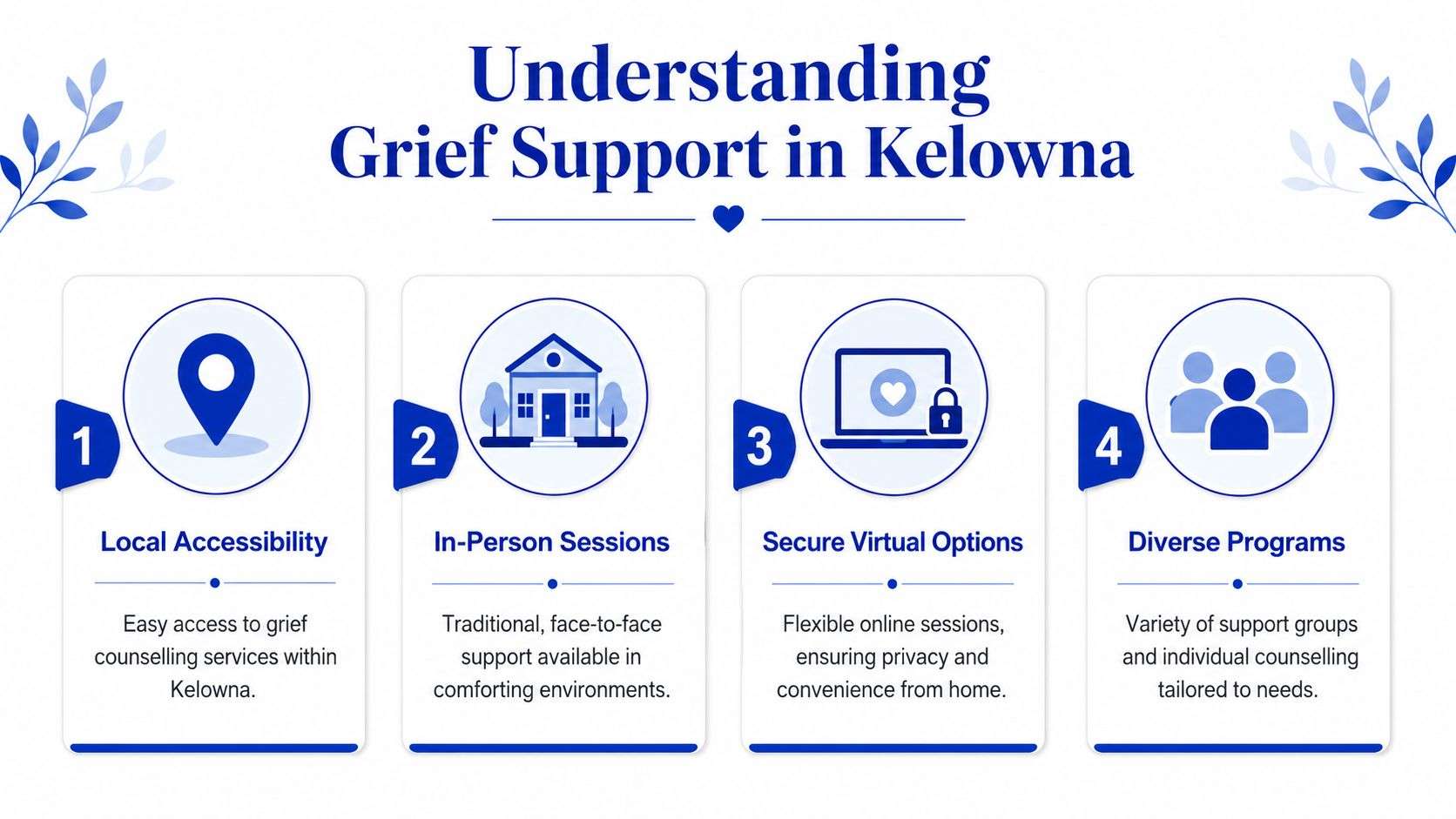
You may be sitting at your kitchen table, searching for help between phone calls, paperwork, missed work hours, and waves of grief that arrive without warning. In that moment, it can feel as if you need to find the one right service on your own. In Kelowna, grief support usually works more like a network of doors than a single doorway.
That matters because loss often creates practical strain alongside emotional pain. You may be trying to figure out time off, childcare, transportation, finances, or what kind of support fits a sudden death, traumatic loss, or pregnancy loss. Local care can help because it connects counselling with community services, referrals, and group programs instead of leaving you to piece everything together by yourself.
What the local network looks like
One helpful place to start is the Central Okanagan Hospice Association. It offers counselling for adults who have lost a loved one and runs structured 8-week grief groups. Its listings include spring 2026 groups for bereaved parents, mixed loss, and spousal loss. The same local guide also identifies RDCO/RCMP Victim Services in Kelowna as available Monday to Friday, 8 a.m. to 4 p.m. through Central Okanagan bereavement services.
Structure provides considerable reassurance in grief. It works a bit like having trail markers when you're exhausted. You still have to walk through the loss, but you do not have to guess where support exists.
In-person and virtual support
The format matters less than whether you can use it.
Some people do better with an office visit because leaving home creates rhythm and privacy. Others need phone or virtual care because they are drained, caring for children, managing work leave, recovering from a traumatic loss, or not ready to sit in a waiting room. A flexible option can also help if your energy changes from week to week.
If you're looking into professional options, many counselling services may include in-person, phone, and secure virtual care depending on what fits your situation.
Why local knowledge helps
Grief happens inside real life. It shows up in your job, your family, your faith, your body, and your bank account. That is one reason local knowledge can be so useful. A counsellor or program familiar with Kelowna and the Central Okanagan may better understand the pressure points around sick leave, community referrals, school routines, travel distance, or where to look for added help after a sudden or traumatic death.
Specialized support matters too. Someone dealing with pregnancy loss, overdose loss, suicide loss, or a death involving trauma often needs care that understands the shape of that grief, not only grief in general. The right support can make room for both the heartbreak and the practical reality of getting through the week.
Taking the First Step to Access Care
Reaching out for grief support can feel strangely hard. People often tell themselves they should wait until they're more composed, more certain, or more clearly "bad enough." Usually, waiting doesn't make the first step easier. It only means you're carrying it alone longer.
You don't need a perfect plan. You just need one small next move.
A simple way to begin
If you're thinking about counselling, start with the least overwhelming action:
- Write down what feels hardest. You might note sleep, panic, anger, guilt, numbness, parenting, work, or feeling unable to function.
- Decide what kind of support feels possible. One-to-one counselling, a grief group, or a first consultation may all be reasonable starting points.
- Use plain language when you reach out. A message can be as simple as: "I've lost someone important to me, and I'm looking for grief support."
- Ask practical questions if you need to. You can ask about format, availability, and whether the counsellor works with the kind of loss you're facing.
That is enough. You don't need to sound polished.
When grief also affects work and money
One of the least discussed parts of bereavement is the practical fallout. Grief can arrive at the same time as missed work, estate tasks, housing pressure, childcare changes, or sudden financial strain. Many people search for emotional support when what they really need is emotional support plus help understanding the next few practical steps.
In British Columbia, people may be entitled to up to three days of unpaid bereavement leave after the death of an immediate family member, and the province also points bereaved people toward Service Canada for possible death benefits and the BC Bereavement Helpline through the province's guidance on support after a death.
If your loss has affected your income, housing, caregiving, or ability to work, that does not make your grief less emotional. It means your grief is happening in real life.
What to say when you don't know what to say
People often freeze because they think they need to explain everything clearly. You don't.
Try one of these:
- "My loss has been harder than I expected."
- "I think I need support, but I'm not sure what kind."
- "The grief is mixed with other stress, and I'm struggling."
- "I need help with both the emotions and the practical impact."
Those sentences open the door. A good counsellor or support service can help with the rest.
Your Questions About Grief Counselling Answered
Some questions are hard to say out loud after a loss. They can feel too vulnerable, too confused, or too small to ask. They're not small.
Is my grief bad enough for counselling
If your loss is affecting your ability to function, think clearly, rest, connect, or feel steady, counselling may help. But even that isn't a strict test. You don't have to prove your pain.
People seek grief counselling for many reasons. Some feel shattered. Some feel numb. Some are managing daily tasks but sense that everything inside them has changed. All of those experiences are valid.
What if I'm not a big talker
You don't need to be eloquent to benefit from counselling. Many grieving people struggle to find words. A skilled counsellor won't expect a polished story.
You can bring fragments. You can say, "I don't know." You can talk about your loved one, your anger, your sleep, or the paperwork sitting on your kitchen table. Therapy can begin there.
Can counselling help with anger, guilt, or relief
Yes. Grief isn't limited to sadness. After a death, people may feel resentment, blame, regret, relief, confusion, or all of those in the same day.
These reactions often frighten people because they seem to conflict with love. Usually, they don't. They often reflect the full truth of the relationship, the circumstances of the death, and the strain of being human in an unbearable situation.
Some of the most painful parts of grief are the feelings people think they're not allowed to have.
How long does grief counselling take
There isn't one correct timeline. Some people need brief support around a recent loss or a specific crisis point. Others need longer-term counselling, especially when the grief is traumatic, layered, or tied to complicated family dynamics.
A more useful question is often: what do you need help with right now? If that answer changes, therapy can change too.
Is group support better than one-to-one counselling
Neither is automatically better. They help in different ways.
| Option | May be most helpful when |
|---|---|
| Group support | You want to feel less alone and hear from others with similar losses |
| One-to-one counselling | You need privacy, tailored pacing, or support for trauma and complex emotions |
| A combination | You want shared understanding and individual space |
Some people start individually, then join a group later. Others do the opposite. The best fit is the one that feels safe enough to use.
A Gentle Path Forward
Grief changes the shape of ordinary life. It can affect your thoughts, your body, your relationships, your work, and your sense of who you are now. None of that means you're doing grief badly. It means loss is real, and it asks a lot of a person.
Support can help make this season more bearable. Not by erasing love or removing pain, but by giving you steadier footing while you learn how to live with what has happened. For some people, healing also includes finding small ways to remember and honour the person who died. If that feels meaningful to you, ideas like how to create a memorial blanket can offer a tangible way to hold memory close.
You don't have to have the right words before seeking help. You don't have to wait until things are worse. If you're looking into grief counselling in Kelowna, it may be enough to admit that this is hard and that you could use support.
If you'd like to learn more about grief support, Interactive Counselling offers information about counselling options for people navigating loss, trauma, and major life changes in a safe, non-judgmental setting.
Clinically Reviewed By
Amy Mosset, MCP, RCC-S
Amy Mosset is a Master Practitioner in Clinical Counselling, Clinical Supervisor, and the owner of Interactive Counselling. She provides trauma-informed, evidence-based care and clinical supervision to registered therapists, with a focus on ethical practice, client safety, and high-quality therapeutic outcomes.