Grief counselling in Vernon is a supportive, professional relationship that helps you find your way through the pain of loss, offering a safe place to process what has happened and practical ways to keep moving through daily life. In Canada, 14 to 18% of bereaved adults experience prolonged grief symptoms that warrant professional help, yet only 25 to 30% of them access support, which means many people who are hurting never receive care that could help them steady themselves again. For more information, see our Vernon grief counselling.
Navigating the First Steps After Loss
It is often 11 p.m. when people start this search. The house is quiet, your phone screen is bright, and you are trying to work out one practical question through the fog. Who in Vernon can help me with this? For more information, see our counselling in Vernon.
Some people reach out days after a death. Others wait months because they are handling funeral details, paperwork, family tension, work demands, or an ICBC claim after a fatal crash. There is no correct timeline. The act of looking for support is a clear sign that something painful and important needs care. For more information, see our grief counselling.
"Grief counselling in Vernon helps you carry loss in a way that feels more survivable, more supported, and less lonely."

Early grief is often disorienting in very ordinary moments. You may answer one email, forget to eat lunch, cry in the grocery store, then feel embarrassed that you cannot manage simple tasks. Many grieving people also find themselves comparing options for support while they are exhausted. In Vernon, that usually means sorting through a few real choices. In-person sessions may feel steadier if leaving the house is still possible. Virtual sessions can be the better fit if driving, childcare, pain, work schedules, weather, or privacy make getting across town feel like too much.
The first step does not need to be dramatic. It needs to be manageable.
Start with what lowers pressure the fastest:
- Pick one form of support: one counsellor to contact, one intake call to book, or one trusted person to tell the truth to.
- Simplify this week: postpone tasks that can wait, and let other people handle errands, meals, or school pickups where possible.
- Cover the basics: water, food, medication, sleep, and a short walk are not small things in acute grief. They support a nervous system under strain.
- Gather key documents in one place: death-related paperwork, insurance information, and any ICBC claim details are easier to handle when they are not scattered.
- Choose the easier format first: if in-person feels like too much, start virtually. If home feels unbearable, meeting face-to-face may offer more structure.
For families dealing with a sudden death related to a motor vehicle accident, the counselling search can get tangled up with claim questions. People often ask whether sessions can be covered, what documents are needed, and whether they need to wait for approvals before getting help. Those are practical concerns, not signs that you are making grief too administrative. A good first contact with a counsellor or clinic should help clarify the process, including whether they have experience with ICBC paperwork and how virtual or in-person appointments are arranged.
Support can also look very simple in the first week or two. If you are caring for someone who is grieving and words keep failing you, a concrete gesture can reduce one small burden.
Treat your search for help as useful information. Something in you knows extra support may be needed, and that instinct deserves respect.
Understanding When Grief Needs More Support
Grief is a human response to losing someone important. It isn't an illness to be erased, and it doesn't follow a tidy schedule. It involves changing waves of sadness, disbelief, anger, longing, relief, confusion, and exhaustion. The intensity may shift from day to day, or hour to hour.
Grief is like an ocean; it comes in waves, ebbing and flowing. Sometimes the water is calm, and sometimes it is overwhelming.
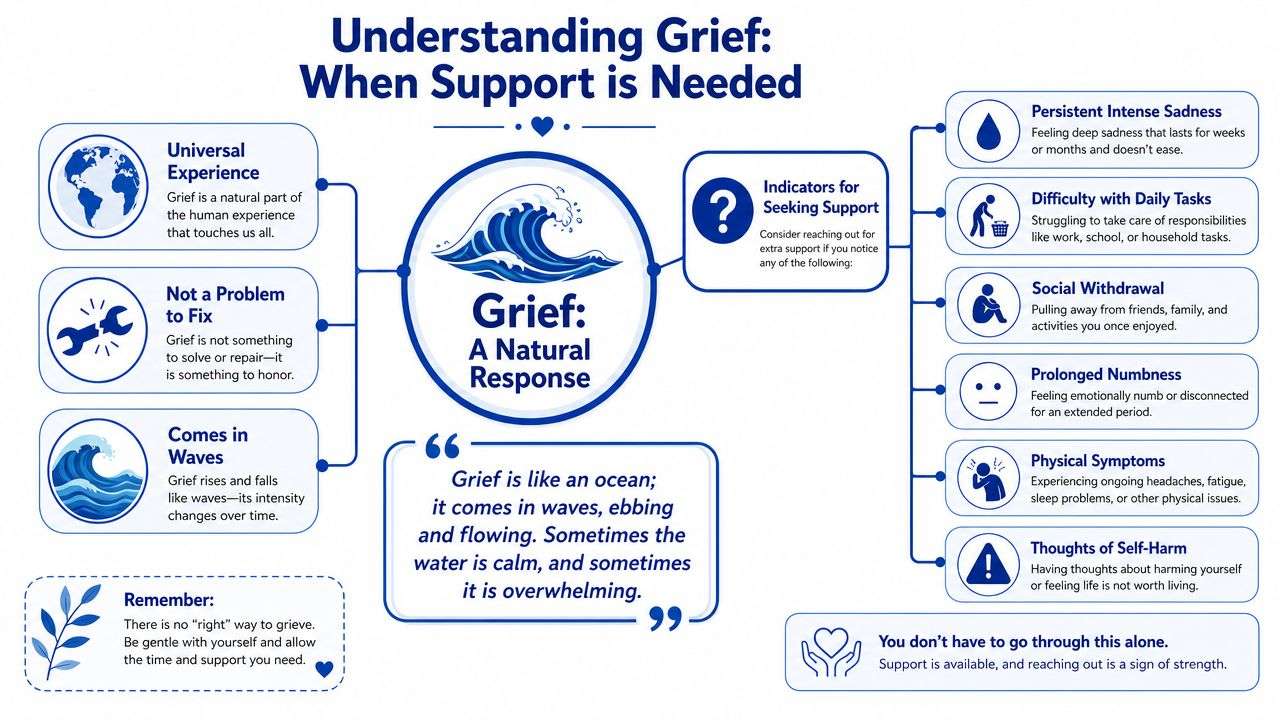
That said, there are times when grief asks for more than time, family support, or keeping busy. Professional support becomes especially useful when the loss is disrupting your ability to function, when emotions feel unmanageable, or when you're stuck in patterns that keep life very small.
Signs it may be time to reach out
You don't need a formal checklist, but these experiences are often meaningful indicators:
- Daily life feels consistently unworkable: Getting out of bed, eating, answering messages, or completing basic tasks feels persistently beyond reach.
- You feel trapped in the loss: Your mind circles the death constantly and can't settle, even briefly.
- Avoidance is taking over: You can't go near reminders, conversations, places, or belongings connected to the person who died.
- Your world has narrowed: You're withdrawing from people who matter to you and feeling increasingly cut off.
- Your body is carrying the strain: Sleep, concentration, energy, and physical tension are being heavily affected.
- You're having thoughts of self-harm or not wanting to be here: This needs prompt support and immediate attention.
Local support is there because the need is real
In the Vernon area, the North Okanagan Hospice Society alone provides over 500 individual grief counselling sessions annually and supports hundreds more through group activities, illustrating the significant local need and capacity for bereavement care (North Okanagan Hospice Society grief and bereavement services). That local reality helps normalise something many people struggle to admit. Grief support is not a fringe service. It's part of how communities care for people after loss.
If your grief feels confusing, intense, or too heavy to keep carrying in private, you don't need to wait until things get worse. Support isn't only for crisis. It can also help when you want steadier footing, better coping tools, or a place where you don't have to protect everyone else from what you're feeling.
What to Expect in a Grief Counselling Session
For many people, the hardest part is not the session itself. It's the uncertainty before the first appointment. People often wonder whether they'll be expected to talk the whole time, whether they'll cry uncontrollably, or whether the counsellor will analyse them instead of listening.
Most grief counselling begins more straightforwardly than that.
The first session
The first meeting usually focuses on understanding what happened, who you lost, what life looks like right now, and what feels hardest. You set the pace. Some people speak in detail right away. Others can only manage fragments. Both are okay.
A counsellor may ask about:
- the loss itself
- your relationship with the person who died
- current sleep, appetite, concentration, and daily functioning
- supports you do or don't have
- what you're hoping might feel different if counselling helps
You won't be asked to “perform” grief in a certain way. There is no correct amount of emotion. Some people cry. Some stay flat and numb. Some become very practical and talk mostly about logistics. Those are all recognisable grief responses.
Ongoing work often looks quieter than people expect
In later sessions, the work may include telling the story of the loss more fully, noticing moments that trigger intense waves, making space for complicated feelings, and finding ways to stay connected to the person who died without feeling swallowed by the absence.
A session might involve one or more of these:
- Making room for emotion: naming sadness, anger, guilt, relief, or fear without judging it
- Understanding patterns: noticing avoidance, overworking, social withdrawal, or feeling “stuck on alert”
- Building coping tools: using breathing, grounding, routine, or structured reflection to make hard moments more manageable
- Honouring the bond: creating rituals, memory practices, or ways of speaking about the person who died that feel real and sustaining
You are allowed to go slowly. Good grief counselling doesn't force disclosure before safety is there.
What grief counselling is not
It isn't about being told to “move on.” It isn't a place where someone tries to talk you out of loving who you lost. It also isn't just a place to retell painful details without direction.
Helpful grief work balances compassion with structure. It gives you a place to feel, remember, and speak openly, while also helping you function, connect, and regain some steadiness in the present.
Confidentiality is also part of what helps counselling feel safer. Within professional and legal limits, what you share is treated with care. That privacy can matter a great deal when friends or family are grieving too, or when you don't want to burden the people around you with every part of what you're carrying.
Evidence-Based Approaches for Healing
Grief counselling works best when it respects two truths at the same time. Loss is personal, and effective therapy still benefits from structured methods. A useful comparison is physiotherapy. A physiotherapist doesn't heal an injury by saying “tell me how your shoulder feels” every week with no plan. They use specific exercises, pacing, and reassessment. Grief counselling can work the same way.
Meaning-making can soften the sense that life stopped
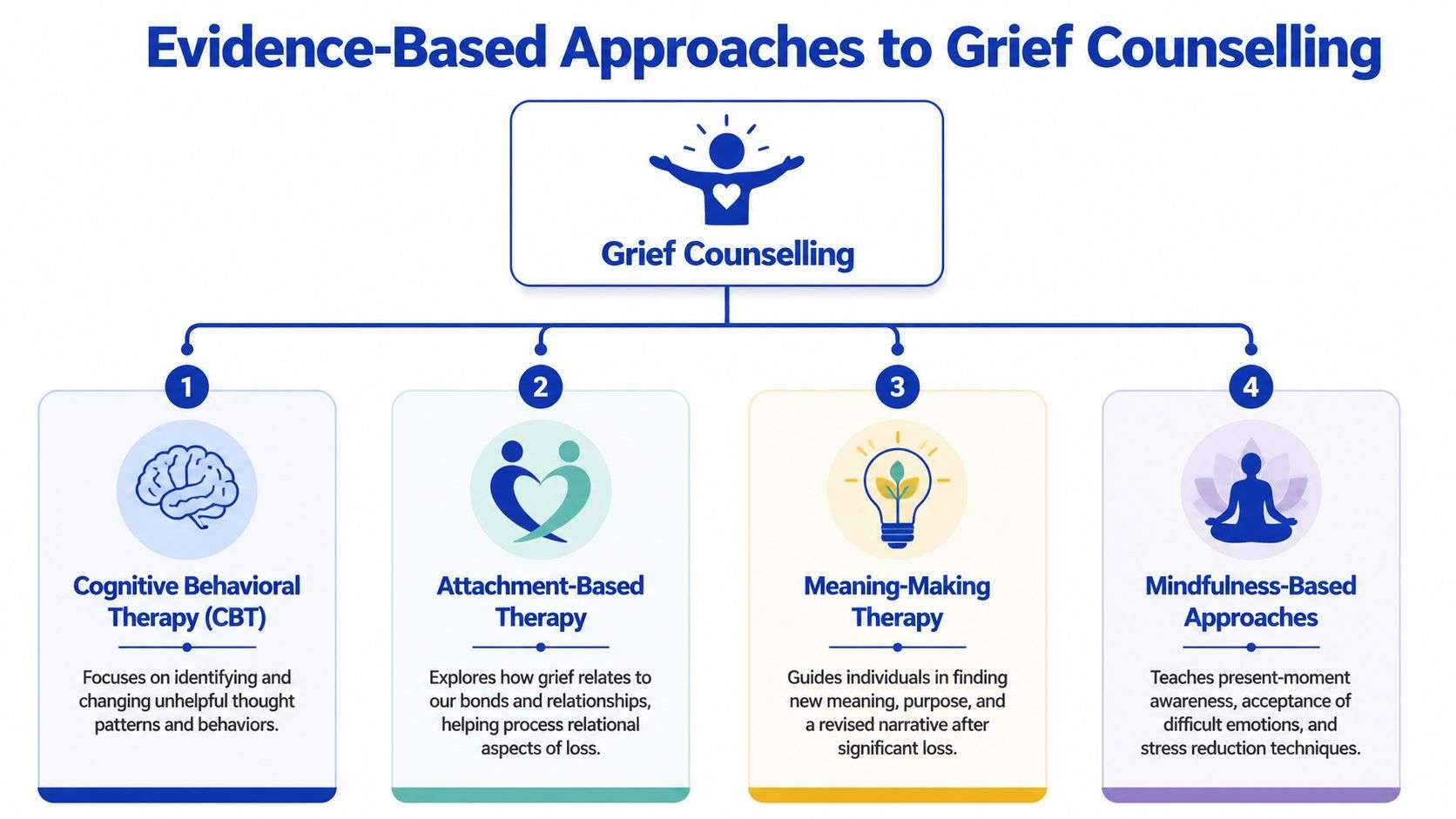
After a death, many people aren't only grieving the person. They're grieving the future they expected, the roles that changed, and the version of themselves that existed before the loss. Meaning-making approaches help people rebuild a workable narrative around what has happened.
That doesn't mean putting a positive spin on tragedy. It means slowly answering questions like:
- What has this loss changed in me?
- How do I continue this relationship in a new form?
- What values or commitments still matter now?
- What do I want my life to stand for while carrying this grief?
Canadian studies on grief counselling show that structured interventions, such as meaning-making frameworks delivered over several months, can reduce prolonged grief symptoms by 35 to 45%, demonstrating the effectiveness of evidence-based approaches.
CBT tools can help when grief gets tangled with fear or avoidance
Some grieving people start avoiding reminders of the person who died. Others get pulled into harsh thoughts such as “I should have done more,” “I can't survive this,” or “If I stop hurting, I'm betraying them.” In these situations, Cognitive Behavioural Therapy, often called CBT, can be useful.
A counsellor might help you:
- identify thoughts that deepen distress
- test whether guilt is accurate, incomplete, or distorted
- reintroduce avoided places, routines, or memories carefully
- rebuild daily structure when grief has collapsed motivation
Other approaches matter too
Attachment-based work can help when the loss shakes your sense of safety or belonging. Mindfulness-based approaches can help when emotions arrive fast and intensely, making it hard to stay grounded. These methods don't remove grief. They help you stay present enough to bear it without becoming overwhelmed by every wave.
Here is a simple comparison:
| Approach | Often helps with | What it may look like |
|---|---|---|
| Meaning-making | Loss of direction, identity disruption | Writing, reflection, memory work, values-based action |
| CBT | Guilt, avoidance, spiralling thoughts | Thought records, behavioural activation, gradual exposure |
| Attachment-based work | Intense longing, relational pain | Exploring the bond and the impact of separation |
| Mindfulness-based support | Emotional overwhelm, nervous system activation | Breathing, grounding, noticing without panic |
The best grief counselling isn't rigid. It draws from approaches that fit the person, the loss, and the stage of grief they're in.
How to Find the Right Grief Counsellor in Vernon
You may be sitting in your car outside a clinic in Vernon, or staring at a list of counsellors late at night, too tired to sort out who truly helps with grief and who only mentions it on a profile. That confusion is common. Grief already drains attention, patience, and energy. The search for support should be simpler than it often is.
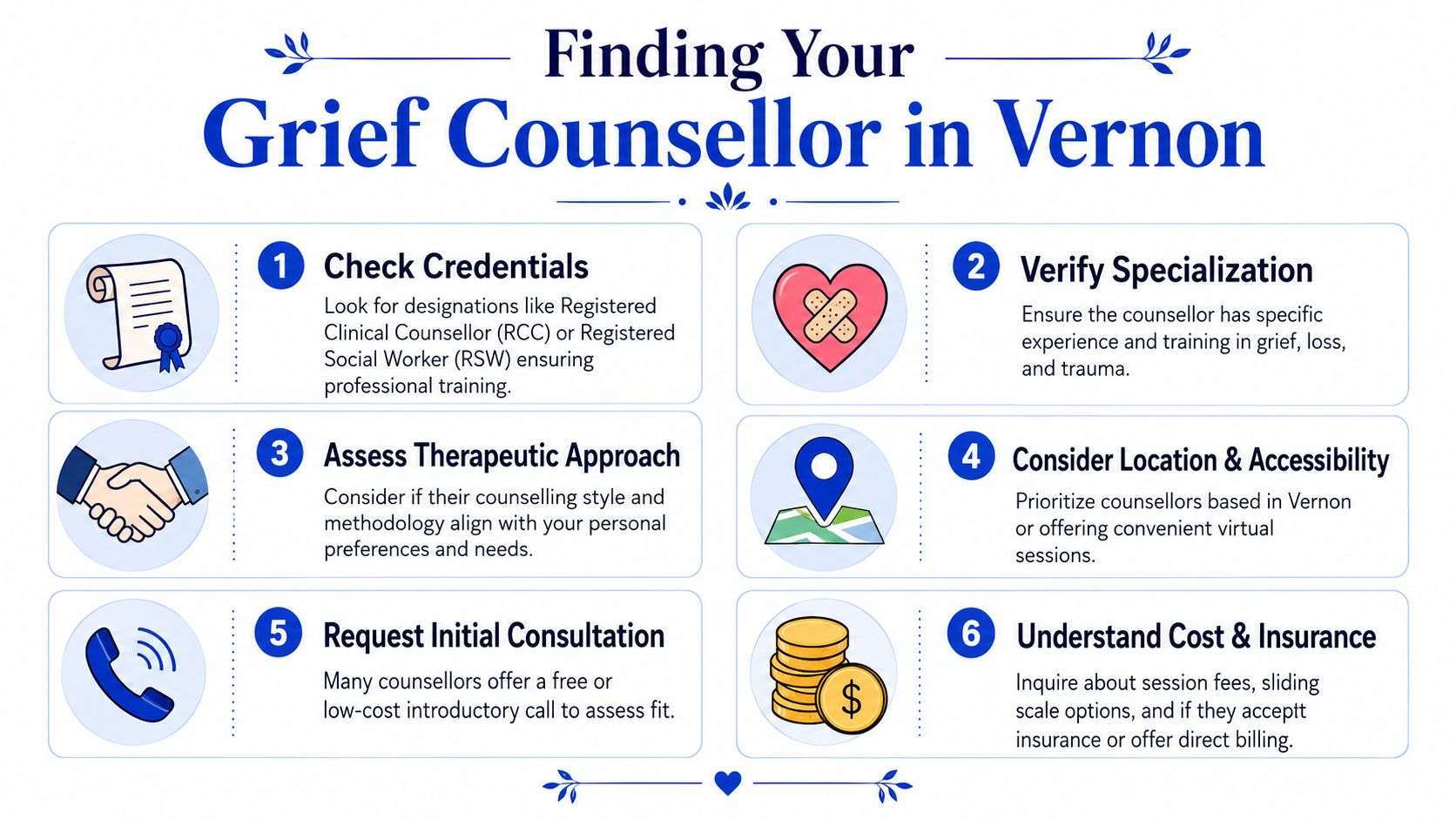
A useful starting point is to narrow your search to professionals with clear credentials and real grief experience. In BC, that often means a Registered Clinical Counsellor or Registered Social Worker. Credentials matter because they tell you the person works within professional standards, privacy requirements, and ethical oversight. After that, look for actual focus. Grief support is different from general supportive counselling. The work changes when the loss involved sudden death, trauma, estrangement, addiction, suicide, or several losses at once.
Fit matters just as much as training.
A counsellor can be skilled and still not be the right person for you. The first conversation should help you feel steadier, not rushed or managed. You do not need to perform your grief well. You do not need to tell the whole story. You are listening for signs that the counsellor can tolerate strong emotion, respect your pace, and answer practical questions clearly.
These questions often help:
- What kind of grief work do you do most often?
- Have you worked with sudden loss, traumatic loss, or complicated family situations after a death?
- What does a first session usually look like?
- Do you offer in-person, virtual, or phone appointments in Vernon or across BC?
- How do you respond if I become overwhelmed, shut down, or cannot talk much?
- Can you support children, teens, couples, or family members too, if needed?
Format is not a small detail. It affects whether you will attend.
In-person sessions can help if home feels chaotic, privacy is limited, or you need the structure of leaving the house and sitting in a room set aside for this work. Virtual sessions can be the better choice if driving across Vernon feels like too much, if you are balancing work or childcare, or if grief makes ordinary tasks feel heavy. Phone sessions can also be a good fit for people who find video too exposing or tiring.
Here is a practical comparison:
| Format | Often works well when | Potential trade-off |
|---|---|---|
| In-person | You want a contained space away from home and daily demands | Travel time, parking, weather, scheduling |
| Virtual | You need flexibility, easier access, or support from home | You need privacy and a stable internet connection |
| Phone | Video feels intrusive, or eye contact makes it harder to speak freely | Your counsellor has fewer visual cues to work with |
Local logistics matter more than people expect. A good counsellor on paper may still be the wrong fit if getting there feels impossible on a hard day. Ask yourself whether you can realistically attend when sleep is poor, motivation is low, or the anniversary dates start hitting harder. Reliable access often matters more than choosing the perfect profile.
If the death or injury was connected to a motor vehicle accident, ask whether counselling may be covered through an ICBC claim. Many people in Vernon do not realize this can be part of the conversation. It is worth raising early, because funding options can affect which type of help is realistic right now.
Group support can also be useful, either on its own or alongside individual counselling. Some people want private space first. Others feel relieved when they stop being the only person in the room who understands what grief has done to time, memory, sleep, or family life. There is no single right choice. The right choice is the one you can use consistently and authentically.
A good fit usually feels like this: you feel respected, your grief is not rushed, and the counsellor makes the process easier to understand. That is enough for a first step.
Frequently Asked Questions About the Process
Is my grief bad enough for counselling
Often, the answer is yes. You don't need to meet some invisible threshold before seeking support. Counselling can help when grief feels unbearable, but it can also help when you're functioning on the outside and falling apart on the inside.
People seek grief support for many reasons. Some can't stop crying. Some can't cry at all. Some are doing the paperwork, making dinners, and showing up to work while feeling absent from their own life. All of those experiences matter.
What if I don't want to talk about everything right away
You don't have to. Good grief counselling respects pacing. You can begin with what feels most immediate, such as sleep problems, panic in the evenings, anger, or the strain on your family. Trust usually builds over time, not on command.
Many people worry that starting counselling means opening every painful memory at once. It doesn't. A skilled counsellor helps you approach difficult material carefully, with enough support that you're not overwhelmed by it.
How long does grief counselling last
There isn't one fixed timeline. Some people want short-term support around a recent loss, a funeral, or a hard anniversary. Others need a longer process because the grief is complicated by trauma, family conflict, earlier losses, or the way the death changed daily life.
What's most useful is not chasing a perfect timeline. It's asking whether counselling is helping you feel more steady, more able to function, more connected, or more capable of carrying the grief without being consumed by it.
What if I cry the whole time, or don't cry at all
Both are normal. Crying doesn't mean you're too fragile for therapy. Not crying doesn't mean you didn't love the person enough. Grief shows up differently in different bodies and personalities.
A lot of people move between extremes. One session may be full of tears. Another may feel strangely practical or emotionally flat. That variation doesn't mean you're doing it wrong. It means you're human.
Can grief counselling help if the loss brought up old wounds too
Yes. Loss often reactivates earlier pain, unresolved trauma, childhood attachment injuries, or previous bereavements that were never fully processed. Sometimes people come in for one death and realise it's touching several other losses at the same time.
That doesn't make your situation too complicated for support. It means the work may need care, pacing, and a counsellor who can hold both present grief and older layers with skill.
Your Path Forward Through Grief
Grief changes the texture of daily life. It can make simple tasks feel heavy, relationships feel harder to manage, and the future feel much less certain than it once did. None of that means you're broken. It means loss has had a real impact, and your mind and body are trying to adapt to something painful.
Healing doesn't mean forgetting. It doesn't mean rushing toward closure or forcing gratitude before you're ready. More often, it means learning how to live with the absence in a way that allows room for love, memory, functioning, and eventually moments of steadiness again.
If the people around you don't understand what you're carrying, support from outside your immediate circle can help.
Seeking help is not a surrender. It's an act of care toward the part of you that is trying very hard to survive something significant. If you're looking for grief counselling in Vernon, the most important next step is often the simplest one. Let someone help you carry this.
When you're ready, learning more about your options can be a gentle and sensible way forward.
If you're considering support for grief, trauma, or another difficult life transition, Interactive Counselling offers a place to learn more about available counselling options, including in-person, phone, and secure virtual care.
Clinically Reviewed By
Amy Mosset, MCP, RCC-S
Amy Mosset is a Master Practitioner in Clinical Counselling, Clinical Supervisor, and the owner of Interactive Counselling. She provides trauma-informed, evidence-based care and clinical supervision to registered therapists, with a focus on ethical practice, client safety, and high-quality therapeutic outcomes.