You can look fine on the outside and still feel like you're running on empty. Maybe work still gets done, you keep answering texts, and nobody would guess you're carrying a constant edge of tiredness, irritability, or pressure in the background. That's often where men start thinking about counselling, not because life has fallen apart, but because something's not right anymore and pushing through hasn't fixed it. For more information, see our Kelowna depression counselling.
For a lot of men in Kelowna, that moment comes after weeks or months of sleeping poorly, snapping at family, zoning out at work, or feeling like rest doesn't restore anything. Support doesn't have to mean a crisis, and it doesn't have to mean talking endlessly about feelings you can't name yet. It can start as a practical conversation about stress, burnout, and what's draining your system.
What matters most is finding help that fits real life. That means understanding what burnout looks like, what counselling can do, and how to find support when local options are limited, waitlisted, or hard to fit around work and family. For more information, see our depression counselling.
Why Men in Kelowna Are Seeking Support for Stress and Burnout
A man in Kelowna might not describe himself as “struggling.” He might say he's just tired, short-tempered, flat, or not sleeping well. He's still working, still showing up, still taking care of everyone else, but the pressure has started following him home and sitting down beside him.
That's often where counselling starts to make sense. Not as a dramatic last resort, but as a place to sort through what's been building for too long. If you're trying to understand why stress management matters for recovery, why stress management matters for recovery is a useful companion piece because it frames stress as something that affects how the whole system recovers, not just how the mind feels in the moment.
Stress can look ordinary before it looks serious
Men often delay support because the early signs don't look “clinical.” They look like a shorter fuse in the kitchen, less patience with the kids, more scrolling, more work, or more drinking to take the edge off. The pattern can stay hidden because it still resembles functioning.
Counselling gives that pattern a name. It also gives you room to ask a more honest question, not “What's wrong with me?” but “What has been getting too heavy for too long?”
Practical rule: if you're still performing but you're no longer recovering, that's a good time to talk to someone.
Men's counselling is useful here because it doesn't have to begin with deep self-disclosure. It can begin with workload, sleep, relationships, anger, motivation, or the sense that you're running on fumes. That practical starting point is often what makes it workable for men who don't want therapy to feel vague or performative.
Recognizing the Signs of Stress and Burnout in Men
Burnout in men rarely shows up as one neat symptom. It usually arrives as a cluster, with body, mood, and behaviour all shifting at once. The key is not whether you can keep going, it's whether keeping going is starting to cost too much.
A Canadian workplace survey of 449 men found that only 15.3% had never experienced work burnout, while 45.0% reported burnout annually, 30.2% monthly, 15.9% weekly, and 5.5% daily, and the same study found strong links between burnout frequency and depression, anxiety, and suicidal or self-injury ideation (PMCID study). That matters because burnout isn't always a simple work problem. It can overlap with mood and safety concerns.
What burnout can look like day to day
A lot of men notice burnout in their routines before they notice it in their emotions. You might be sleeping, but waking up tired anyway. You might keep working, but the effort feels heavier than it used to. Even normal demands, a staff meeting, a school pickup, a conversation with a partner, can feel oddly expensive.
Burnout often shows up as:
- Physical strain: tension in the jaw, headaches, poor sleep, or a body that never quite settles.
- Emotional narrowing: irritability, numbness, impatience, or feeling detached from people you care about.
- Behaviour changes: withdrawing, working longer, drinking more, or avoiding anything that asks for more energy.
- Mental load: trouble concentrating, second-guessing decisions, or feeling behind before the day starts.
A helpful way to think about burnout is that it often starts with too much demand and too little recovery. The BC article on self-awareness and burnout prevention, preventing burnout through self-knowledge, fits well with that idea because men often need clearer awareness of their own warning signs before they can change course.
Burnout is not the same as depression, anxiety, or trauma
Burnout can resemble depression because both can involve exhaustion, low motivation, and withdrawal. It can resemble anxiety because both can involve tension, overthinking, and a sense of being on edge. It can also overlap with trauma when the nervous system stays braced for pressure long after the original stressor has passed.
The difference is usually in the pattern. Burnout often tracks to workload, role strain, caregiving pressure, or chronic overextension. Depression tends to affect enjoyment, self-worth, and mood more broadly. Anxiety often brings persistent worry and a sense of threat. Trauma can involve triggers, hypervigilance, or feeling unsafe in ways that don't match the immediate situation.
That's why counselling shouldn't treat burnout as a stand-alone label and stop there. If you're exhausted, irritable, and withdrawing, a good therapist will look for what else is happening underneath.
Evidence-Based Therapy Approaches That Work for Men
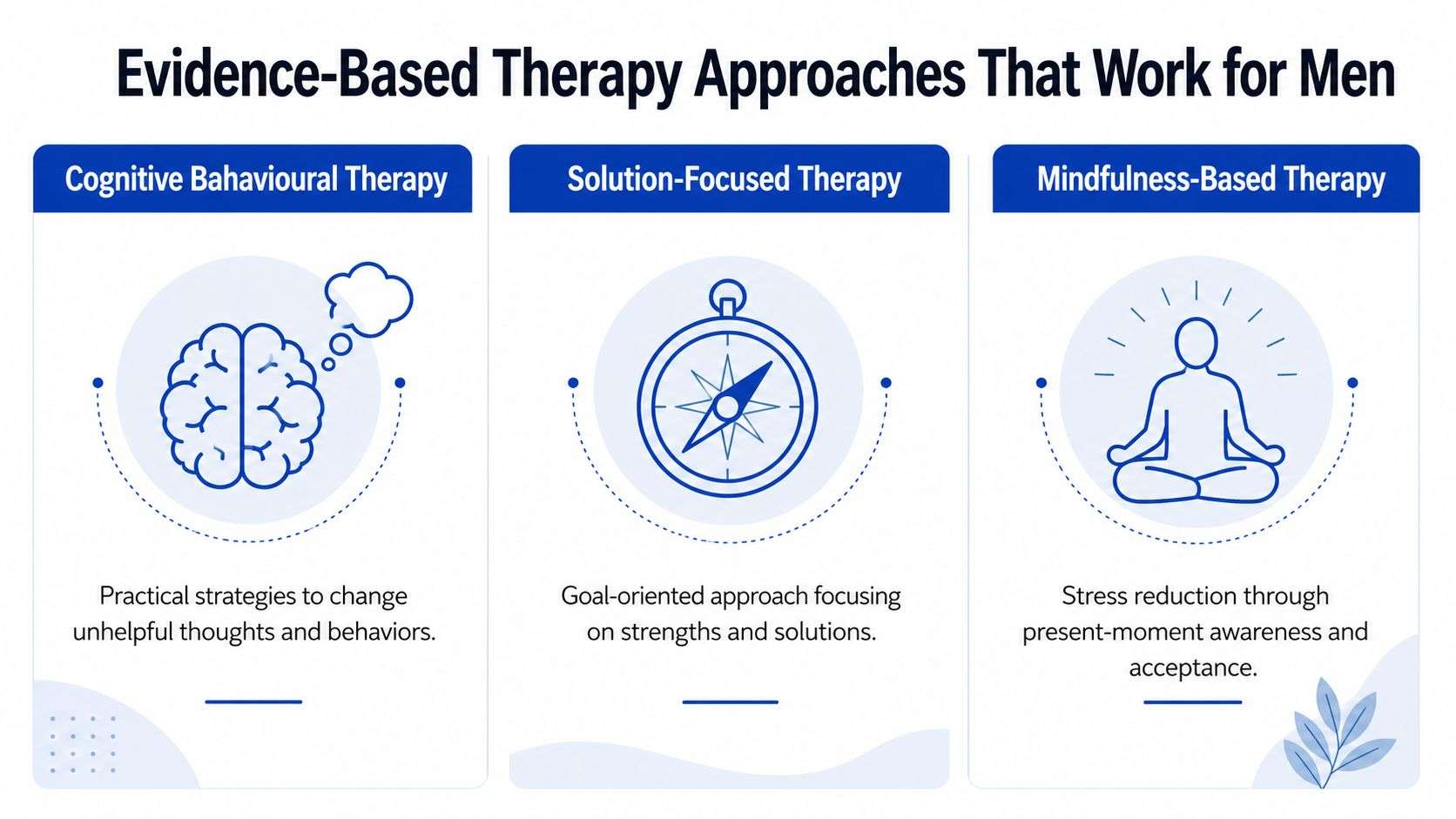
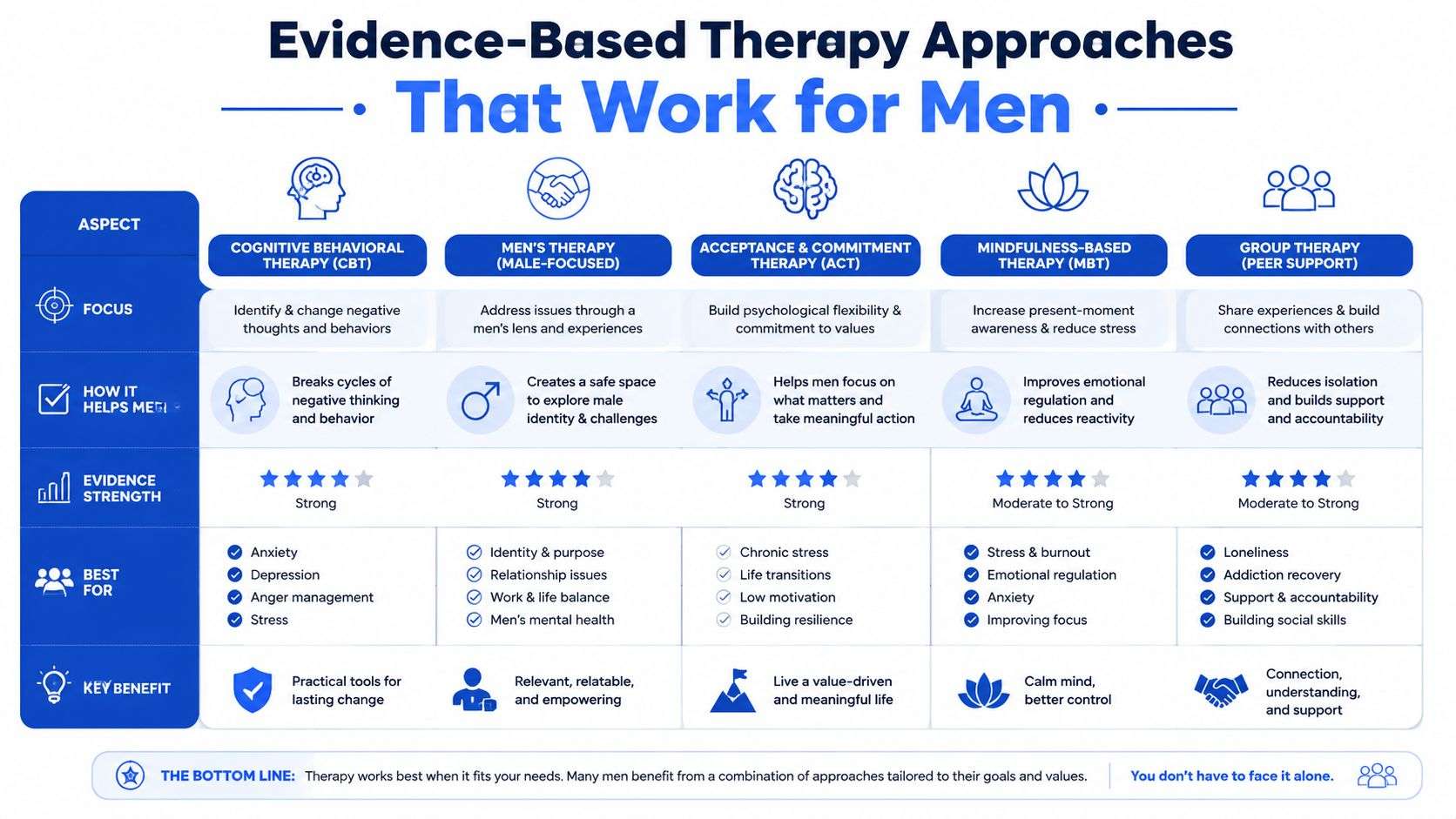
Men usually don't need therapy that feels mysterious. They need something that makes sense fast enough to use in real life. The good news is that several evidence-based approaches fit that style well, especially when stress and burnout are tangled up with work pressure, relationships, or self-criticism.
CBT gives you something concrete to work with
Cognitive Behavioural Therapy, or CBT, helps you notice the thoughts that keep stress stuck in place. If your mind keeps saying, “I should be handling this,” or “If I slow down, everything will fall apart,” CBT helps you test whether those thoughts are helping or hurting.
A useful analogy is debugging code. You're not blaming the computer, you're finding the line that keeps producing the same error. CBT is often a good fit for men who want practical steps, homework, and a clear sense of progress.
ACT helps you move even when emotions are messy
Acceptance and Commitment Therapy, or ACT, focuses on acting in line with your values, even when stress, fear, or frustration are present. That doesn't mean liking the discomfort. It means not letting discomfort make every decision for you.
If CBT is debugging, ACT is learning to drive in bad weather. You still check the road, keep your hands on the wheel, and move toward where you need to go. Men who feel stuck between overcontrol and shutdown often find ACT useful because it respects difficult emotions without turning therapy into a debate about whether those emotions are allowed.
Solution-focused work builds on what's already working
Some men do better when therapy starts with what's already there. Solution-focused counselling looks for exceptions, small wins, and patterns that already show some resilience. Maybe you do better on days when you leave work on time, or when you hit the gym before checking email, or when you have one honest conversation with your partner.
That's one reason a practical guide like the practical guide to healing can be a useful companion. It fits the idea that recovery usually comes from repeatable habits, not a single breakthrough.
Good therapy doesn't force one style on every man. It matches the approach to the person, the stressor, and the pace he can actually sustain.
What to Expect in Your First Counselling Session
The first session is usually less dramatic than men expect. Most of the time, it starts with a conversation about what brought you in, what's been getting harder, and what you'd like to be different. You do not need the perfect explanation.
A first appointment often feels awkward for about five minutes, sometimes longer. That's normal. You may not know where to start, and a therapist who works with men will usually expect that.

The first conversation is about fit, not performance
A therapist will usually ask some basic questions about sleep, stress, work, relationships, coping habits, and any history that might matter. You can answer briefly. You can also say, “I'm not sure how to talk about this yet,” and that's enough to begin.
Confidentiality is part of the process too. A counsellor should explain what stays private and any exceptions related to safety. That matters because men often hold back until they know the room is actually safe.
Practical rule: you're not being tested, you're checking whether this person can help.
The first session is also your chance to assess the therapist. Do they speak plainly? Do they seem to understand burnout without making it sound like a character flaw? Do you feel more understood by the end than you did at the beginning? If not, that doesn't mean therapy failed. It may just mean the fit isn't right.
A good counsellor won't expect instant trust. They'll expect a real person with a real load on his shoulders.
Counselling Options and Access in Kelowna
Access matters as much as insight. If a man can only attend at the end of a long workday, or if privacy at home is limited, the format of counselling may decide whether he books at all. In Kelowna, the practical question is often not “Should I get help?” but “What can I realistically access this week?”
The local area includes in-person, secure virtual, and phone-based options. Some services also offer evening or weekend availability, which can make a difference for shift workers or anyone who can't leave work in the middle of the day. Interactive Counselling's Kelowna clinic, for example, says sessions are available in-person, by secure online video, or by phone, seven days a week, with open hours from 8:00 AM to 9:00 PM, and that same-week appointments usually are available; the address listed is 2009 Enterprise Way Unit I, Kelowna, BC V1Y 8G6. The clinic also states that individual sessions start at $165 and couples sessions at $175 per 50-minute session (Interactive Counselling Kelowna counselling).
Different formats solve different problems
In-person counselling can help if you want a private space away from home or work. Virtual counselling can make attendance easier if your schedule is tight or you're guarding your privacy. Phone sessions can be a lower-friction option if video feels like too much on a hard day.
Kelowna also has more limited local supports that may be waitlisted or not currently available. A Central Okanagan men's support group listing is marked not currently accepting referrals and shows a waitlist for Fall 2025, while another directory notes no in-person male therapists currently available in the city (Central Okanagan Pathways listing). That's a real access issue, not a personal failure.
Practical options can include coverage after an accident
If stress followed a motor vehicle accident, ICBC-funded counselling may be relevant. That can matter because burnout symptoms, sleep disruption, irritability, and avoidance sometimes show up after physical or psychological strain, not just after workload pressure. If you're sorting out where to start, it helps to ask directly whether a service supports ICBC claims, virtual appointments, or after-hours bookings.
The useful question in Kelowna is not which format is “best” in theory. It's which one you can attend consistently without adding more stress.
Practical Steps to Find and Book the Right Support
Finding the right counsellor gets easier when you know what to look for. Start with registration. In BC, many people look for an RCC or RCC-S designation because that tells you the therapist is professionally registered and accountable to standards of practice.
Then look for experience that matches the problem you're bringing in. A counsellor who works with men's issues, stress, burnout, workplace overwhelm, relationship strain, or trauma will usually understand the way these concerns can hide behind overworking, irritability, or shutdown.
A short checklist can keep the search manageable
- Check the credentials: Look for RCC or RCC-S, and confirm the therapist is active and in good standing.
- Read the focus areas: Search for men's counselling, burnout, stress, anger, high pressure jobs, or trauma-informed care.
- Ask about format: Find out whether they offer in-person, video, or phone sessions.
- Ask about timing: Evening or weekend appointments can make the difference between “someday” and “this week.”
- Notice your response: If the therapist sounds rushed, vague, or dismissive on a consult call, keep looking.
Some men prefer a highly structured approach. Others want a therapist who is more conversational but still direct. Either can work, as long as the sessions stay useful and grounded in your actual life.
If the first counsellor isn't the right fit, that isn't wasted effort. It's information. You're allowed to move on and try someone else without treating that as a setback.
A brief call, email, or booking form is often the hardest part. After that, you're not carrying it alone anymore.
Common Questions Men Ask Before Starting Counselling
Do I need to be in crisis before I start?
No. Counselling can help when you're overwhelmed, stuck, angry, withdrawn, or just not feeling like yourself. Waiting until everything falls apart usually makes the work harder, not easier.
How long does it take to notice a difference?
That depends on what you're carrying and what kind of support you need. Some men feel relief just from naming the problem clearly, while deeper patterns take longer to shift. The important part is that counselling should give you something useful to work with, not just another conversation.
Will anyone find out what I say?
Confidentiality is a core part of counselling. Your therapist should explain the limits clearly, including safety-related exceptions. If privacy is one of your biggest concerns, ask about it before you book.
What if my partner or family wants me to go?
You can still make it your decision. External pressure doesn't cancel the fact that you're allowed to want support for your own reasons. Therapy works better when you can speak openly, even if someone else suggested the first step.
Does asking for help mean I'm weak?
No. It usually means you've recognized that carrying everything on your own isn't working. Men often benefit from therapy precisely because they've been strong for too long without enough support.
If you want practical, private support for stress, burnout, or the weight that's been building in the background, Interactive Counselling offers in-person, phone, and secure virtual sessions in Kelowna. If you're ready to talk with someone who can help you sort through what's been draining you, visit Interactive Counselling to learn more and choose the next step that feels manageable.
Clinically Reviewed By
Amy Mosset, MCP, RCC-S
Amy Mosset is a Master Practitioner in Clinical Counselling, Clinical Supervisor, and the owner of Interactive Counselling. She provides trauma-informed, evidence-based care and clinical supervision to registered therapists, with a focus on ethical practice, client safety, and high-quality therapeutic outcomes.