When you lose someone you love, the world can suddenly feel foreign and isolating. It’s a profound, personal journey, but for some, it becomes a place where they feel permanently stuck. If it feels like your life stopped the day they died and you just can't seem to get it started again, please know you are not alone in this. For more information, see our grief counselling.
Complicated grief, now more formally known as Prolonged Grief Disorder (PGD), is what happens when the acute, intense pain of mourning doesn't fade with time, remaining so debilitating that it prevents you from adapting to the reality of life without your loved one.
This guide is here to help you understand what happens when the pain of loss digs in its heels and refuses to soften. We’ll look at how this experience, Prolonged Grief Disorder (PGD), is different from the more typical path grief takes, and shine a light on the proven ways you can find your way back to a life with meaning.
Grief is a universal, if unwelcome, part of the human experience. For most of us, the sharpest, most unbearable pangs of loss do begin to soften over the months and years. The sadness doesn't vanish, but it changes. It becomes something we learn to carry, allowing us to hold onto our loved one's memory while re-engaging with our own life.
But for a notable minority—roughly 7-10% of bereaved adults—that natural healing process gets derailed. Instead of easing, the grief stays raw, persistent, and completely consuming. This is the heart of complicated grief. It's not a personal failing or a sign of weakness. It's a very specific, recognized condition where the mind and heart haven't been able to adapt to a new reality.
Think of it like a deep physical wound. In a typical grieving process, the wound slowly knits itself back together, leaving a scar that you learn to live with. With complicated grief, it's as if the wound stays open, raw, and infected, causing constant pain and preventing any real healing from happening.
What Is Complicated Grief and How Does It Feel?
Beyond any clinical definition, what truly matters is what complicated grief feels like day-to-day. It’s the lived reality of being trapped in an emotional state that disrupts every corner of your life.
People navigating complicated grief often describe feeling:
- An intense, persistent yearning or longing for the person who died.
- That a part of them died right alongside their loved one.
- A profound sense of disbelief, as if they can't accept the loss is real.
- An overwhelming need to avoid any reminders of their loss, or, on the flip side, an inability to stop focusing on it.
Our goal here is to offer clarity and, most importantly, hope. Support is available to help you navigate this incredibly difficult journey. Learning how to deal with grief is a unique process for everyone, and understanding its different forms is a powerful first step toward healing.
Distinguishing Between Grief and Complicated Grief
Grief is a universal human experience, a messy and painful journey we all navigate after a loss. It’s the heart's natural response to losing someone or something we love. While incredibly difficult, the initial, acute pain usually softens over time, changing shape as we learn to live with our loss.
But what happens when that pain doesn’t ease? When the sharp edges of bereavement remain, and the world stays grey? This is where we start talking about complicated grief.
It isn’t a sign of weakness or a reflection of how much you loved someone. It’s a recognized condition where the natural grieving process has hit a roadblock. Think of it like this: typical grief is like being caught in a storm at sea. The waves are huge and terrifying at first, but eventually, the storm passes. You learn to navigate the swells, find moments of calm, and slowly make your way back to shore.
Complicated grief, on the other hand, feels like being caught in a powerful undertow, constantly being pulled beneath the surface, unable to catch your breath.
The image below shows this journey. While everyone starts in a place of pain and feeling lost, those with complicated grief can get stuck there, unable to move toward healing and renewal.
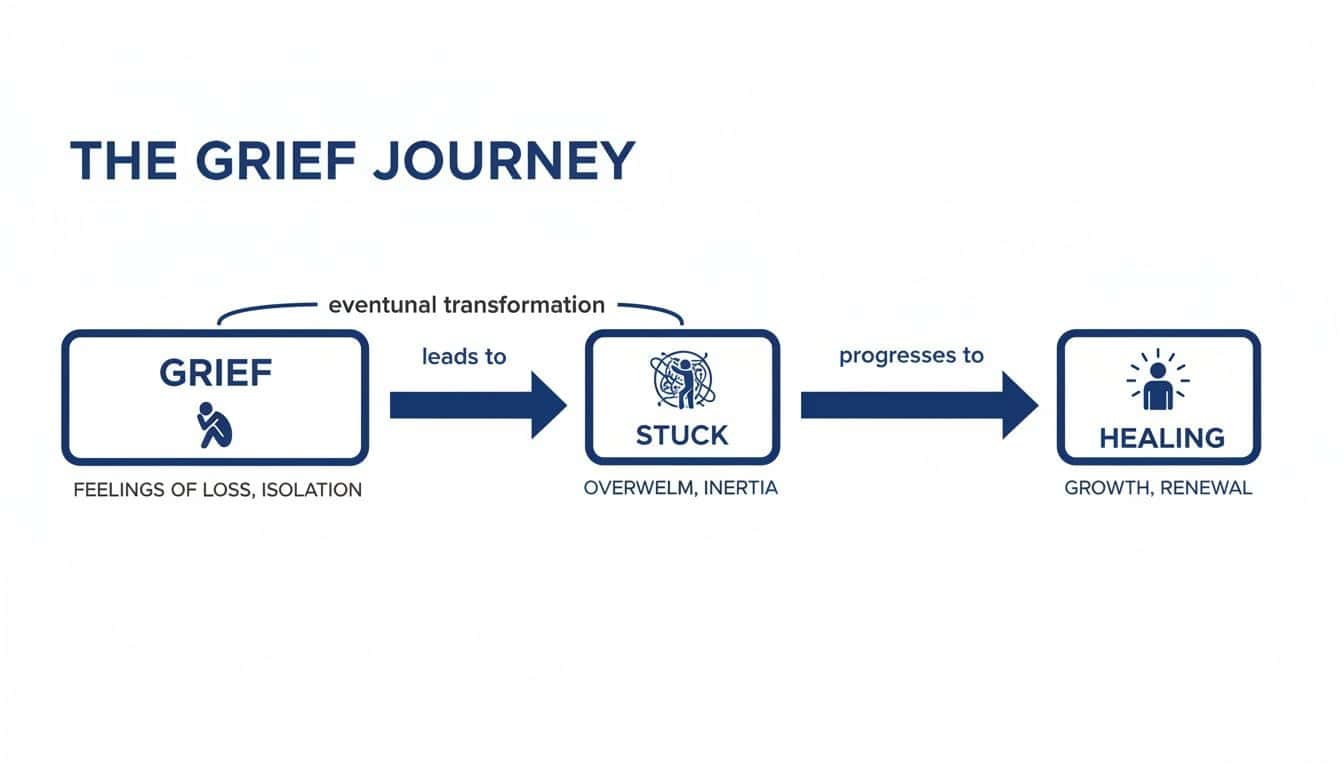
As you can see, getting stuck prevents the forward movement that is essential for adapting to a life after loss.
The Trajectory of Grief and Time
One of the clearest differences between typical grief and complicated grief is the path it takes over time. With typical grief, the intense feelings of sadness, yearning, and pain tend to come in waves. As weeks and months pass, these waves usually become less frequent and less overwhelming, creating space for positive memories and a gentle re-engagement with life.
With complicated grief, this doesn't happen. The grief remains as raw and intense as it was in the first few days after the loss. It feels like you're frozen in time, with the pain staying sharp and relentless for a year or longer.
Grief vs. Depression: A Common Point of Confusion
It’s also incredibly important to tell the difference between complicated grief and major depression. They can look similar on the surface, with shared symptoms like deep sadness and pulling away from others, but their core focus is distinct.
Depression is often a pervasive cloud of low mood, emptiness, and a loss of interest in almost everything. In contrast, with complicated grief, the intense emotional pain is specifically tethered to the person who died. Someone might be able to imagine feeling joy, but only in the impossible scenario of their loved one returning. Their longing is exclusively for that person.
Sometimes, a loss can be foreseen, but that doesn't always lessen the blow. If you're currently supporting a loved one through a terminal illness, you might find our guide on anticipatory grief and coping strategies to be a helpful resource.
To make these distinctions clearer, we've put together a table comparing the common characteristics of typical grief, complicated grief, and depression. Please remember this is for informational purposes and is not a substitute for a professional diagnosis.
Comparing Typical Grief, Complicated Grief, and Depression
| Symptom/Characteristic | Typical Grief | Complicated Grief (PGD) | Major Depression |
|---|---|---|---|
| Primary Emotion | Sadness and yearning that come in waves and gradually soften over time. | Intense, persistent longing and emotional pain focused on the deceased. | Pervasive sadness, emptiness, and loss of interest in most or all things. |
| Self-Esteem | Self-esteem usually remains intact, though guilt about specific actions may be present. | May involve intense guilt or self-blame related to the loss or the deceased. | Often includes feelings of worthlessness and self-loathing unrelated to a loss. |
| Response to Support | Can accept comfort and support from others, even while in deep pain. | Often leads to withdrawal from social support systems and increased isolation. | Characterized by social withdrawal and an inability to feel pleasure or connection. |
| Future Outlook | The ability to imagine a future with happiness and meaning returns gradually. | Difficulty imagining a meaningful future without the person who has died. | A general sense of hopelessness about the future, not specifically tied to one person. |
| Duration & Impact | The most acute symptoms lessen over months, allowing for a return to daily life. | Symptoms remain intense for a year or more, significantly disrupting daily functioning. | Symptoms must be present for at least two weeks and cause significant distress. |
Understanding these nuances is the first step toward finding the right kind of support. While grief, PGD, and depression can feel isolating, recognizing what you're experiencing helps illuminate the path toward healing.
Recognizing the Signs of Complicated Grief
Figuring out what you're feeling is the first real step toward finding a path forward. When we talk about recognizing the signs of complicated grief, it isn't about slapping a label on your pain. It's about giving your experience a name, validating that what you're going through is real, and seeing that specialized support can make a difference. These signs aren't a measure of your strength; they're simply signals that your natural grieving process has hit a roadblock and needs some gentle, focused help to get moving again.

The signs of complicated grief tend to show up in a few core areas of your life, reflecting just how deeply the loss has shaken both your inner world and your day-to-day reality.
Persistent and Intense Yearning
If there's one hallmark of complicated grief, it's this. This isn't just missing someone. It’s a constant, gut-wrenching ache for the person who died—a deep, persistent longing that just won’t quit.
This yearning doesn’t eventually settle into the background of your life. Instead, it stays front and centre, making it feel almost impossible to concentrate on anything else. It can feel like a physical pull toward them, an endless loop of thoughts about them, or an intense pining for their return, even when you logically know it’s impossible.
Profound Emotional Pain
While all grief brings profound sadness, the emotional pain of complicated grief stays incredibly sharp and raw. It doesn't soften into manageable waves over time but remains acute and debilitating, feeling as fresh as it did in the first days after the loss.
This can show up in a few different ways:
- Intense sorrow and pain about the death that never seems to lessen.
- Deep-seated bitterness or anger about the loss that just won’t fade.
- A pervasive sense of numbness or detachment, leaving you feeling disconnected from yourself and everyone around you.
- Overwhelming guilt or self-blame tied to the death or your relationship with the person. You might get caught up in the painful differences between guilt vs. shame and how they are shaping your grief.
These emotions can be incredibly isolating, making you feel like no one on earth could possibly understand the depth of what you're feeling.
Struggles with Accepting the Reality of the Loss
A natural part of grieving is gradually, painfully, coming to terms with the finality of death. With complicated grief, that process stalls out.
You might find yourself wrestling with:
- A persistent sense of disbelief, as if you just can't wrap your head around the fact that your loved one is truly gone.
- Difficulty recalling happy memories without being immediately ambushed by the pain of the loss.
- An intense fixation on the "how" and "why" of the death, getting stuck on the details of their final moments.
This is different from the initial shock everyone feels. It's a prolonged state of being unable to integrate the reality of their absence into the fabric of your life.
Significant Disruption to Your Life
Maybe the most telling sign of complicated grief is the way it fundamentally disrupts your ability to live your life—and that disruption doesn't get better over time. It’s as if a bomb went off in your world, and the dust just never settles.
This can look like:
- Feeling that life is utterly meaningless or empty without your person.
- Being unable to engage in activities you used to enjoy or even think about the future.
- Pulling away from friends, family, and your community, feeling completely alone and cut off from the very people who want to help.
- A profound loss of identity, as if a part of you died right alongside the person you lost.
The impact of this is huge. Unfortunately, in Canada, grief services can be fragmented, and a widespread lack of understanding leaves many people without the help they need when they need it. This gap is a key focus of national action plans calling for better public health approaches to bereavement care. You can learn more about these public health recommendations and the wider impact of grief by exploring the findings on grief support in Canada.
If these signs feel all too familiar, please know that you are not alone, and that real, effective help is out there.
Understanding the Risk Factors for Complicated Grief
Why does grief get "stuck" for some people, while others seem to move through it? It's a question many of us ask, often with a quiet sense of self-blame. The most important thing to understand is that developing complicated grief is never a personal failing. It’s almost always a response to an overwhelming combination of circumstances that short-circuit our natural ability to heal.
Learning about these risk factors isn't about creating a checklist for pain or assigning blame. It's about finding compassion for your own experience. When you see how certain situations can make grieving harder, it helps to validate what you're feeling. It's a powerful reminder that you aren’t broken—you are simply a human being reacting to an immense loss.
The Circumstances of the Loss
The way someone died can profoundly shape the path your grief takes. A peaceful passing after a long, well-lived life is one thing. A sudden or violent death is something else entirely.
Circumstances that can make grief far more complex include:
- A sudden, unexpected, or violent death: Events like accidents, suicides, or homicides rob you of any chance to prepare. They often leave behind a layer of trauma, a deep sense of injustice, and a relentless search for answers that can keep your mind locked on the moment of the loss.
- The death of a child: This is often seen as one of the most devastating losses anyone can face. It goes against the natural order of things and carves out a void that feels impossible to fill.
- A loss that feels preventable: If you find yourself thinking the death could have been avoided, it can open the door to intense anger, bitterness, and a debilitating cycle of "what if" scenarios that block the path to healing.
Your Personal History and Support System
Your own life experiences and the people you have around you also play a huge role. If you have a history of trauma, depression, or anxiety, you might be more vulnerable to complicated grief. It's as if your emotional reserves are already running low when the loss hits.
Likewise, the strength of your support network acts as a crucial buffer. Feeling isolated or lacking friends and family who can offer both practical and emotional comfort can make the weight of grief feel truly unbearable. Even how you learned to form attachments in childhood can influence how you cope with loss as an adult. Our guide on how childhood emotional neglect shapes adult attachment explores this connection in more detail.
Major Societal Disruptions
Sometimes, huge external events can steal the very rituals our society has built to help us process loss. The COVID-19 pandemic is a stark, recent example of this. It isolated countless Canadians and disrupted essential grieving practices like funerals, memorial services, and family gatherings.
This disruption had a real, measurable impact. The Canadian Grief Alliance warned that our country's grief services were simply not ready for this wave, which was made worse by widespread isolation and overwhelmed systems. To learn more, you can read the BC Centre for Palliative Care's report on grief and bereavement.
Finding Your Pathway to Healing From Complicated Grief
If you’re seeing your own story in the description of complicated grief, please know this: there is so much hope. Healing is absolutely possible, and there are proven, compassionate ways to help you find your footing again. It’s never about "getting over" the person you lost, but about finding a way to carry their memory that allows you to reconnect with life.

The path forward is about learning to integrate the reality of what happened, gently work through the most painful emotions, and build a future that honours your loved one while also making space for you. Let's walk through the treatments and strategies that can guide you there.
The Central Role of Specialized Psychotherapy
While the support of friends and family is invaluable, the tangled nature of complicated grief often needs a different kind of support. Psychotherapy, especially approaches designed specifically for this experience, is widely seen as the most effective path to healing.
A therapist creates a safe, confidential space where you can unpack everything without worrying about burdening others or hearing that you "should be over it by now." A big part of the work is helping you build a bridge from your past with your loved one to a future that feels meaningful again.
Therapy for complicated grief isn’t about trying to forget. It’s about learning to remember in a way that brings warmth instead of just raw pain.
What to Expect From Grief Counselling
The idea of starting therapy can feel overwhelming, but the process itself is gentle and collaborative. A good counsellor will meet you right where you are, helping you to:
- Tell the story of your loss: You’ll have the space to talk about the person who died, the circumstances, and the depth of your pain—all at a pace that feels right for you.
- Process painful emotions: A therapist can guide you as you work through intense feelings like guilt, anger, or deep sadness that might be keeping you stuck.
- Reconnect with positive memories: Therapy helps you find a way to access the warm, happy memories without them being immediately swamped by the pain of the loss.
- Rebuild your identity: Together, you’ll explore who you are in the wake of this loss and find ways to build a life that honours both your past and your future.
The goal is always to help you move forward with your grief, not leave it behind. We work to transform it from a source of constant, sharp pain into a cherished part of your story that you carry into a future that has purpose and joy.
Self-Help Strategies to Complement Professional Support
While therapy is a powerful tool, there are many things you can do on your own to support your healing. These strategies can help you process your feelings, stay grounded in the present, and gently reconnect with yourself.
Engaging in therapeutic grief activities can also provide constructive outlets for coping with the persistent pain.
Here are a few powerful strategies to try:
- Mindful Journaling: Writing down your thoughts, memories, and struggles without any judgment can be a huge emotional release. It's a private space to be completely honest with yourself.
- Creating Rituals: Establish small, meaningful rituals to honour your loved one. This could be as simple as lighting a candle on their birthday, visiting a favourite spot, or creating a memory box.
- Mindfulness and Grounding: When you feel overwhelmed, simple grounding practices can help. Try taking a few deep breaths or focusing on the sights and sounds around you to pull yourself back to the present moment.
- Gentle Movement: Even when it feels like the last thing you want to do, activities like a short walk in nature or some gentle yoga can help release physical tension and subtly lift your mood.
These small, consistent actions won't replace professional help, but they are essential pieces of the puzzle. They provide stability and a sense of gentle control when everything else feels chaotic, creating a strong foundation for your healing journey.
Knowing When It’s Time to Seek Professional Help
There's no set timeline for grief. The old idea that you "should be over it by now" is not only unhelpful, it's a myth. So, how do you know if what you're feeling has moved from the natural process of grieving into something more complicated?
The real question isn't about how much time has passed. It's about how deeply your grief is affecting your ability to live your life. If the loss still feels so raw that it disrupts your work, your relationships, or even your ability to manage day-to-day tasks, it might be time to get some support.
Making that first call to a counsellor can feel like a monumental task. But reaching out isn’t a sign of weakness—it's an act of profound courage and self-care. It’s you saying that you deserve a space to heal.
Moving Beyond Fear and Hesitation
It's completely normal to feel hesitant about seeking professional help. Many people worry they'll be judged, or that talking about the loss will only make the pain worse. Some even feel like they’re betraying the person they lost by trying to feel better.
A good therapist gets it. They are trained to create a safe, confidential space where these fears are understood and respected. Therapy is a place to say the things you can’t say anywhere else and to learn practical ways to navigate the overwhelming emotions that can come with complicated grief.
When you're ready, professional guidance can offer the focused support you need. The right support helps you find a way to honour your loved one while gently, and at your own pace, rebuilding your own life.
The Impact on Your Daily Life
The weight of complicated grief, where the pain simply doesn’t ease over time, often extends far beyond your own emotional world. It can have real-world consequences, creating significant economic and social costs for people across Canada who are struggling with intense distress, functional impairment, and social isolation.
This kind of profound grief can impact productivity at work, put a strain on your closest relationships, and make it feel impossible to find joy or meaning again. As detailed in these findings on grief-compromised productivity, the ripple effects are significant.
If any of this sounds familiar, please know that compassionate professionals are ready to help. Exploring your options for counselling services can be the first step toward finding a way forward. Our goal is simply to help you make an informed choice for your own well-being, on your own terms.
Common Questions About Complicated Grief and Healing
As we wrap up our discussion, you might still have some questions swirling around. That’s completely normal. Let's take a moment to tackle some of the most common ones people ask about complicated grief and what the path toward healing can actually look like.
How Can I Tell the Difference Between Deep Sadness and Complicated Grief?
Think of typical, profound grief like ocean tides. The waves of sadness can feel huge and overwhelming, but there are also moments when the water recedes, giving you a chance to breathe. You might even find moments of peace, share a fond memory, or catch a small glimmer of light. The pain is real, but life, however slowly, continues around it.
Complicated grief, now clinically known as Prolonged Grief Disorder, feels more like being caught in a relentless current that just won’t let you go. It’s the feeling of being permanently stuck in that first, raw stage of mourning. The pain doesn’t ease over time; instead, it consistently gets in the way of your ability to function—at work, in your relationships, and even with basic self-care. If your grief feels like it has completely taken over your life for a year or more, it’s worth exploring whether it might be complicated grief.
Is It Possible I Waited Too Long to Get Help?
Let's be perfectly clear: it is never too late to seek help. Grief doesn't come with an expiry date, and neither does the opportunity to heal. The idea that you "should be over it by now" is a deeply harmful myth. It puts so much unfair pressure on a process that is intensely personal for every single one of us.
It doesn’t matter if your loss happened one year ago or twenty years ago. Therapy can offer a safe, dedicated space to finally process the pain, develop new ways of coping, and find a way to carry the loss without it carrying you. The goal isn't to forget, but to find peace and a renewed sense of purpose. The right time to ask for help is simply whenever you feel ready to take that step.
What Does Therapy for Complicated Grief Actually Look Like?
Therapy for complicated grief is, above all else, a gentle and collaborative process rooted in compassion. Your first few sessions are all about building a trusting relationship with your counsellor. You are always in the driver’s seat, sharing your story at a pace that feels right for you, completely free from judgment.
Your therapist will work alongside you to:
- Carefully explore the circumstances of the loss and the difficult emotions that have kept you feeling stuck.
- Find meaningful ways to honour your loved one while also reconnecting with your own life and looking toward the future.
- Develop practical techniques for managing painful memories and overwhelming feelings when they surface.
- Set small, realistic goals to help you re-engage with the people and activities that bring you joy.
The entire focus is on what you need. It’s not about "moving on" from the loss, but about finding a way to move forward with it.
Can Children Experience Complicated Grief?
Yes, children and adolescents can absolutely experience complicated grief, but it often shows up differently than it does in adults. Their grief is filtered through their developmental stage and their still-evolving understanding of life, death, and the world around them.
In children, signs might include:
- Persistent behavioural issues at school or at home.
- Regressing in their development (for example, a return to bedwetting).
- Intense separation anxiety or recurring nightmares about the loss.
- A seeming inability to imagine a future for themselves or a persistent sense of emotional numbness.
Because children process loss in such a unique way, getting support from a counsellor who is experienced in working with youth is incredibly important. It gives them a safe outlet to express what they’re feeling in age-appropriate ways and helps the entire family learn how to navigate the grieving process together.
The journey through grief is one of the most personal you’ll ever take, and reaching out for support is a true act of courage. If you are struggling with a loss and feel like the weight isn’t lifting over time, you don’t have to walk this path alone. To learn more about how professional support can help, we invite you to explore our counselling services. At Interactive Counselling, our compassionate team is here to provide a safe, non-judgmental space where you can begin to heal.
Clinically Reviewed By
Amy Mosset, MCP, RCC-S
Amy Mosset is a Master Practitioner in Clinical Counselling, Clinical Supervisor, and the owner of Interactive Counselling. She provides trauma-informed, evidence-based care and clinical supervision to registered therapists, with a focus on ethical practice, client safety, and high-quality therapeutic outcomes.