The path through grief often feels incredibly lonely. When you're reeling from a loss, the pain can be so all-consuming that shutting out the world seems like the only way to survive. It’s a completely natural, protective instinct—a kind of emotional hibernation where you retreat to begin the healing process. For more information, see our grief counselling.
"When grief turns into isolation, reconnecting after loss begins with understanding why you withdrew in the first place and then gently re-establishing connections, first with yourself and then with others, at a pace that feels safe and manageable."
Why We Pull Away When We Are Grieving
If you've found yourself pulling back from friends, family, and things you used to love, you're not alone. The reflex to withdraw after a major loss is one of the most common human responses to pain. It isn't a sign that you're failing or not coping well; it's an instinctive defence mechanism.
Think of it as emotional hibernation. Like a wounded animal that finds a quiet, hidden place to heal, your mind instinctively looks for a sanctuary from the noise and demands of the outside world. You need that quiet space to even start processing an event that feels far too big to grasp all at once.
The Exhaustion of Grieving
Grief is hard work. It takes a staggering toll on your physical, mental, and emotional energy reserves. Simply navigating a social event—or even just a casual conversation—can require a level of energy you just don't have. The pressure to act "okay" can feel like an impossible task, so retreating becomes a way to save what little energy you have for the core work of grieving.
This profound exhaustion is a huge reason why being alone can feel like such a relief. It's a practical, necessary response to the sheer weight of your loss. You might find that even simple small talk feels draining, making withdrawal an act of self-preservation.
Feeling Misunderstood
Another powerful reason we retreat is the feeling that no one really gets what we’re going through. Even well-meaning friends and family can say things that miss the mark or, worse, feel deeply hurtful. You might start to believe it’s just easier to be alone than to navigate conversations that only make you feel more alienated.
It’s okay to protect your heart from more pain while you feel this vulnerable. It's also helpful to learn the difference between healthy coping and outright avoidance, which is a crucial step in moving forward.
Signs Your Solitude Is Becoming Isolation
After a loss, pulling back from the world for a while isn't just normal—it's often a necessary part of the healing process. This quiet time, or solitude, gives you the space to process what’s happened without the pressure of putting on a brave face.
But there’s a subtle difference between this healthy retreat and a more harmful, prolonged isolation. Knowing when you've crossed that line is the first real step toward finding your way back to connection. This isn't about judging yourself; it's about gently checking in and listening to what your mind and body are telling you.
From A Necessary Pause To A Permanent State
The shift from restorative solitude to draining isolation often creeps up on you. You might not even notice it's happening until you feel completely adrift.
Behaviourally, it starts small. You consistently turn down invitations from friends. You let calls from family go to voicemail, telling yourself you’ll call back when you have more energy, but "later" never seems to arrive. What began as a needed break starts to feel like a permanent pattern of avoidance.
Emotionally, the real tell is in how that time alone actually feels.
- Healthy Solitude is intentional. It might be steeped in sadness, but it feels restorative, like you're recharging. You know you'll eventually re-engage with the world when you're ready. It's a chosen pause.
- Prolonged Isolation feels heavy and depleting. Instead of feeling rested, the loneliness leaves you feeling more empty and exhausted. It stops feeling like a choice and starts to feel like a trap you can't escape.
This is what we often call "emotional hibernation"—a state driven by deep exhaustion, feeling misunderstood, and being completely overwhelmed by the sheer weight of grief.
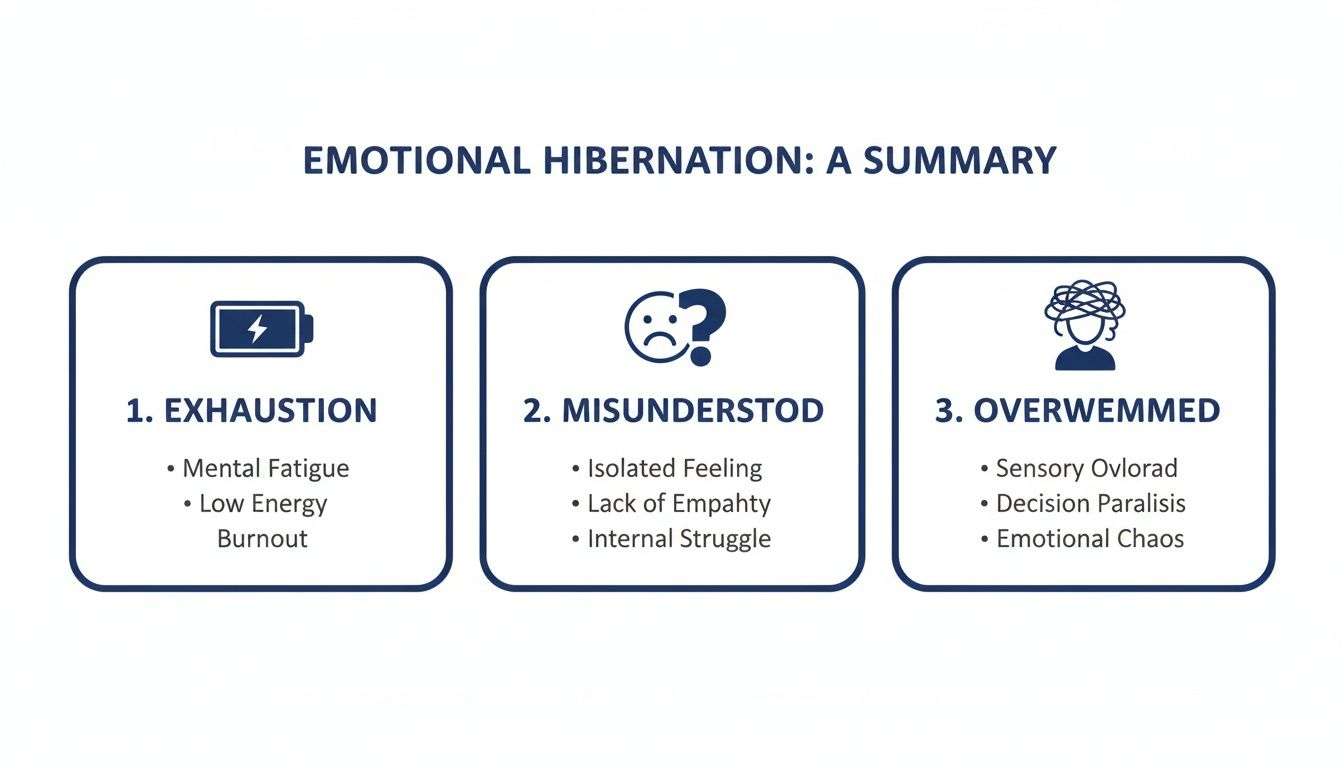
These three feelings—exhaustion, being misunderstood, and overwhelm—create a powerful feedback loop. They reinforce the desire to pull away, making the isolation deeper and harder to break on your own.
To make this distinction clearer, here's a simple comparison.
Comparing Healthy Solitude with Prolonged Isolation in Grief
| Aspect | Healthy Solitude (Healing) | Prolonged Isolation (Concerning) |
|---|---|---|
| Feeling & Energy | Restorative, even if sad. Feels like a necessary recharge. | Draining and heavy. Leaves you feeling more exhausted and empty. |
| Sense of Control | Feels like a conscious choice—"I need some space right now." | Feels like an inescapable trap—"I can't face anyone." |
| Connection to Self | You still feel connected to your own needs and identity. | A growing sense of emptiness and disconnection from who you are. |
| Future Outlook | You assume you will eventually reconnect with others. | The future feels lonely; reconnection seems impossible or undesirable. |
| Social Interactions | You politely decline, intending to reschedule when you feel up to it. | You actively avoid calls, texts, and invitations without any plan to re-engage. |
This table can help you self-assess where you might be. If your experience lines up more with the right-hand column, it’s a sign that your grief might be leading you toward isolation.
The Stories You Start Telling Yourself
Isolation doesn’t just change what you do; it fundamentally changes how you think—especially about yourself and your place in the world.
Your inner monologue can become incredibly harsh. You might start to believe you’re a burden to others, that your sadness is just too much for your friends to handle, or that nobody could possibly understand the depths of what you’re going through.
This internal shift is one of the most definitive signs that solitude has morphed into isolation. It’s no longer about just needing space; it’s about feeling fundamentally separate from and unworthy of connection.
These thoughts can easily become a self-fulfilling prophecy. When you believe you're a burden, you pull away to "protect" others, which in turn reinforces your loneliness and proves the "truth" of your isolation. For some, these thought patterns and the accompanying lack of motivation can look and feel a lot like depression. If you're managing to get through your days but feel hollow inside, it might be helpful to learn more about the signs of high-functioning depression in our related article.
Realising these patterns are taking hold isn't a sign of weakness. It's an incredible act of self-awareness and the first, most crucial step toward finding your way back.
Your First Gentle Step: Reconnecting with Yourself

Before you can even begin to think about reaching out to others, the most important connection you need to mend is the one with yourself. Grief can make you feel like a stranger in your own skin, completely unmoored from the person you were before. The path back starts with small, gentle steps inward.
This isn't about grand gestures or trying to force yourself to feel "better." It's about finding quiet, low-energy ways to re-establish that inner line of communication. Think of it as creating tiny pockets of peace in the middle of a storm. This quiet, internal work lays the foundation you'll need to feel ready to face the world again.
Finding Comfort in Simple Rituals
When your world feels chaotic, small and predictable routines can become powerful anchors. We’re not talking about productivity here. This is all about comfort and creating a sliver of stability. The only goal is to carve out a moment that belongs entirely to you.
Here are a few low-pressure ideas to get you started:
- A simple morning ritual: Before your phone or the day's to-do list can intrude, take just five minutes for something calming. Maybe that’s slowly sipping a cup of tea by a window, doing a few gentle stretches, or just closing your eyes and listening to a piece of music you love.
- A quiet, forgotten hobby: What’s something you used to enjoy that doesn’t demand much energy? Perhaps it’s sketching with no purpose, listening to an audiobook, or just watering a houseplant. Let go of any pressure to finish a project—the point is simply to engage for a few minutes.
- Simple grounding techniques: When you feel a wave of overwhelm, pull your focus back to your senses. It’s a classic for a reason. Name five things you can see, four things you can feel (the soft texture of your sweater, the warmth of your mug), three things you can hear, two you can smell, and one you can taste. This simple act can gently pull your mind out of a difficult thought spiral.
Embracing Patience and Self-Compassion
This inner work requires a huge amount of patience. There will be days when even the smallest task feels like climbing a mountain. That is completely okay. The goal is not perfection; it's simply a quiet commitment to being kind to yourself through it all.
Healing isn't a race you have to win. Every small moment you claim for yourself is a victory. It's about slowly, gently re-introducing yourself to a life that now looks and feels very different.
Learning to tune into your own needs is a cornerstone of well-being, especially during a time of loss. If you want to explore this idea further, our article on how emotional awareness is the first step toward well-being is a great resource.
Above all, remember to treat yourself with the same kindness and compassion you would offer a dear friend walking this same path.
How to Reconnect with Others on Your Own Terms

After you’ve spent some time just sitting with yourself, the idea of reaching out to others can feel daunting. It’s like emerging from a quiet, dark room back into the bright, noisy world. The key isn’t to force yourself back into the fray all at once, but to slowly, gently, and intentionally let the light back in.
This is about rebuilding social connections at a pace that feels right for you. The goal is to find interactions that replenish your spirit, not drain your already fragile energy reserves. Think of it as taking small, deliberate sips of social connection, rather than trying to drink from a firehose.
Step 1: Low-Stakes Digital Check-Ins
The easiest place to start is often online. Digital communication gives you a buffer, allowing you to connect from the comfort of your own space without the pressure of a live conversation. It’s a gentle way to test the waters.
You could try a few simple things:
- Reply to a text. You don’t owe anyone a long story. A simple, "Thanks for checking in, it really means a lot" is more than enough. It keeps that line of communication open.
- Share something small. Did a funny meme or an interesting article make you think of someone? Sending it is a light, easy way of saying, "I'm still here, and I'm thinking of you."
- "Like" a social media post. This is the lowest-pressure interaction there is, but it’s still a small signal to your network that you’re around.
These tiny actions help you dip your toe back into connection without feeling overwhelmed. They let people know you care, even when you don’t have it in you to have a full conversation.
Step 2: Quiet, One-on-One Time
When you feel ready for a little more, the next step is a short, in-person visit with someone you trust completely. The crucial part here is choosing a person who understands your situation and won't ask for more than you can give.
It's perfectly okay—and incredibly healthy—to set your boundaries upfront.
"I'd love to see you, but I only have the energy for a short visit."
This is not a rejection; it's a powerful act of self-care and honest communication. Being clear about your needs is the foundation of any healthy relationship. If you struggle with this, our guide on how to communicate better in relationships has more practical tips.
A few ideas for this stage could be:
- A brief walk around the block with a good friend.
- Inviting someone over for a single cup of tea, with a clear end time in mind.
- Watching a movie together at home, which takes the pressure off having to talk.
These controlled, gentle interactions let you feel the warmth of connection without getting burned out, setting the stage for more when you’re ready.
When to Consider Professional Grief Support
Taking steps to reconnect with yourself and others is a huge part of healing, but sometimes, the weight of grief and isolation is just too much to carry on your own. Reaching out for professional support isn't a sign of weakness—it's a courageous act of self-care and a clear signal that you’re ready to heal. A therapist offers something unique: a safe, confidential space that is entirely yours.
Making that first call can feel like a monumental task, but certain signs can tell you it might be time. If you feel like your grief is "stuck," or if that sense of isolation has only deepened over the months, talking to a professional could be the right next step.
Signs It Might Be Time to Reach Out
It’s often hard to gauge when you’ve crossed the line from navigating grief to being consumed by it. See if any of these experiences feel familiar:
- Persistent Hopelessness: A constant, heavy feeling that life will never get better or that you’ll never experience joy again.
- Intensifying Isolation: You find yourself actively pulling away from people, and the very thought of being social feels exhausting or impossible.
- Daily Life Feels Overwhelming: Simple, everyday tasks like showering, eating, or getting to work feel like climbing a mountain.
- Complicated Emotions: Your grief feels tangled up with intense guilt, anger, or regret that you just can't seem to work through alone.
Thinking about professional support is a big deal. A counsellor provides a structured, supportive environment where you can unpack these complex feelings and learn proven skills to navigate them. It's a partnership, one focused on helping you find your way forward.
What Professional Support Looks Like
A grief counsellor does more than just listen. They offer specialized strategies built around your personal experience with loss. Therapy can be particularly vital for those struggling with what is known as complicated grief, giving you a framework to understand and process emotions that feel completely unmanageable.
Finding others who truly get it can also be profoundly healing. Exploring local grief support groups can be an incredible step toward feeling less alone. And we know this works—Canadian research continues to show how important timely mental health support is for preventing long-term issues after a profound loss.
If you recognize that your grief has drifted into isolation, please remember that help is available. Learning more about how counselling can help is a hopeful, proactive step you can take toward reconnecting with your life after loss.
Common Questions About Grief and Isolation
When you're navigating the fog of grief, it's easy to feel lost. Questions pop up that have no easy answers, and you might wonder if what you're experiencing is "normal." It's a path with no map, and that's okay. Here are some of the most common concerns we hear from people, answered with the genuine understanding that comes from walking this path alongside others.
Is It Wrong That I Don’t Want to Be Around People?
Absolutely not. In fact, pulling away after a profound loss is one of the most natural protective instincts we have. It’s your mind and body’s way of carving out the necessary space to process immense emotional pain without the extra weight of social expectations. Think of it as a form of emotional self-preservation.
The only time this instinct might become a concern is when that temporary need for solitude settles in for the long haul, turning into a pattern of isolation that makes the sadness and loneliness feel even deeper. The key is to honour your need for quiet while finding gentle ways to stay tethered to your support systems.
My Friends Say the Wrong Things; How Can I Reconnect Without Getting Hurt?
This is a painful and incredibly common hurdle. Your loved ones mean well, they want to help, but they often just don't have the right words. It’s okay to guide them.
A gentle but direct approach can work wonders. You could try saying something like, “I’m so grateful you’re here for me. Honestly, the best thing you can do right now is just listen without trying to find a solution.”
Another great strategy is to pick activities that don’t revolve around heavy conversation. Suggest watching a movie, going for a quiet walk, or working on a puzzle together. This lets you feel their supportive presence without the pressure of navigating conversations that might accidentally cause more pain.
How Do I Know if This Is Normal Grief or Something More?
Every person’s experience with grief is completely unique. However, there are times when the grieving process can become stuck, a condition sometimes called complicated grief, where professional support can make a significant difference.
It might be time to reach out for help if you're experiencing:
- An intense and relentless yearning for the person who died that doesn't seem to soften over many months.
- A persistent feeling that life is empty or meaningless without your loved one.
- Major, ongoing struggles with day-to-day life long after the loss occurred.
If your grief feels locked in place and your sense of isolation is growing instead of shrinking, talking to a counsellor can offer so much clarity. They can provide specialized strategies that are shaped by your own personal experience.
I Feel Like a Burden; How Do I Overcome This?
This feeling is one of the most common and cruelest tricks that grief plays on our minds. It whispers that you’re too much for others, but that feeling is almost never a reflection of reality. More often than not, the people who love you are desperate to help but feel powerless.
You can start to challenge this thought by taking one small step: ask for something very specific and manageable. For example, “Would you mind grabbing a few groceries for me on your way home?”
This gives your loved ones a tangible way to show they care, which in turn can slowly rebuild your confidence in asking for and accepting support. Therapy is also an incredibly effective space to dismantle these thoughts and reaffirm your inherent worth, even when you can't feel it yourself.
Navigating grief is a deeply personal journey, but you don’t have to do it by yourself. The compassionate team at Interactive Counselling is here to offer a safe, non-judgmental space where you can work through your loss, make sense of your feelings, and find your own way back to connection. If you’re ready to take that next step, we invite you to learn more about our counselling services.
Clinically Reviewed By
Amy Mosset, MCP, RCC-S
Amy Mosset is a Master Practitioner in Clinical Counselling, Clinical Supervisor, and the owner of Interactive Counselling. She provides trauma-informed, evidence-based care and clinical supervision to registered therapists, with a focus on ethical practice, client safety, and high-quality therapeutic outcomes.