TL;DR: For more information, see our grief counselling.
- Most parents adapt positively to the empty nest, viewing it as an opportunity for growth.
- The transition involves stages of mourning, loss, sublimation, and adaptation.
- Building a new identity and seeking support can help navigate this life change effectively.
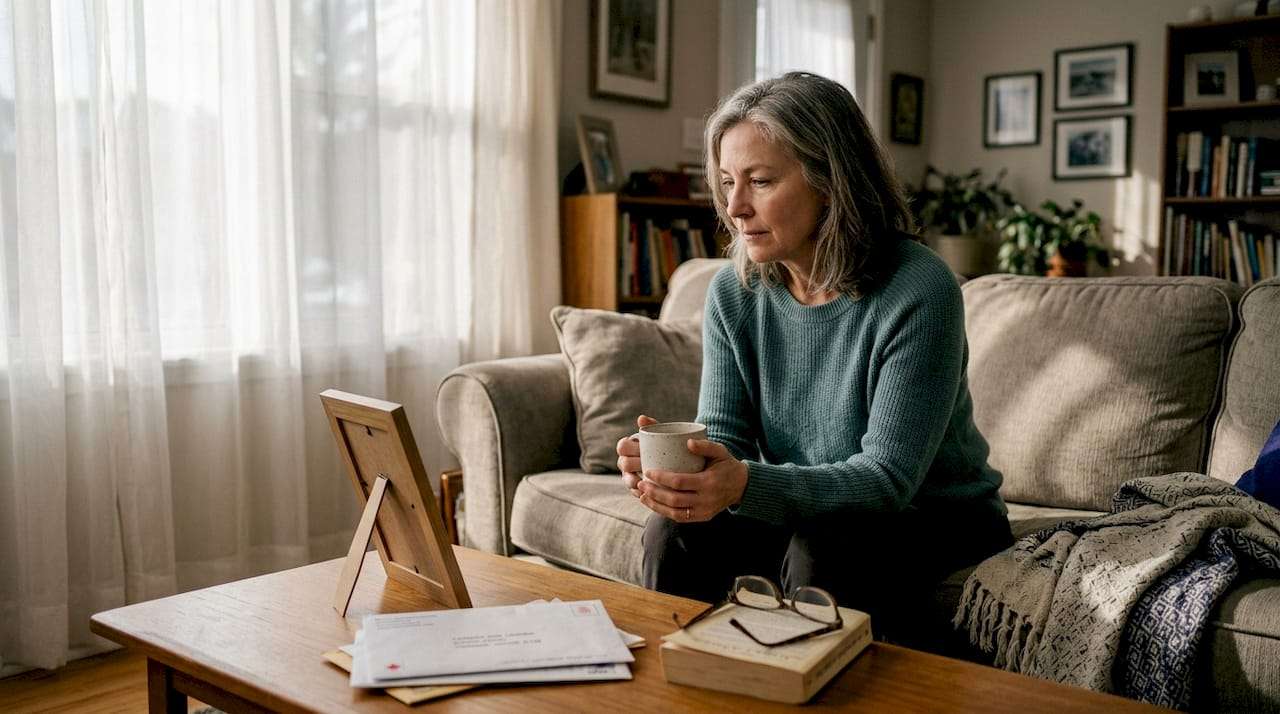
Most parents expect the empty nest to arrive like a storm. Quiet house, hollow hallways, and a grief so heavy it redefines everything. Yet 80% of parents adapt positively to the transition and many even describe it as an unexpected opportunity for growth. That does not mean the feelings are simple or that the shift is painless. It means the story is far more nuanced than the cultural narrative suggests. This guide will walk you through what empty nest syndrome actually is, the stages most parents move through, how different families experience it, and the practical steps you can take to rediscover who you are beyond the role of parent.
Table of Contents
- What is empty nest syndrome?
- The stages of adjustment: from grief to relief
- Real stories and edge cases: more than one path
- What comes next: building identity and finding purpose
- A new chapter: the truth no one tells you about the empty nest
- Support and next steps for your empty nest journey
- Frequently asked questions
Key Takeaways
| Point | Details |
|---|---|
| Most parents adapt well | The majority of Canadian parents experience positive adjustment after children leave home. |
| Emotions are mixed and normal | Feeling grief, relief, joy, or loss is part of the empty nest journey for many parents. |
| Support systems matter | Strong relationships and social support ease the transition and lower distress. |
| New purpose is possible | The empty nest phase can open opportunities for growth, hobbies, and stronger identities. |
What is empty nest syndrome?
Empty nest syndrome is not a clinical diagnosis. You will not find it listed in the DSM-5, the manual mental health professionals use to identify conditions. Instead, it describes a collection of emotional responses that many parents feel when their last child leaves home. Think of it less like a disorder and more like a significant life transition, one that carries real emotional weight even when it unfolds smoothly.
The feelings involved are not uniform. Some parents grieve deeply. Others feel a surprising rush of relief, followed by guilt for feeling relieved. Many experience both at once, which can be disorienting. Symptoms can include reduced self-esteem and anxiety, though the impact varies widely depending on individual circumstances, relationship quality, and available support.
Here are some of the most common emotional reactions parents report:
- Grief and sadness over the loss of daily connection
- Anxiety about the future and shifting identity
- Relief and freedom, especially after years of intensive caregiving
- Loss of purpose, particularly for parents whose identity centred on raising children
- Renewed curiosity about personal goals, relationships, and interests
- Loneliness, even in households where a partner is still present
In Canada, where family structures and cultural backgrounds vary enormously, the experience is shaped by context. A parent in a tight-knit community may have more built-in support than one who relocated for work and built their social world around school activities and parenting circles.
“Empty nest syndrome has largely been debunked as a cultural myth. Most parents see this as a time of opportunity, not crisis.” — SFU researcher on family transitions
The reassuring truth is that most parents adapt well, viewing the transition as a chance for growth rather than a permanent loss. About 20% may need extra support, and there is absolutely no shame in that. Learning more about coping with the empty nest is a strong first step regardless of where you fall on that spectrum.
The stages of adjustment: from grief to relief
Understanding the definition is just the beginning. To make sense of the emotional roller-coaster, it helps to see how the transition often unfolds in stages. Research suggests adjustment moves through mourning, loss, sublimation, and adaptation, influenced by factors like relationship satisfaction and social support.
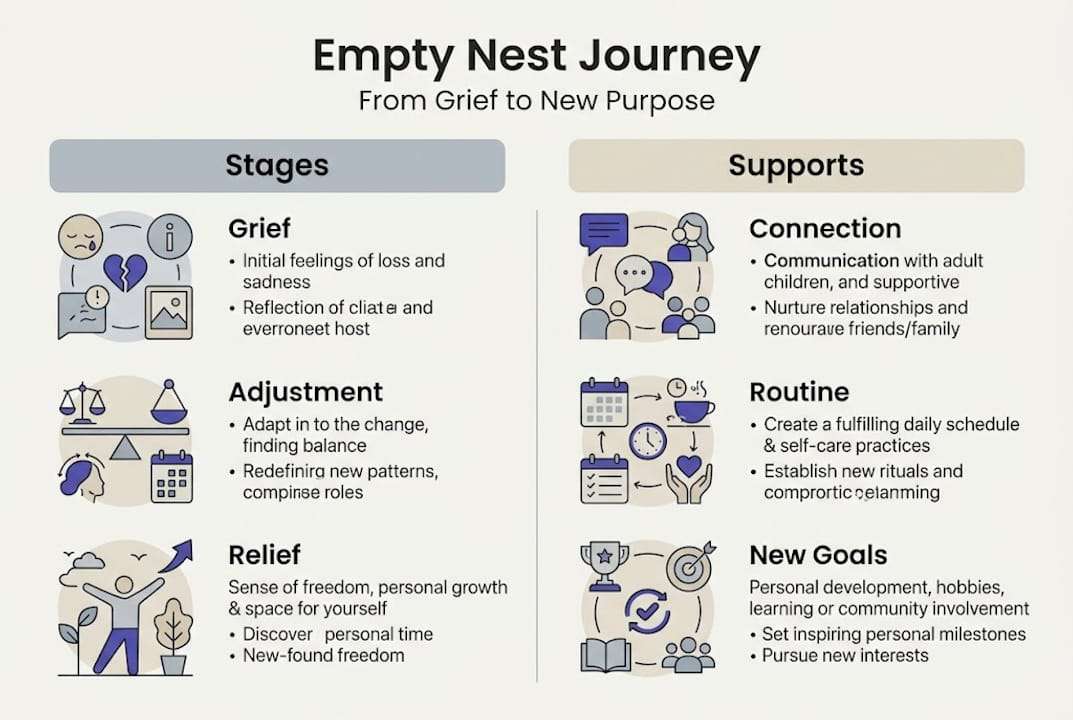
| Stage | What it feels like | Common signs |
|---|---|---|
| Mourning | Raw grief and disorientation | Crying, withdrawal, difficulty concentrating |
| Loss | Awareness of identity shift | Questioning purpose, reduced motivation |
| Sublimation | Redirecting emotional energy | Picking up old hobbies, reconnecting with friends |
| Adaptation | Settling into a new normal | Renewed confidence, clearer sense of self |
Here is how these stages typically unfold:
- Mourning. The house feels too quiet. You may reach for your phone to check on your child before remembering they no longer need checking on. Grief is present and it is real.
- Loss. The identity of active, daily parent begins to feel uncertain. You may ask yourself, “Who am I now?” This is uncomfortable but also the beginning of something important.
- Sublimation. Emotional energy starts to shift. You begin channelling feelings into activities, relationships, or goals that were previously set aside.
- Adaptation. A new rhythm emerges. The transition no longer feels like loss alone. It begins to feel like possibility.
Several factors influence how quickly and smoothly you move through these stages. A strong social support network, a satisfying relationship with your partner, and flexible coping skills all make a meaningful difference. Understanding the difference between healthy coping versus avoidance can help you recognise when you are moving forward and when you might be stuck.
Pro Tip: Keep a simple journal during this transition. Even five minutes of writing each day can help you track emotional shifts, notice patterns, and feel less overwhelmed by the intensity of what you are experiencing.
Real stories and edge cases: more than one path
While many parents follow a typical emotional arc, real life is rarely that simple. Let’s look at how empty nest syndrome plays out for different families, because the experience is far from one-size-fits-all.
Women and homemakers are often more impacted, particularly when parenting was their primary role. Men, on the other hand, may feel the shift more quietly, sometimes only recognising the emotional weight months later. Single parents often face a sharper transition because the household dynamic changes completely, not just partially.
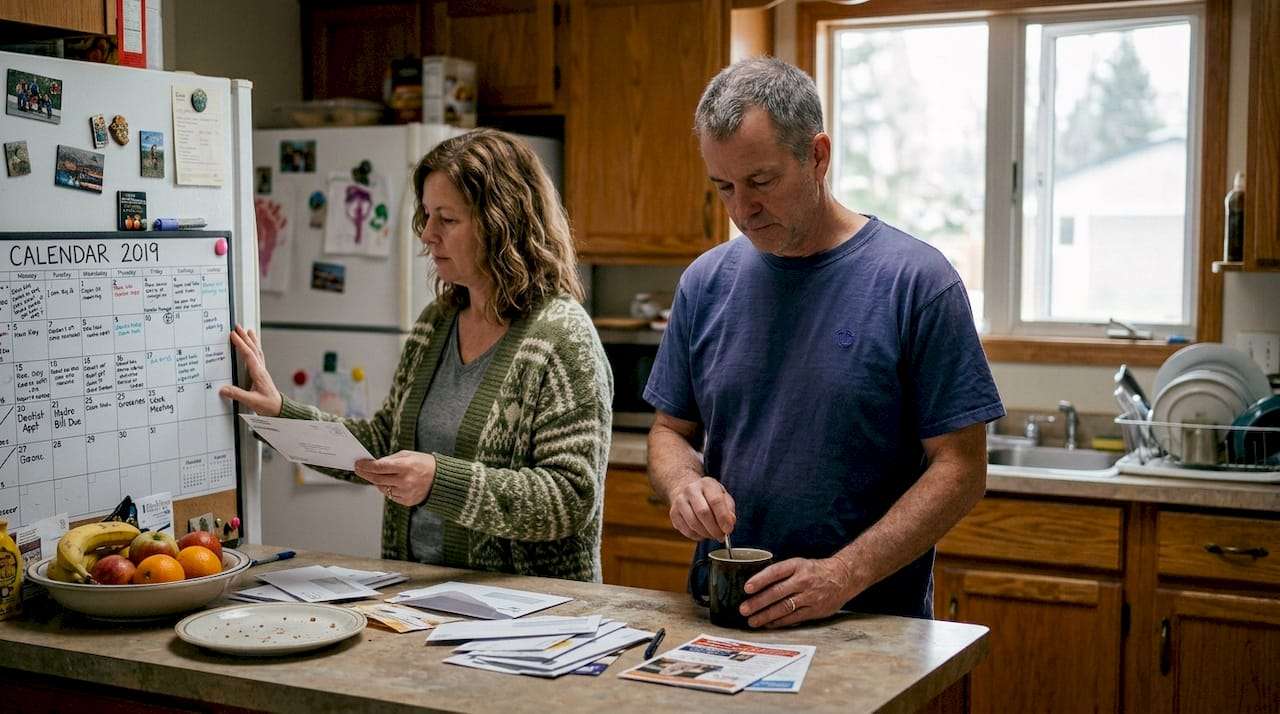
| Family structure | Typical experience | Key challenges |
|---|---|---|
| Two-parent household | Gradual, shared adjustment | Reconnecting as a couple |
| Single parent | Abrupt shift in daily purpose | Isolation, loss of routine |
| Separated or divorced parents | Complicated by co-parenting dynamics | Boundary setting, communication |
| Collectivist or multigenerational families | Less pronounced, more gradual | Cultural expectations around closeness |
Key influences on how you experience this transition include:
- Marriage or relationship satisfaction before the child leaves
- Social support networks outside of the parenting role
- Midlife shifts happening simultaneously, such as career changes or health concerns
- Cultural background, which shapes expectations around family closeness and independence
Boomerang children, those who return home after moving out, add another layer of complexity. Their return can bring comfort but also confusion around boundaries and roles. Many parents feel a mix of joy at having their child back and frustration at the disrupted adjustment process.
“Many parents feel mixed emotions when their children leave. Loss, relief, even joy can all exist at the same time, and none of those feelings cancel each other out.”
Exploring family dynamics after kids leave can help you understand your specific situation more clearly and find approaches that actually fit your life.
What comes next: building identity and finding purpose
Now that we understand the emotional process and its variations, how can you turn challenge into new opportunity? This is where the real work, and the real reward, begins.
Building a new sense of self after years of active parenting is not about forgetting who you were. It is about expanding who you are. Most parents use this transition to explore personal growth, hobbies, volunteering, or renewed intimacy with their partner. That is not a small thing. It is a genuine second chapter.
Here are practical steps to help you move forward:
- Revisit old interests. What did you love before parenting took centre stage? Music, hiking, painting, writing? Start small and let curiosity lead.
- Invest in your relationships. Whether that means deepening your partnership, reconnecting with friends, or building new community ties, relationships are the foundation of wellbeing.
- Volunteer or contribute. Many parents find that giving back, whether through mentoring, community work, or advocacy, restores a sense of meaning and connection.
- Set healthy boundaries with your adult children. Staying close does not mean staying enmeshed. Clear, loving boundaries support both your growth and theirs.
- Explore travel or new experiences. The freedom that comes with an empty nest is real. Use it intentionally.
Pro Tip: Do not try to overhaul your entire life at once. Pick one small change and give it a few weeks before adding another. Gradual shifts are more sustainable and less overwhelming than dramatic reinventions.
If you find that old emotional wounds are surfacing during this transition, that is actually quite common. Exploring reparenting for emotional safety can be a meaningful way to address those layers with professional support.
A new chapter: the truth no one tells you about the empty nest
Here is something the popular narrative gets wrong. It frames the empty nest as either devastating grief or joyful liberation, as if you must land cleanly on one side. The truth is messier and more human than that.
Most parents feel both. They grieve the daily rituals and feel freed by the quiet. They miss their children and enjoy sleeping in. Holding those contradictions is not weakness. It is emotional honesty.
The counterintuitive insight we have seen again and again is this: the parents who struggle most are not those who feel grief. They are those who feel they should not grieve, or who rush past the discomfort to perform happiness. Growth comes from sitting with uncertainty, not sprinting away from it.
Your story is still being written. The empty nest is not an ending. It is a pivot point, and pivot points are where the most interesting chapters begin.
“You do not have to have it all figured out. Asking for support is not a sign that something went wrong. It is a sign that you are paying attention.”
If you are finding the transition harder than expected, deeper insights on coping and professional support are both within reach.
Support and next steps for your empty nest journey
Seeking support during a major life transition is a sign of self-awareness, not struggle. At Interactive Counselling, our licensed therapists understand the identity shifts, relationship changes, and emotional complexity that come with the empty nest. We offer a range of counselling service options including individual, couples, and family therapy, available in-person across Kelowna, Vernon, Grande Prairie, and Penticton, as well as online across Canada. Whether you need space to grieve, tools to rebuild, or guidance on life and family counselling, we are here for you. Reach out today and take the first step toward your next chapter.
Frequently asked questions
What are the most common symptoms of empty nest syndrome?
Symptoms often include sadness, anxiety, and low self-esteem, though many parents also report feeling relief, freedom, and renewed energy once the initial adjustment settles.
Is empty nest syndrome permanent?
No. Most parents adapt positively within months and often discover new sources of purpose, connection, and fulfilment as they settle into their changed lives.
How can single parents manage empty nest syndrome?
Single parents may face a sharper transition and benefit from building social ties and new goals intentionally, along with professional counselling if the adjustment feels overwhelming.
When should I seek professional help for empty nest syndrome?
If sadness or anxiety persists for several months or begins to disrupt your daily life, speaking with a mental health professional is a wise and healthy next step. 20% of parents may need additional support, and reaching out early makes a real difference.
Recommended
- Why the empty nest feels harder and how to cope
- When grief turns into isolation: reconnecting after loss – Interactive Counselling
- Grieving a Sudden or Traumatic Death: A Compassionate Guide to Healing – Interactive Counselling
- How to deal with grief: a compassionate guide to navigating loss