When anxiety controls your life, the first step is to create immediate safety through grounding techniques, then build a plan with coping skills, supportive daily routines, and professional help. In Canada, 18.3% of people aged 15 and older met diagnostic criteria for a mood, anxiety, or substance use disorder in the previous year, yet only 48.8% had talked with a health professional about their mental health, which means many people are struggling for a long time before getting support. For more information, see our Kelowna anxiety counselling.
You might be reading this after another hard night of poor sleep, with your mind looping through worst-case scenarios. Maybe you're cancelling plans, avoiding driving, checking your body for signs that something is wrong, or getting through the day while looking “fine” on the outside and feeling panicked on the inside. When anxiety starts deciding what you do, where you go, and how safe you feel, it can make your world smaller very quickly. For more information, see our counselling in Kelowna.
"When anxiety controls your life, start by calming your body in the moment, then get structured support that helps you face triggers instead of shrinking around them." For more information, see our anxiety counselling.
Feeling Like Anxiety Is in Control? You're Not Alone
Anxiety rarely shows up as just “worry.” It can feel like dread before work, a tight chest in the grocery store, constant overthinking after social interactions, or the urge to stay home because everything feels like too much. Many people in Kelowna are carrying jobs, parenting, relationships, recovery from loss, or trauma while trying to hide how overwhelmed they feel.
That hidden part matters. People often tell themselves they should be able to handle it alone, or that they need to wait until things get worse before asking for help. In reality, anxiety often becomes more entrenched when a person spends months trying to out-think it.
A national Statistics Canada report found that 18.3% of people in Canada aged 15 and older met diagnostic criteria for a mood, anxiety, or substance use disorder in the prior 12 months, while only 48.8% said they had spoken to a health professional about their mental health in the past year (Statistics Canada mental health data). That gap says something important. Struggling is common. Reaching out is often the hard part.
What anxiety often looks like in real life
It may help to see your experience in plain language:
- Your mind won't switch off and every decision feels loaded with consequences.
- Your body stays activated even when there's no immediate danger.
- Avoidance starts to feel safer than facing everyday situations.
- You doubt yourself constantly and look for reassurance that never lasts.
- Your life narrows around what feels manageable today.
Practical rule: If anxiety is changing your sleep, work, relationships, driving, eating, or ability to relax, it deserves attention.
Some people also want support options that feel broader than therapy alone. If complementary reading would help you feel more resourced, this guide to natural care for anxiety may offer a few grounded ideas to pair with clinical support.
What helps, and what usually doesn't
Relief doesn't usually come from forcing yourself to “stop thinking about it.” It also doesn't come from endlessly analysing every fear until you find certainty. Anxiety tends to feed on certainty-seeking.
What helps is a steadier approach:
- settle the body first
- reduce avoidance gradually
- learn how anxiety works in your own system
- practise new responses repeatedly, not perfectly
That's how anxiety starts losing control over your days.
Your First Five Minutes Reclaiming a Sense of Safety
When panic rises, your first job isn't to solve your whole life. It's to help your nervous system register that you're safe enough in this moment.

Grounding works because it shifts attention from threat signals and brings your body back into the present. These skills won't erase anxiety instantly, but they often lower the intensity enough for you to think more clearly.
Use the 5 4 3 2 1 method
If your thoughts are racing, use your senses in order.
- Name five things you can see. Say them slowly. Look for colour, shape, and detail.
- Notice four things you can feel. Your feet in your shoes, the chair against your back, air on your skin.
- Identify three things you can hear. A fan, traffic, birds, your own breathing.
- Find two things you can smell. If nothing stands out, smell your tea, soap, sleeve, or the room around you.
- Notice one thing you can taste. Water, mint, gum, coffee, or the taste already in your mouth.
Don't rush it. The point is not performance. The point is orienting.
Try box breathing
Breathing exercises help most when they are simple and paced. Box breathing is a good place to start.
- Breathe in for four
- Hold for four
- Breathe out for four
- Hold for four
Repeat for a few rounds. If holding your breath feels uncomfortable, shorten the count and keep the rhythm gentle.
If a breathing exercise makes you feel more focused on your body in an uncomfortable way, stop and switch to a visual or touch-based grounding skill. Not every tool fits every person.
Use temperature to interrupt panic
A cold object can be surprisingly effective when anxiety spikes hard. Hold a cool drink can, rinse your hands in cold water, or press a cold cloth to your face.
This doesn't fix the underlying problem. It helps interrupt the spiral.
A short script for the moment
When the mind is loud, use fewer words.
I'm anxious right now. Anxiety is loud, but it isn't the whole truth. I can slow this down one step at a time.
If you need a five-minute reset
Here's a simple sequence:
- First minute: Put both feet on the floor.
- Second minute: Exhale longer than you inhale.
- Third minute: Name five things you can see.
- Fourth minute: Hold something cold or textured.
- Fifth minute: Decide on one next action only. Sit down, text someone, drink water, or step outside.
Small actions restore agency. That matters when anxiety is making you feel trapped.
Building Your Short-Term Coping Plan
Once the immediate wave settles, the next task is getting through the next few days with less chaos. Many people get stuck at this point. They either try to fix everything at once, or they do nothing because they feel too overwhelmed to begin.
A short-term coping plan should be small, repeatable, and realistic on a difficult day. Think less “new life system” and more “what will help me get from this morning to tonight without feeding the anxiety cycle?”
Contain worry instead of arguing with it all day
If anxious thoughts keep breaking into everything, set aside a brief daily “worry window.” Pick a consistent time. During the day, when worries pop up, write them down and tell yourself you'll return to them later.
This isn't avoidance. It's containment.
During that time, ask:
- What is the actual problem here
- Is there an action I can take today
- If not, am I trying to get certainty that doesn't exist
That last question matters. Anxiety often disguises itself as problem-solving.
Start a low-pressure trigger journal
You do not need pages of deep reflection. A few lines is enough. Open a note on your phone and track patterns for a week.
Try prompts like these:
- What happened right before my anxiety rose
- What did my body do first
- What did I start telling myself
- What did I avoid, cancel, check, or seek reassurance about
- What helped even a little
Over time, this can show you whether your anxiety is tied to conflict, health fears, driving, crowded places, uncertainty, being alone, being observed, or something else more specific.
Be careful with avoidance
Avoidance often feels like relief, but it usually teaches your brain that the feared situation really was dangerous. That's why anxiety spreads. First you avoid one road, then all busy roads. First you skip one gathering, then every social plan starts to feel impossible.
Relief is not always recovery. Some relief strategies train anxiety to come back stronger.
A better approach is gentle approach behaviour. Not flooding. Not forcing. Just one manageable step toward what you've been avoiding.
For example:
- If mornings are hard, sit up and open the curtains before checking your phone.
- If errands feel overwhelming, go to one small shop for one item.
- If driving feels scary, sit in the parked car, then try a short familiar route on another day.
- If emails trigger dread, open the inbox and answer one simple message first.
Make a coping card you can actually use
A coping card is one of the most practical tools I recommend. Keep it in your wallet or notes app. You want something brief enough to read when your thinking narrows.
Include:
- My signs that anxiety is rising
- Three grounding tools that work for me
- One truthful reminder
- One person I can contact
- My next smallest step
A simple example:
- My signs: tight jaw, shallow breathing, urge to cancel
- My tools: cold water, slow exhale, 5 4 3 2 1
- Reminder: anxiety predicts danger. It doesn't prove danger
- Contact: text my sister
- Next step: step outside for two minutes
What a short-term plan is supposed to do
It's not meant to remove every symptom. It's meant to reduce chaos, increase predictability, and stop anxiety from making every decision for you.
That's real progress. It also makes deeper therapy work more effective because you're not starting from complete overwhelm every session.
Creating a Lifestyle That Supports Your Mental Health
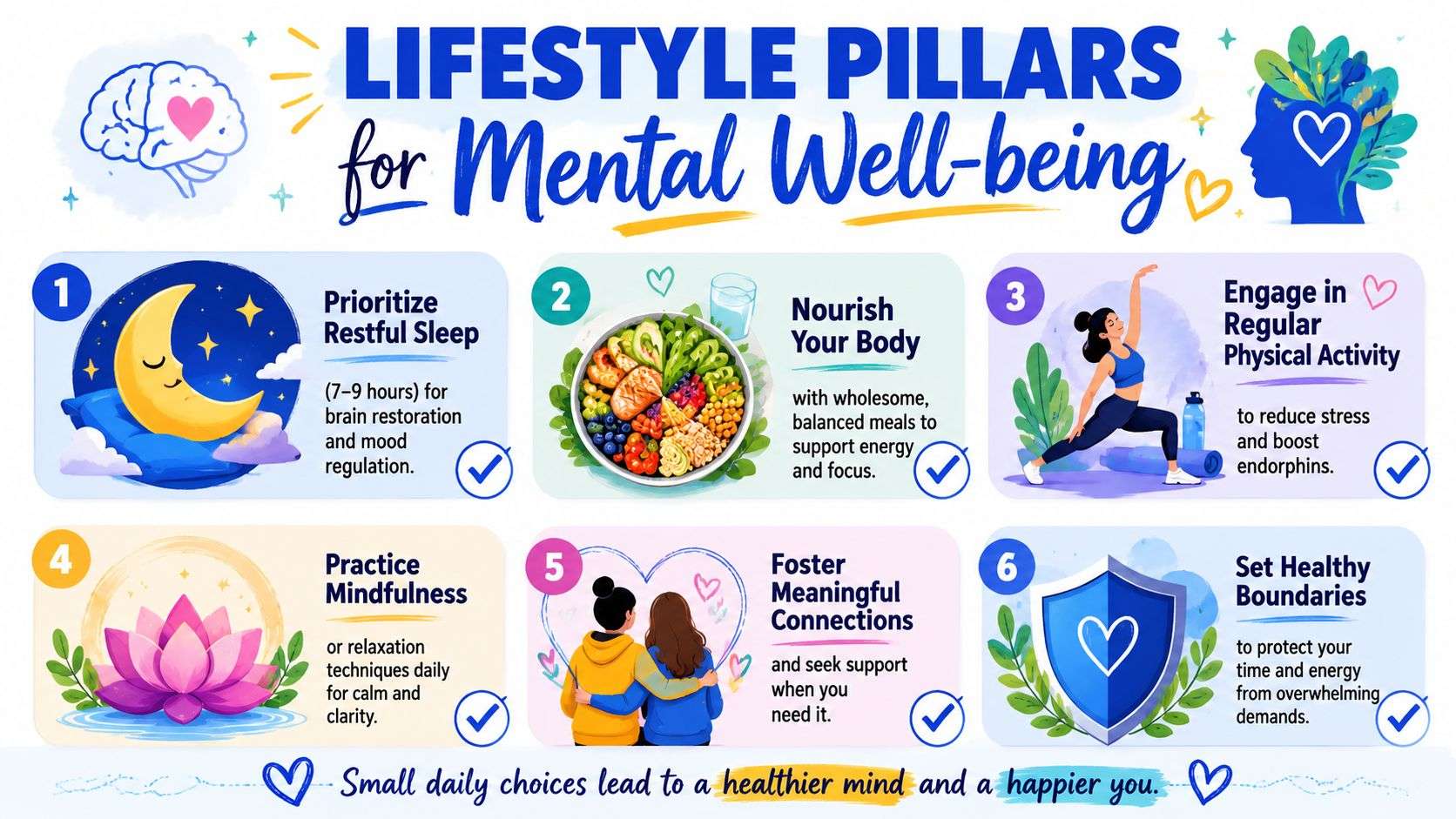
Anxiety treatment doesn't live only in a therapy room. It also lives in how you sleep, eat, move, rest, and structure your days. That doesn't mean you need a perfect routine. It means your body needs enough support that it isn't fighting on every front at once.
Think of lifestyle supports as the floor under your feet. They don't do the whole job, but they make it much easier to stand.
Sleep is not a luxury
When sleep gets disrupted, anxiety usually gets louder. Thoughts become more rigid, your body feels more reactive, and small stressors hit harder.
Helpful sleep support often looks simple:
- Keep a rough sleep window so bedtime and wake time aren't wildly different every day.
- Reduce stimulation before bed by lowering lights and stepping away from stressful content.
- Create a repeatable cue such as tea, stretching, a shower, or the same calming playlist.
If sleep has become a battleground, the goal is to build steadiness, not chase the perfect night.
Food and movement are nervous system care
Many anxious people either forget to eat, eat irregularly, or rely on whatever is easiest once they're already depleted. Then the body feels shaky, tired, irritable, or overstimulated, and the mind interprets that as danger.
Movement works the same way. It doesn't need to be intense to help. A brief walk, gentle stretching, or getting outside can lower the sense of internal pressure that builds when stress has nowhere to go.
Here's one practical way to look at it:
| Support | What it does |
|---|---|
| Regular meals | Helps your body feel more stable and less alarmed |
| Gentle movement | Releases tension and interrupts mental looping |
| A basic routine | Reduces decision fatigue when you're already overloaded |
Boundaries reduce background anxiety
Some anxiety is made worse by chronic overextension. Saying yes when you need rest. Taking on everyone else's emotions. Pushing through long after your system is asking for recovery.
A healthier lifestyle often includes:
- More margin between commitments
- Less doom-scrolling when you're already activated
- More contact with steady people who help you feel grounded
- Fewer inputs that keep your mind in threat mode
Your nervous system can't heal well in a schedule that keeps overwhelming it.
For some people, spiritual reflection is also part of emotional regulation.
Aim for support, not self-improvement pressure
Lifestyle changes backfire when they become another standard you're failing to meet. Anxiety already supplies enough self-criticism.
Choose one or two supports that feel doable this week:
- prepare breakfast the night before
- take a short evening walk
- put your phone across the room at bedtime
- text one safe person instead of isolating
- build in ten quiet minutes before the day gets busy
These aren't small because they're unimportant. They're small because that's how change becomes repeatable.
Understanding Professional Anxiety Counselling
Anxiety often tells people they need to have the whole story organized before they book a session. They do not. In practice, good counselling starts by lowering pressure, clarifying what is happening, and helping you decide what kind of support fits the problem in front of you.
The first few sessions are usually focused and practical. A therapist will ask what anxiety looks like in your day, what sets it off, what you do to get through it, and where life has started to shrink because of it. If panic is the main issue, treatment needs to address panic. If the anxiety started after a car accident, trauma work may matter more than general stress management. That distinction saves time.
What professional anxiety counselling usually includes
Effective therapy is not just talking about stress in broad terms. It should give you a working map of your anxiety and a plan for responding differently.
That often includes:
- identifying triggers, body cues, and early warning signs
- noticing patterns such as avoidance, overchecking, reassurance-seeking, or mental replaying
- learning skills you can use during anxious spikes, not only after the fact
- practising between sessions so progress happens in real life, not only in the office
- adjusting the approach if trauma, grief, pain, sleep disruption, or relationship stress are also involved
Insight helps. Repetition creates change.
What different therapy approaches actually feel like
The names can sound technical, so it helps to know how they differ in the room.
| Therapy | Primary focus | Best fit when you… |
|---|---|---|
| CBT | Thoughts, behaviours, triggers, avoidance | want a structured plan for patterns that keep anxiety going |
| ACT | Accepting internal discomfort while choosing actions that match your values | feel exhausted by fighting your thoughts all day |
| EMDR | Processing distress linked to specific events or trauma responses | notice anxiety connected to collisions, frightening events, medical scares, or stored trauma |
CBT for anxiety that has taken over daily life
CBT is often a strong fit when anxiety is shaping your schedule, your decisions, and your sense of freedom. It looks closely at the cycle between thoughts, body sensations, emotions, and behaviour.
A common example is simple. Your chest tightens, your mind jumps to danger, you leave or avoid the situation, and your nervous system learns that the situation must have been unsafe. The short-term relief is real. The long-term cost is that anxiety grows.
A CBT-based process helps interrupt that cycle by testing anxious predictions, reducing avoidance gradually, and building tolerance for discomfort in manageable steps., practice between sessions matters because new responses need repetition before they start to feel natural.
ACT for people caught in constant mental struggle
Some clients are less trapped by one specific fear and more trapped by the fight with their own mind. They argue with thoughts, try to force certainty, and end up more tangled.
ACT helps by changing the relationship to those thoughts. The goal is not to erase every anxious thought. The goal is to notice it, make room for the discomfort it brings, and still choose the next right action. That approach can be especially useful for high-functioning anxiety, perfectionism, health anxiety, and chronic overthinking.
EMDR and trauma-informed work when anxiety has a clear origin
Anxiety is not always general. Sometimes it started after something happened. A crash on Harvey Avenue. A frightening medical event. An assault. A season of repeated overwhelm that never fully settled.
In those cases, standard coping tools may help only a little because the nervous system is still reacting as if the danger is present. EMDR and other trauma-informed approaches are often used when anxiety is tied to stored distress rather than only current worry. This matters in Kelowna because some people seeking anxiety counselling are dealing with post-collision symptoms, driving fear, nightmares, flashbacks, or body-based panic after an accident. If ICBC funding applies, that can affect what support is available and how care is arranged.
What a good therapy fit looks like
A good therapist does more than listen kindly. They should be able to explain what they think is happening, describe how treatment will help, and pace the work so it is challenging without becoming overwhelming.
You should leave early sessions with more clarity than you had when you arrived.
If that is not happening, it is reasonable to ask direct questions: What approach are we using? How will we know if this is helping? What should I practise between sessions? Good counselling is collaborative, specific, and grounded in the kind of anxiety you are dealing with.
How to Find the Right Anxiety Counselling in Kelowna
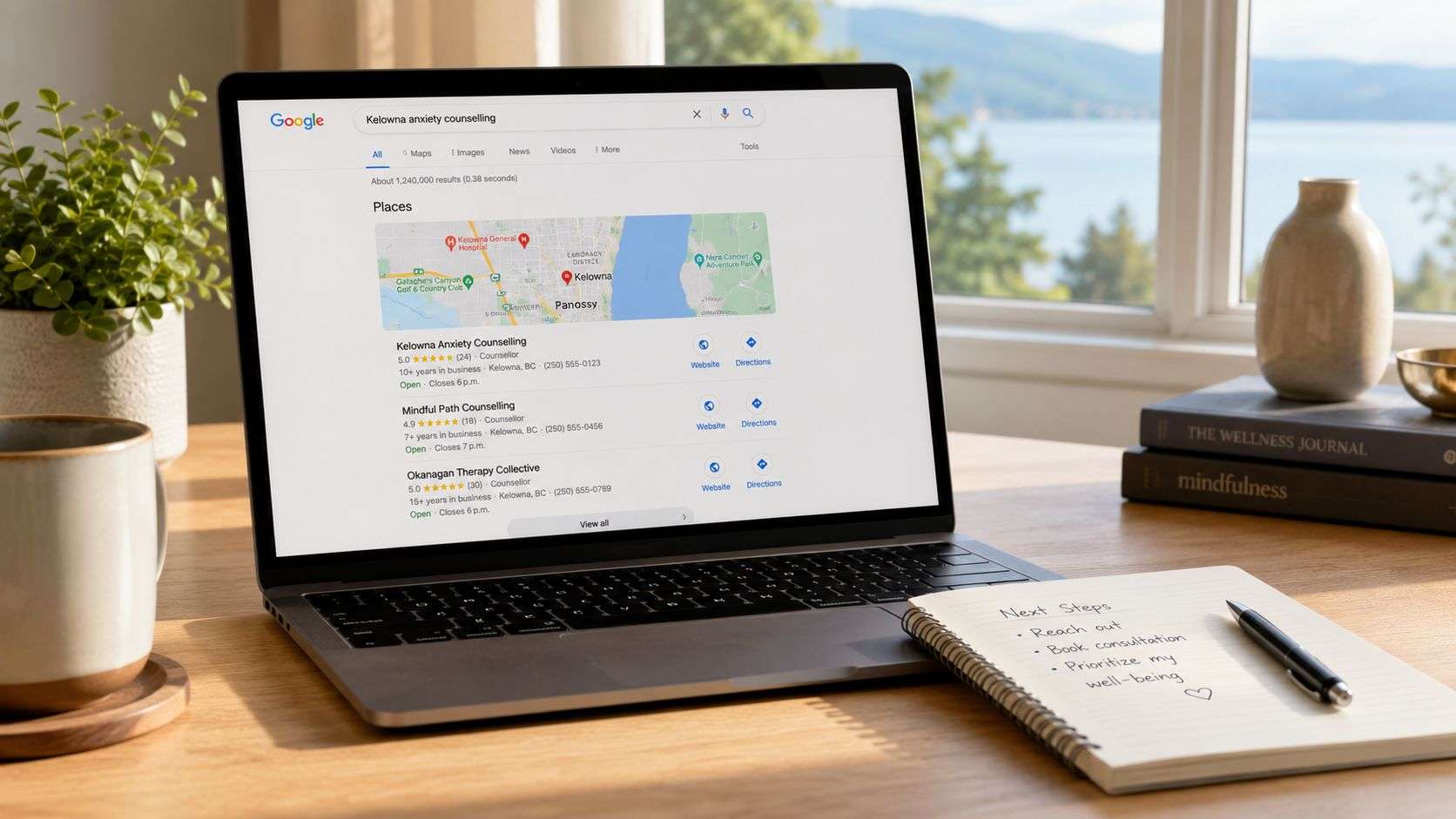
You sit down to look for help and end up with ten browser tabs open, three counsellor bios that all sound similar, and a rising sense that you might choose wrong. That spiral is common. The goal is not to find the perfect therapist on the first try. The goal is to choose a solid first option and start.
Start by narrowing the field
A counsellor's website should answer a few practical questions quickly. If it does not, keep looking.
Check for:
- Professional registration and a clear scope of practice
- Specific experience with anxiety, panic, trauma, or OCD-related patterns, depending on what you are dealing with
- Approaches used, such as CBT, ACT, EMDR, or other trauma-informed methods
- Appointment options that fit your life, including in-person, phone, or virtual sessions
- Fees, availability, and consultation options, so you can tell whether support is realistic right now
This part is less about chemistry and more about ruling out poor fits. If the information is vague, overly broad, or hard to find, that usually tells you something about how organized the care may feel.
Match the therapist to the kind of anxiety you actually have
“Anxiety” is a broad label. In practice, the right fit often depends on what is driving it.
If your anxiety shows up as panic attacks, you want someone who knows how to work with body symptoms, fear of fear, and avoidance. If it revolves around health worries or intrusive thoughts, the therapist should understand reassurance-seeking, checking, and rumination. If it began after a car accident, the questions change again. You may need trauma treatment, support with driving fear, and guidance around ICBC-funded counselling rather than generic stress management.
That distinction matters in Kelowna. Accident-related anxiety often gets missed because people search for “anxiety counselling” when they are also dealing with nightmares, hypervigilance, pain-related distress, or fear behind the wheel. Some local practices, including Interactive Counselling, include ICBC-funded trauma support as part of their services. If a collision changed your nervous system, ask about that directly.
Questions to ask before you book
A brief consultation can save you weeks of second-guessing. You do not need to ask everything. A few direct questions are enough:
- Have you worked with anxiety that looks like mine?
- How would you approach panic, avoidance, intrusive thoughts, or trauma symptoms in my case?
- What does the first session usually focus on?
- Will I leave with anything practical to work on between sessions?
- Do you offer in-person, phone, or virtual appointments?
- If my anxiety is tied to a car accident, do you work with ICBC-funded counselling or related documentation?
Listen for clarity. A good answer should sound specific, calm, and grounded in real treatment, not just reassurance.
Use a simple filter if you feel stuck
If you are choosing between two or three counsellors, use this test:
- I understand how they would help
- Their style feels steady and respectful
- Their format, fee, and schedule are workable
- They have experience with my actual problem, not only the word “anxiety”
That is enough to make a good first decision.
The best fit is not always the warmest website or the longest list of modalities. Sometimes it is the clinician who explains the process clearly, has room in their schedule, and knows how to treat the exact pattern that is disrupting your life. If you start with someone and the fit is off, you are allowed to change course. That is not failure. It is part of finding care that works.
Common Questions About Starting Anxiety Counselling
What if I'm too anxious to call a counsellor?
That's very common. If calling feels like too much, send an email or use a contact form instead. You can write something simple: “I'm looking for support for anxiety and I'm nervous about reaching out. Can you tell me what the first step would be?” You don't need to sound polished.
How do I know if my anxiety is bad enough for counselling?
If it's affecting your quality of life, it's enough. You do not need to wait until you're in crisis. If anxiety is controlling your sleep, concentration, relationships, work, driving, routines, or sense of peace, support is appropriate.
How long does counselling take?
There isn't one timeline that fits everyone. Some people need focused short-term help with a specific pattern, while others need longer support because anxiety is tied to trauma, grief, chronic stress, or multiple life pressures. A better question is whether therapy is helping you function with more freedom and less fear over time.
What's the difference between stress and anxiety?
Stress is usually tied to a specific pressure and often settles when that pressure changes. Anxiety tends to linger, spread, or keep showing up even when the immediate situation doesn't fully explain the intensity. It often pulls in avoidance, dread, reassurance-seeking, and body symptoms.
What if I've tried therapy before and it didn't help?
That doesn't mean therapy can't help. It may mean the fit, pace, method, or focus wasn't right. Anxiety often responds best when the work is structured, practical, and carried into daily life between sessions.
If you're looking for steady, practical support, Interactive Counselling offers information about counselling options for anxiety, trauma, life transitions, and accident-related concerns in Kelowna and across British Columbia. Reaching out doesn't have to mean you have everything figured out. It can mean you're ready for support that helps you feel less alone and more in control.
Clinically Reviewed By
Amy Mosset, MCP, RCC-S
Amy Mosset is a Master Practitioner in Clinical Counselling, Clinical Supervisor, and the owner of Interactive Counselling. She provides trauma-informed, evidence-based care and clinical supervision to registered therapists, with a focus on ethical practice, client safety, and high-quality therapeutic outcomes.