Waking up each day feeling weighed down with exhaustion and a sense of emptiness is a reality many Canadians in their thirties quietly face. When motivation seems to vanish and everyday tasks become harder, it’s easy to wonder if this is just sadness or something deeper. Depression goes beyond emotional pain, affecting both mind and body, often disrupting sleep, energy, focus, and even daily routines. Understanding this difference is the first step toward finding therapy that fits your unique experience and helps you reclaim your daily life. For more information, see our depression counselling.
Table of Contents
- Depression And Sadness: Key Differences
- How Depression Drains Motivation And Energy
- Common Symptoms Beyond Emotional Pain
- Contributing Factors: Biological, Psychological, Social
- Evidence-Based Treatments And Support Options
- Practical Strategies For Regaining Daily Function
Key Takeaways
| Point | Details |
|---|---|
| Distinction Between Sadness and Depression | Sadness is a transient emotional response tied to specific events, while depression is a persistent medical condition requiring professional intervention. |
| Impact of Depression on Daily Life | Depression severely impairs daily functioning, impacting energy, motivation, and overall ability to engage in activities and relationships. |
| Recognising Symptoms | Understanding physical, cognitive, and emotional symptoms is crucial for identifying depression and seeking appropriate help. |
| Effective Treatment Options | Both psychotherapy and medication are proven effective for depression; combining approaches alongside lifestyle changes enhances recovery outcomes. |
Depression and Sadness: Key Differences
You’ve likely heard the terms used interchangeably. Someone has a bad day and says “I’m so depressed.” A friend loses their job and you hear “They’re really depressed about it.” But here’s what most people don’t realise: sadness and depression are fundamentally different experiences. Understanding this distinction matters because it changes how you approach what you’re experiencing and whether professional support is necessary.
Sadness is a normal emotional response. It’s what happens when you face loss, disappointment, or difficult life circumstances. Your best friend moves away. A relationship ends. A project you worked hard on falls through. These situations trigger sadness, and that’s completely healthy. Sadness typically arises because of something specific. You know why you’re feeling it. The key characteristic is that sadness, while uncomfortable, eventually lifts. It doesn’t consume your entire day for weeks on end. You can still laugh at a funny video. You can still feel moments of relief. Sadness is like a storm that passes through rather than one that moves in permanently.
Depression, by contrast, is a medical condition. Unlike sadness triggered by specific events, depression involves persistent symptoms that don’t necessarily have an obvious cause. You might wake up and feel the weight of hopelessness even on days when nothing particularly bad has happened. Depression brings a combination of symptoms: a depressed mood that lingers, loss of interest in activities you once enjoyed, changes in sleep patterns (sleeping too much or barely at all), appetite shifts, fatigue that feels bone-deep, difficulty concentrating, and sometimes thoughts of worthlessness or suicide. These aren’t just emotions you can push through. They’re physical and mental changes that interfere with your ability to function at work, maintain relationships, or complete daily tasks. Depression persists beyond two weeks and typically doesn’t resolve without treatment. Recognising these distinctions helps you understand what’s actually happening.
The practical difference comes down to this: sadness is something you experience. Depression is something that happens to you. Sadness has an endpoint. Depression requires intervention. If you’ve been feeling low for more than two weeks, notice a loss of pleasure in things that once mattered to you, experience significant sleep or appetite changes, or find yourself struggling to get through basic daily tasks, you’re likely dealing with depression rather than sadness. This is exactly the kind of situation where speaking with a therapist at Interactive Counselling can help you understand what’s happening and develop a plan forward. Our therapists across Kelowna, Vernon, Grande Prairie, and Penticton work with individuals experiencing depression regularly, offering personalised therapy tailored to your specific situation.
Here’s a comparison of sadness and depression to clarify their distinct features:
| Aspect | Sadness | Depression |
|---|---|---|
| Duration | Brief, resolves naturally | Persistent, often over 2 weeks |
| Cause | Triggered by specific events | May arise without clear reason |
| Impact on Daily Life | Functions mostly unaffected | Daily functioning often impaired |
| Recovery | Improves with time or support | Requires medical or therapeutic intervention |
| Physical Symptoms | Rarely present | Common (fatigue, sleep changes) |
Pro tip: If sadness lingers beyond two weeks or you notice persistent physical symptoms like exhaustion or sleep disruption, keep a brief daily log of your mood and energy levels for one week. This concrete record helps both you and a therapist identify whether this is situational sadness or clinical depression requiring professional support.
How Depression Drains Motivation and Energy
You know the feeling. Your alarm goes off and you lie there staring at the ceiling, unable to summon the energy to get out of bed. Not because you’re tired in the typical sense, but because something feels fundamentally broken inside. The tasks waiting for you—responding to emails, getting groceries, even calling a friend—feel impossibly heavy. This isn’t laziness. This isn’t weakness. This is depression at work, and it operates on a level most people don’t fully understand unless they’ve experienced it themselves.
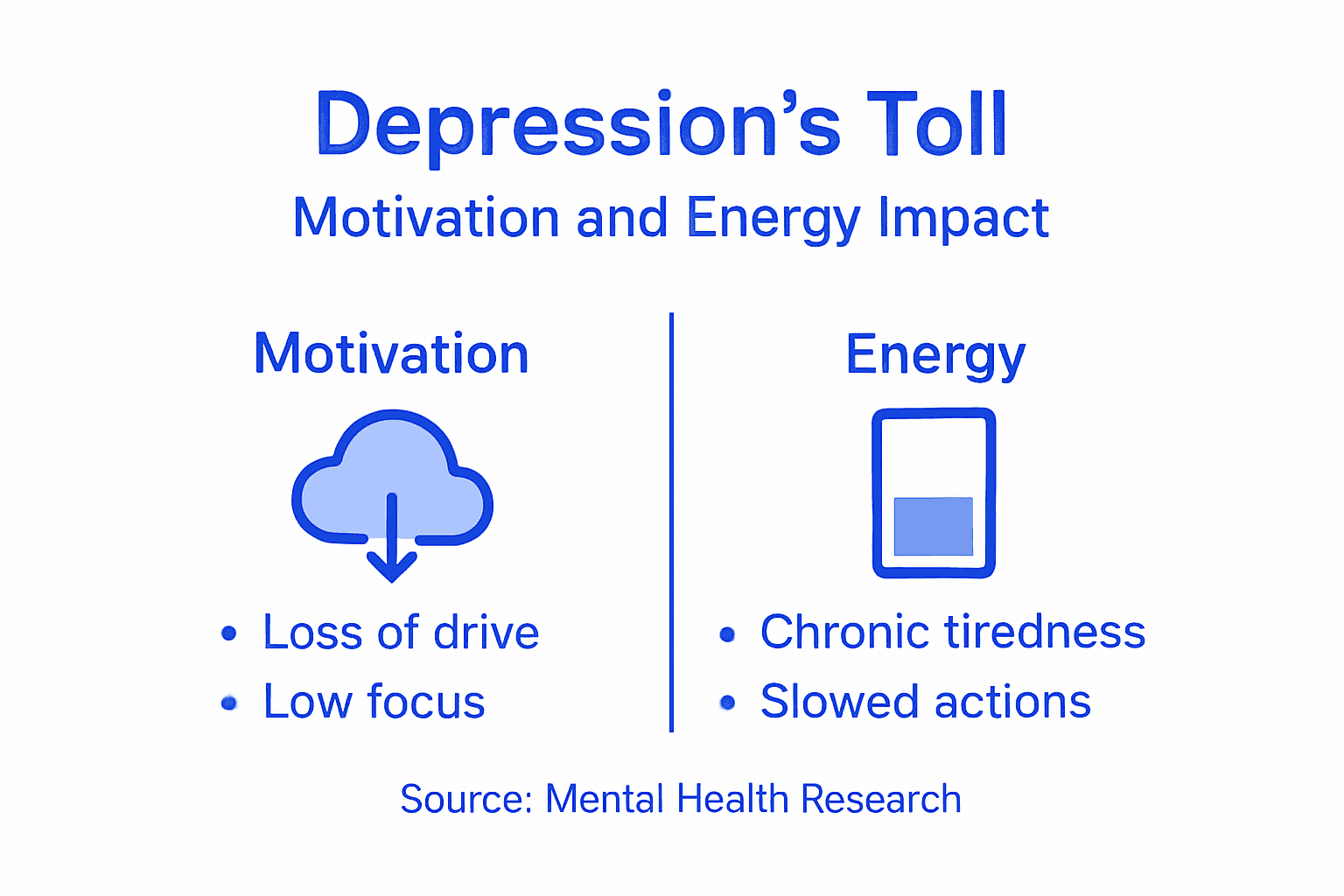
What makes depression’s impact on motivation so distinct is that it doesn’t follow normal logic. You might genuinely want to accomplish something. You know logically that you should care about it. But the connection between wanting something and actually doing it gets severed. Depression creates significant reduction in motivation and action, even when your mind intellectually knows what you want to do. This happens because depression affects your body’s fundamental systems. Your nervous system shifts into a state where initiation feels impossible. Movement feels weighted. Decisions that should be simple become paralyzing. You’re not choosing to be unmotivated. Your brain chemistry has made motivation physically unavailable to you.
The energy depletion that accompanies depression operates through a different mechanism. Most fatigue comes from exertion: you work hard, you get tired, you rest and recover. Depression’s fatigue works backwards. You could sleep twelve hours and still feel depleted. This happens because altered energy regulation underlies depression’s fatigue symptoms, involving dysregulation in how your body manages metabolic and motivational pathways. Your body becomes inefficient at producing, storing, or accessing the energy you need. The result is that even small tasks feel monumental. Getting dressed becomes an achievement. Taking a shower requires planning and recovery time. This isn’t about being weak or undisciplined. It’s about your biological systems operating in a way that depletes your reserves faster and replenishes them slower than normal.
This combination—the motivational freeze and the energy drain—creates a cycle that makes depression particularly stubborn. Because you lack energy and motivation, you accomplish less. Accomplishing less makes you feel worse about yourself. Feeling worse deepens the depression. And the cycle continues. Breaking this cycle usually requires external support, not just willpower. Speaking with a therapist who understands how depression affects your physical capacity can help you develop strategies that work with your body’s current state rather than against it. At Interactive Counselling, our therapists in Kelowna, Vernon, Grande Prairie, and Penticton specialise in helping clients recognise that this isn’t a character flaw—it’s a treatable medical condition.
Pro tip: Start with activities requiring the least energy possible, not the ones you think you “should” do—a five-minute walk, drinking a glass of water, or sitting outside—to interrupt the depletion cycle without triggering frustration from unmet expectations.
Common Symptoms Beyond Emotional Pain
When most people think of depression, they picture sadness. Someone sitting alone, feeling tearful or despondent. But if that’s all depression looked like, it would be far easier to recognise and treat. The reality is messier and more complex. Depression doesn’t confine itself to your emotional world. It invades your body, disrupts your sleep, scrambles your thinking, and changes how you interact with the people around you. Understanding these physical and cognitive symptoms is crucial because they’re often what makes depression so debilitating in daily life.
Your body becomes the first messenger that something is wrong. Fatigue hits differently than normal tiredness. You might sleep nine hours and wake up feeling like you haven’t slept at all. Your muscles feel heavy. Simple movements require conscious effort. Changes in appetite are common too. Some people lose all interest in food and lose weight without trying. Others eat constantly, seeking comfort in food even when they’re not physically hungry. Your sleep patterns shift dramatically. You might lie awake for hours despite exhaustion, or you might sleep excessively and still feel unrefreshed. Physical aches and pains appear without clear cause: headaches, back pain, joint soreness. You visit your doctor, run tests, find nothing obviously wrong, and yet the pain persists. This happens because depression involves physical symptoms extending beyond mood changes, affecting your entire bodily system.

Your mind becomes equally disrupted. Concentration becomes nearly impossible. You read the same paragraph three times and retain nothing. Work tasks that once felt manageable now feel insurmountable. Memory problems emerge. You forget conversations you had last week. You struggle to recall simple information. Indecisiveness paralyses you. Choosing between two breakfast options feels overwhelming. These cognitive symptoms mean that even when you have the energy to attempt something, your brain can’t reliably execute it. Behaviourally, depression manifests in visible ways. You might stop showering or changing clothes regularly. Social withdrawal intensifies as you decline invitations and avoid contact with friends. You become quieter, less engaged, less like yourself. These marked changes in sleep, appetite, energy, and concentration must persist for at least two weeks to meet depression’s diagnostic criteria, and they significantly impair your ability to function.
The following table summarises common symptom clusters seen in depression:
| Symptom Domain | Typical Features | Impact on Life |
|---|---|---|
| Physical | Fatigue, appetite change | Limits energy and routine activities |
| Cognitive | Poor concentration, memory issues | Affects work and decision-making |
| Behavioural | Withdrawal, less self-care | Reduces social and daily engagement |
The reason understanding these broader symptoms matters is that they’re often what prompts people to finally seek help. A Canadian adult in their thirties experiencing unexplained fatigue, struggling to concentrate at work, and withdrawing from their social life doesn’t always connect those dots to depression at first. They might think they need more sleep, better nutrition, or just need to push harder. But these symptoms working together point to something requiring professional support. This is where therapy becomes transformative. A therapist at Interactive Counselling can help you recognise how these physical, cognitive, and behavioural symptoms interconnect and develop strategies to address them simultaneously rather than treating each one separately.
Pro tip: Track your physical symptoms (sleep, appetite, energy) alongside your mood for one week using a simple daily chart, which reveals patterns you might otherwise miss and provides concrete evidence to discuss with a therapist.
Contributing Factors: Biological, Psychological, Social
Depression doesn’t emerge from a single cause. You can’t point to one thing and say “that’s why this happened.” Instead, depression results from a complex interplay of factors operating simultaneously across your biology, your psychology, and your social environment. Understanding this helps explain why depression affects people so differently and why what helps one person might not work for another.
Biological factors form the foundation. If depression runs in your family, your genetic risk increases. Your brain chemistry matters too. Depression involves imbalances in neurotransmitters like serotonin, dopamine, and norepinephrine that regulate mood, motivation, and energy. Hormonal shifts trigger depression in some people, particularly around menopause or after pregnancy. Chronic health conditions, certain medications, and poor sleep hygiene all contribute to biological vulnerability. Psychological factors layer onto this biological base. Your thinking patterns matter significantly. If you tend toward negative self-talk, catastrophising, or perfectionism, you’re more vulnerable to depression. Past trauma, particularly experiences from childhood, leaves neural imprints that make your brain more reactive to stress. Low self-esteem and difficulty managing emotions create vulnerability. Your coping strategies determine whether you bounce back from setbacks or spiral deeper. How you talk to yourself, the stories you tell about your capabilities and worth, these shape your resilience or fragility.
Social and environmental factors complete the picture. Depression risk is influenced by genetics, early life trauma, social support, lifestyle behaviours, and environmental conditions. Loneliness and weak social connections amplify depression risk dramatically. Discrimination, financial stress, and unstable housing create chronic pressure that depletes your reserves. Your daily environment matters too. Living in areas with high noise pollution or poor air quality creates ongoing stress on your nervous system. Work environments that are toxic or unrewarding drain motivation. The loss of meaningful relationships, transitions like moving to a new city, or major life changes all trigger depression in vulnerable individuals.
What makes this biopsychosocial framework so important is recognising that these factors interact in specific ways. You might have a genetic predisposition toward depression, but strong social support and effective coping skills might keep you stable. Conversely, you might have minimal genetic risk, but trauma combined with social isolation could trigger significant depression. This explains why two Canadian adults with similar life circumstances experience depression differently. Therapy at Interactive Counselling works within this framework, addressing not just what you’re thinking or feeling, but how your whole system functions. Your therapist in Kelowna, Vernon, Grande Prairie, or Penticton can help you identify which factors are most influential in your situation and develop targeted strategies addressing your unique combination of biological, psychological, and social circumstances.
Pro tip: Identify one factor from each category (biological, psychological, social) that feels most relevant to your depression, then focus on one small change in each area, since improvements across multiple dimensions create more sustainable progress than addressing one area alone.
Evidence-Based Treatments and Support Options
The good news about depression is that it responds to treatment. Unlike decades past when people simply endured depression, we now have multiple evidence-based approaches that actually work. Understanding your options helps you make informed decisions about what might work best for your situation and preferences.
Psychotherapy remains one of the most effective treatments. Cognitive-behavioural therapy (CBT) helps you identify thought patterns that feed depression and gradually shift them toward more balanced thinking. Behavioural activation works by gently pushing you to engage in activities despite low motivation, which paradoxically lifts mood. Interpersonal therapy addresses relationship patterns and life changes contributing to depression. Acceptance and commitment therapy teaches you to live meaningfully even while experiencing difficult emotions. The specific types of therapy explained for better mental health vary in approach, but research consistently shows that therapy works. What matters most is finding a therapist you trust and a modality that resonates with you. Some people respond quickly to therapy; others need time to experience shifts. Consistency matters more than intensity. Seeing a therapist weekly for three months often produces better results than sporadic sessions over a longer period.
Medication can be transformative for many people. Antidepressants don’t fix depression like antibiotics fix infection, but they can restore enough neurochemical balance that therapy becomes possible and your brain can access motivation again. Selective serotonin reuptake inhibitors (SSRIs) work for some people; others respond better to different classes. Finding the right medication sometimes requires patience and adjustment. The goal isn’t medication alone but often therapy plus medication working together. Lifestyle interventions create a foundation. Regular physical activity, even a twenty-minute walk, boosts mood and energy. Sleep quality matters enormously. Reducing alcohol consumption and improving nutrition support recovery. Social connection, despite depression’s tendency to isolate you, directly impacts how quickly you improve. These aren’t substitutes for therapy or medication, but they amplify their effectiveness.
Building your support system matters as much as clinical treatment. Having people who understand what you’re experiencing, who don’t minimise your struggle, and who show up consistently provides essential grounding. At Interactive Counselling, our approach combines professional therapy with practical support. Our therapists across Kelowna, Vernon, Grande Prairie, and Penticton understand both the clinical and human dimensions of depression. If you’re considering treatment, starting with a consultation helps you understand what approach might suit your unique situation. Whether you need individual counselling, want to understand treatment options more deeply, or need guidance on supporting someone with depression, professional support provides clarity and direction.
Pro tip: If you’re considering therapy, schedule a consultation call first to assess compatibility with the therapist before committing to sessions, since the therapeutic relationship significantly influences treatment success.
Practical Strategies for Regaining Daily Function
Depression makes everything harder. Getting out of bed feels like climbing a mountain. Completing a work project feels impossible. Replying to a text message requires energy you don’t have. But here’s what research and clinical experience show: small, deliberate actions can gradually restore function even when motivation feels absent. You don’t need to overhaul your entire life. You need micro-strategies that work with your current capacity rather than against it.
Start with the absolute smallest actions possible. Not the ones you think you “should” do, but ones requiring minimal energy. This might mean sitting outside for five minutes instead of exercising for an hour. Drinking a glass of water instead of overhauling your diet. Sending one text instead of attending a social gathering. Increasing regular physical activity, engaging in social connections, and participating in pleasant activities all help restore daily function, but the key is starting where you actually are, not where you think you should be. Depression thrives when you’re isolated and inactive, so even tiny movements in these directions interrupt the cycle. The goal isn’t perfection. It’s consistency. Doing one small thing daily beats doing the “right” thing sporadically.
Plan your actions deliberately. Rather than vaguely hoping you’ll “feel better,” write down three specific, manageable actions for tomorrow. Not ten. Not five. Three. Examples: take a shower, eat one proper meal, text one friend. When motivation is absent, written plans remove the decision-making burden. You already know what to do. You just execute. This simple practice shifts depression from an overwhelming fog into concrete, bite-sized steps. Recognize and gently challenge negative thought patterns. Depression creates distorted thinking: “I’m useless.” “Nothing will improve.” “I’m a burden.” These aren’t reflections of reality; they’re symptoms of depression. When you notice them, pause and ask: “Is that absolutely true? What would I tell a friend in this situation?” You don’t need to force positive thinking. You just need to question the automatic negativity.
Track what actually helps. After you take a small action, notice what happens. Did your mood shift slightly? Did energy improve? Did you sleep better? Recognising these connections, even tiny ones, builds evidence that recovery is happening. Over weeks and months, these micro-improvements compound into real restoration of daily function. At Interactive Counselling, our therapists in Kelowna, Vernon, Grande Prairie, and Penticton help you develop these specific strategies tailored to your situation. A therapist can help you identify which actions genuinely matter for your recovery and build sustainable routines that work with your life rather than against it.
Pro tip: Create a “depression survival kit” listing three tiny actions you can do in thirty seconds or less (drink water, step outside, text a friend), then use this list during your lowest moments when deciding what to do feels impossible.
Find Support to Restore Your Motivation and Energy
Depression’s hidden toll on your motivation and energy can leave you feeling stuck and unable to face daily tasks despite your true desire to improve. When the weight of fatigue is overwhelming and mental clarity slips away, it is not a sign of weakness but a medical experience that requires compassionate, personalized care. At Interactive Counselling, our licensed therapists across Kelowna, Vernon, Grande Prairie, and Penticton are skilled in addressing these complex symptoms through supportive therapy tailored to your unique situation.
If you are ready to break the cycle of exhaustion and regain control over your life, do not wait. Start today by exploring how our personalized therapy solutions can help restore your motivation and energy safely and effectively. Reach out now for a consultation and take the first step toward healing with a professional team who understands the challenges depression creates.
Frequently Asked Questions
What is the difference between sadness and depression?
Sadness is a normal emotional response triggered by specific events, while depression is a medical condition characterized by persistent symptoms that last longer than two weeks and require intervention.
How does depression affect motivation and energy levels?
Depression creates a significant reduction in motivation and can result in a feeling of energy depletion, making tasks seem monumental and often leading to difficulty initiating even basic activities.
What are some common physical symptoms of depression?
Common physical symptoms of depression include fatigue, changes in appetite, sleep disturbances, and unexplained physical aches and pains.
What strategies can help improve motivation when dealing with depression?
Starting with small, manageable actions, planning daily tasks, challenging negative thoughts, and tracking what helps can gradually restore motivation and daily function.
Recommended
- Depression Counselling Services | Professional Therapy Support
- Signs of Depression in Teenagers: A Practical Guide for Parents and Guardians
- Understanding the Symptoms of Bipolar Depression
- Penticton Depression Counselling | Interactive Counselling