If someone has ever told you that healing from grief happens in neat, predictable stages, they probably meant well. But the reality? It’s often messy, confusing, and doesn't follow a straight line at all. And that is completely, one hundred percent normal. Whatever you're feeling, your experience is valid, even when it feels chaotic. For more information, see our grief counselling.
"Healing isn't a linear process because grief is a reflection of love, and love doesn't follow a straight line; it ebbs, flows, and changes shape, but it never truly ends."
Your Grief Is Valid Even When It Feels Messy

When you lose someone or something precious, it can feel like you’ve been handed a map with no clear destination. One day, you might catch a flicker of hope or a quiet moment of peace, only to be pulled back into a tidal wave of sorrow the next. This back-and-forth can be incredibly disorienting, leaving you to wonder if you’re somehow “doing grief wrong.”
Let’s get one thing straight: There is no right or wrong way to grieve.
The well-known idea of moving cleanly through phases like denial, anger, and acceptance just doesn't line up with most people's lived experience. Grief is much more like a winding, overgrown trail through a dense forest than a paved, straight road. You'll encounter twists, turns, and moments where you feel completely and utterly lost. This isn't a sign that you've failed; it's simply the nature of the journey.
Understanding Your Unique Path
Your grief is as individual as your fingerprint, shaped by your personality, your life experiences, and the unique bond you shared with what you lost. No one can walk this path for you, and comparing your journey to someone else’s is a recipe for more pain.
Feeling messy isn't just normal—it’s a necessary part of the healing process. It shows you’re actively working through a profound loss and making room for all the complicated emotions that come with it. You might recognise some of these:
- Sudden, intense waves of sadness that seem to come from nowhere.
- Moments of anger or frustration at your circumstances, the world, or even the person you lost.
- A bone-deep fatigue that no amount of sleep seems to touch.
- Unexpected pockets of joy or laughter that might feel confusing or even guilty.
Simply acknowledging these feelings without judgment is a powerful act of self-compassion. Realising that your grief is valid—messiness and all—is the first real step on a genuine path to healing. It’s about giving yourself permission to feel whatever comes up, without the pressure to be “over it” by some imaginary deadline.
As you navigate this terrain, it can be a huge relief to understand why your emotions feel so overwhelming. Learning more about your own emotional responses can help normalise the experience, making it feel less like you're losing control and more like you're human.
Why the Five Stages of Grief Are a Myth
For decades, we’ve been told that grief follows a predictable path: denial, anger, bargaining, depression, and finally, acceptance. It’s a framework so deeply woven into our culture that we often treat it like a roadmap for healing. But what if that map is actually leading us astray?
The problem is, we’ve been using it all wrong. This model wasn't created for people grieving a loss. It came from psychiatrist Elisabeth Kübler-Ross's groundbreaking work in the 1960s with terminally ill patients. The stages were her observations of how people grappled with their own mortality—not how they coped with the death of someone they loved.
This fundamental misunderstanding has created a harmful myth that grief is a neat, linear process. When your own experience doesn't fit into these tidy boxes—when you feel a wave of anger months after you thought you’d found acceptance, or you never felt denial at all—it's easy to think you're failing at healing. You’re not. You’re just human.
The Reality of a Fluctuating Journey
Real grief is messy. It’s chaotic and unpredictable, and it certainly doesn't follow a script. If there’s one thing to understand about the hidden stages of grief, it’s that healing is not linear. Your emotional state is supposed to fluctuate.
Some days will feel lighter, maybe even filled with happy memories. Others might plunge you back into a deep, raw sadness without any warning. This isn't a setback; it's the natural rhythm of the healing process. It’s less like climbing a ladder and more like navigating the weather. Some days are calm and sunny, others are stormy and turbulent, and you can’t always predict the forecast.
The pressure to “move through the stages” can make you feel incredibly isolated when your grief resurfaces. Feeling delayed sadness or recurring anger isn't a sign that you're stuck; it's a normal part of a dynamic, ongoing process.
This non-linear pattern is well-supported by modern research. For instance, a fact sheet from the Canadian Psychological Association on grief in adults points out that real-world grief doesn't follow a set sequence. While about half of bereaved Canadians show resilience and don't experience a major depressive phase, many others feel a spike in sadness or anxiety four to six months after their loss. This isn't a failure to progress; it's a normal wave of adjustment as the full reality of the loss sinks in. You can read more about these findings on grief patterns to better understand these complexities.
Releasing the Pressure to Perform
Letting go of the five-stages myth can feel incredibly liberating. It gives you permission to have your own unique experience, without judgment. Your journey is yours alone, and it’s valid no matter what it looks like.
Instead of trying to force your feelings into predetermined categories, you can simply focus on noticing and honouring them as they come and go. This self-compassionate approach allows you to:
- Acknowledge your true feelings: If you feel numb when everyone expects sadness, or a moment of joy when you think you "should" be grieving, that’s perfectly okay.
- Validate the ups and downs: Good days don't mean you're "over it," and bad days don't mean you're regressing. They are all part of the same journey.
- Trust your own process: Healing doesn’t run on a schedule. By letting go of the myth, you can release the pressure to perform your grief and instead focus on what you genuinely need in each moment.
Moving away from this outdated model opens the door to a more accurate, kind, and human understanding of what grief really is. It helps you find your way forward with more patience and self-kindness.
The Hidden Landscape of Your Grief Journey
So, if we’re moving on from the old five-stage model, what does the reality of grieving actually look like? The truth is, there’s a whole hidden landscape to navigate after a loss. To understand the hidden stages of grief and why healing is not linear, we need a new map—one that reflects the complex, personal, and often unpredictable territory you're travelling through.
Think of your grief less like a straight road and more like a vast, changing shoreline. Some days, the water is calm, and you feel a sense of peace. On other days, an unexpected storm rolls in, and the waves of sorrow are all you can focus on. This constant ebb and flow isn’t just normal; it’s the very nature of healing.
Moving Between Two Worlds with the Dual Process Model
To better explain this tidal experience, grief researchers developed the Dual Process Model of Coping with Bereavement. This is a framework we often use in therapy because it resonates so deeply with what people actually go through. It explains healing as a dynamic dance between two different modes of being.
One mode is “loss-oriented”—this is when you are actively confronting the pain of your loss. You might be crying, looking at old photos, or simply sitting with your sadness.
The other mode is “restoration-oriented.” This is when you are focused on adapting to life without your loved one. You could be learning a new skill they used to handle, making plans with friends, or starting a new project.
The model shows us that swinging between these two states is not only normal but necessary. It gives you permission to step away from your pain without feeling guilty and to return to it when you need to process.
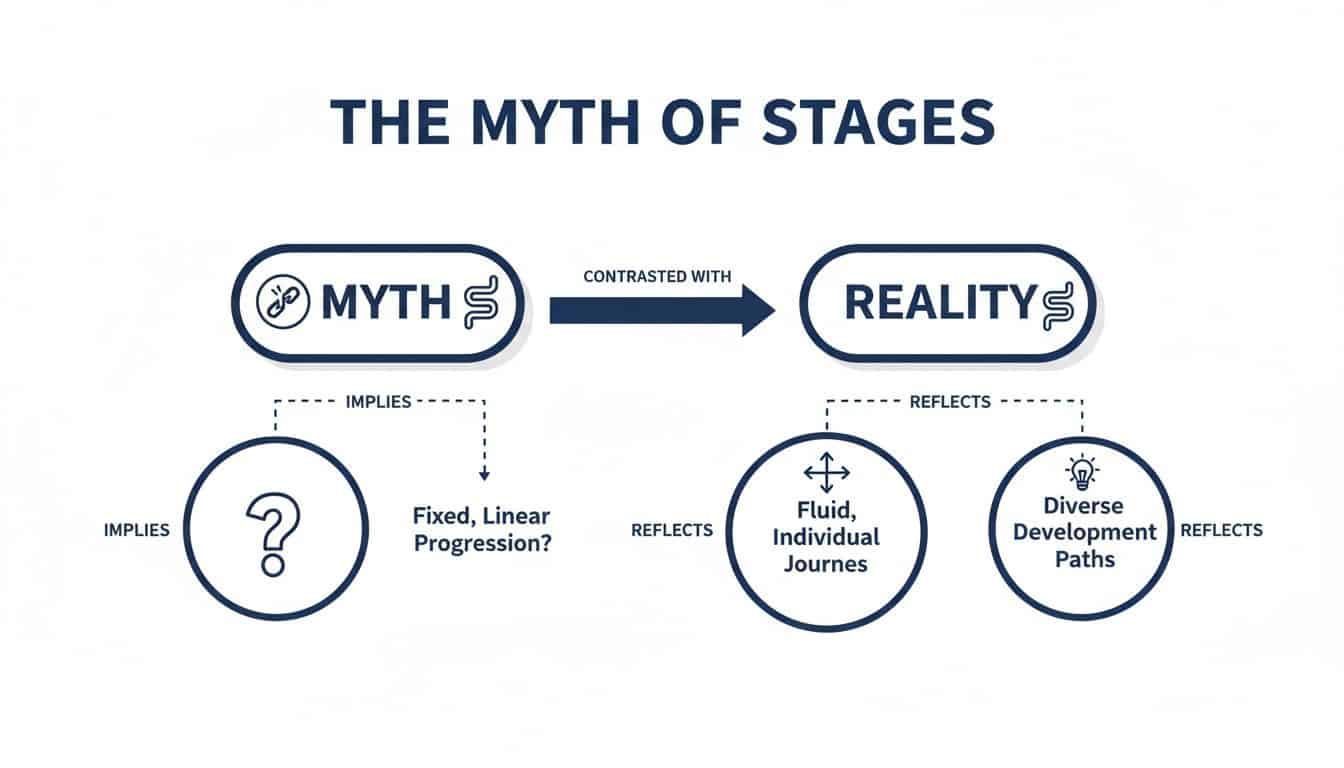
This visual really captures the difference. Grief isn't a broken timeline you have to escape. It's a fluid journey where you gradually learn to carry both your loss and your life forward at the same time.
To help you see how these ideas compare, let's break them down. This table contrasts the outdated linear myth with the more realistic, fluid experience described by the Dual Process Model.
Understanding Your Grief's Ebb and Flow
| Concept | Linear Myth (Outdated View) | Dual Process Model (Realistic View) |
|---|---|---|
| Grief's Path | A predictable, one-way street with fixed stages (denial, anger, etc.). | A fluid, back-and-forth movement between coping with loss and rebuilding life. |
| "Good Days" | Seen as "being over it" or a sign you've moved on to the next stage. | A healthy and necessary part of healing; time spent in restoration-oriented activities. |
| "Bad Days" | Viewed as a setback or failure to progress through the stages correctly. | A natural and vital part of healing; time spent in loss-oriented processing. |
| The Goal | To "get through" all the stages and achieve "acceptance" or "closure." | To integrate the loss into your life and find a new way of being in the world. |
Seeing it laid out like this helps normalise the feeling of having a good day followed by a hard one. Both are essential parts of adapting to your new reality.
Understanding Grief Spikes and Plateaus
Within this landscape, you’ll also encounter specific terrains that can feel confusing until you have a name for them. Giving these experiences a vocabulary is incredibly powerful.
Grief Spikes: Have you ever been feeling fine when a song, a smell, or a random thought suddenly plunges you back into intense sorrow? That’s a grief spike. It’s not a setback or a sign you’re going backwards. It's simply a powerful, triggered reminder of the love that’s still there.
The Grief Plateau: Sometimes, you might feel stuck. The sharp, acute pain is gone, but you don't feel like you’re moving forward, either. This is the grief plateau. While it can be frustrating, this is often a time of quiet integration, where your heart and mind are processing the loss on a deeper, less conscious level.
Moving between loss and restoration is the central work of grieving. One moment, you might be sorting through your loved one's belongings (a loss-oriented task), and the next, you could be planning a coffee date with a friend (a restoration-oriented task). Both are equally important for healing.
This oscillation isn’t a sign of confusion; it’s a sign of a healthy psyche. It’s your mind’s natural way of managing an overwhelming reality by breaking it into more manageable pieces. This same dynamic often appears in other types of loss, like the unique journey of caring for a loved one who is terminally ill.
By understanding these hidden patterns, you can find a new language for your experience. It confirms that the ups, downs, spikes, and plateaus aren’t signs you're doing it wrong. They are simply the landmarks of a journey you are navigating with strength, one day at a time.
Navigating Societal Pressures and Unseen Grief
Your grief never happens in a vacuum. It’s always unfolding against a backdrop of social expectations, well-meaning but often clumsy advice, and the unspoken rules our culture has about how to mourn. This can add another layer of pain, making you feel like your grief is something you need to manage on a schedule or hide from view.
We’re often told to “be strong” for others, put on a brave face, and get back to normal as quickly as possible. When you’re living the messy, unpredictable reality of grief, this pressure can be incredibly isolating. If you’re hit with a wave of sadness months after a loss, you might start to worry that others see it as weakness or a sign you aren't coping.
The Loneliness of Unrecognized Grief
If you've ever felt alone in your grief, you’re not imagining it. A national survey in Canada found that a staggering 50% of Canadians didn't feel they got the support they needed while grieving, and 53% felt their grief wasn't properly recognized by others. These aren't just statistics; they represent a quiet epidemic of silent suffering.
The same study revealed that 25% of grievers didn't seek any support at all, with many believing they just had to handle it on their own. It’s a powerful look at a widespread issue, and you can read the full action plan on grief support in Canada to learn more.
This lack of validation is especially sharp when your loss is one that society doesn't fully acknowledge. This experience has a name: disenfranchised grief.
Disenfranchised grief is any loss that isn't openly acknowledged, socially mourned, or publicly supported. It can leave you feeling like your pain is invisible or illegitimate, which only complicates the healing process.
This kind of grief often surrounds losses that aren't related to a death but are still profoundly painful. You might be grieving:
- The end of a marriage or a significant relationship.
- The loss of a job that was a core part of your identity.
- A major life change, like a decline in health or the loss of your independence.
- The heartbreaking death of a beloved pet.
- A close friendship that has faded or ended suddenly.
When your grief isn’t seen as valid, you don't receive the same compassion that's offered for more "traditional" losses. It can make you question your own feelings, adding shame and confusion on top of your pain. We explore this experience in much more detail in our guide to understanding disenfranchised grief.
Moving Beyond Unhelpful Platitudes
When people don't know what to say, they often fall back on clichés. You’ve probably heard them: "They're in a better place," "Everything happens for a reason," or "At least you had them for as long as you did." As well-intentioned as they may be, these phrases often shut down the conversation and minimize what you're feeling.
Real support isn’t about finding the perfect words. It’s about creating a space where your grief is allowed to just be.
What True Support Looks Like:
- Active Listening: Someone who can just sit with you in your sadness without trying to fix it.
- Specific Offers of Help: Instead of, "Let me know if you need anything," they might say, "I'm heading to the grocery store—what can I pick up for you?"
- Validation of Feelings: Simple statements like, "This must be so incredibly hard," or, "It's okay to not be okay."
- Sharing a Memory: Recalling a positive story about the person, pet, or situation you lost can be a beautiful way to honour the connection.
Learning to navigate these social pressures means giving yourself permission to honour your own timeline, no matter what anyone else expects. It's about recognizing that your loss, whatever it may be, is real and deserves to be mourned. Finding even one person who can offer this kind of genuine, non-judgmental support can make all the difference.
Practical Ways to Navigate Your Non-Linear Path

Knowing your grief won't follow a straight line is one thing; figuring out how to walk that winding path with kindness toward yourself is another. There’s no magic cure for loss, but there are gentle, real-world ways to support yourself through the inevitable highs and lows.
Try to see these strategies as tools in a kit you can turn to, not as a checklist you have to complete. It’s all about finding small, steady ways to honour your feelings while you begin to piece your life back together. When the waves of grief feel overwhelming, these practices can become the anchors that hold you steady.
Create Rituals to Honour Your Loss
In the chaos that follows a loss, rituals can bring a comforting sense of structure and meaning. They don’t need to be elaborate. In fact, some of the most powerful ways to process grief and feel connected are small, personal acts.
You might want to try:
- Lighting a candle: Take a few quiet moments each day or week to light a candle in their memory. It’s a simple, peaceful way to hold space for them.
- Making a memory box: Gather photos, letters, or little mementos that remind you of who or what you’ve lost. You can revisit this box whenever you feel the need to connect.
- Continuing a shared tradition: Did you have a favourite walk or a weekly movie night together? Carrying on that tradition, on your own or with others, is a beautiful way to keep their spirit alive in your life.
These rituals help you engage with your loss on your own terms.
Journal to Make Sense of Your Emotions
Your feelings about your loss will change, sometimes from one hour to the next. Keeping a journal gives you a private, judgment-free place to explore those shifts without having to filter yourself or explain anything to anyone. It’s a way of mapping your own non-linear path, seeing the grief spikes and the quiet plateaus as they come and go.
Don’t stress about writing well. Just let whatever is in your heart spill onto the page. Some days, that might be a flood of anger and sadness. On others, it could be a warm memory or even a flicker of hope. Every entry is a valid part of your story.
Over time, your journal can become a trusted companion. It's a place to untangle confusing thoughts, acknowledge moments of peace, and witness your own quiet resilience.
Practice Self-Compassion and Set Boundaries
On the hard days—and there will be hard days—the kindest thing you can do is treat yourself gently. Give yourself the same grace you would offer a close friend who was struggling. That means accepting that it's okay to not be okay.
This kindness also extends to protecting your own energy. It is more than acceptable to set boundaries with people who, often with good intentions, just don’t understand what you’re going through. You have every right to:
- Say no to invitations when you don’t feel up to it.
- Politely excuse yourself from conversations that feel draining or unhelpful.
- Ask for exactly what you need, whether that’s someone to just listen or a hand with a practical task.
These aren't quick fixes for "curing" grief; they are skills for learning to live with it. Building this personal toolkit helps you navigate your path with more grace, and exploring these kinds of coping skills is often how people begin to deal with grief in a supportive, therapeutic environment.
Recognizing When Your Grief Needs More Support
Grief is a powerful, deeply personal journey. Its pain is a completely normal response to losing someone or something significant. But what happens when that weight doesn't just feel heavy, but becomes crushing? How do you know when it’s time to reach out for more support?
Thinking about getting help isn’t about judging your healing process; it’s an act of strength and profound self-care. While grief is full of ups and downs, there's a real difference between a rough patch and feeling permanently stuck in overwhelming pain. It’s about learning to see when the natural path of healing might have become complicated.
Differentiating Intense Grief from Complicated Grief
For most of us, even the most gut-wrenching grief will eventually soften with time. Peace begins to find its way back into our days, and we start reconnecting with life. But for some, that initial, acute phase of grief simply doesn't let up. This is sometimes known as Prolonged Grief Disorder (PGD).
It's crucial to understand that PGD isn't the standard grief experience. It's a specific clinical condition marked by persistent, disabling symptoms that linger much longer than a typical grief reaction. If you're wondering if you need more support, see if any of these feel familiar:
- Intense, persistent yearning: An all-consuming longing for the person who died that never seems to ease.
- Identity disruption: A nagging feeling that a part of you died right along with your loved one.
- Persistent disbelief: An ongoing struggle to accept that the loss is real.
- Emotional numbness: A chronic sense of being detached from others and from your own life.
- Severe difficulty moving forward: Feeling completely unable to plan for the future or pursue things you once enjoyed.
Recognizing these signs isn't about diagnosing yourself. It’s about noticing when the pain has stopped flowing and has instead become a roadblock, preventing you from truly living.
When Grief Intersects with Other Conditions
Grief doesn't exist in a vacuum. It often magnifies or gets tangled up with other mental health challenges, like anxiety and depression. You might find yourself trapped in a cycle of worry, having panic attacks, or feeling a deep sense of hopelessness that goes far beyond the loss itself.
Seeking professional support is not a sign of weakness or failure. It’s a brave and proactive step toward understanding your experience and finding a sustainable path forward.
Working with a therapist gives you a safe, confidential space to start untangling these overlapping emotions. Having a compassionate professional guide you through the hidden stages of grief and why healing is not linear can be a game-changer, especially when your journey feels incredibly complex. The support available through professional counselling can give you the right tools to manage your unique experience.
Honouring Complex and Generational Trauma
Sometimes, our grief has roots that go much deeper than a single, recent loss. Historical and intergenerational trauma can add layers of grief that don’t follow any textbook timeline. In fact, bereavement support protocols in Canada are beginning to acknowledge this, sometimes extending for years because healing this kind of deep-seated grief takes more time.
Interestingly, while only about 10% of grieving individuals may need specialized therapy for PGD, a staggering 85% of others who don't fit the clinical criteria are often overlooked. Many of these people could still greatly benefit from support in navigating their non-linear journey. You can discover more insights about these findings here.
If your grief feels tied to a larger family or cultural story, professional support can help you honour that complexity. It provides a space to heal in a way that acknowledges your whole story, empowering you to assess your own needs with clarity and confidence.
Frequently Asked Questions About Grief and Healing
Grief can be a deeply confusing time, and it's natural to have questions bubble up as you try to make sense of it all. We’ve gathered some of the most common concerns we hear, hoping these answers provide some comfort and clarity.
Why Do I Feel Worse Months After the Loss?
This is something so many people experience, and it often catches them by surprise. It’s a classic example of grief’s non-linear path. Right after a loss, you’re often running on adrenaline, caught up in a state of shock or buried in practicalities like planning services or sorting out affairs.
When that initial whirlwind dies down and the world starts to move on, the quiet sets in. That's often when the full weight of the loss truly hits. This isn't a sign that you're getting worse or going backward. It's your heart and mind finally having the space to begin the difficult work of processing this new reality. Be kind to yourself—this delayed wave of pain is part of the process, not a failure of it.
Is It Okay to Feel Happy or Laugh While Grieving?
Yes, without a doubt. Allowing yourself to laugh at a joke, enjoy a sunny day, or feel a moment of peace doesn't mean you're forgetting your loved one or that your grief isn't profound. In fact, it's essential for your survival and healing.
Think back to the Dual Process Model we talked about. Those moments of lightness are you switching into "restoration mode." They give your mind and body a much-needed break from the exhausting work of grieving. These moments are a testament to your resilience and a beautiful reminder that joy and sorrow can, and do, coexist.
My Loss Was Not a Death. Is My Grief Still Valid?
One hundred percent, yes. Grief is the human response to loss, period. It doesn't just apply to death. The end of a marriage, the loss of a career, a difficult health diagnosis, or even moving away from a home you loved—all of these are significant losses that trigger a genuine grieving process.
Society doesn't always make space for these kinds of mourning, which can lead to what’s known as disenfranchised grief. You might feel like you don't have the "right" to be this sad. Please know that your pain is real, your loss matters, and you deserve just as much compassion and support as anyone else.
How Can I Support Someone Grieving Without Saying the Wrong Thing?
It’s a common fear, but the most meaningful support often has less to do with finding the perfect words and more to do with simply showing up. Your quiet, steady presence can be more powerful than any eloquent phrase.
Instead of reaching for platitudes like "they're in a better place," which can feel dismissive, try focusing on simple, heartfelt actions:
- Stick to the basics: "I'm so sorry. I'm thinking of you and I'm here."
- Listen more than you speak. Let them lead the conversation without feeling the need to offer solutions.
- If you feel comfortable, share a specific, positive memory of the person who passed.
- Offer concrete help. Instead of a vague "Let me know if you need anything," try "I'm going to the grocery store, what can I pick up for you?" or "Could I come by on Wednesday to mow your lawn?"
More than anything, your consistent and non-judgmental support shows them they aren’t alone in their sorrow.
Your path through grief is yours alone, but you don't have to walk it in isolation. Understanding that healing isn't a straight line can be a profound relief. It allows you to honour your experience—the good days, the hard days, and everything in between—with the patience and self-compassion you deserve. If you feel you could benefit from guidance on your journey, we invite you to learn more about how our approach might help.
Clinically Reviewed By
Amy Mosset, MCP, RCC-S
Amy Mosset is a Master Practitioner in Clinical Counselling, Clinical Supervisor, and the owner of Interactive Counselling. She provides trauma-informed, evidence-based care and clinical supervision to registered therapists, with a focus on ethical practice, client safety, and high-quality therapeutic outcomes.