You may be sitting beside the crib at 3 a.m., listening for every change in your baby's breathing while your mind runs through everything that could go wrong. Or perhaps the baby is finally asleep, but you're wide awake, tearful, tense, and wondering why this new chapter feels so different from what you expected. Your partner may be exhausted too, and neither of you knows how to begin talking about it. For more information, see our Kelowna depression counselling.
Postpartum counselling in Kelowna can give new parents a calm, confidential place to make sense of these changes. Support doesn't have to wait until you're in crisis, and you don't need a formal diagnosis before asking for help. Counselling can support emotional wellbeing, relationships, identity, coping, and practical adjustment throughout the first year after birth and beyond. For more information, see our counselling in Kelowna.
What Postpartum Counselling Really Is
A parent might arrive at a first appointment saying, “I should be happier than this.” They may describe crying during ordinary tasks, feeling disconnected from their baby, or becoming frightened by thoughts they don't want to have. Often, they're also worried that admitting these experiences means they're failing. For more information, see our depression counselling.
It doesn't.
Postpartum counselling is a private space to talk through the emotional, relational, and identity changes that follow birth. You can discuss pregnancy, labour, feeding, sleep, body changes, family expectations, co-parenting, grief, anxiety, or the loss of your former routine. You can also talk about feeling fine in some moments and overwhelmed in others. Counselling isn't reserved for people at the most severe point of distress.
Understanding the emotional spectrum
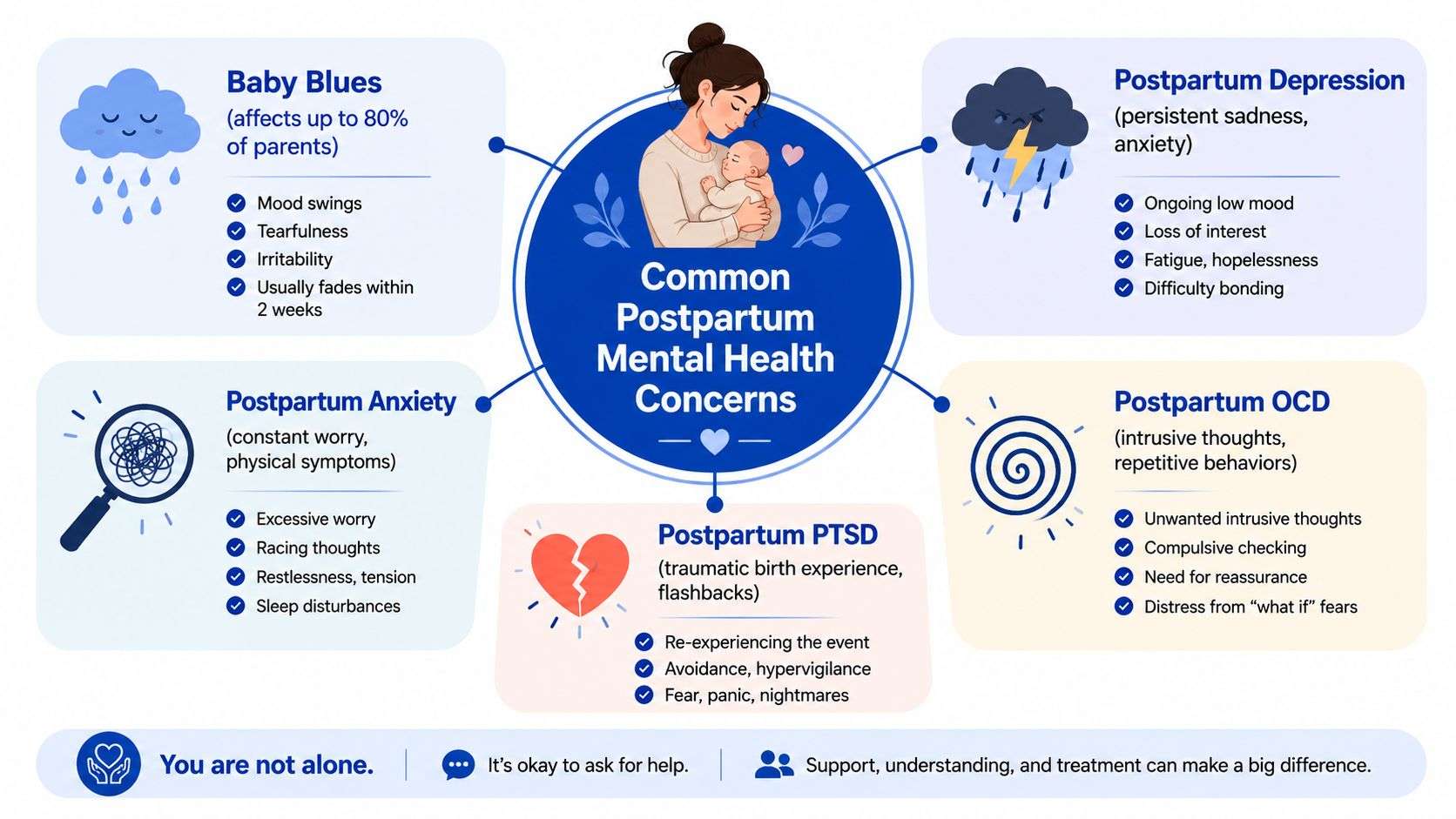
The baby blues can involve tearfulness, irritability, sensitivity, and feeling emotionally raw during the early adjustment to parenthood. These feelings may settle, but ongoing or worsening symptoms deserve attention. Postpartum depression can include persistent low mood, loss of interest, guilt, hopelessness, low energy, or difficulty feeling connected.
Postpartum anxiety may look like constant worry, repeated checking, physical tension, or an inability to rest even when your baby is safe. Adjustment difficulties can also be significant without fitting neatly into one diagnosis. You may be grieving a birth that didn't go as planned, struggling with a new identity, or feeling overwhelmed by the demands of caring for an infant.
Counselling differs from psychiatric medication management, although a counsellor can help you decide when to speak with a physician, midwife, or psychiatric provider. Sessions often combine emotional support with practical skills, such as calming the nervous system, communicating with a partner, setting boundaries, or responding differently to distressing thoughts.
A useful starting point: You don't have to prove that your struggle is serious enough. If it's affecting your sleep, relationships, confidence, or ability to enjoy daily life, it's reasonable to seek support.
Common Postpartum Mental Health Concerns New Parents Face
Postpartum mental health concerns rarely arrive as tidy categories. Anxiety may sit alongside depression. A difficult birth can affect sleep and confidence, while feeding stress can intensify conflict between partners. Naming the experience can help you choose the right kind of care.
Anxiety, depression, and intrusive thoughts
Postpartum anxiety can feel like your brain is permanently scanning for danger. You might repeatedly check the baby, fear illness, worry that you're making the wrong decision, or experience a racing heart and tight chest. These worries can become so consuming that rest feels impossible.
Postpartum depression isn't limited to sadness. Some parents feel numb, angry, ashamed, isolated, or unable to experience pleasure. Others function outwardly while privately feeling detached or hopeless. Depression may affect the birthing parent, a partner, or another primary caregiver.
Postpartum OCD may involve unwanted images or thoughts about harm, contamination, accidents, or mistakes. These thoughts can be upsetting precisely because they conflict with your values. Repetitive checking, reassurance-seeking, avoidance, or rigid routines may temporarily reduce fear but can keep the cycle going.
If you're exploring physical or nutritional support alongside professional care, discuss it with a qualified healthcare provider. Resources such as safe supplements for pregnancy hormones shouldn't replace assessment or counselling, especially during pregnancy, breastfeeding, or medication use.
Birth trauma and family distress
A traumatic birth may involve an emergency, loss of control, unexpected intervention, severe pain, separation from your baby, or feeling ignored or unsafe. You might have flashbacks, nightmares, body tension, avoidance, or intense reactions to medical settings. Sometimes the emotional impact becomes clearer only after the immediate demands of newborn care ease.
Partners and non-birthing parents can struggle too. They may feel helpless, excluded, overwhelmed by responsibility, or unable to process what happened because they focused on supporting someone else. Counselling can include individual sessions, joint sessions, or both, depending on the family's needs.
Canadian data support making this care easy to access. Statistics Canada reported that 23% of mothers who recently gave birth experienced feelings consistent with postpartum depression or an anxiety disorder in 2018/2019, while a national survey found symptoms consistent with postpartum depression in 17.9% of women and postpartum anxiety in 13.8%. These figures are reported in the Society of Obstetricians and Gynaecologists of Canada's perinatal mental health guidance.
How Counselling Helps and the Approaches Used
A good session doesn't require you to arrive with the perfect explanation. You might begin with one concrete problem, such as waking in panic, arguing with your partner, or feeling afraid to be alone with the baby. The counsellor helps you slow the problem down, understand what maintains it, and choose a manageable place to begin.
Counselling may help you:
- Feel less isolated: Say the parts out loud that you've been hiding from family and friends.
- Recognise patterns: Notice how sleep disruption, fear, self-criticism, avoidance, and conflict reinforce one another.
- Practise usable skills: Learn grounding, breathing, thought reframing, emotional regulation, and communication strategies.
- Restore confidence: Build a more compassionate understanding of your abilities as a parent.
- Make decisions: Clarify boundaries, support needs, medical questions, and conversations with your partner.

What therapy may look like
Cognitive-behavioural therapy, or CBT, examines the relationship between thoughts, feelings, and actions. A postpartum adaptation might focus on beliefs such as “If I'm anxious, I'm unsafe,” or “A good parent should manage this without help.” You may practise responding to worry without checking, avoiding, or criticising yourself.
Interpersonal therapy focuses on relationships and life transitions. Sessions may address changing roles, conflict with a co-parent, grief, social isolation, or difficulty asking family members for practical help.
Trauma-informed counselling prioritises choice, pacing, safety, and collaboration. You won't be pressured to describe every detail of a difficult birth before you're ready. The work may begin with present-day triggers, body-based calming, and restoring a sense of control.
Mindfulness-based strategies help you notice thoughts and sensations without immediately treating them as instructions. This might include brief grounding during a feeding, observing a worry, or returning attention to the present moment.
Counselling can't remove every sleepless night or guarantee that difficult feelings will disappear quickly. It can help you respond to those experiences with more understanding and support, while connecting you with medical or psychiatric care when that's needed.
What to Expect in Your First Sessions
You might join the first appointment holding your baby, sitting in a parked car, or trying to find a quiet corner while someone else watches the children. That's normal. A postpartum counsellor understands that your environment may be imperfect and that interruptions are part of early parenthood.
The first conversation usually includes introductions, confidentiality, your current concerns, and a gentle history of pregnancy, birth, and the weeks since delivery. You won't need to tell the whole story in one sitting. You can start with what feels most urgent, whether that's panic at night, sadness, anger, intrusive thoughts, relationship tension, or feeling unlike yourself.
A manageable beginning
Your counsellor may ask about sleep, support, feeding, physical recovery, safety, previous mental health experiences, and what you hope will change. These questions aren't a test. They help distinguish a short-term adjustment from concerns that need more structured care and help the counsellor recommend appropriate next steps.
Early goals might be practical:
- getting through a bedtime routine without spiralling
- asking your partner for specific help
- finding a way to rest without guilt
- reducing repeated reassurance-seeking
- feeling safer when remembering the birth
- making room for emotions that don't fit the expected story
You may learn one calming exercise, identify a thought pattern, or plan a conversation before the next appointment. Progress can be quiet. It may look like recognising anxiety sooner, taking a pause before reacting, or telling someone you need help.
Some parents worry they'll be judged, that the baby can't attend, or that they'll be forced to relive a traumatic birth. You can ask about these concerns directly. A careful counsellor will explain boundaries, adapt the pace, and discuss whether the baby can be present or whether a virtual format would work better.
You remain part of the decision-making process. Counselling should feel collaborative, not like an interrogation.
How to Choose a Postpartum Counsellor
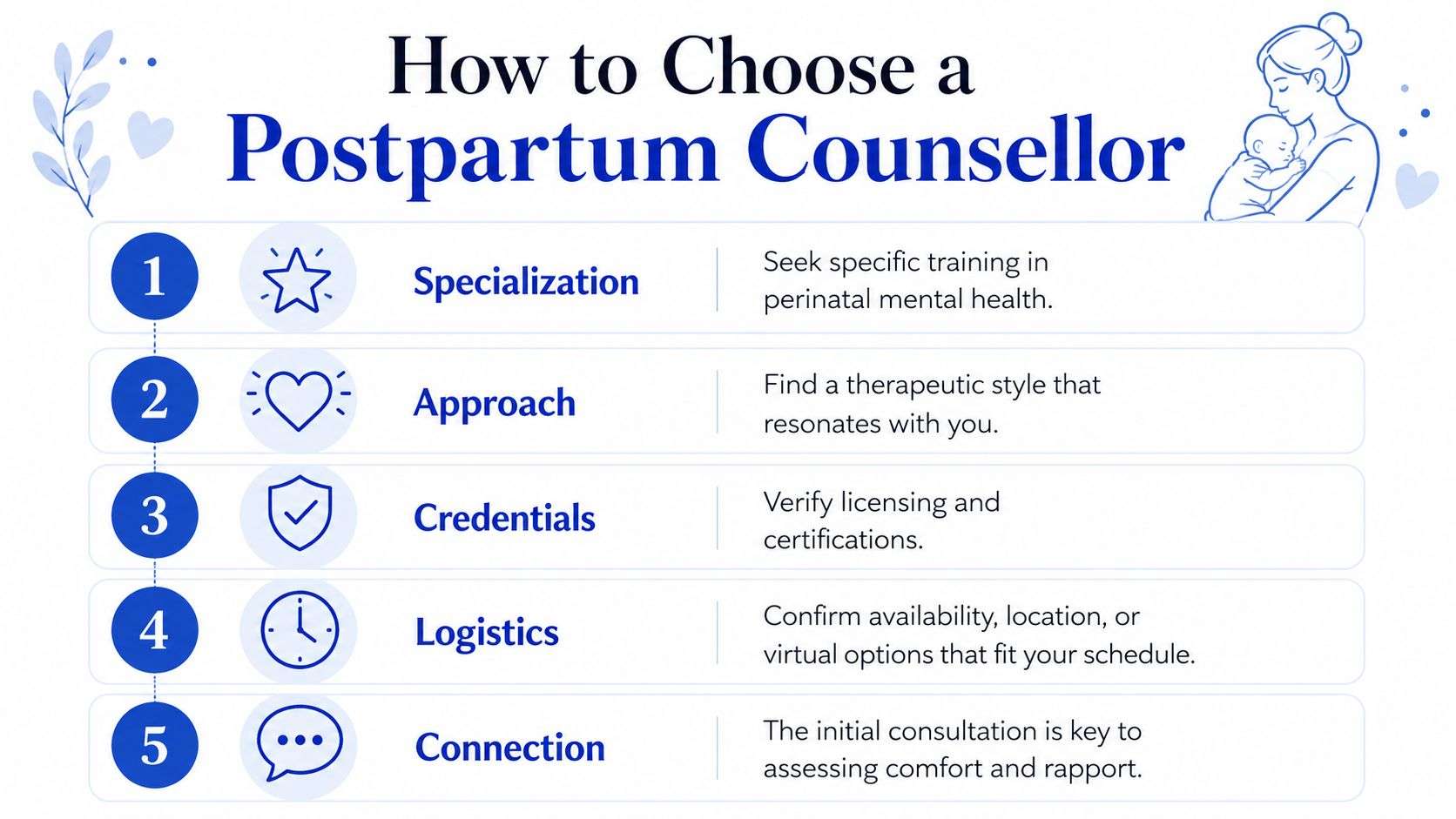
When you're sleep-deprived, comparing providers can feel like another demanding task. You don't need to find a perfect counsellor on the first attempt. You're looking for someone with relevant training, a safe approach, practical availability, and a style that allows you to speak openly.
Questions that make the choice clearer
Ask about perinatal experience. A counsellor should understand pregnancy, birth recovery, feeding pressure, sleep disruption, postpartum anxiety, depression, trauma, and the needs of non-birthing parents. Perinatal-specific knowledge matters because ordinary advice can feel dismissive when your nervous system is depleted and your responsibilities have changed overnight.
Check credentials and professional standing. In British Columbia, ask what professional designation the counsellor holds, what training they've completed, and how they maintain ethical practice. You can also ask whether they have experience with the concerns you're bringing.
Explore the approach. “How would you work with intrusive thoughts?” or “How do you support birth trauma?” gives you useful information. Look for an answer that balances compassion, education, safety, and practical treatment rather than promising a quick fix.
Discuss partners and family members. If co-parenting strain is part of the problem, ask whether the counsellor offers joint sessions or can help you decide between individual and couples counselling. The right format may change over time.
Confirm logistics. Ask about in-person appointments in Kelowna, secure virtual sessions across British Columbia, phone options, appointment timing, cancellation arrangements, and what to do if symptoms worsen between visits.
A brief introductory call can reveal whether you feel listened to. You might not know immediately, but you'll often notice whether the counsellor answers clearly and respects your questions.
If the fit feels wrong, that doesn't mean counselling has failed. A different pace, approach, or provider may suit you better. You're allowed to say that the relationship isn't working and ask about referrals or alternatives.
Accessing Support in and Around Kelowna
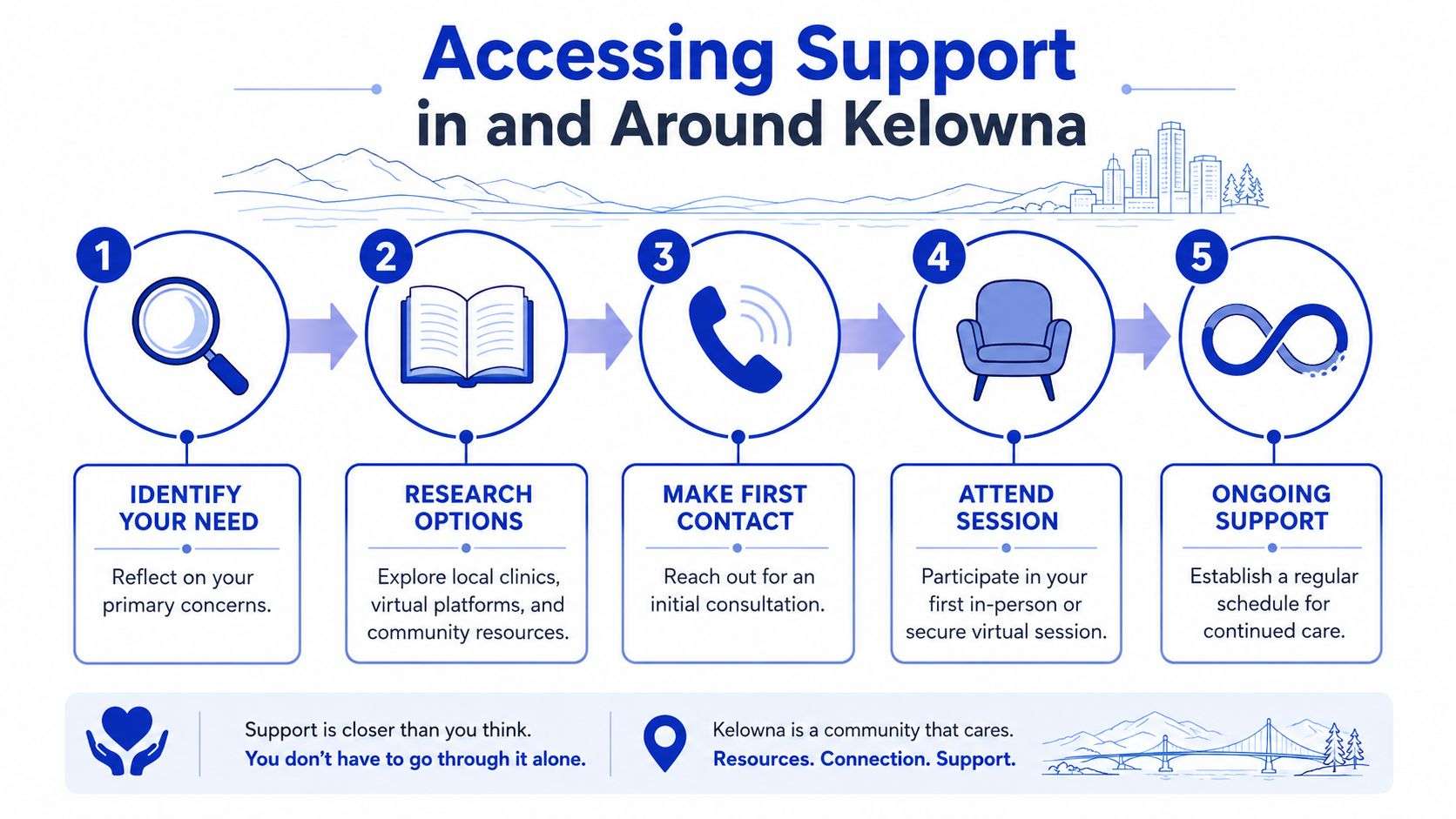
Kelowna families don't have to rely on one doorway. Postpartum support in British Columbia is organised as a stepped-care system, which means people can begin with low-barrier education or peer support and move toward psychotherapy, assessment, or psychiatry when symptoms are more persistent, impairing, or complex.
A layered route to care
A self-guided first step might include postpartumcare.ca and BC Women's reproductive mental health resources, which include education, self-care information, peer stories, BC-specific resources, and a mood and anxiety tracker. Tracking can help you describe patterns to a physician, midwife, or counsellor, but it isn't a substitute for a clinical assessment.
Phone and text support can be useful when leaving home feels unrealistic. HealthLink BC identifies the Pacific Post Partum Support Society as a province-wide telephone and text support service for mothers and families. HealthLink BC's postpartum depression information also describes telephone and home-visitation supports available through BC services.
For health questions, call 8-1-1, which can connect you with HealthLink BC guidance. The BC Mental Health Support Line, 310-6789, is available 24/7 without an area code, as described by Here to Help's postpartum depression resource.
When symptoms need faster escalation
A counsellor, doctor, or midwife can help determine whether individual therapy is enough or whether you need a specialist referral. BC Women's reproductive mental health services include care related to depression, anxiety disorders, bipolar disorder, and psychotic disorders across the period before pregnancy through after birth.
If you're in the Interior, local crisis routing can provide support outside regular counselling hours. Fraser Health lists telephone and home-visitation support for pregnant women and new mothers experiencing depression or anxiety, along with medical and 24/7 mental health contacts in its guidance on depression and anxiety supports. Although the listed regional numbers serve Fraser Health, Kelowna residents should use local Interior crisis services, 8-1-1, or 9-1-1 when immediate safety is at risk.
Gentle Next Steps and Common Questions
You don't need to solve everything today. Start by noticing the experience you're having, without arguing with yourself about whether it's “bad enough.” Persistent fear, numbness, anger, sadness, unwanted thoughts, exhaustion, relationship conflict, or a sense that you're not coping are all reasonable reasons to begin a conversation.
Then choose the lowest-friction access point. That might be a text or phone service, a discussion with your family doctor or midwife, a secure virtual appointment, or an in-person counselling session in Kelowna. One conversation can help you understand what kind of support fits.
Questions parents often hold back
Am I taking help away from someone who needs it more? No. Counselling isn't a limited moral resource that you have to earn by reaching a crisis point. Asking early can help you understand what's happening before distress becomes harder to manage.
Will counselling automatically lead to medication? Not necessarily. A counsellor can provide therapy and, when appropriate, recommend that you speak with a physician or psychiatric provider about medication. That decision should consider your symptoms, medical history, preferences, pregnancy or breastfeeding, and professional medical advice.
Can my partner be included? Often, yes. Your counsellor can help decide whether individual sessions, couples sessions, or a combination makes sense. Partner distress deserves attention even when the birthing parent is the person who first reaches out.
What if I'm having frightening thoughts? Unwanted thoughts can be distressing and deserve an honest, non-judgmental assessment. If you're experiencing hallucinations, fixed beliefs that feel real, severe confusion, or a loss of contact with reality, seek immediate help through emergency services or a hospital. If you or your baby may be in immediate danger, call 9-1-1.
What if symptoms suddenly worsen outside office hours? Use an urgent support route rather than waiting for the next appointment. Contact 8-1-1, the BC Mental Health Support Line at 310-6789, local crisis services, or emergency services when safety is at risk.
In British Columbia, a population-based study covering 189,530 deliveries found 812 postpartum psychiatric admissions, about 4 admissions per 1,000 deliveries. Depression accounted for 28.7% of admissions and substance-related disorders for 28.8%, with admissions occurring at a median of 5.5 months postpartum, according to the BC population-based study indexed by PubMed. The timing is a reminder that support may be needed well beyond the first few weeks. The same study identified stronger risk among parents younger than 20, those with a psychiatric diagnosis during pregnancy, and those treated for schizophrenia during pregnancy, so early screening and individualized care matter.
You're not weak for needing support, and you're not failing because parenthood feels complicated. Postpartum counselling is ordinary healthcare for a major life transition, not a last resort.
Interactive Counselling offers individual, couples, family, phone, in-person, and secure virtual counselling for concerns including postpartum depression, anxiety, trauma, parenting, and co-parenting. To explore a supportive next step that fits life with a new baby, visit Interactive Counselling and learn more about available care.
Clinically Reviewed By
Amy Mosset, MCP, RCC-S
Amy Mosset is a Master Practitioner in Clinical Counselling, Clinical Supervisor, and the owner of Interactive Counselling. She provides trauma-informed, evidence-based care and clinical supervision to registered therapists, with a focus on ethical practice, client safety, and high-quality therapeutic outcomes.