Taking the first step toward exploring counselling isn't a sign of weakness; it's a profound act of strength. It means you're ready to move toward something better, and it's important to know you absolutely don't have to do it alone. For more information, see our depression counselling.
Counselling for anxiety and depression is a collaborative process where a trained professional helps you understand your feelings, develop coping strategies, and change thought and behaviour patterns to improve your mental well-being.
Your Path to Healing Starts Here

Deciding to seek support can feel like standing at an open door—a little uncertain, but also filled with the possibility of light and relief. If you're reading this, you’ve already taken a courageous first step. You've acknowledged that things could be better, and you're curious about how professional support might help. This guide is here to walk with you through that doorway, demystifying the process and showing you that healing is absolutely possible.
Therapy isn't a last resort for when things are broken. Think of it as a powerful tool for anyone wanting to build a healthier, more resilient life. It's a space dedicated entirely to you, where you can explore your thoughts and emotions without any judgment.
Understanding the Landscape of Mental Health in Canada
Feeling overwhelmed by anxiety or weighed down by depression is an incredibly common part of the human experience. These challenges are far more widespread in Canada than most people realize. In fact, current data shows that 1 in 5 Canadians experiences a mental illness each year, a number that rises to 1 in 2 by the age of 40.
This reality is especially true for younger generations. Between 2011 and 2018, diagnosed anxiety disorders among Canadian adolescents doubled. By 2021, the overall rate of diagnosed mood and anxiety disorders among youth and young adults had climbed to 17.3%. These aren't just statistics; they represent millions of people navigating similar struggles. You can learn more about these Canadian mental health trends.
Why Counselling for Anxiety and Depression Works
Counselling provides a structured, supportive environment to untangle the complex thoughts and feelings that anxiety and depression create. Think of your counsellor as a skilled guide who helps you map out the internal terrain that feels confusing or overwhelming. They don’t just listen; they offer evidence-based tools and fresh perspectives to help you find your way.
This partnership helps you:
- Gain Clarity: Understand the root causes and triggers behind your feelings.
- Build Skills: Learn practical coping strategies to manage symptoms in your daily life.
- Change Patterns: Identify and shift the unhelpful thought and behaviour cycles that keep you stuck.
- Foster Resilience: Develop the inner strength to navigate future challenges with more confidence.
Starting on this journey is a real investment in your long-term well-being. It’s about more than just feeling less anxious or sad—it's about creating a more fulfilling and connected life. If you're ready to learn more, exploring your options for professional counselling is a great next step.
Recognizing When It’s Time to Seek Professional Support
Deciding to get support is a deeply personal choice. It usually starts not with a dramatic crisis, but with a quiet, persistent feeling that something just isn't right. It's less about ticking boxes on a clinical checklist and more about noticing how your inner world is starting to shrink your outer one.
Many people wait until they hit a breaking point to reach out, but counselling is a powerful tool you can use long before you get there.
Maybe you’re living with a constant, low hum of unease—that feeling like you’re always braced for something to go wrong. Or perhaps the things that once brought you joy now feel distant and colourless, and just thinking about them feels exhausting. These aren't signs of weakness. They are simply signals from your mind and body that you're carrying too heavy a load.
Moving From Surviving to Thriving
It’s easy to brush off persistent worry or a flat mood as just "a rough patch." We tell ourselves to just push through it. But when that rough patch stretches into weeks, then months, it starts to take a real toll. The clearest sign it’s time to consider professional support is when these feelings begin to get in the way of living the life you actually want.
Think of it like having a pebble in your shoe. At first, you might just ignore it. But after a while, that tiny irritation will change the way you walk. You’ll start avoiding certain paths, and eventually, it will cause real pain. Anxiety and depression work the same way, subtly chipping away at your daily life until you realize you’re living in a much smaller, more restricted world than you used to.
Common Signs It Might Be Time to Talk to Someone
Recognizing these signs in yourself is an act of self-awareness and real compassion. It’s about acknowledging your own experience without layering on any judgment. If you're wondering whether counselling could help, see if any of the following feel familiar:
- Your Sleep Is Consistently Disrupted: You either can't fall asleep because your mind is racing, or you wake up throughout the night. On the flip side, you might be sleeping far more than usual but still feel completely exhausted.
- Relationships Are Feeling Strained: Maybe you’re more irritable, withdrawn, or quick to feel hurt in your interactions with loved ones. It can feel harder to connect, leading to a sense of isolation even when you're surrounded by people who care.
- Daily Tasks Feel Overwhelming: Things that used to be no big deal—work projects, household chores, even simple decisions—now feel monumental. This often leads to a cycle of procrastination, which only makes you feel more behind and overwhelmed.
- You've Lost Interest in Hobbies and Passions: Activities that once filled you up now just seem draining or unappealing. This loss of enjoyment, sometimes called anhedonia, is a classic sign of depression.
- You Rely on Unhelpful Coping Mechanisms: You might notice you're leaning more on things like emotional eating, doom-scrolling, or avoiding social events to manage how you feel. These can offer a quick escape but often make things worse in the long run. To better understand the nuances, you might be interested in our guide on recognizing the signs of anxiety.
If these experiences resonate, it doesn't mean you're broken. It just means you're human, and you've been navigating a difficult emotional landscape on your own for a while. Reaching out for counselling is a proactive, powerful step toward finding your footing again and rediscovering a sense of balance.
Exploring Evidence-Based Therapies That Genuinely Help
Deciding to get support is a huge step. The next natural question is, what does counselling for anxiety and depression actually look like? There's no single, one-size-fits-all answer because good therapy isn't a generic prescription. Instead, it’s a collaboration where a skilled counsellor draws from proven, evidence-based approaches to fit your specific needs, personality, and life story.
Think of it like hiring a personal trainer. You wouldn't want someone who gives every client the exact same workout plan, right? You'd want an expert who understands the fundamentals of fitness but also takes the time to learn about your body, your goals, and your limits. Therapy works the same way. Your counsellor is a guide trained in effective methods designed to help you understand your inner world and build practical skills to navigate it.
The good news is that these methods are backed by solid research and have helped countless people find relief and build resilience. Often, the need for this kind of support becomes clear when our internal struggles start seeping into the core areas of our lives—our sleep, our relationships, and our ability to simply enjoy the day.
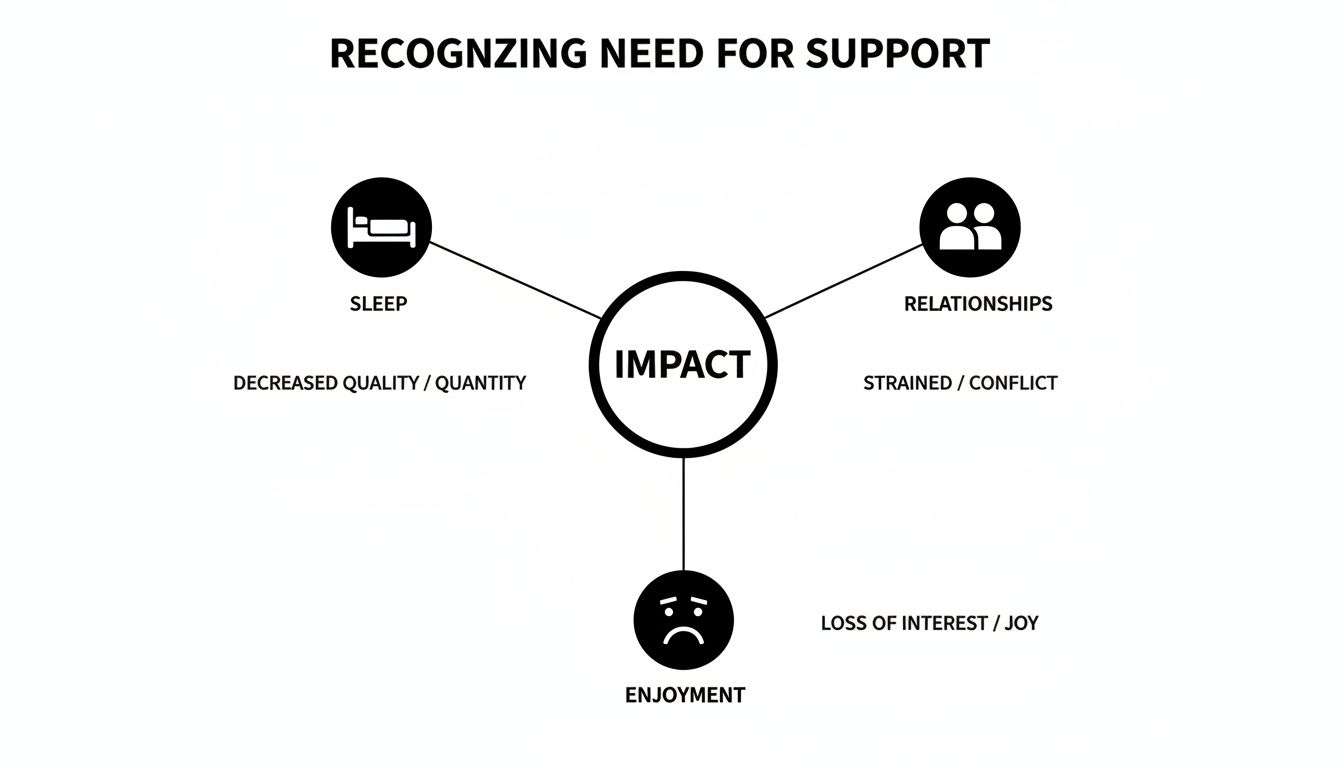
As this image shows, when these fundamental parts of our well-being start to suffer, it's often a clear signal that it's time to reach out. Let's look at some of the most effective therapeutic roadmaps your counsellor might use to help you find your way back.
Cognitive Behavioural Therapy (CBT)
Cognitive Behavioural Therapy (CBT) is one of the most widely recognized and effective approaches out there, and for good reason. The main idea is simple but powerful: our thoughts, feelings, and behaviours are all connected. It's often not an event itself that causes us pain, but the story we tell ourselves about that event.
Imagine you send a text to a friend and don't hear back for a few hours. An anxious thought might immediately jump to, "They're mad at me," or "I must have said something wrong." That thought can spark feelings of worry and sadness, which might then lead you to avoid your friend, making the whole situation worse.
CBT helps you become a detective of your own mind, learning to spot these automatic negative thoughts. In sessions, you learn how to:
- Identify the unhelpful thought patterns that fuel your anxiety or depression.
- Challenge these thoughts by looking for real evidence, like a detective examining a case.
- Reframe them into more balanced and realistic perspectives.
This isn't about forcing yourself to "think positive." It's about building a more flexible, accurate, and compassionate way of thinking. You’ll walk away with practical tools, like thought records, that you can use in your daily life to manage difficult feelings as they pop up. You can learn more about how a cognitive therapy thought record works and see how practical it can be.
Acceptance and Commitment Therapy (ACT)
While CBT focuses on changing your thoughts, Acceptance and Commitment Therapy (ACT) takes a slightly different angle. ACT helps you build a new relationship with your difficult thoughts and feelings, rather than trying to wrestle them into submission. It’s based on the idea that pain is a normal part of the human experience, and trying to fight it often just makes it stronger.
Think of your anxiety as a monster in the back of your car. You can spend all your energy trying to push it out, but you'll end up swerving all over the road. ACT teaches you how to let the monster sit there, acknowledge its presence, and keep your hands firmly on the wheel, driving toward what truly matters to you.
This approach uses mindfulness to help you observe your thoughts and feelings without getting tangled up in them. It also helps you get crystal clear on your personal values—the things that give your life meaning—and use them as a compass to guide your actions, even when anxiety or sadness is along for the ride.
Eye Movement Desensitization and Reprocessing (EMDR)
Eye Movement Desensitization and Reprocessing (EMDR) is a highly structured therapy that is incredibly effective when anxiety or depression is linked to past trauma. When something traumatic happens, the memory can get "stuck" in the brain, causing you to re-experience the sights, sounds, and feelings as if it's happening right now.
EMDR uses bilateral stimulation—like guided eye movements or alternating taps—while you briefly focus on the traumatic memory. This process helps your brain finally process the memory correctly, filing it away in the past where it belongs. The memory doesn't vanish, but it loses its painful emotional charge.
What to Expect in Your First Counselling Sessions

Starting any new journey can feel a bit intimidating, and counselling is no different. It’s completely natural to wonder what will happen behind that door. The good news is that your first session isn’t a test or an interrogation; it's simply a conversation designed to help you feel safe, heard, and understood.
Think of it as a gentle introduction. The real focus is on building a connection—what therapists call the therapeutic alliance. This trusting relationship is one of the most powerful predictors of successful therapy. You’ll have the chance to share your story at your own pace, and your counsellor will listen with compassion and zero judgment.
Building Your Foundation Together
Your first few appointments are all about laying the groundwork for your time together. You are the expert on your own life, and your counsellor is there to offer guidance and a supportive space for you to explore it. This is a partnership, through and through.
Together, you and your counsellor will start to map out what you hope to achieve. These aren’t generic, one-size-fits-all goals, but ones that are deeply personal and meaningful to you.
Possible goals might include:
- Developing practical skills to manage panic attacks.
- Understanding the root causes of persistent feelings of sadness.
- Improving communication in your most important relationships.
- Learning to set boundaries that protect your emotional energy.
What a Typical Session Looks Like
While every session is unique, most follow a gentle rhythm of conversation and collaboration. It’s dedicated time for you to talk openly about what’s on your mind—your struggles, your worries, and also your strengths and hopes for the future.
Your counsellor will listen actively, ask thoughtful questions to help you see things from a new angle, and may introduce simple, evidence-based tools you can start using right away. You’ll work together to gently explore the thought and behaviour patterns that might be keeping you stuck, all within a confidential environment where your privacy is protected.
Unfortunately, many people who could benefit from support face significant barriers to getting it. Research shows a high percentage of adults with diagnosed mental health disorders feel their needs are only partially met or completely unmet, with rates as high as 48% in some provinces. You can learn more about the research on mental health care access to see the full picture.
Ultimately, a counselling session is your time. It is a space carved out just for you, where you can be vulnerable, honest, and truly yourself without fear. This collaborative and respectful process is the heart of effective counselling for anxiety and depression.
Finding the Right Counsellor For You
Finding a counsellor you genuinely connect with is arguably the most important step in the entire healing process. While qualifications and therapy methods are definitely important, the real magic happens in the relationship you build together. This connection is what we call the therapeutic fit. It’s that feeling of being truly seen, heard, and respected in a space that feels safe and completely free of judgment.
Think of it like finding a trusted guide for a tough mountain hike. You absolutely need someone with the right map and skills, but you also need to feel confident they get your pace, respect your limits, and will be right there to support you if you stumble. The right person makes the whole journey feel more manageable and, most importantly, more hopeful.
Understanding Professional Credentials
Before we get into the personal side of things, it’s helpful to know what all those letters after a counsellor’s name actually mean. In British Columbia, for example, a common and respected designation is Registered Clinical Counsellor (RCC). This title isn't just jargon; it’s your assurance of quality and safety.
An RCC designation tells you the counsellor:
- Holds a master's degree in counselling or a related field.
- Has completed extensive supervised clinical practice.
- Follows a strict code of ethics and professional standards.
- Is committed to ongoing education to keep their skills sharp and current.
Choosing a registered professional ensures you're working with someone who is accountable, ethical, and has the training to provide care that’s backed by research. It’s the solid foundation upon which a trusting therapeutic relationship can be built.
The Importance of the Therapeutic Fit
Beyond the credentials, the therapeutic fit is all about human connection. Study after study has shown that a strong bond between you and your counsellor is one of the most powerful predictors of a positive outcome—sometimes even more so than the specific type of therapy used.
Why? Because healing requires vulnerability, and we can only allow ourselves to be truly vulnerable with someone we trust.
This fit is deeply personal. What works wonders for your friend might not be the right fit for you, and that’s perfectly okay. It’s about finding a personality, a communication style, and a presence that makes you feel comfortable enough to open up and explore the tough stuff. You have every right to be selective and find someone who feels right for you.
Questions to Help You Find Your Fit
So, how do you know if a counsellor is the right one? The best way is to have an initial conversation, often called a consultation, and treat it like a gentle, two-way interview. You're not there to be judged; you're there to see if this partnership feels right.
Here are a few questions you can ask a potential counsellor to help you get a feel for their approach. It’s also helpful to ask these questions of yourself after the conversation.
- Can you describe your approach to counselling for anxiety and depression? This helps you understand their philosophy and see if it resonates with what you're looking for.
- How do you help clients set and work toward their goals? This gives you a peek into how collaborative and structured their process is.
- What does a typical session with you look like? This paints a picture of the session dynamic—is it more conversational, skill-based, or exploratory?
- How will we know if we're making progress? A good counsellor will be able to talk about how they track progress with you to make sure you’re moving forward.
After your chat, take a moment to reflect. Ask yourself: Did I feel heard and respected? Did their communication style put me at ease? Do I feel a sense of hope after talking with them? Trust your gut on this one. Your feelings are a valid and vital guide in this decision. Taking the time to find the right person isn't just a small step—it's a true investment in your well-being.
Your Practical Next Steps Toward Feeling Better
Taking the time to read through this guide is a real, meaningful step. You've just armed yourself with knowledge about what counselling is, how it works, and what to expect, and that alone is a huge act of self-care.
The path to feeling better isn't some dramatic, overnight transformation. It’s built on a series of small, brave choices—and you’ve already made a few of the most important ones just by being here.
Remember, the point isn’t to find a quick fix. It’s about finding a professional you can partner with, someone who can offer solid guidance, practical tools, and steady support. Lasting, genuine change is completely possible, and reaching out for help is a sign of incredible strength.
Reflect and Move Forward
So, where do you go from here? Getting started can feel like the hardest part, but you don't have to figure it all out at once. You can start with a few small, practical actions right now.
- Check in with yourself: Take a quiet moment. What part of this guide really hit home for you? What kind of support feels like it would actually help right now?
- Just browse: You don't have to commit to anything today. Simply scrolling through a few therapist profiles to see who’s out there is a productive step. Get a feel for different approaches and personalities.
- Acknowledge your own courage: Give yourself credit for getting this far. Every bit of curiosity and every question you’ve asked yourself has been progress.
You’ve built a great foundation of knowledge. When you feel ready, the next step is simply reaching out. To get a clearer picture of what that looks like, our guide on how to start therapy in Canada breaks down the practical side of things.
No matter where you are on your path, please know you aren’t alone in this. Support is here, and you absolutely deserve to feel seen, heard, and hopeful about what's next.
Frequently Asked Questions About Therapy
Stepping into counselling for anxiety or depression is a big deal, and it's totally normal to have questions swirling around. Feeling curious, hopeful, or even a little nervous is all part of the process. Below are some straight-up, honest answers to the questions we hear the most, designed to give you some clarity as you think about what’s next.
How long does counselling for anxiety and depression take?
This is one of the first things people ask, and the honest answer is: it’s as unique as you are. There's no set timeline or magic number of sessions. The journey of healing is deeply personal. For some, a few focused months are enough to gain the skills and clarity they need to move forward. For others, especially those working through deeper, long-standing patterns or complex life events, longer-term support feels more right. The goal isn’t to keep you in therapy forever. It's about empowering you with the tools and self-awareness to handle life’s ups and downs with confidence, long after your sessions are done. Your counsellor will work with you to map out your goals and will check in often to make sure the process is still working for you.
Is what I share in counselling confidential?
Yes, absolutely. Confidentiality isn't just a promise; it's a sacred and legally protected pillar of therapy. It's the bedrock of trust that makes real healing possible. Everything you say to your counsellor stays between you and them. This creates a safe space where you can be completely open and vulnerable, without ever worrying about judgment or your privacy. The only exceptions, which are required by law, are situations where there's an immediate risk of serious harm to you or someone else, or if there is suspected child abuse. Your counsellor will go over this with you clearly in your first session so you feel completely informed and secure.
Can counselling help if I'm also taking medication?
Absolutely. In fact, therapy and medication often work hand-in-hand as a powerful team for managing anxiety and depression. Think of them as two different tools supporting you in complementary ways. Medication, prescribed by a doctor or psychiatrist, can help regulate your brain chemistry, taking the edge off your symptoms. This often creates the stability you need to dive deeper into the root issues during your therapy sessions. Counselling, on the other hand, is where you do the work of understanding why you feel the way you do. You'll learn practical coping skills and start changing the underlying thought and behaviour patterns that have been holding you back.
What if I don’t feel a connection with my counsellor?
This is such a great and important question. The relationship you have with your counsellor—what we call the "therapeutic alliance"—is one of the single biggest predictors of whether therapy will be successful. It is perfectly okay if you don't click with the first counsellor you meet. You should never feel like you have to stick with someone if the connection doesn't feel right. Feeling safe, respected, and truly understood is non-negotiable. Any good therapist knows this and will never take it personally if you decide they're not the right fit. In fact, they’ll support you in finding someone who is. Trust your gut on this one—you deserve a therapeutic partnership that feels right for you.
If you’re ready to learn more, we invite you to explore our services and see how professional support can make a difference.
https://interactivecounselling.ca
Clinically Reviewed By
Amy Mosset, MCP, RCC-S
Amy Mosset is a Master Practitioner in Clinical Counselling, Clinical Supervisor, and the owner of Interactive Counselling. She provides trauma-informed, evidence-based care and clinical supervision to registered therapists, with a focus on ethical practice, client safety, and high-quality therapeutic outcomes.