You've been trying to keep up, but the harder you push, the more the same problems keep showing up, missed details, unfinished tasks, forgotten appointments, emotional overload, and the quiet worry that maybe you've just been “bad at life” for too long. For many adults in Kelowna, that pattern is exactly what sends them looking for adult ADHD counselling in Kelowna, assessment support and everyday strategies, especially after anxiety, burnout, or depression has already entered the picture. For more information, see our Kelowna counselling.
“Adult ADHD counselling in Kelowna can help you sort out what's ADHD, what's something else, and what to do next.”
Recognizing When Adult ADHD Might Be the Missing Piece
A lot of adults don't arrive at the ADHD question because they're curious. They arrive because they're tired. They've already tried pushing harder, colour-coding their calendar, setting more alarms, or promising themselves they'll “get it together” next week, and nothing sticks for long.
When the pattern feels bigger than stress
A common starting point is an adult who looks functional from the outside, but feels like they're always one step behind. They may manage work, parenting, or school by sheer effort, then collapse at home with a racing mind and a pile of unfinished tasks. If that sounds familiar, it's worth knowing that current depression or anxiety is one of the situations that should prompt consideration of ADHD, and CAMH recommends the Adult ADHD Self-Report Scale as a screening tool to help decide whether ADHD should be considered, often with partner input as well, even though it does not make the diagnosis.
That matters because ADHD in adults often gets hidden inside labels like “burnout,” “anxiety,” or “not coping well enough.” A counsellor can help you sort through the overlap without jumping straight to conclusions. They can also help you describe what's happening in daily life, which is often the hardest part when your own experience has been dismissed for years.
Practical rule: if you keep blaming yourself for the same attention, organisation, and follow-through problems, it's reasonable to ask whether ADHD belongs in the picture.
What counselling can hold before diagnosis is confirmed
Counselling is not a shortcut around diagnosis, and it doesn't replace a medical assessment. It does give you a place to start making sense of your story while you wait, wonder, or decide whether to pursue formal testing.
For many adults, that first step is less about getting a label and more about getting traction. A skilled counsellor can help you notice patterns, organise examples, and begin using strategies that make ordinary life feel less chaotic. That can be especially helpful when symptoms overlap with stress, low mood, poor sleep, or emotional exhaustion, because those overlaps are exactly where people get confused and stuck.
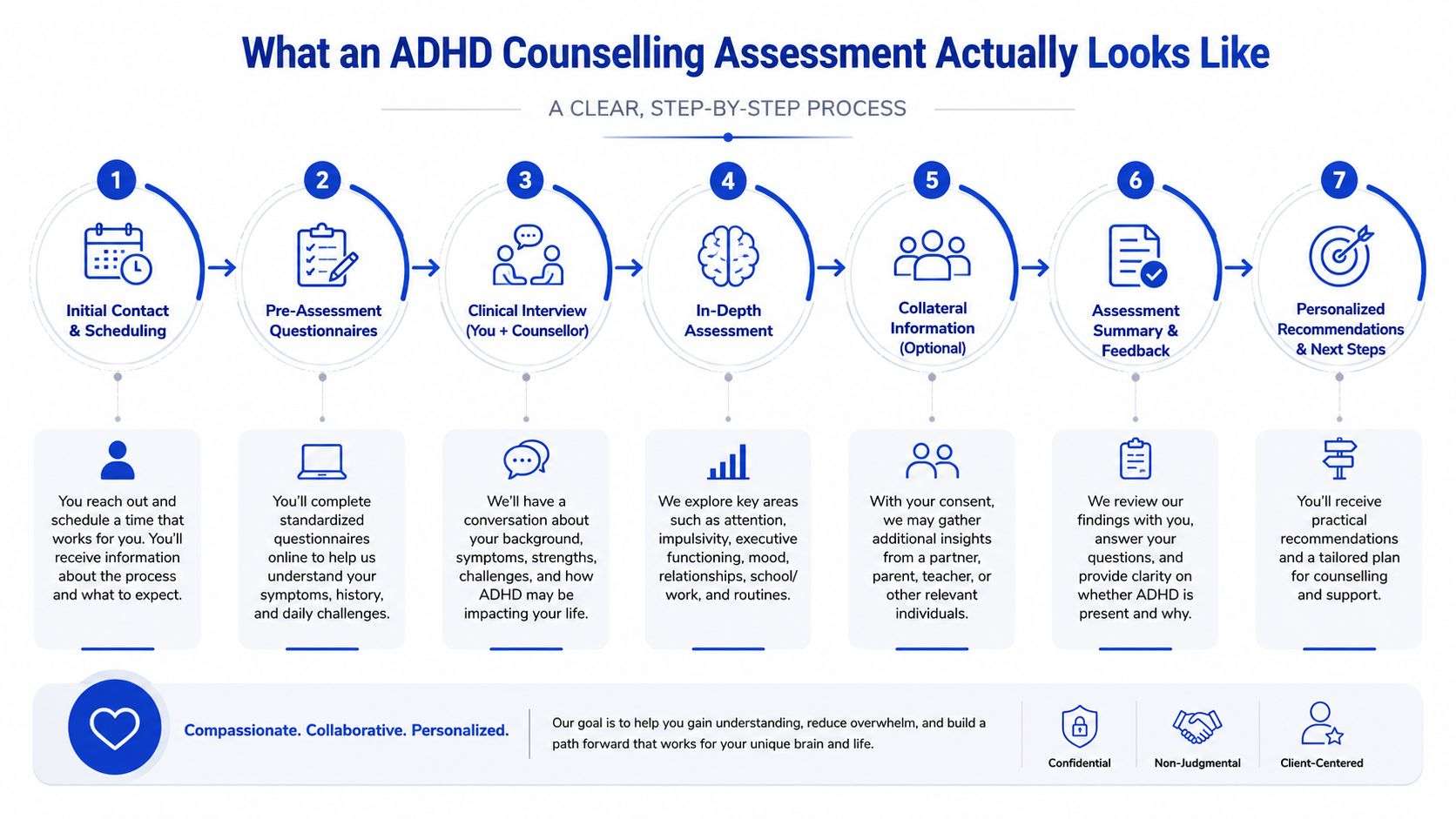
What an ADHD Counselling Assessment Looks Like
A counselling assessment for adult ADHD usually starts as a structured conversation, not a quick yes-or-no verdict. It begins with your history, your current struggles, and the parts of life that are being affected, then moves toward a plan for what happens next. If you are expecting a label to appear in one short conversation, that is usually not how this works.
The difference between counselling support and diagnosis
A formal adult ADHD assessment is a medical process. In British Columbia, the public pathway is generally covered by MSP when the assessment is done by a psychiatrist or physician, while private assessments are commonly listed in the $1,800 to $4,500 CAD range, with many providers clustering between $2,200 and $3,500.
A counsellor's role is different. The adult ADHD assessment quality assurance standard says the direct contact time is likely to be at least 2 hours in most cases, across one or multiple sessions, and may take longer when cases are more complex. By contrast, a first ADHD counselling session in Kelowna is commonly 50 to 60 minutes, which fits an intake-and-planning model rather than a full diagnostic workup. Adult ADHD assessment standard
That distinction matters because counselling can help you prepare for the diagnostic pathway. It is often the place where people finally gather the details they have never organised before, like childhood patterns, work problems, relationship friction, or the places where life repeatedly falls apart in the same way.
What you may be asked to bring
A useful intake usually includes:
- Symptom examples: concrete moments where attention, follow-through, or time management broke down.
- Functional impact: how these issues affect work, home life, relationships, or self-esteem.
- History notes: old report cards, prior diagnoses, medication history, or family patterns if you have them.
- Current supports: what you have already tried, and what helped even a little.
A local service example shows how some Kelowna pathways split the process into pre-assessment appointments with a Registered Clinical Counsellor plus a physician appointment, and some clinic booking systems are first-come, first-served, which affects pacing and wait time. Stepping Stones Okanagan ADHD assessments
This is rarely the whole story in the first session. It is the point where you and the counsellor decide whether the next step is screening, referral, more detailed history gathering, or a strategy plan you can start using right away. When clients feel relieved after that first meeting, it is often because someone has finally helped them separate the mess into understandable parts.
Evidence-Informed Therapy Options for Adult ADHD
Adult ADHD counselling works best when it's practical. People usually don't need a lecture about trying harder, they need support that changes what happens on Monday morning when the email queue, the laundry, and the overdue forms all land at once.
Skills-based therapy is not just “talking about it”
Evidence-informed ADHD counselling in Canada tends to focus on practical coping strategies, not a cure. One BC counselling provider describes ADHD as a neurodevelopmental condition, not something to be “cure,” and offers sessions in-person in Kelowna and virtually across British Columbia and Alberta.
That framing matters. It moves the conversation away from shame and toward skill-building. In practice, therapy often targets executive-function challenges like planning, time estimation, task initiation, and emotional regulation through repeated practice, accountability, and problem-solving. Those are not abstract goals. They are the exact places adult life tends to unravel.
How counselling supports treatment without replacing it
Counselling is often one part of a broader support system that may also include medication and self-care. That combination makes sense because adult ADHD rarely shows up as one neat symptom. It shows up as the missed bill, the forgotten reply, the pile of half-started jobs, or the emotional crash after a day of masking.
Counselling works best when it helps the client build a life structure that supports the brain they actually have.
A helpful comparison is this: diagnosis tells you what you're dealing with, but counselling helps you decide what to do on a Tuesday afternoon when your attention is gone and your motivation has disappeared. That might include building routines, setting up reminders, reducing overload, or learning how to recover after a derailment without spiralling into self-criticism.
For adults in Kelowna, the practical value is that support can happen locally or virtually, which reduces friction when energy is already stretched thin. If leaving the house is the hardest part, online care can lower that barrier without lowering the quality of the conversation.
Everyday Strategies That Actually Fit Adult Life
Generic productivity advice falls apart quickly when you're dealing with ADHD plus real life. A parent juggling school pickups, a professional working on tight deadlines, and someone recovering from burnout all need different strategies, even if the underlying attention problem looks similar.
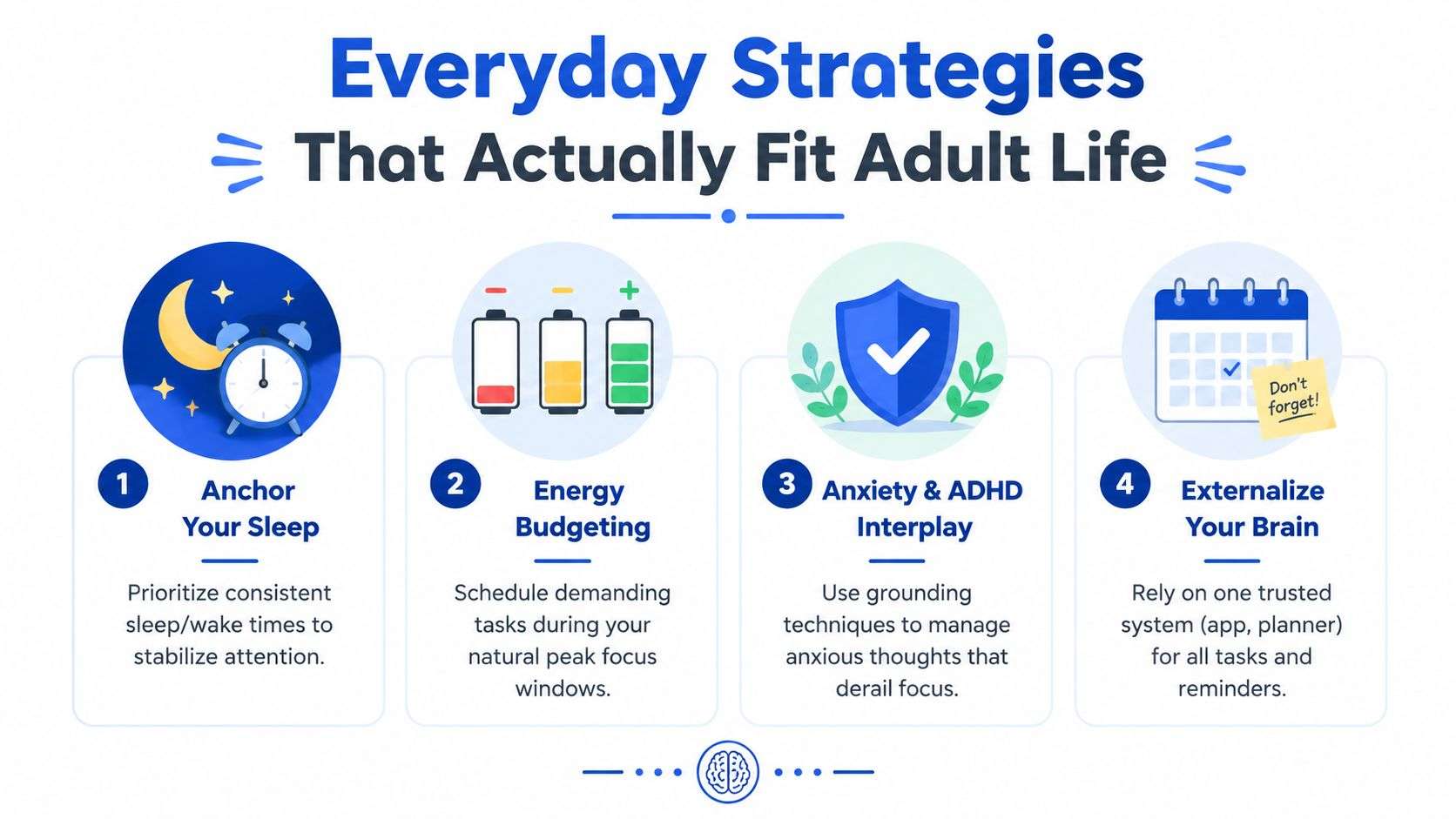
Start with structure, not motivation
One of the most useful shifts is to stop waiting for motivation to arrive before acting. Adults with ADHD often do better when they rely on a single trusted system, such as one planner or one app, instead of scattering reminders across notes, texts, and memory. That aligns with common ADHD strategies like calendars, lists, alarms, and visual cues used to support daily routines. Psychology Today Canada overview
Sleep-first planning helps too. BC guidance notes that many adults with ADHD experience sleep problems, and that consistent schedules, notes or lists, exercise, and support groups can help. CMHA BC adult ADHD guidance That's not glamorous advice, but it is often the difference between a day that starts with control and one that starts with panic.
Use energy patterns instead of fighting them
Not every hour is equal. Some adults think they're lazy because they can focus at 10 a.m. but not at 4 p.m., when the issue is energy depletion. A better plan is to place demanding tasks into your natural focus window, then keep lower-effort tasks for the parts of the day when attention drops.
This is especially important when anxiety, burnout, or hormonal changes are part of the picture. In those situations, the focus problem may not be pure ADHD at all. It may be a layered issue where sleep, stress, and emotional overload all pull attention apart, and that's exactly why a careful treatment plan matters more than a generic app suggestion.
Make the system visible
Adults with ADHD often need reminders outside their heads because internal tracking gets unreliable under stress. That can mean:
- One home base: a single calendar or planner that contains every appointment.
- Short reset rituals: a nightly bag, keys, and lunch check before bed.
- Body-based cues: standing up, stretching, or walking before a difficult task.
- Grounding for anxious spirals: a few breaths, cold water, or naming five things you can see before returning to work.
For people who want more focus support tools, find focus help for neurodivergent learners can be useful as an external resource with ideas that complement counselling.
The point is not to make life perfect. It's to create enough external structure that your brain isn't expected to hold everything at once.
How to Choose the Right ADHD Counsellor in Kelowna
A first ADHD counselling conversation can feel a lot like standing at a fork in the road. One path is about figuring out what is going on, the other is about building a way to live with it day to day. Choosing the right counsellor in Kelowna means finding someone who can help with both the uncertainty around diagnosis and the practical problems that show up at work, at home, in relationships, and in sleep.
Compare the kind of help you need most
Some adults are looking for assessment support because they still do not know whether ADHD explains their patterns. Others already have a diagnosis and need post-diagnosis strategy building so life stops feeling like a constant reset. These are different kinds of help, and the best fit depends on which part feels most urgent right now.
A useful question is whether the counsellor can help you do some of the following:
- Document patterns: organize a clear symptom history.
- Clarify next steps: decide whether a medical assessment makes sense.
- Build routines: turn insight into habits you can keep.
- Coordinate care: work with a physician when medication or diagnosis is part of the plan.
The right counsellor does more than listen with care. They help you leave with something you can use.
Look at logistics and fit
Practical details matter more than many people expect. If your energy is already stretched, it helps when the practice offers a format that matches your life, whether that is in-person, phone, or secure virtual sessions. Interactive Counselling offers that mix of service delivery, along with daytime, evening, and weekend availability, which can make it easier to keep appointments when your schedule already feels full. Interactive Counselling
Safety matters too. Adults with ADHD often come in carrying years of criticism, missed deadlines, and the feeling of having been misunderstood, so a counsellor's tone can shape the whole experience. The first conversation should feel clear, respectful, and grounded in real-life change, not vague reassurance.
Use a simple filter before you book
A short checklist can make the decision easier:
- Do they understand adult ADHD specifically?
- Can they help with both assessment support and strategy building?
- Do their session options fit my routine?
- Do they work in a calm, practical way?
- Can they coordinate with medical care if needed?
That filter helps you sort out whether you have found a real match or just a general counselling practice that mentions ADHD in the marketing. The difference matters because adults usually need more than sympathy. They need someone who can help turn confusion into a workable plan.
Common Questions About Adult ADHD Counselling
Do I need a formal diagnosis before starting counselling?
No. Many adults start counselling while they're still wondering whether ADHD is the issue. That can be a smart first step because counselling can help you organise your history, spot patterns, and decide whether to pursue a medical assessment. It also gives you support now instead of waiting months to feel better.
Can counselling work with medication management?
Yes. Counselling and medication often play different roles, and they can complement each other. Medication may reduce some symptoms, while counselling helps you build routines, improve follow-through, and manage the emotional fallout of years of struggling. If you already have a prescriber, a counsellor can help you track what changes in daily life after treatment starts.
What can a counsellor document for me?
A counsellor can usually help you organise symptom examples, functional impacts, and the history that supports a referral or assessment conversation. They're not the one making the medical diagnosis, but they can help you prepare the information a physician or psychiatrist may need. That often makes the next step feel less chaotic.
How long does it take to see progress?
It depends on what you're trying to change. Some people feel relief after one session because they finally understand their patterns. Bigger changes, like consistent routines or improved task follow-through, usually take repeated practice and support. Progress tends to show up first in small things, like noticing overwhelm earlier or recovering faster after a missed task.
Taking the Next Step Toward Clarity and Support
The first step is often the hardest one, especially when you're not even sure what kind of help you need yet. A person might walk into counselling feeling scattered, ashamed, or convinced they're overreacting, and leave with a clearer story, a calmer plan, and a better sense of what comes next.
If you're in that place, you don't need to have the whole path figured out. You just need a place where your symptoms can be understood, your questions can be taken seriously, and your next steps can be practical instead of overwhelming.
If you want support with ADHD assessment questions, everyday routines, or post-diagnosis strategy building, Interactive Counselling offers a safe, inclusive setting with in-person, phone, and secure virtual options. You can learn more about their approach to Interactive Counselling and explore whether it feels like the right fit for your next step.
Clinically Reviewed By
Amy Mosset, MCP, RCC-S
Amy Mosset is a Master Practitioner in Clinical Counselling, Clinical Supervisor, and the owner of Interactive Counselling. She provides trauma-informed, evidence-based care and clinical supervision to registered therapists, with a focus on ethical practice, client safety, and high-quality therapeutic outcomes.