You've been keeping the same mental tabs open for years. The missed deadlines, the half-finished plans, the relationships that keep circling back to the same friction, the feeling that everyone else got a user manual for adulthood and you didn't. In Vernon, that often comes to a head when someone finally wonders if adult ADHD has been hiding underneath the chaos all along. For more information, see our Vernon counselling.
That moment can feel relieving and unsettling at the same time. Relief makes sense, because a pattern finally has a name. Grief can show up too, because naming it also means seeing how long you've been compensating, apologising, and working twice as hard just to keep up.
Counselling can help before every question is fully settled. A thoughtful first visit can make the day-to-day strain more workable while assessment is still unfolding, and that matters when life doesn't pause for paperwork or referrals.
When Adult ADHD Finally Has a Name
A Vernon adult might arrive at counselling after years of hearing the same things from other people, “You're capable, you just need to focus.” On the outside, they may look organised enough. On the inside, they're running on reminders, panic, and last-minute repair work.
That's why a late diagnosis often lands with mixed emotions. The label can explain a lifetime of missed cues, rushed mornings, and endless mental backtracking, but it can also make people grieve the support they didn't get earlier. Both reactions are normal.
Why this feels so personal
Adult ADHD rarely looks like one dramatic symptom. It more often shows up as a pattern, the same kind of trouble repeating across work, home, and relationships. One person forgets appointments, another can't start paperwork, another talks themselves out of tasks until the pressure becomes unbearable.
The useful part of counselling is that it doesn't require you to have every answer on day one. It starts with your actual experience, what is hard, what keeps slipping, and what you've already tried. That's often where real relief begins.
Help-seeking is not a delay tactic. It's the first practical move when your life has become too expensive to run on guesswork.
The main point still holds here, a name can clarify the problem, but it doesn't have to be the only thing that gets attention.
What Adult ADHD Actually Means
Adult ADHD is a chronic neurodevelopmental pattern of inattention and/or hyperactivity-impulsivity that shows up in more than one setting and interferes with functioning. BC public health guidance also notes that symptoms must be present in more than one setting and affect day-to-day life to support diagnosis. That matters, because one stressful job or one rocky relationship by itself isn't enough to explain the full picture.
The childhood-onset piece exists for a reason. ADHD doesn't begin in adulthood, even if adulthood is the first time it becomes impossible to ignore. Many adults have spent years building compensations, such as over-preparing, using fear as a timer, or relying on a partner's memory to keep the household moving.
Think of executive function like an air-traffic controller who's trying to land too many planes at once. The planes are tasks, appointments, messages, bills, and emotional reactions. The controller isn't lazy, they're overloaded.
What often gets mistaken for personality
Common adult experiences include time blindness, trouble starting tasks, inconsistent follow-through, emotional reactivity, and the sense that everything takes more mental effort than it should. None of those experiences by itself proves ADHD, but together they can form a pattern that is worth assessing carefully.
A strong assessment looks at both lifelong history and current impact. The Centre for ADHD Awareness Canada notes that adults are often under-recognised because they've built compensation strategies, and that assessment should include a clinical interview, developmental history, and review of current functioning rather than a checklist alone.Centre for ADHD Awareness Canada
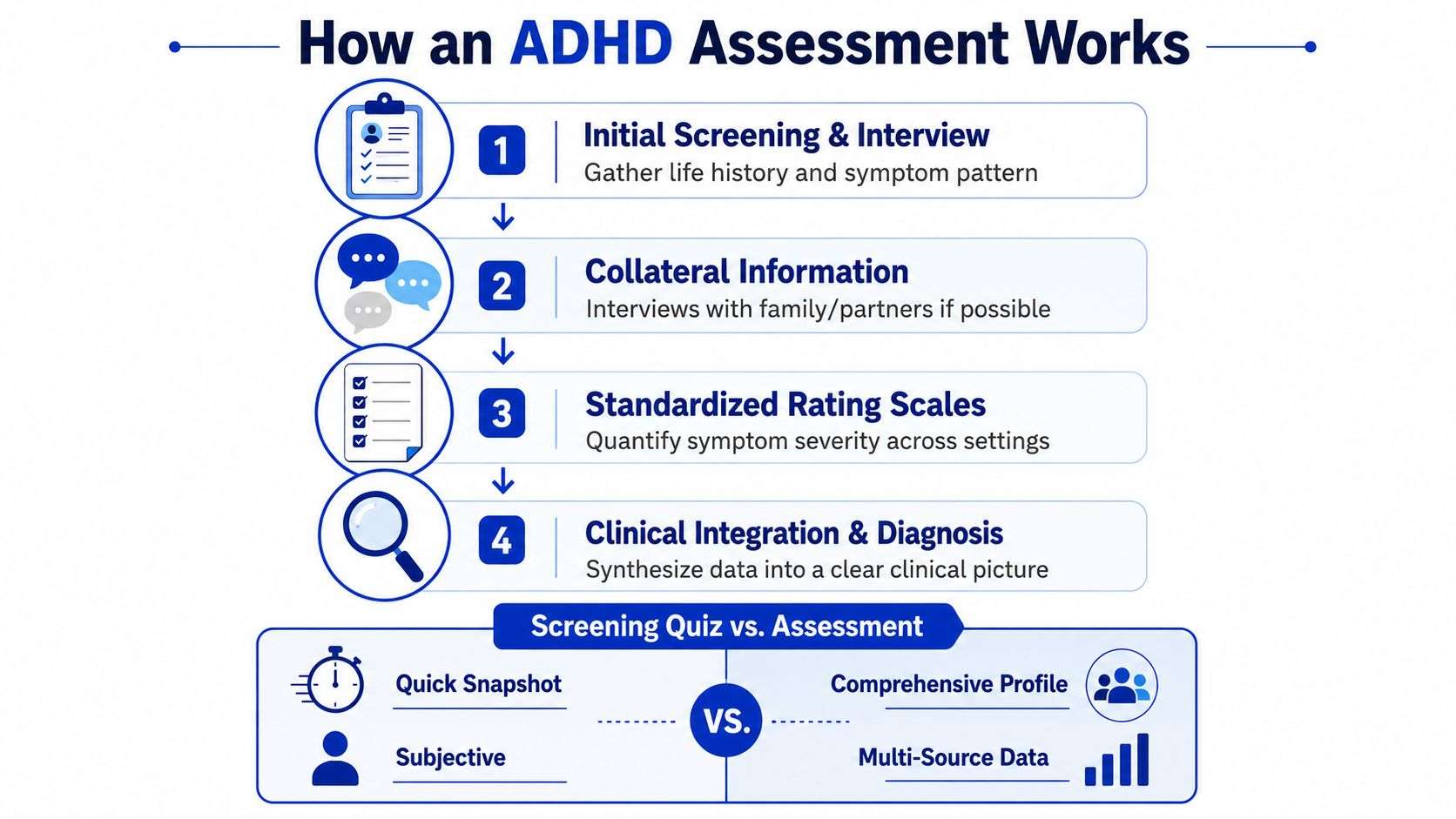
For a plain-language comparison of screening and assessment, ADHD counselling and testing overview gives a useful contrast between quick snapshots and fuller clinical work.
How an ADHD Counselling Assessment Works
A good intake doesn't start with, “Do you think you have ADHD?” It starts with, “What's happening in your life, and where is it costing you the most?” That distinction matters, because subjective frustration has to be translated into functional information before a care plan can be built.
Screening tools such as the ASRS can help flag symptoms, but they're not the whole assessment. A clinically strong adult ADHD intake also asks about developmental history, work history, school history, sleep, trauma, mood, substance use, learning differences, and medical factors that can mimic ADHD. NICE recommends diagnosis by a specialist using a full clinical assessment, not rating scales alone.NICE recommendation on ADHD diagnosis
What a counsellor may ask you to bring
You don't need a perfect folder, but a few items can make the conversation more useful.
- School records or report cards: These can help show whether focus, organisation, or unfinished work have been present for years.
- Past work reviews: Comments about missed deadlines, disorganisation, or inconsistent performance can add context.
- A simple symptom timeline: A rough outline of when difficulties became more obvious is often enough.
- Medication or treatment history: If you've already tried treatment for anxiety, depression, or sleep problems, that history helps separate overlap from cause.
Canadian guidance also emphasises that assessment should screen for anxiety, depression, substance use, and medical disorders before treatment planning begins.Adult ADHD clinical guidance
Practical rule: if a symptom checklist describes you, but it doesn't explain your life, the intake isn't done yet.
That's where counselling becomes especially useful. It can turn “I'm scattered all the time” into specific observations like missed transitions, forgotten follow-ups, conflict about time, or repeated errors when tasks pile up. Those details point to the right intervention, instead of guessing.
For adults who are comparing options, XO ADHD assessment options is a useful reminder that a careful process usually includes much more than a quick quiz.
Types of Counselling and Therapy Support
Different adults need different kinds of help, and ADHD counselling isn't one single method. Some people need emotional processing first, because years of criticism have worn them down. Others need practical structure straight away, because daily functioning is the biggest problem.
Common counselling approaches used in adult ADHD support
| Approach | Main focus | Best fit when |
|---|---|---|
| Cognitive-behavioural therapy | Self-talk, planning, follow-through, emotional regulation | You get stuck in shame, avoidance, or all-or-nothing thinking |
| Supportive counselling | Validation, stress relief, emotional processing | The diagnosis question feels heavy or you're grieving years of struggle |
| Psychoeducation | Understanding ADHD patterns and compensation | You want a clearer map of why your systems keep failing |
| Skills-based or coaching-adjacent work | Routines, reminders, task setup, accountability | Daily life needs structure, not just insight |
CAMH notes that psychotherapy for adult ADHD is typically used to improve self-awareness, coping, and self-regulation, not to replace medical evaluation.Adult ADHD clinical guidance
That framing matters. Counselling can help you understand what happens before you derail, what your emotional triggers look like, and how to build a plan that fits your actual life. It can also help you decide whether a physician or psychiatrist referral is the next step.
Interactive Counselling offers individual counselling in Vernon, which can fit that early support role when someone is still sorting out diagnosis, routines, or stress around daily functioning. The point isn't to force one model on everyone. It's to choose the right mix for the problem in front of you.
Everyday Strategies That Actually Stick
Generic productivity advice usually fails adults with ADHD because it asks for more willpower from the same system that's already overloaded. Better strategy design works like scaffolding. It holds things up from the outside.
Build fewer systems, not more
The most useful supports are usually simple and repeatable.
- One calendar: Keep appointments in one place so you're not hunting across apps and notebooks.
- One task list: A single running list reduces decision fatigue and keeps tasks visible.
- Nightly reset routine: Ten minutes to check tomorrow's priorities, gather what you need, and clear the most obvious clutter can reduce morning friction.
- Buffer time: Plan extra time around transitions, because adults with ADHD often underestimate how long a switch will take.
- Movement on purpose: Physical activity is often a high-yield support for attention, hyperactivity, and mood.
Evidence-based ADHD resources also recommend breaking complex tasks into smaller steps, filing information consistently, and using one reliable reminder system rather than several competing ones.Evidence-based ADHD management strategies
The inner script matters too
A lot of adults are fighting themselves as much as they're fighting the task. Cognitive restructuring can help here. If the thought is, “I'm lazy,” the more accurate version might be, “My task setup is too vague, and I'm losing momentum before I start.”
That's not soft thinking. It's precision.
Useful reframe: don't ask, “How do I become more disciplined?” Ask, “What friction can I remove so the right action is easier to start?”
The true test is whether a strategy lowers chaos this week. If it doesn't, simplify it. Adults with ADHD usually do better with a few personalised systems that they can repeat than with a long list they'll resent by Thursday.
Accessing ADHD Counselling in Vernon
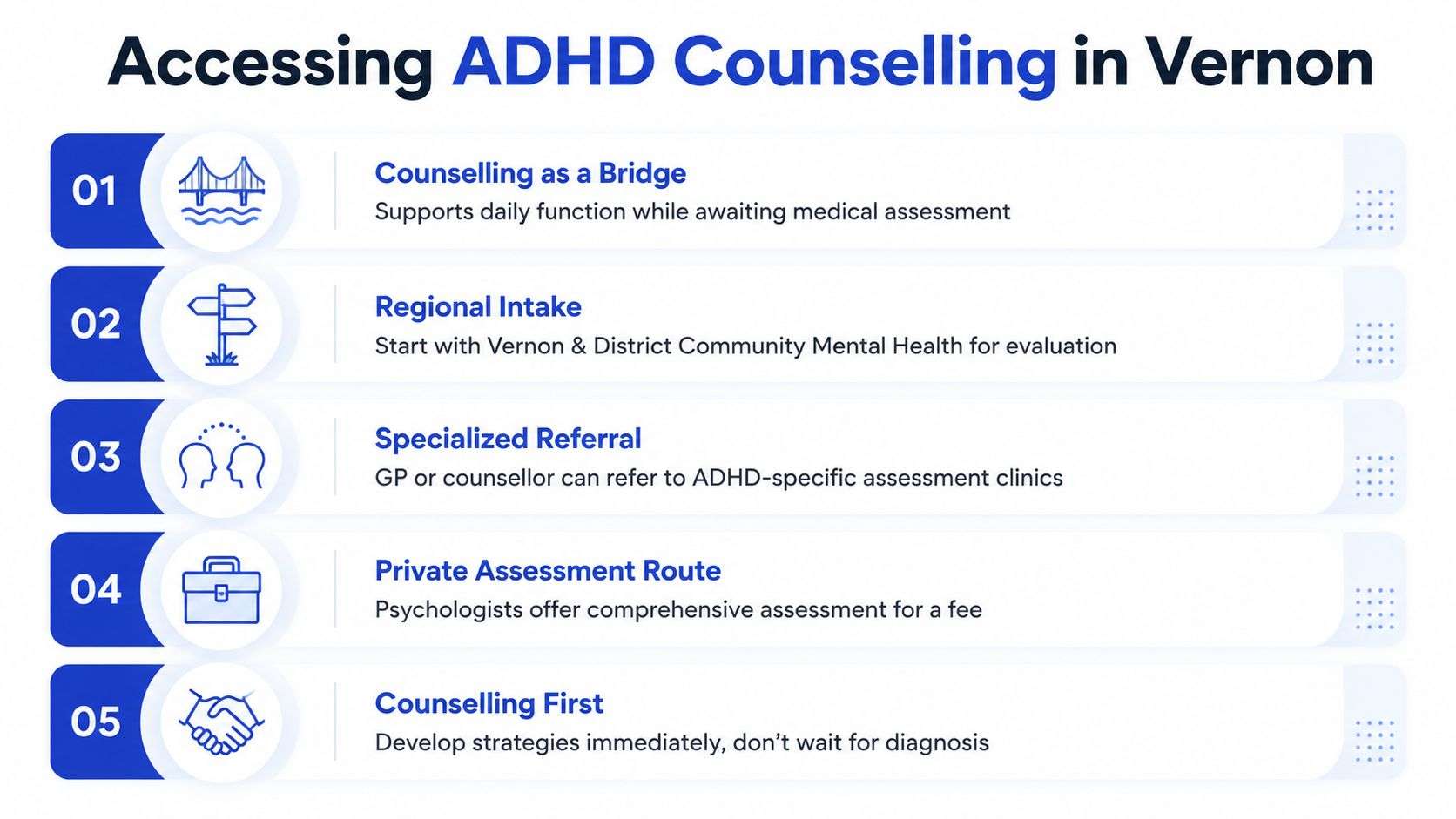
In Vernon, the practical path often begins with the local mental health system, then branches into counselling, medical assessment, or both. The Vernon Mental Health and Substance Use Intake service lists the Vernon catchment and operates by phone Monday to Friday, 9:00 am to 4:30 pm, which gives the region a central public entry point for adult mental health support.Vernon intake service
That public pathway matters, but it doesn't replace counselling. Adults often need help while they wait, especially if their main strain is keeping work, parenting, or relationships together. Counselling can fill that gap by helping with organisation, routines, emotional regulation, and planning for next steps.
What access can look like in real life
People in Vernon usually want care that fits around shift work, school pick-up, commuting, and winter schedules. That's why session format matters. In-person appointments work well for some people, phone sessions are easier for others, and secure virtual sessions can reduce the energy cost of getting to an office.
Counselling doesn't have to wait for a final label. It can start with the problem you're living today.
A formal diagnosis is not always required to begin skills-based counselling. A therapist can still help you build systems, reduce shame, and track patterns even while assessment is pending. If a physician or psychiatrist referral becomes necessary, good counselling can help you arrive there with clearer notes and less confusion.
For adults looking at local service context, Vernon already has an ADHD-related counselling footprint through directory-listed providers, which means the topic isn't abstract here. It's a real part of the local care scene.
What Progress Looks Like Over Time
The first month of counselling usually isn't about perfect habits. It's about sorting the signal from the noise. A client and therapist might choose two or three priority systems, like one calendar, one reminder routine, and one way to reduce morning chaos.
Months two and three often look different. The person starts noticing where they lose momentum, which thoughts trigger avoidance, and which routines collapse under pressure. That's useful information, not proof that the work failed.
A realistic change pattern
By the later phase of support, progress often shows up in smaller but steadier ways. Appointments get missed less often. Transitions feel less explosive. Partners or employers may have a clearer sense of what help works.
Some adults pursue medical assessment alongside counselling, and some don't. Either way, useful work is happening if daily life is becoming more organised and less demoralising.
Setbacks are data. They show where the system needs adjustment, not where you've failed.
It also helps to expect unevenness. A good week doesn't cancel a hard one, and a hard one doesn't erase the gains. Progress with adult ADHD is often more like getting a better map than reaching a final destination.
Common Questions About ADHD Counselling
Do I need a formal diagnosis to start counselling? Often no, because skills-based support can begin with your current difficulties, not just a final label.
Should I choose in-person or virtual sessions? Pick the format you'll keep, since consistency matters more than theory.
What should I bring to the first appointment? Bring a few concrete examples of how the problem shows up, plus any past records if you have them.
How do I know if the therapist is a good fit? You should feel understood, not rushed, and the plan should sound specific enough to try in daily life.
How often do sessions happen? It depends on need and availability, but the right pace is the one that supports follow-through without overwhelming you.
If you're trying to make sense of adult ADHD in Vernon, Interactive Counselling offers individual counselling that can support assessment preparation, daily structure, and emotional regulation while you figure out the next step. If you'd like a calm, practical place to start, visit Interactive Counselling to learn more about counselling support that fits real life.
Clinically Reviewed By
Amy Mosset, MCP, RCC-S
Amy Mosset is a Master Practitioner in Clinical Counselling, Clinical Supervisor, and the owner of Interactive Counselling. She provides trauma-informed, evidence-based care and clinical supervision to registered therapists, with a focus on ethical practice, client safety, and high-quality therapeutic outcomes.