When your mind won't stop scanning, replaying, predicting, and bracing, it can feel like there's no off switch. You might lie in bed exhausted while your thoughts keep running. You might notice a tight chest in the grocery store, a racing heart while driving, or a flood of “what if” thoughts the moment the house gets quiet. Many people in Vernon live with this kind of inner speed. It's unsettling, tiring, and often lonely. It can also make you wonder whether you're overreacting, losing control, or somehow doing anxiety wrong.
"Anxiety counselling in Vernon offers practical tools to calm a racing mind by helping you understand your nervous system, regulate your body, and build steadier coping skills over time." For more information, see our counselling in Vernon.
If that's where you are right now, there's good news. A racing mind usually makes more sense than it seems. There are ways to settle it in the moment, and there are forms of support that go beyond generic advice to help you feel safer in your own body again. For some people, that means learning simple grounding tools. For others, especially after a frightening event like a motor vehicle accident, it means working with the body's alarm system more directly.
Introduction When Your Thoughts Wont Slow Down
Some people describe anxiety as “too many thoughts.” Others say it feels more like their whole system is speeding up at once. Their shoulders tighten, their breathing gets shallow, and their mind starts hopping from one fear to the next. Even small decisions can feel loaded when your nervous system is acting as if something bad is about to happen.
A racing mind often pulls you into a harsh cycle. You feel keyed up, then you worry about feeling keyed up, then your body reacts even more strongly. That loop can make ordinary moments feel hard. Replying to a message, driving across town, sitting through a meeting, or trying to sleep can all start to feel bigger than they are.
You don't need to “win” against anxiety. You need ways to understand what your mind and body are trying to do, then respond with steadiness.
That's one reason Anxiety Counselling in Vernon: Tools to Calm a Racing Mind matters as more than a search phrase. People usually aren't looking for theory alone. They want relief, clarity, and a path that feels realistic. They want to know why this is happening, what to do when it spikes, and how to get help without feeling overwhelmed by the process.
Understanding Your Racing Mind and Body
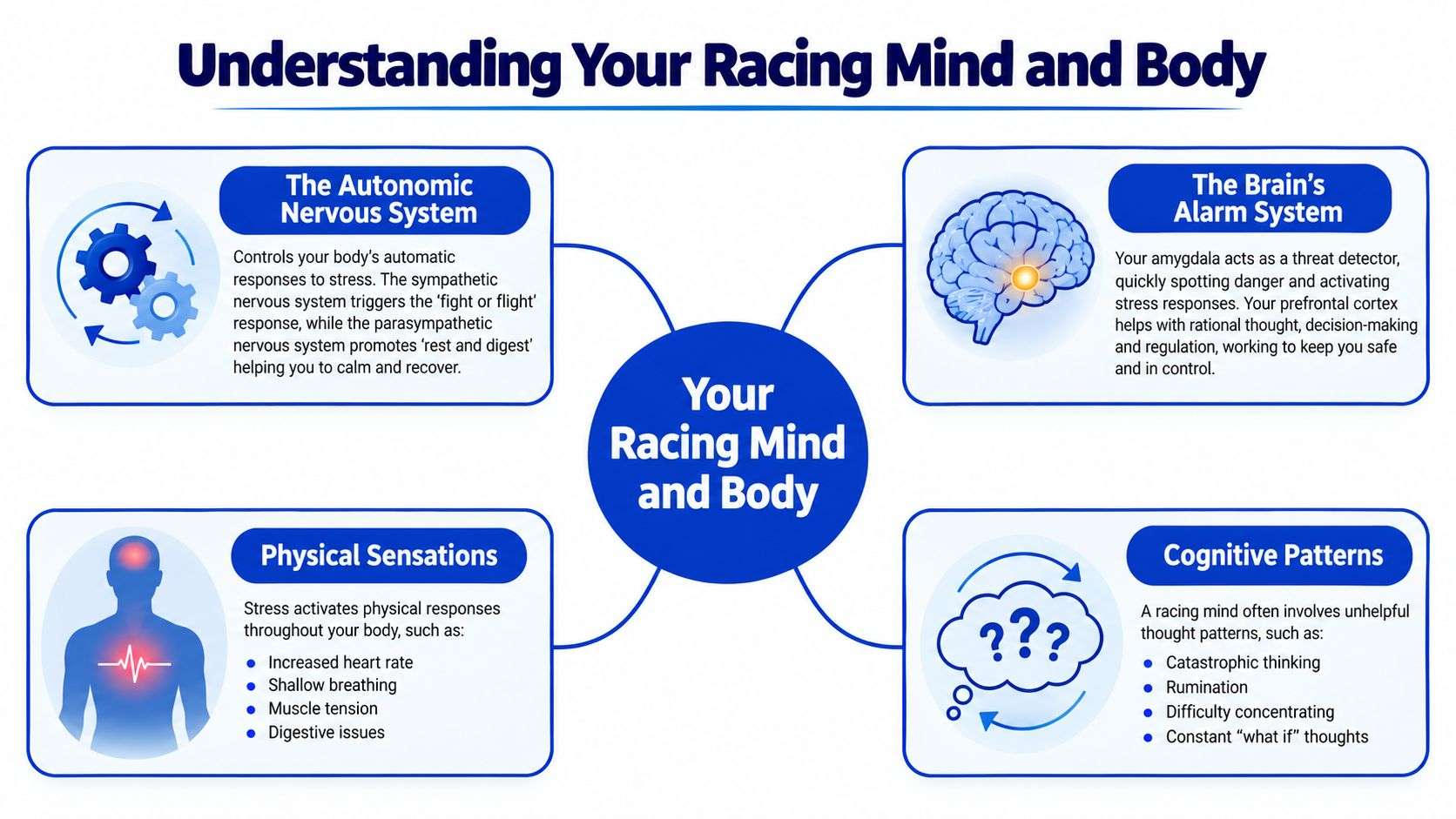
A racing mind isn't a character flaw. It's often a sign that your autonomic nervous system has shifted into protection mode.
Think of your brain's alarm system like a smoke detector. A smoke detector is useful when there's a real fire. But if it becomes too sensitive, it can go off when you burn toast. Anxiety works in a similar way. Your system is trying to protect you, but it may start reacting to stress, uncertainty, memories, or body sensations as if they're immediate danger.
What happens inside the body
When the alarm system turns on, your body prepares to act. That can include:
- Faster heartbeat so your body can respond quickly
- Shallow breathing because your system is mobilising
- Muscle tension in the jaw, neck, shoulders, or stomach
- Restlessness or agitation that feels hard to explain
- Looping thoughts as the mind searches for a reason for the alarm
This is why “just think positively” rarely works when anxiety is intense. If your body is already acting as if there's danger, your thinking brain has less room to do its usual job.
Why it can feel so personal
People often blame themselves for anxiety because the symptoms happen inside them. But the symptoms themselves are protective. Your system is trying to help, even when it's misreading the situation.
Chronic stress can make this protective response more sensitive. Past experiences can do the same. Sometimes one difficult period is enough to leave the body more watchful. Sometimes the nervous system has been carrying tension for a long time, so anxiety starts to feel normal even when it's exhausting.
Practical rule: When your body is in alarm, start with regulation before analysis. Understanding comes easier after your system has settled a little.
When a racing mind is also a body memory
For some people, the problem isn't only overthinking. The body may be reacting to something it learned during a frightening experience. For some, a racing mind isn't just cognitive worry. It can be a somatic flashback from a traumatic event like a motor vehicle accident. This type of anxiety requires specialized, trauma-informed care that goes beyond standard calming tools to address the body's stored stress response, a critical need for some Vernon residents given the availability of ICBC-funded MVA counselling.
That distinction matters. If someone's anxiety after an accident is tied to body-based hyperarousal, generic “calm down” advice may not land well. It may even feel frustrating or activating. In those cases, support often needs to help the body relearn safety, not just help the mind challenge thoughts.
Practical Tools to Calm Anxiety in the Moment
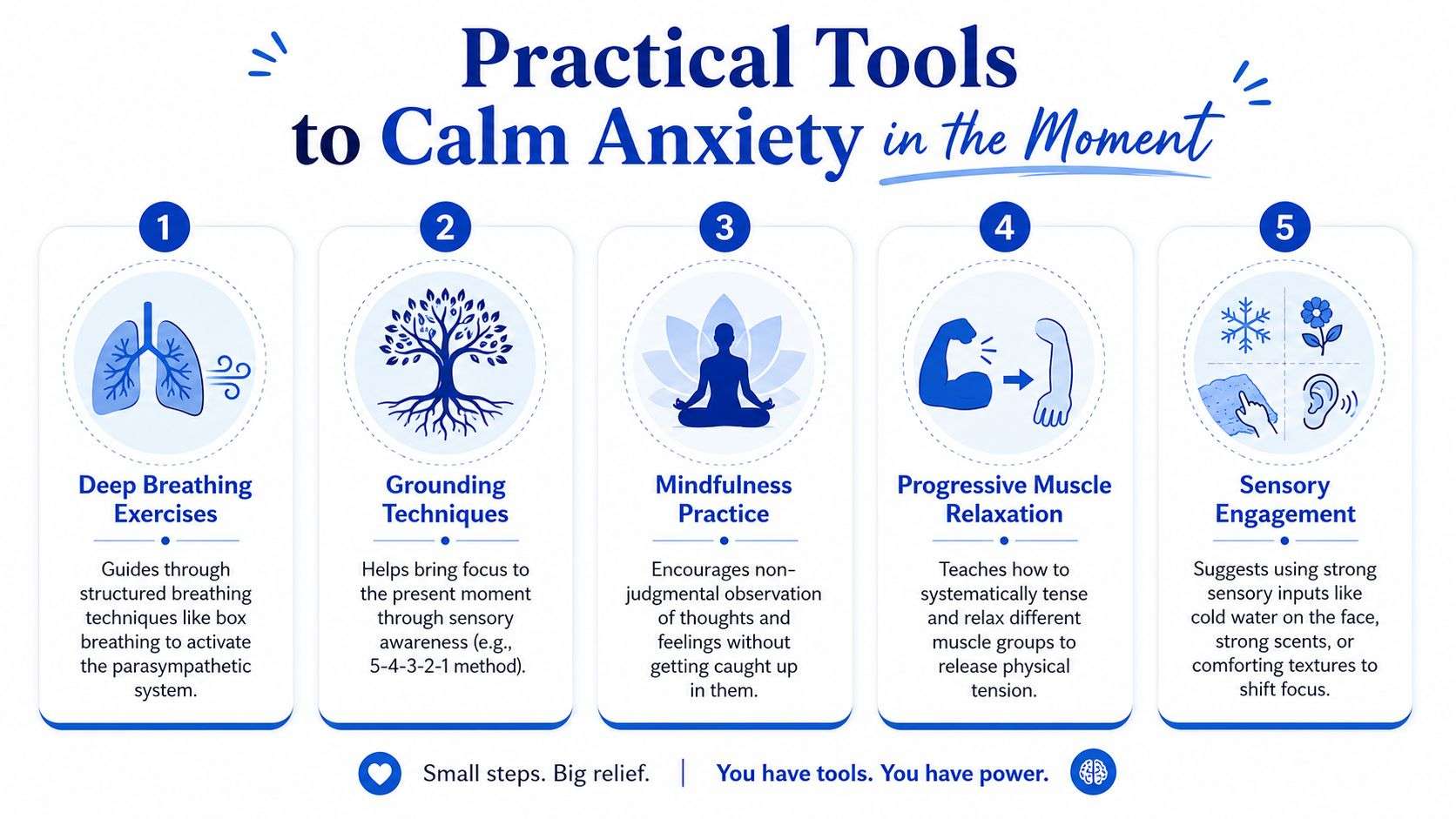
When anxiety spikes, simple tools work best. You're not trying to solve your whole life in that moment. You're trying to interrupt the spiral and give your nervous system a clearer signal that you're safe enough right now.
Use the physiological sigh first
The physiological sigh is one of the fastest ways to reduce physical intensity. The method is simple: take a double inhale through the nose, then a long exhale through the mouth., the physiological sigh is one of the fastest ways to mechanically slow a racing heart, and the 5-4-3-2-1 technique helps shift focus from the brain's fear centre to its sensory processing region.
Try it like this:
- Inhale through your nose.
- Take a second small inhale on top of the first.
- Exhale slowly through your mouth.
- Repeat a few times without forcing it.
Why it helps: the long exhale tells your body the emergency response can start easing. It gives your system a physical cue, not just a mental instruction.
Ground your mind through your senses
When thoughts are spiralling, sensory input can anchor you in the present. The 5-4-3-2-1 grounding technique is especially useful when your mind feels fast, foggy, or unreal.
Notice:
- Five things you can see
- Four things you can feel
- Three things you can hear
- Two things you can smell
- One thing you can taste
Do it slowly. Name specific details. Instead of saying “chair,” you might say, “blue chair with a scratch on the arm.”
This works because anxiety narrows attention toward threat. Grounding widens attention and brings the brain back to current sensory reality. If you'd like more examples to practise with, you can discover evidence-based grounding strategies that expand on this approach.
Give worry a container
If your mind keeps saying, “Don't forget this fear,” it may help to stop arguing with it and set a boundary instead. One approach is scheduled worry time. You choose a brief daily window and save anxious thinking for that period rather than letting it run all day.
A simple version looks like this:
| Step | What to do |
|---|---|
| Pick a time | Choose a consistent part of the day when you're usually alert |
| Set a short limit | Keep it contained rather than open-ended |
| Write worries down | Put the thought on paper instead of rehearsing it repeatedly |
| Return later | If a worry shows up outside that window, remind yourself it has a place |
This can feel strange at first. But it teaches your brain that anxious thoughts don't need unlimited access to your attention.
Use movement when your body feels trapped
Sometimes anxiety creates so much internal energy that sitting still makes things worse. In that case, gentle movement can help. The verified guidance available for this topic notes that even 30 minutes of moderate aerobic exercise three to four times per week can reduce anxiety symptom severity, as described in this discussion of anxiety regulation tools.
In the moment, that doesn't need to mean a workout. It might mean:
- Walking around the block
- Going up and down the stairs
- Stretching your shoulders and jaw
- Shaking out your hands
- Standing outside for fresh air
If your thoughts are racing because your body is activated, a body-based response often works faster than trying to reason your way out of panic.
Not every tool works every time. That's normal. The goal isn't perfection. It's building a small set of responses you can reach for when your system needs help.
How Counselling Builds Lasting Calm
Immediate tools are helpful, but they don't always answer the deeper question: why does my mind keep going back here? Counselling is where relief starts becoming more organised and more personal.

Therapy helps you map your anxiety
In counselling, anxiety becomes something you can study with support instead of something you just endure. A therapist may help you notice patterns such as:
- what tends to trigger your spirals
- how anxiety shows up in your body
- what thoughts make the cycle stronger
- which coping habits soothe you and which ones keep the fear loop going
That process often reduces shame. Once you can see the pattern, you're no longer just “too anxious.” You're learning how your system works.
Lasting calm usually needs more than one approach
Some people benefit from cognitive work that helps them examine fearful predictions and challenge unhelpful thinking. Others need more support with the body first, especially if anxiety feels sudden, intense, or linked to trauma.
That's where somatic and trauma-informed work can be especially important. If someone's racing mind is tied to hyperarousal after an accident or another frightening event, body regulation isn't an extra. It's central.
A counselling process may include:
- Thought-focused work to notice patterns and create more balanced responses
- Body-based regulation to reduce tension, bracing, and internal alarm
- Grounding practice for moments when symptoms surge
- Trigger mapping so reactions feel less confusing
- Pacing and safety so the work doesn't become overwhelming
One option for exploring your counselling options is Interactive Counselling, which offers anxiety-informed support along with trauma-informed care and ICBC-funded counselling for clients recovering from motor vehicle accidents.
Counselling doesn't erase all anxious thoughts. It helps you respond differently, recover faster, and feel less controlled by them.
Why the relationship matters
People often focus on the method, but the fit matters too. A helpful therapist doesn't rush you, minimise your symptoms, or push you into strategies that don't match what your body is doing. Good anxiety therapy tends to feel collaborative. You're building a customized set of tools, not being handed a script.
Over time, many people notice a quieter kind of change. They still have stress. They still have hard days. But their mind doesn't grab the steering wheel as often, and when it does, they know what to do next.
Beginning Your Counselling Journey in Vernon
It is 10:30 p.m., your body is tired, and your mind is still sprinting. You open your phone, search for anxiety counselling in Vernon, and then freeze because even choosing help feels like one more decision your nervous system cannot sort out right now.
That stuck feeling is common, especially for people whose anxiety is intense, physical, or tied to a motor vehicle accident. A racing mind can make therapy seem complicated before it even begins. The process is usually much simpler than anxious thoughts make it seem.
What support can look like locally
Vernon offers more than one path to support. Some people want private counselling. Others start with community programs, short-term supports, or a mix of both while they figure out what fits their symptoms, schedule, and budget.
The format matters more than people sometimes expect. If your body settles more easily in a quiet office, in-person sessions may help. If driving has felt hard since an accident, phone or secure video sessions can remove one layer of stress and make it easier to begin.
You might look for:
- In-person counselling if physical presence helps you feel steadier
- Phone sessions if leaving home or getting in a car feels too activating
- Secure video appointments if consistency is easier from home
- Community programs if you want support while deciding on longer-term care
For high-intensity racing thoughts, the biggest question is often not only "Do they treat anxiety?" but "Do they know how to work with a body that stays on high alert?" That gap matters in Vernon, especially for people dealing with post-MVA symptoms such as adrenaline surges, startle reactions, dizziness, muscle bracing, or fear that spikes while driving.
What to look for in a therapist
A helpful therapist should be able to explain their approach in plain language. If your anxiety feels fast, physical, and hard to interrupt, ask whether they use somatic regulation along with talk therapy. That means they help you notice and settle what your nervous system is doing, not only what your thoughts are saying.
A good fit often includes these qualities:
- Calm and non-judgemental in the way they respond to distress
- Clear about how sessions work and what anxiety treatment may involve
- Trauma-informed if your symptoms began or worsened after a frightening event
- Skilled in body-based regulation if talking alone has not changed the panic cycle
- Collaborative so the pace feels manageable and respectful
This can be especially important after a motor vehicle accident. Post-accident anxiety often works like a car alarm with a faulty sensor. It keeps firing long after the danger has passed. In that state, a person may understand logically that they are safe and still feel a rush of alarm in traffic, at stoplights, or even while sitting as a passenger.
Interactive Counselling is one local option for people who need anxiety support that includes trauma-informed and somatic regulation work, including care for post-MVA concerns and ICBC-funded counselling where applicable.
A first contact can stay simple
You do not need a polished explanation before you reach out.
A short message is enough: you have been dealing with a racing mind, panic, body tension, sleep disruption, or anxiety after an accident, and you want to know whether the therapist's approach fits. That gives plenty to start with.
The first session is often less about telling your whole story and more about getting oriented. You might talk about what happens in your mind, what happens in your body, what situations set things off, and what has or has not helped so far. A careful therapist will pay attention to pace, because people with intense anxiety often need steadiness before they need analysis.
That is a real beginning.
Frequently Asked Questions About Anxiety Counselling
It is 10:30 p.m., your body is tired, and your mind is still sprinting. You may be wondering whether counselling would help, whether your anxiety is "serious enough," or whether you will freeze in the first session and not know what to say.
Those questions make sense. Anxiety often turns simple decisions into heavy ones. A clear answer can lower some of that pressure.
Common Questions About Starting Anxiety Therapy
| Question | Compassionate Answer |
|---|---|
| What if I'm nervous about the first session? | That's a very common feeling. You do not need to arrive calm, organised, or ready with the perfect explanation. The first session is a place to begin, not a test you have to pass. |
| Do I need to know whether my anxiety is “serious enough”? | No. If a racing mind, panic, constant worry, body tension, sleep disruption, or driving-related fear is affecting daily life, that is enough reason to ask for help. |
| What if my anxiety got worse after a motor vehicle accident? | That pattern is common after a frightening collision. In those cases, the problem is often not only worried thinking. The nervous system may still be acting as if danger is close. Counselling that includes trauma-informed, body-based regulation can be especially helpful for this kind of high-intensity anxiety. |
| Can I use community support while I wait for therapy? | Yes. Local crisis and community services can offer short-term support while you arrange counselling or during a difficult spike in symptoms. |
How do I access free or low-cost anxiety support in Vernon while waiting for a therapist
Many people in Vernon need support before regular counselling begins, especially when anxiety is affecting sleep, work, parenting, or driving. Short-term community help can act like a bridge. It does not replace therapy, but it can steady things while you wait.
One local option is the Vernon Family Resource Centre, which offers short-term counselling for anxiety, depression, and related concerns. Its service listing appears through HealthLink BC's counselling services information, including contact details for the Vernon location.
Another overview of local options is available through Theravive's Vernon anxiety support page.
If your distress feels urgent, use crisis support right away. You do not need to wait until things feel extreme.
What should I do during an immediate racing mind episode
Start with the body. A racing mind often behaves like an engine that is revving too high. Trying to reason with it before the body settles can feel frustrating.
A simple sequence can help:
- Use the physiological sigh a few times.
- Name what you can sense with 5-4-3-2-1 grounding.
- Lower stimulation by stepping away from noise, screens, or traffic if possible.
- Contact support if the intensity stays high or you feel unsafe.
For urgent support in BC, you can call the crisis line at 1-888-353-2273 (1-888-353-CARE).
Reaching for support during a spike is a healthy response to distress.
Will counselling only focus on talking about my thoughts
Counselling for anxiety can include thoughts, emotions, body sensations, and habits. For some people, traditional talk therapy is enough. For others, especially those with a very fast, high-intensity nervous system or anxiety after a motor vehicle accident, talking alone does not fully settle the alarm response.
That is where somatic regulation matters. It helps the body learn safety in real time through grounding, breath work, pacing, and other trauma-informed strategies. Interactive Counselling offers this kind of support for clients in Vernon, including people dealing with post-MVA anxiety and related trauma responses.
If your anxiety feels less like "too much thinking" and more like your whole system is stuck on high alert, that difference matters. The right counselling approach should match the kind of anxiety you are experiencing.
A Gentle Closing A Path Toward Quiet
A racing mind can make life feel narrow. It can convince you that rest is out of reach, that your body can't settle, or that you should be able to handle this alone. None of that is true. Anxiety is understandable, workable, and treatable.
The first step might be learning one simple tool that helps tonight. The next might be understanding your nervous system with more compassion. After that, it may be finding support that fits, especially if your anxiety is tied to trauma or the after-effects of a motor vehicle accident.
Quiet usually doesn't arrive all at once. It builds. With practice, support, and the right kind of care, your mind and body can learn a different rhythm.
Clinically Reviewed By
Amy Mosset, MCP, RCC-S
Amy Mosset is a Master Practitioner in Clinical Counselling, Clinical Supervisor, and the owner of Interactive Counselling. She provides trauma-informed, evidence-based care and clinical supervision to registered therapists, with a focus on ethical practice, client safety, and high-quality therapeutic outcomes.
If you'd like to learn more about counselling support for anxiety, trauma, or a racing mind, Interactive Counselling offers information about available services in a calm, straightforward way.