Couples therapy helps many partners reconnect. About 70 to 75% of couples report improved relationship satisfaction after completing couples therapy, and benefits often begin within a few months of consistent sessions and can last for over a year. When you're in the middle of tension, distance, or repeated arguments, those numbers can matter because they remind you that repair is possible. For more information, see our Vernon couples counselling.
Maybe you still care a great deal about each other, but daily life has started to feel heavy. One of you brings up the same hurt again and again. The other shuts down, gets defensive, or says, “I don't know what else to say.” You may be sleeping beside each other while feeling miles apart. That doesn't automatically mean your relationship is beyond help. It often means the two of you need a safer, more structured way to understand what's happening underneath the conflict. For more information, see our counselling in Vernon.
"Couples counselling rebuilds connection by creating a safe, guided space where you and your partner can understand each other's underlying emotional needs, learn constructive communication skills, and work together to solve problems." For more information, see our couples counselling.
Recognizing When Your Relationship Needs Support
Many couples don't seek support because they think they should be able to “figure it out” on their own. They worry that therapy means failure, or that going to counselling is something only couples in crisis do. In practice, the opposite is often true. Reaching for help can be a sign that you still value the relationship enough to work on it.
In Canada, approximately 40% of couples report that relationship distress is a primary reason for seeking mental health support, with conflict resolution and communication breakdown being the most cited specific issues according to Psychology Today's Vernon couples counselling listings overview. If your conversations keep turning into arguments, silence, or emotional exhaustion, you're not alone.

Signs the relationship may need more support
Sometimes the need for counselling is obvious. Sometimes it's subtle. The relationship hasn't “blown up,” but it no longer feels steady, warm, or safe.
You may notice signs like these:
- You feel more like roommates than partners. There's coordination about chores, schedules, or kids, but very little closeness.
- Arguments repeat without resolution. You talk about the same issue over and over, and nothing really changes.
- One or both of you avoid difficult topics. Conversations feel so fragile that it seems easier to say nothing.
- Trust has been shaken. That might involve infidelity, secrecy, broken promises, or smaller repeated disappointments that have built up over time.
- Affection feels strained or absent. Physical closeness, warmth, and ease have become uncomfortable, awkward, or rare.
- Stress outside the relationship is spilling in. Work pressure, parenting, grief, health concerns, or extended family conflict can erode patience and connection.
- Separation is being discussed, feared, or used in arguments. Even if no decisions have been made, that kind of tension deserves careful attention.
When uncertainty is part of the picture
Some couples aren't sure whether they want to repair the relationship or just understand what has happened to it. Counselling can still help. It can slow things down enough for both people to think more clearly, speak more truthfully, and make decisions with less reactivity.
Not because your path is predetermined, but because many couples feel less isolated when they see their struggles in a wider social context.
A helpful question: Are we dealing with a problem, or are we stuck in a pattern that keeps making the problem worse?
That distinction matters. Many couples don't need perfect communication. They need a way out of the cycle they keep getting pulled back into.
How to Prepare for Your First Counselling Session
The evening before a first appointment often looks familiar. One partner is wondering what to say first. The other is worried the whole hour will turn into another painful argument. Both may be carrying the same question in different words: will this help, or will it make things worse?
That uncertainty is normal. A first session is less like a courtroom and more like the first medical appointment for an injury that has been ignored for too long. You are not expected to arrive with a diagnosis. You are coming in so the pattern can be seen clearly, named carefully, and treated with skill.
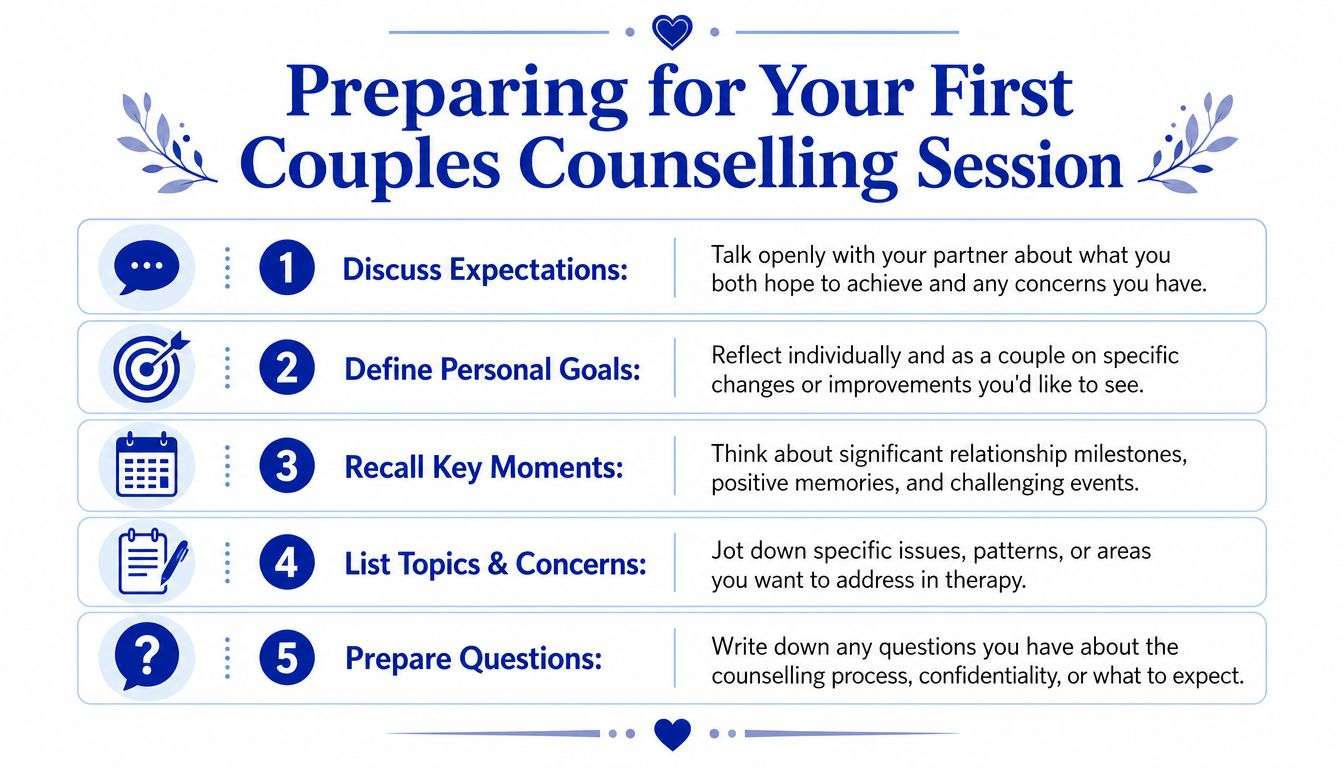
Preparation is simple. The goal is to help you arrive a little less flooded and a little more clear about what hurts, what matters, and what you hope can change.
Before the appointment
A short period of private reflection can make the first conversation more useful. Keep notes brief. A few honest lines are often better than a long explanation written in the heat of frustration.
These prompts can help:
- What feels most painful right now? Try to name the lived experience, such as criticism, loneliness, mistrust, sexual distance, parenting tension, or feeling dismissed.
- What would improvement look like in daily life? For example, “I want us to repair arguments faster,” or “I want to feel safer bringing up hard things.”
- What am I worried will happen in counselling? Some people fear blame. Others fear shutting down, crying, or hearing something they have tried not to face.
- What is still worth protecting here? This question matters. Even in high conflict, many couples can still name care, history, commitment, friendship, or shared values.
If writing feels hard, keep it to one sentence per question. The purpose is clarity, not perfection.
Talk together before you go
A pre-session conversation does not need to solve anything. It only needs to reduce the chance that you walk in already bruised from a fight in the car.
Try a brief agreement:
- State the purpose of the visit. “We are going to understand our pattern and get help with it.”
- Choose one or two priorities. Too many goals can scatter the first session.
- Save the full argument for the room. Hard topics are easier to discuss when someone is there to slow the pace and keep both people engaged.
A useful mindset is simple: go in ready to describe your experience clearly and listen for your partner's, even if you disagree with parts of it.
Common worries before a first session
Many couples worry about three things. Will there be enough time? Will one person dominate? Will the therapist take sides?
The structure of the first appointment often helps with all three. In Vernon, some counsellors begin with a longer initial session so each partner has space to speak without feeling rushed. Interactive Counselling, for example, offers relationship support in person, by phone, and through secure virtual sessions, and some couples find that format easier to fit into work and family life.
Therapists who work well with couples are listening for interaction patterns, not collecting evidence for a verdict. If one person pursues and the other shuts down, that pattern becomes part of the work. If both people feel misunderstood, that becomes part of the work too. The focus is on the cycle between you, because that cycle is often what keeps hurting both partners.
What to bring emotionally
You do not need polished language or perfect self-awareness on day one.
You do need a few basic ingredients, the way a physical therapist needs you to show up willing to try the exercises, even if your muscles are tight and sore.
| Bring this | Why it matters |
|---|---|
| Honesty | Clear information helps the therapist understand the relationship as it is, not as either partner fears it will be judged |
| Curiosity | Curiosity creates room for new meanings, which is often the first step out of a stuck pattern |
| Patience | Early sessions often focus on understanding the map of the relationship before deeper repair begins |
| Willingness | Change usually depends on what happens between sessions as much as what happens during them |
Nervous is allowed. So is hope.
Many couples arrive feeling both at once, and that is often a strong place to begin.
The Therapeutic Journey What to Expect in Sessions
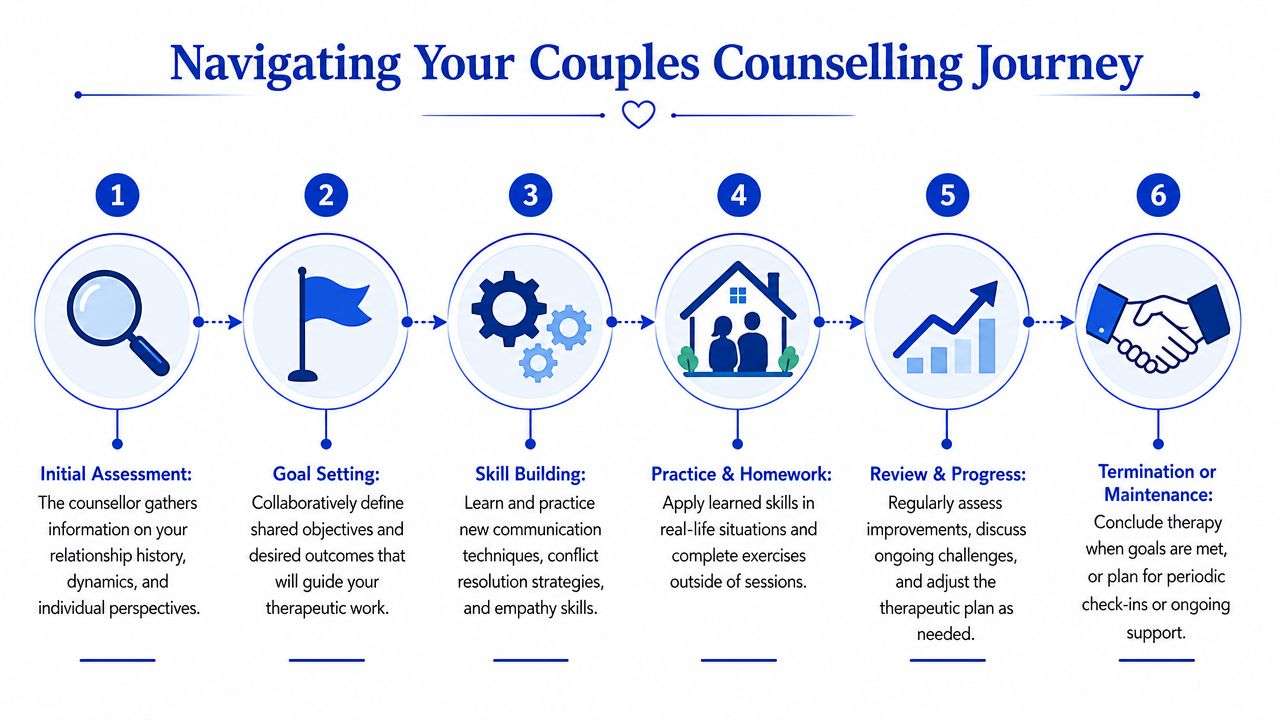
Many couples feel relief once they understand the basic shape of the process. Therapy is not a free-for-all argument with a witness in the room. Good couples counselling is structured, purposeful, and paced so both people can stay engaged.
A common approach begins with understanding the relationship itself. How do disagreements start? What happens next? Who pursues? Who withdraws? What meanings do each of you attach to the same event? Those patterns matter more than proving which person remembers an argument more accurately.
What happens early on
At the beginning, the therapist usually helps both partners describe current strengths and current challenges. That matters because distressed couples often arrive focused only on what's broken. Counselling works better when the room also holds what still exists between you, such as commitment, loyalty, shared history, parenting teamwork, humour, or care.
After that, goals become clearer. These might include repairing trust, improving communication, rebuilding intimacy, or deciding how to manage conflict without emotional damage.
Here's what many couples can expect in the first phase:
- A balanced hearing of both perspectives. Each person needs room to speak without interruption.
- Clarifying patterns instead of assigning blame. The therapist looks for loops, triggers, and emotional reactions.
- Shared goal setting. Therapy gets more focused when both people can name what they want to move toward.
- Discussion of outside practice. Change rarely happens from insight alone.
Why approaches like EFT matter
One evidence-based model often used in couples work is Emotionally Focused Therapy (EFT). In plain language, EFT helps couples understand the deeper emotions under the visible conflict. A harsh comment might be covering fear. Withdrawal might be protecting shame, hurt, or the expectation of rejection.
That shift is important. When couples only argue about content, they stay stuck. When they start recognizing the emotional meaning underneath the pattern, the conversation changes.
Counselling is rarely about finding the perfect phrase. It's about creating enough safety that a different conversation becomes possible.
The therapist's role in the room
A skilled couples therapist helps in several ways at once:
- They slow the pace. Fast, reactive exchanges usually hide the core issue.
- They translate. “You never care” may become “I feel alone and don't know how to reach you.”
- They protect fairness. Both partners need equal emotional space.
- They track what's working. Therapy should respond to your feedback, not follow a rigid script.
Some sessions feel relieving. Others feel tender, confronting, or tiring. That doesn't mean therapy is going badly. It often means you're touching something important instead of circling around it.
Bringing the Work Home Communication Exercises to Practice
The true test of couples counselling isn't whether a session felt insightful. It's whether the relationship starts to feel different on an ordinary Tuesday evening. That's why practice at home matters so much.
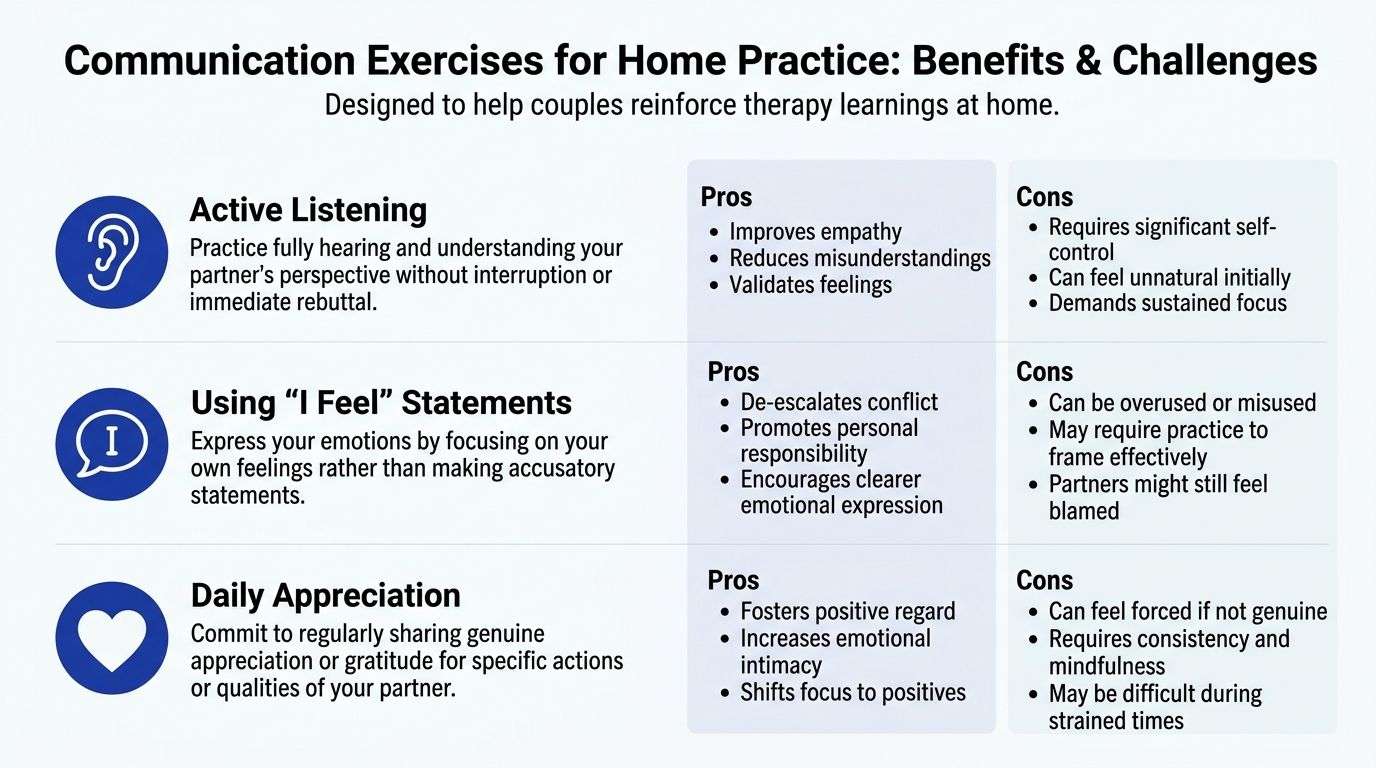
Small exercises can interrupt familiar patterns and create new ones. They don't need to be dramatic. They need to be repeatable.
Try the speaker-listener reset
This exercise works well when conversations derail quickly.
One person speaks for a short stretch about one issue. The other person only reflects back what they heard before responding. Then you switch.
How to do it
- Choose one topic only.
- The speaker uses short sentences and sticks to their own experience.
- The listener reflects back the message in their own words.
- The speaker corrects anything that was missed.
- Only after feeling understood does the listener share their side.
Practice rule: Don't rebut until your partner says, “Yes, that's what I meant.”
Why it helps
This slows down reactivity. Many couples think they have a communication problem when they have a pace problem. The conversation moves so quickly that neither person feels heard.
Use “I feel” statements the right way
This tool is widely known and often poorly used. “I feel like you don't care” sounds like an emotion, but it usually lands as criticism. A true feeling statement names your internal experience first.
Examples:
- “I felt hurt when we stopped talking and went to bed angry.”
- “I feel anxious when plans change and we don't talk about it.”
- “I feel lonely when we only discuss logistics.”
What to watch for
- Keep it specific.
- Link the feeling to a moment or pattern.
- Don't smuggle blame into the sentence.
Speak from your own experience first. It gives your partner something they can respond to without immediately defending themselves.
Start a daily appreciation ritual
When a relationship is strained, couples often become highly trained in noticing what's missing. Appreciation helps rebalance attention without pretending everything is fine.
Try this each evening:
- Name one specific action you appreciated.
- Name one quality you still value in your partner.
- Keep it brief and genuine. Forced praise usually backfires.
A few examples:
| Instead of this | Try this |
|---|---|
| “Thanks for everything” | “Thanks for handling dinner when I was overwhelmed” |
| “You're nice” | “I appreciate how patient you were with the kids tonight” |
| “Good job” | “I felt cared for when you checked in with me after work” |
Why it helps
Appreciation doesn't erase pain. It does create more emotional oxygen. Couples in distress often need help remembering that the relationship contains more than injury.
Make practice realistic
The goal isn't perfection. It's repetition.
A few ways to make home practice stick:
- Choose calm moments. Don't try a structured exercise in the middle of a heated argument.
- Set a time limit. Short, contained practice is often more effective than long emotional marathons.
- Expect awkwardness at first. New relational habits can feel mechanical before they feel natural.
- Bring your experience back to therapy. The useful question is not “Did we do it perfectly?” It's “What happened when we tried?”
Measuring Progress and Understanding the Timeline
Progress in couples counselling is rarely neat. Most couples don't move from pain to harmony in a straight line. More often, they begin by having the same hard moments in a slightly different way. The pause comes sooner. Repair happens faster. One person stays present instead of walking away. The other softens instead of escalating.
Those early shifts matter.
What progress often looks like
You may be making progress if you notice:
- Arguments are less intense. Not gone, but less damaging.
- Recovery is quicker. You reconnect after conflict without carrying the same rupture for days.
- Emotional safety is growing. It feels a bit easier to tell the truth.
- Defensiveness is softening. One or both of you can hear impact without instantly counterattacking.
- Affection returns in small ways. A touch on the shoulder, humour, warmth, or checking in starts to feel more natural again.
What the timeline can realistically feel like
Research indicates that approximately 70 to 75% of couples report improved relationship satisfaction after completing couples therapy, with benefits often emerging within a few months of consistent sessions and lasting for over a year. That can be reassuring, but it's also important to remember that “a few months” doesn't mean every week feels easier than the last.
Improvement often starts with a different pattern, not a different personality.
Some weeks may feel encouraging. Others may feel flat or discouraging. That doesn't automatically mean the work has stalled. It may mean you're learning how to interrupt old habits under real-life stress.
A healthier question than “Are we fixed yet?” is this: Are we relating differently when something hard happens? If the answer is gradually becoming yes, the process is often doing what it's supposed to do.
Common Questions About Couples Counselling in Vernon
A lot of couples reach this section with the same quiet worry: “We want help, but what if counselling makes things more awkward, more painful, or more confusing?” That concern makes sense. Starting therapy can feel a bit like walking into a room without knowing the rules. Good couples counselling reduces that uncertainty by making the process clear, respectful, and structured from the beginning.
What if my partner is reluctant to come?
Reluctance is common, especially if one partner expects blame or fears being pushed into a conversation they do not feel ready for. It often helps to present counselling as a place to study the pattern between you, not to decide who is the problem. A simple invitation usually works better than a persuasive speech: “We keep ending up in the same painful place, and I'd like help understanding how we get there.”
If your partner still says no, one person can begin. Individual sessions cannot do the same job as couples therapy, but they can help you understand the cycle, change your side of it, and decide how to invite your partner again in a calmer way.
Is couples counselling confidential?
Yes, and it is wise to ask exactly how that works.
In couples therapy, the relationship is part of the treatment, so confidentiality can be a little more layered than it is in individual counselling. A therapist should explain how notes are handled, what happens if one partner shares something privately, and whether there is a “no secrets” policy for ongoing couples work. Asking these questions early is a sign of good judgment, not distrust.
What if we are not sure whether we want to stay together?
Counselling can still help. Some couples arrive wanting repair. Others arrive unsure whether repair is possible. Therapy gives you a place to slow the conversation down enough to tell the truth clearly, hear each other with less interruption, and make decisions with more care.
For couples facing addiction, betrayal, or repeated crises alongside relationship distress, a higher level of support may also be part of the discussion.
Do our problems have to be serious enough for therapy?
No. Couples do not need to be on the edge of separation to benefit from support. Many seek counselling because they feel distant, stuck in the same argument, or unable to talk without one person shutting down and the other pushing harder.
Early support often works like addressing a small crack before it spreads through a wall. The issue may look manageable from the outside, but repeated strain usually makes repair harder, not easier.
What if one session feels worse before it feels better?
That can happen. Therapy sometimes brings long-avoided feelings into the open, and that can leave both partners tender for a day or two. A hard session does not automatically mean counselling is failing. The better question is whether the process is helping you understand the conflict more accurately and respond with a little more honesty and care over time.
If you are considering whether this kind of support fits your relationship, Interactive Counselling offers information about its approach to relationship therapy and what the process can look like for couples in Vernon who want clear structure, evidence-based support, and practical ways to carry the work home between sessions.
Clinically Reviewed By
Amy Mosset, MCP, RCC-S
Amy Mosset is a Master Practitioner in Clinical Counselling, Clinical Supervisor, and the owner of Interactive Counselling. She provides trauma-informed, evidence-based care and clinical supervision to registered therapists, with a focus on ethical practice, client safety, and high-quality therapeutic outcomes.