It's 3 a.m. One of you is warming a bottle or shifting a baby from one shoulder to the other. The other is half-awake, trying to remember whose turn it is, whether the laundry got switched, and why a simple question somehow turned into a sharp exchange. You still love each other. You may even feel more tenderness than ever when you look at your baby. But you might also feel distant, irritated, lonely, or strangely like co-workers in survival mode. If that's where you are, you're not doing parenthood wrong. You're in one of the most demanding transitions a relationship can go through. For more information, see our Kelowna couples counselling.
"Protecting your relationship after having a baby in Kelowna starts with building small, reliable systems for connection, rest, teamwork, and intimacy that still work when you're exhausted." For more information, see our counselling in Kelowna.
Welcome to Parenthood Your Relationship Has Changed
A new baby changes the rhythm of everything. The day no longer belongs to the clock. It belongs to feeds, naps, crying spells, recovery, appointments, and the endless small decisions that fill every hour. Many couples are surprised by how quickly they can move from feeling bonded to feeling short with each other. For more information, see our couples counselling.
That doesn't mean the relationship is failing. It means the relationship is under pressure.
In counselling, I often see new parents worry that the tension means they've lost something important. Usually, what they've lost is not love. It's margin. Margin for sleep. Margin for patience. Margin for easy affection, long conversations, and spontaneous fun. When that margin disappears, even good couples can start misreading each other.
What often changes first
Some shifts are easy to recognise. Others are quieter.
- Conversation gets functional. You talk about diapers, feeding, pickup times, and groceries, but not about how you're doing.
- Fairness becomes sensitive. One partner may feel overworked. The other may feel unappreciated.
- Touch can get complicated. One person may want comfort. The other may feel touched out, sore, or emotionally far away.
- Small disappointments land harder. A forgotten task can feel like proof that you're carrying everything alone.
New parents rarely need more guilt. They need more structure, more compassion, and fewer assumptions.
For many Kelowna families, there's another layer. You may not have family nearby. You may not have an easy babysitting option. You may be parenting in a beautiful place, but still feel isolated inside your own home. That's why protecting your relationship after having a baby in Kelowna often needs to happen at home, in ordinary moments, not only on date nights or special weekends.
The hopeful part
This season can stretch a relationship. It can also mature it.
Couples do better when they stop waiting for things to “go back to normal” and start building a new normal on purpose. That usually looks less romantic than people expect. It's not grand gestures. It's clear agreements. Softer communication. Protected rest. Pressure-free closeness. Tiny daily repairs.
Those things may seem small. In the newborn stage, small is what saves you.
Understanding the New Parent Fog and Why You Feel Disconnected
Many couples share the same unspoken question after a baby arrives. Why do we feel so off when this is supposed to be a happy time? The answer is that joy and strain often exist together in early parenthood.
Research has found that the transition to parenthood is a significant stressor, with about two-thirds (67%) of couples reporting lower relationship satisfaction for up to three years after childbirth, and the most critical period for protecting the relationship is during the first 36 months when this decline is most commonly observed, according to longitudinal postpartum relationship research.
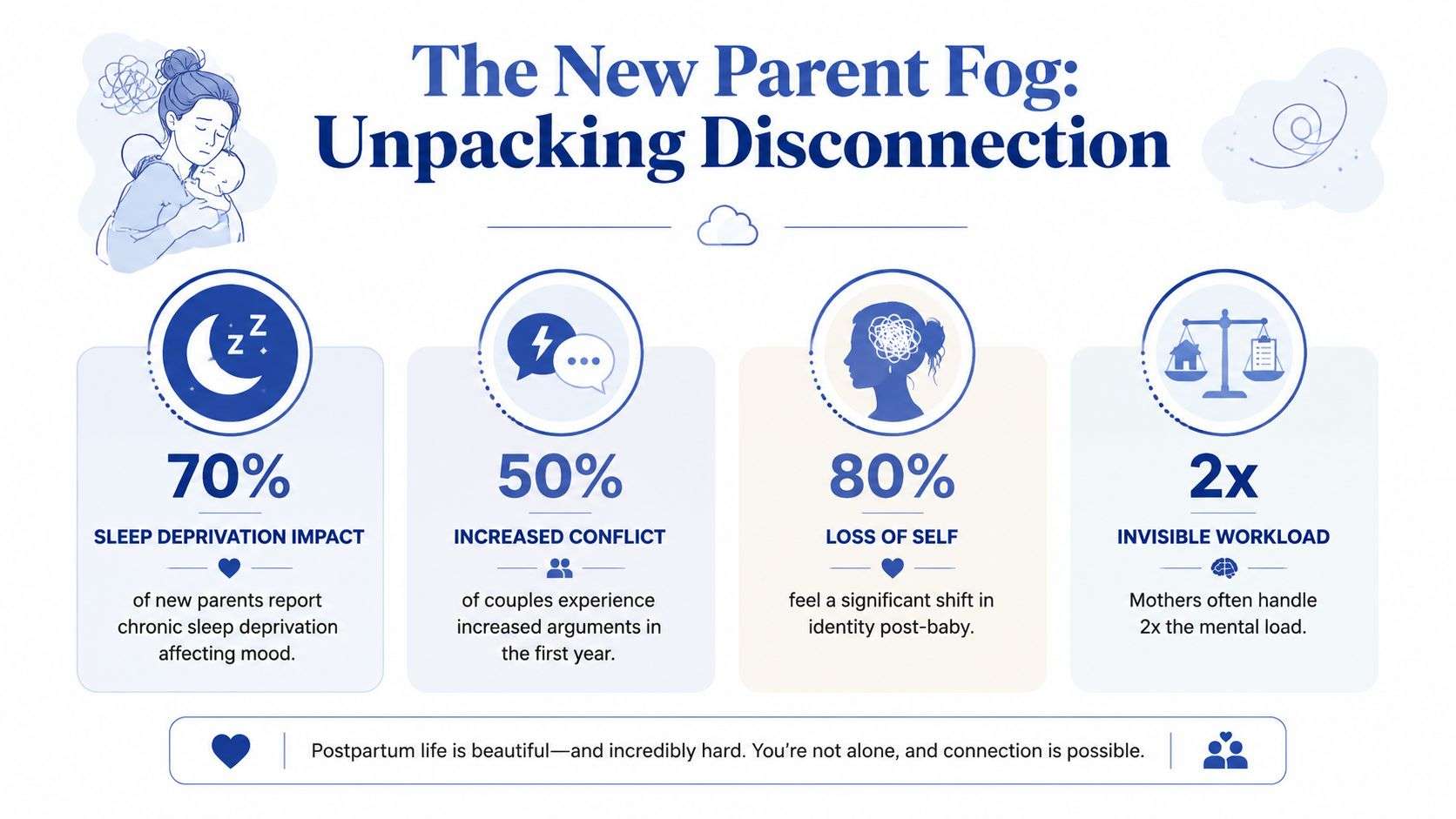
That finding matters because it removes a lot of shame. If you feel less connected, less patient, or less like yourselves, that isn't automatically a sign of a broken relationship. It's often a sign that you're in a known and difficult life stage.
What the new parent fog actually feels like
The “fog” isn't one problem. It's several problems stacked on top of each other.
| Stressor | How it shows up in daily life |
|---|---|
| Sleep disruption | You cry faster, snap faster, and solve problems worse |
| Mental load | One of you becomes the default rememberer, planner, and anticipator |
| Identity shift | You miss parts of who you were before becoming someone's parent |
| Reduced couple time | Conversations shrink to logistics and emergencies |
Sleep loss alone can make ordinary moments feel loaded. A neutral comment can sound critical. A simple request can feel like one more demand. You may both be trying hard and still feel unseen.
Why blame gets in the way
When couples don't understand the fog, they often personalise it.
They start thinking:
- “You don't care.”
- “You've changed.”
- “I'm doing this alone.”
- “We shouldn't be fighting if we're a good couple.”
Usually, the deeper truth is more ordinary and more repairable. You're both overloaded. You're both missing cues. You're both carrying fear, exhaustion, and grief for the ease you used to have.
Important shift: Stop asking, “What's wrong with us?” Start asking, “What pressure are we under, and how do we respond to it as a team?”
A clearer frame for Kelowna parents
In the Okanagan, families often tell me they expected the local lifestyle to buffer this stage. Fresh air helps. A walk helps. A beautiful setting helps. But no scenery cancels out postpartum recovery, broken sleep, or the strain of trying to coordinate a home and a baby.
That's why protecting your relationship after having a baby in Kelowna works best when you focus on what's predictable and repeatable. Not waiting until you both feel rested and spontaneous. Not waiting until someone offers help. Not waiting until tension becomes a bigger problem.
The fog lifts more gently when couples build supports before resentment hardens.
Building Your Daily Communication Lifeline
At 6:40 p.m., one of you is warming a bottle, the other is trying to remember whether the clean sleepers made it out of the dryer, and a simple question like “Did you call the pharmacy?” lands like criticism. That is usually not a character problem. It is a system problem.
After a baby arrives, couples need a way to stay connected that still works on three hours of broken sleep. A daily communication lifeline is that system. It works like the handrail on a steep set of stairs. You may still feel tired and wobbly, but you have something reliable to hold onto.
Guidance for the postpartum period often points couples toward small, repeatable habits instead of rare, heartfelt talks. A 10-minute daily screen-free check-in, clear requests, and regular appreciation can lower the pressure that builds when too much goes unsaid.
The 10-minute check-in
Keep it short on purpose.
Long conversations often fail in early parenthood because tired brains lose track, get defensive fast, or drift into problem-solving before either person feels heard. Ten minutes is small enough to do during a contact nap, while the kettle boils, or after a quick evening reset in your Kelowna kitchen.
Use the same three prompts each time:
- What felt hard today?
- What would help in the next 24 hours?
- What did you appreciate?
That structure matters. It reduces guesswork. It also helps prevent the common pattern where one partner starts sharing feelings and the other starts offering fixes.
Keep the check-in from turning into a fight
Many couples get stuck here, so let me make this plain. The goal is not to settle every issue before bed. The goal is to stay in contact and get clear on the next small step.
A useful rule is this: share one feeling, one need, and one concrete request.
Instead of:
- “You never help unless I ask.”
- “You get to sleep while I do everything.”
Try:
- “I'm overwhelmed and I need you to handle bedtime tomorrow without checking in with me.”
- “I'm running on empty. I need one uninterrupted hour after dinner.”
- “I'm starting to feel resentful, and I want us to catch it early.”
This kind of wording keeps the problem where it belongs. Between the two of you and the pressure you are under. Not inside one person as the villain.
A script for heated moments
When emotions are high, long explanations usually make things worse. Short scripts help because they give you something to say before your tired brain reaches for blame.
| Situation | Try saying |
|---|---|
| You feel invisible | “I know we're both stretched. I need some acknowledgment right now.” |
| You need practical help | “Can you take full ownership of this task so I can stop managing it in my head?” |
| A conversation is spiralling | “I want to talk about this well. I'm too flooded right now. Can we pause and return to it later?” |
If “later” tends to mean “never” in your home, pick a time right then. “After the next feed” or “tomorrow at 10 a.m.” is enough.
Two small habits that protect connection
These habits look minor. They are not minor.
- Name one thing your partner did well each day. Be specific. “Thanks for washing pump parts.” “Thanks for taking the fussy stretch so I could sit down.” Appreciation helps couples feel seen when most of the work is repetitive and easy to miss.
- Use touch that does not ask for anything. A hand on the back while passing in the hallway. Sitting knee-to-knee on the couch. Eye contact for three seconds before trading off the baby. This helps your nervous systems register, “We are still on the same side.”
For many Okanagan families, this is the shift that finally makes communication feel possible. You stop waiting for a free evening, a babysitter, or the energy for a big relationship talk. You build a few repeatable supports into ordinary days. That is how connection survives the hard weeks.
Creating a Fair Play System for Your New Life
One of the fastest ways couples get stuck after a baby is this. Both people feel maxed out, and both feel the other person doesn't fully see what they're carrying. Arguments about dishes, bottles, bedtime, or who got more sleep often aren't really about that one task. They're about load.
Research on over 2,000 parents found that stable, shared expectations and coordinated coping mechanisms, such as an explicit division of infant care and household tasks in the first postpartum year, were associated with a slower decline in relationship quality, according to this Fragile Families analysis.

Make the invisible visible
Most couples divide visible tasks and forget the hidden ones.
A fair system starts with a master list. Sit down together and write out everything required to keep the baby, household, and your lives functioning.
Include obvious items like:
- Night feeds
- Laundry
- Meal prep
- Bath and bedtime
Then add invisible work:
- Tracking diaper stock
- Remembering appointments
- Researching sleep issues
- Packing the diaper bag
- Texting family updates
- Planning meals
- Knowing when baby clothes no longer fit
This step alone can reduce conflict because it gives language to work that often goes unrecognised.
Assign ownership, not helpers
Many new parents accidentally create a manager-assistant dynamic. One person notices, plans, delegates, and follows up. The other “helps” when asked. That rarely feels fair for long.
Ownership sounds more like this:
| Task | Shared poorly | Shared clearly |
|---|---|---|
| Bottles | “Tell me if you need me to wash them” | “You fully own washing, drying, and checking clean bottle supply” |
| Groceries | “I can go if you make the list” | “You own the list, shop, and restocking basics” |
| Night care | “Wake me if it's bad” | “You cover this shift unless we agree otherwise” |
The point isn't rigid scorekeeping. It's lowering ambiguity.
Practical rule: If a task still lives in one person's head, it hasn't really been shared.
Build a rest-protection shift system
Rest cannot be a vague hope. It needs a plan.
For many couples, a shift system works better than trying to split every wake-up evenly in real time. The exact schedule will depend on feeding, work, recovery, and your baby's patterns. The key is that each partner gets some protected off-duty time where they are not “on call.”
A useful agreement includes:
- Who is primary during which block
- What counts as a true handoff
- What issues justify interrupting the off-duty partner
- When you'll review whether the system is still working
Resentment often grows when one person is technically resting but still listening for the baby, answering questions, or supervising from the background.
Keep revising as your baby changes
A system that worked at six weeks may fail at four months. Sleep changes. Work schedules change. Recovery changes. Your list should be a living document, not a one-time talk.
Ask each week:
- What's working?
- What feels unfair?
- What has shifted back onto one person?
- What needs to be simplified?
Protecting your relationship after having a baby in Kelowna often depends less on romance and more on whether your household runs in a way that feels like a partnership.
Reclaiming Intimacy and Closeness on Your Own Terms
Many couples feel confused or hurt by changes in intimacy after a baby. One partner may worry that desire is gone. The other may feel pressure before they feel physically or emotionally ready. Both can end up lonely.
Many articles, however, become too simplistic. They jump straight to “make time for sex” without acknowledging that postpartum intimacy is often more layered than that. Clinical guidance emphasizes that readiness, physical comfort, and emotional safety matter, and that a six-week medical clearance does not equal emotional or physical readiness.

Broaden what intimacy means
If intimacy only counts when it ends in sex, many couples stop reaching for each other at all. That creates more distance.
A healthier approach is to widen the definition of closeness. Intimacy can include:
- Sitting together without screens
- A longer hug in the kitchen
- Talking openly about fear, grief, or body image
- Laughing together
- Holding hands during a walk
- Saying “I miss you” without making it a demand
This doesn't minimise sex. It protects the bridge back to it.
How to talk about it without pressure
Pressure shuts down honesty. Safety opens it up.
A useful conversation might sound like:
- “I miss feeling close to you, and I don't want you to feel pushed.”
- “My body doesn't feel like mine yet, but I still want us to stay connected.”
- “What kinds of touch feel good right now and what doesn't?”
- “I want closeness, but I need slowness and choice.”
These talks go better when they happen outside the bedroom and outside a moment of disappointment.
Closeness returns more easily when both people feel free to tell the truth.
When pain or fear is part of the picture
Pain with sex after childbirth is not something to push through for the sake of the relationship. If intercourse feels painful, scary, or emotionally loaded, support can help.
You may also want to speak with your doctor or another qualified care provider if pain, dryness, fear, or body changes are making intimacy feel out of reach.
Rebuild in stages
Couples often do better when they stop asking, “Are we back to normal yet?” and start asking, “What kind of closeness feels possible right now?”
That might mean:
- Affection first. Touch with no expectation.
- Honesty next. Naming what feels tender, awkward, or missed.
- Experiment slowly. Trying closeness in ways that respect recovery and consent.
- Pause without panic. If something doesn't feel right, stop and talk.
For many couples, intimacy improves when home life feels fairer, rest is more protected, and emotional tension is lower. The body often follows the nervous system. If someone feels braced all day, they won't easily move into desire at night.
When and How to Seek Support in Kelowna
It often looks like this. The baby is finally asleep, the house is quiet, and one small comment about bottles, money, or whose turn it is turns into the same fight you had three nights ago. By morning, both of you feel discouraged and a little farther apart.
That pattern is common in early parenthood, especially when both people are running on too little sleep and too much responsibility. Sometimes the problem is not a lack of love or effort. The problem is that your current system cannot carry the pressure your family is under.
Outside help can be useful when home life keeps slipping into the same loop. One person pursues, the other shuts down. One keeps track of everything, the other feels criticized and stops trying. Guidance from the NHS relationship guidance after having a baby echoes what many couples discover firsthand. Early support can help before resentment hardens into your new normal.
Signs it may be time to reach out
Counselling is not only for couples in crisis. It can help when things feel stuck, tense, or harder than they need to be.
Support may make sense if:
- You keep having the same argument with different words
- One or both of you feels more like co-managers than partners
- Small conversations turn sharp very quickly
- Repair takes a long time, or never quite happens
- Intimacy feels loaded, distant, or easier to avoid
- You are both trying hard, but the home still feels heavy
A good rule of thumb is simple. If you spend more time managing friction than feeling like a team, it may be time for another layer of support.
What support can actually help with
In the postpartum season, useful couples support is less about grand insights and more about building better scaffolding. A counsellor can help you slow a conflict down, hear what is under the argument, and create repeatable agreements for real life in Kelowna. That might mean a clearer handoff plan for nights, a fairer way to divide invisible tasks, or a script for hard conversations when both of you are tired.
For some families, relationship support works best alongside broader community care. Resources like support for new parents can reduce isolation and remind you that many local families are dealing with the same strain, even if nobody talks about it at the playground or in the grocery line.
You do not have to wait until things feel severe. The earlier couples get help, the easier it often is to rebuild trust, steadiness, and closeness.
FAQ Your Questions About Post-Baby Relationships Answered
What if my partner isn't interested in trying any of this
Start smaller than you think you need to. In the first year, a relationship often responds better to a simple system than to a big heart-to-heart that lands at 11 p.m. after three wake-ups.
Pick one change that is easy to test for a week. A 10-minute daily check-in. One person fully owning bottles. A clear handoff after dinner. Frame it like a household experiment, not a verdict on the relationship.
You could say, “I'm not asking us to fix everything. I want to try one small change that could make this week feel lighter for both of us.”
How long does this hard phase last
There is no single timeline, because newborn months, feeding changes, returning to work, and sleep patterns all place different strain on a couple. What tends to help is not waiting for the season to pass, but building routines that protect rest, fairness, and a little connection inside ordinary days.
That is why resilient systems matter so much. They keep carrying you on the nights when no one has energy for a date night, a long talk, or a polished plan.
If your home needs more hands during recovery or early feeding, some Kelowna families also look into elite maternity and nursing support to lower the pressure during the most demanding stretch.
Are arguments about the baby truly about the baby?
Sometimes. Often they are also about what the baby stress is stirring up underneath.
A disagreement about naps might be about trust. A fight about dishes might be about feeling alone. Tension about visitors might be about whose needs keep getting prioritized. The baby becomes the surface topic because it is right in front of you, but the deeper issue is often, “Do I matter to you right now when everything feels hard?”
If the same fight keeps changing costumes, slow down and ask what the argument is protecting. That question usually gets you closer to the underlying issue.
Is it normal if I love my baby and still miss my old relationship
Yes. That is a very human response to a major life change.
Becoming parents adds joy and grief at the same time. You may adore your baby and still miss lazy mornings, private jokes, easy sex, spontaneous plans, and the version of your partnership that had more space around it. Missing those things does not mean you made the wrong choice. It means something important changed.
Both love and loss can sit in the same room.
When should we worry that this is becoming a bigger problem
Pay attention if resentment keeps stacking up, if one or both of you feels alone for long stretches, or if even small conversations quickly turn tense. Another sign is when repair stops happening. You argue, then stay distant, and the distance starts to feel normal.
That pattern can become its own system. The good news is that systems can be changed.
If things feel heavy, getting support early often helps more than waiting until the relationship feels brittle.
If this article felt familiar, and you'd like more support making sense of this season, Interactive Counselling offers evidence-informed care for couples and families facing life transitions, stress, communication strain, and the relationship changes that often come with new parenthood.
Clinically Reviewed By
Amy Mosset, MCP, RCC-S
Amy Mosset is a Master Practitioner in Clinical Counselling, Clinical Supervisor, and the owner of Interactive Counselling. She provides trauma-informed, evidence-based care and clinical supervision to registered therapists, with a focus on ethical practice, client safety, and high-quality therapeutic outcomes.