Repeated arguments can leave you feeling trapped in a frustrating loop with no clear way out. For many Canadians, these persistent conflicts signal deeper issues beneath the surface, not just about chores or finances but about unmet needs and emotional wounds. Recognizing these underlying patterns is the first step to building healthier communication and finally understanding what your relationship is truly asking for.
Table of Contents
- Recurring Fights: What They Really Mean
- Emotional Cycles and Relationship Patterns
- Common Triggers and Attachment Styles
- Communication Pitfalls and Their Impact
- Breaking the Cycle with Therapy Support
Key Takeaways
| Point | Details |
|---|---|
| Recognise Recurring Fights | Recurring arguments signal underlying issues such as unmet emotional needs and power imbalances. Address the root causes to prevent repetition. |
| Understand Emotional Cycles | Emotional cycles can heighten tensions leading to conflicts. Awareness of these cycles is essential for breaking harmful patterns. |
| Acknowledge Attachment Styles | Individual attachment styles shape responses to triggers and conflict. Understanding them helps partners communicate more effectively. |
| Utilise Therapy for Change | Therapy offers tools to disrupt negative cycles and build healthier communication habits. Seeking support early can lead to more effective interventions. |
Recurring Fights: What They Really Mean
When you and your partner have the same argument for the third time this month, it feels like nothing changes. But these cycles aren’t random—they’re sending you a message.
Recurring fights reveal underlying patterns that surface because the root issue hasn’t been addressed. You’re not fighting about dishes or schedules; you’re fighting about unmet needs, misaligned expectations, or unresolved hurt hiding beneath the surface.
Here’s what these patterns typically signal:
- Unmet emotional needs — One partner feels unseen, unheard, or undervalued in the relationship
- Power imbalances — Decisions feel one-sided, and one person’s voice carries more weight
- Triggering past wounds — Current conflicts remind you of earlier relationship hurts or childhood experiences
- Communication breakdowns — You’re talking at each other, not with each other, so the real issue never gets discussed
- Incompatible expectations — You want different things and haven’t found common ground
The same fight, repeated, is your relationship asking for something to change.
When couples describe fighting about the same things, they often discover through professional counselling that why couples argue over the same issues reveals deeper disconnection. The content itself—whose turn it is to cook, how money gets spent—becomes less important than what the fight represents emotionally.
Why repetition happens is straightforward: without addressing what’s really bothering you, the tension rebuilds until you fight again. The conversation ends without resolution because you never reached the actual problem.
Consider this common pattern: Sarah and Marcus fight about household chores every few weeks. On the surface, it’s about fairness. Underneath, Marcus feels his work isn’t appreciated, and Sarah feels unsupported when she’s stressed. Until they discuss those feelings—appreciation and support—the chore fight will return.
Recurring arguments also show you where your relationship communication needs strengthening. You’ve identified the trigger; now you need tools to handle it differently.
Pro tip: The next time you have a familiar fight, pause and ask yourselves: “What am I really upset about here?” Write down the first answer that comes to mind before continuing the conversation—it often reveals the true issue beneath the obvious one.
Emotional Cycles and Relationship Patterns
Emotional cycles in relationships follow predictable patterns, much like a storm that builds, peaks, and subsides—only to build again. Understanding these cycles is the first step toward breaking them.
A typical emotional cycle might look like this: tension builds over days or weeks, a trigger sets off the argument, emotions escalate, conflict peaks, and then there’s a cooldown period before the cycle repeats. The problem is that each cycle leaves residual hurt, making partners more reactive and defensive the next time around.
Here’s what drives these patterns:
- Unresolved conflict — Each fight ends without true resolution, so the original wound stays open
- Emotional reactivity — Partners become hyper-sensitive to triggers because previous hurts haven’t healed
- Withdrawal and pursuit — One person distances while the other pursues, creating a push-pull dynamic that intensifies tension
- Shame and defensiveness — Partners defend their position rather than examining their own contribution
- Repeating childhood patterns — You unknowingly recreate relationship dynamics you witnessed growing up
Emotional cycles persist because they’re familiar, not because they’re healthy.
Many couples discover that building self-awareness through therapy reveals how their individual emotional wounds feed into relationship patterns. When one partner shuts down during conflict because they learned silence equals safety in childhood, and the other pursues connection because they learned speaking up was ignored, you get a cycle that repeats automatically.
These cycles also create a false sense of normalcy. You fight, make up, feel close for a while, then gradually drift until the next explosion. This can feel like the relationship is working—you resolve conflict, after all—but you’re not actually addressing what causes the conflict.
Consider how stress amplifies cycles. When finances tighten or work pressure increases, couples tend to revert to their most familiar patterns. The stressed partner might withdraw, triggering the other’s pursuit response, and suddenly you’re fighting about something entirely different because both people are already activated.
Breaking cycles requires awareness first. You need to see the pattern clearly: what triggers it, who does what, and what the cycle protects you from feeling. Only then can you interrupt it.

Pro tip: Map your cycle on paper: write down what happens first, then next, then what follows. Identify where you could pause the cycle—even small shifts in one person’s response can change the entire pattern.
The table below contrasts healthy emotional cycles with unhealthy recurring cycles, aiding recognition and intervention:
| Cycle Type | Recognition Signs | Long-term Outcome |
|---|---|---|
| Healthy Cycle | Open discussion, resolution | Increased trust, growth |
| Unhealthy (Recurring) | Repeated fights, no closure | Resentment, disconnection |
Common Triggers and Attachment Styles
Your attachment style—formed in childhood through interactions with caregivers—shapes how you respond to conflict today. Understanding this connection is crucial to recognizing why the same triggers set you off repeatedly.
Attachment styles and their relationship to trauma reveal that secure, anxious, avoidant, and disorganised attachment patterns influence emotional responses to relational stress. Each style has distinct triggers that activate vulnerability and defensive reactions.
Here’s how each attachment style responds to common triggers:
- Secure attachment — You handle conflict calmly, express needs clearly, and trust your partner’s intent
- Anxious attachment — You fear abandonment, need frequent reassurance, and interpret distance as rejection
- Avoidant attachment — You withdraw from emotional closeness, suppress needs, and perceive demands as suffocating
- Disorganised attachment — You oscillate between pursuing and withdrawing, creating confusing, contradictory responses
Your attachment style isn’t your fault, but understanding it is your responsibility.
When a partner needs space during conflict, an anxiously attached person feels panicked—abandonment triggers flood their nervous system. That same request makes an avoidantly attached person feel relieved and safe. Neither response is wrong; they’re protective strategies learned long ago.
Common triggers linked to attachment include perceived rejection, criticism, feeling unheard, or emotional unavailability. These triggers bypass your rational mind and activate your survival responses. Your nervous system reacts before your brain can think.
The challenge is that partners often have opposite attachment styles. One pursues connection when stressed; the other withdraws for safety. Both are trying to protect themselves, but their strategies create the exact opposite of what they need.
Recognising your emotional triggers and attachment patterns allows you to pause before reacting. You can ask yourself: “Is this truly about what my partner did, or is this an old wound being activated?”
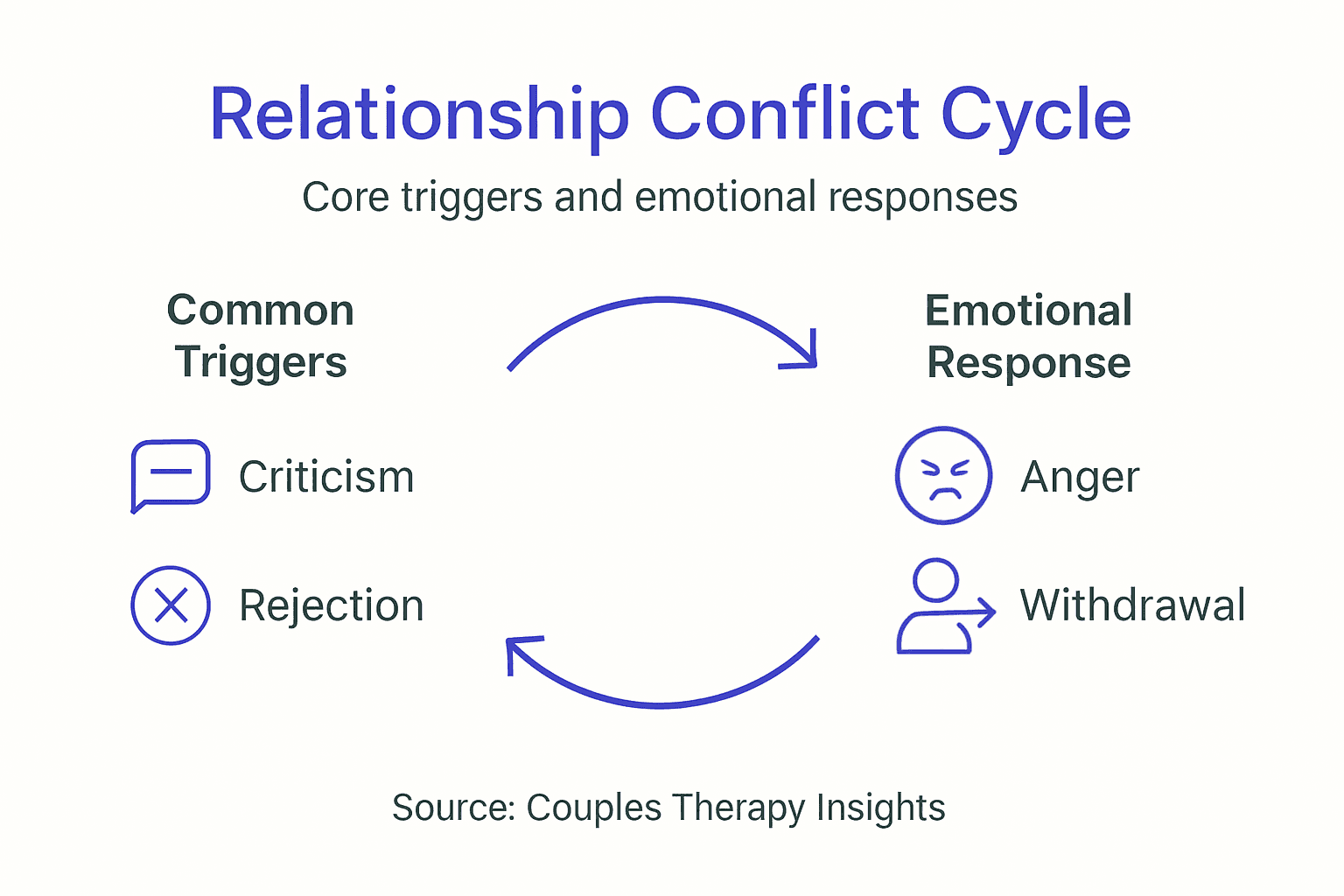
This distinction changes everything. Suddenly, conflicts become opportunities to heal childhood wounds together rather than battles to win.
Pro tip: Identify your three biggest triggers by thinking back to recent fights. For each one, ask: “What did this remind me of from childhood?” This connects present conflict to past patterns, making them easier to interrupt.
Here’s a quick overview of how attachment styles can affect common relationship triggers and responses:
| Attachment Style | Typical Trigger | Emotional Response | Impact on Conflict |
|---|---|---|---|
| Secure | Disagreement or disappointment | Calm, open communication | Promotes quick resolution |
| Anxious | Perceived distance or rejection | Worry, need for reassurance | Intensifies pursuit behaviour |
| Avoidant | Requests for closeness or sharing | Withdrawal, discomfort | Leads to emotional distancing |
| Disorganised | Unpredictable situations | Confusion, mixed reactions | Creates inconsistent cycles |
Communication Pitfalls and Their Impact
Most recurring fights aren’t really about what you’re discussing—they’re about how you’re discussing it. Communication pitfalls create misunderstandings that pile up over time, turning small conflicts into entrenched patterns.
The most destructive pitfall is assuming you understand your partner’s intent without checking. You see them withdraw and assume they don’t care, when they actually feel unsafe expressing emotions. That assumption triggers your defensive response, and suddenly you’re both hurt.
Common communication pitfalls include:
- Focusing on personal agenda — You’re waiting for your turn to speak rather than truly listening
- Interpreting body language incorrectly — A frown means anger; silence means rejection (often untrue)
- Emotional flooding — Stress and hurt make you reactive rather than thoughtful
- Using criticism instead of requests — “You never listen” instead of “I need you to look at me when I talk”
- External noise and distractions — Phones, fatigue, and stress block genuine connection
You can’t solve a problem you haven’t actually discussed.
Communication barriers like emotional distractions and information overload hinder the active listening required to truly understand your partner. When you’re flooded with emotion or distracted by stress, your brain filters out what your partner is actually saying.
Misinterpreting non-verbal cues is particularly damaging. Your partner’s silence might mean they need processing time, but you interpret it as coldness. This disconnect repeats because neither person addresses the actual barrier.
The solution starts with active listening. This means full attention, awareness of your own assumptions, and genuine curiosity about what your partner means. It requires setting aside your need to defend or convince.
Partners in Canadian relationships often struggle with common couple communication mistakes that have simple fixes. Naming the pitfall—“I notice I’m getting defensive instead of listening”—creates space to try differently.
When you interrupt the pitfall pattern, the entire dynamic shifts. Suddenly, conflicts become conversations where both people feel heard, not battles where both feel wronged.
Pro tip: Before responding in a heated moment, pause and ask: “What did my partner actually say, not what am I afraid they meant?” Then say it back to them to confirm you understood correctly.
Breaking the Cycle with Therapy Support
You cannot break a cycle alone. Therapy provides the external perspective, tools, and safe space needed to interrupt patterns that feel automatic and inescapable.
When couples work with a therapist, something shifts. A trained professional can see patterns you’re too close to recognise and name the cycle in ways that create space for change. You’re no longer trapped in the fight; you’re observing it together.
Therapy helps in specific ways:
- Identifying root causes — Understanding why this particular trigger activates both partners
- Building communication skills — Learning to express needs without criticism or defensiveness
- Healing individual wounds — Addressing childhood patterns that fuel adult conflicts
- Developing emotional regulation — Managing reactions before they escalate conflicts
- Creating safety — Building trust that the relationship can handle difficult conversations
Therapy isn’t admission of failure; it’s commitment to change.
Research on early intervention and family support demonstrates that targeted therapeutic approaches successfully disrupt harmful cycles and promote healthier relationship dynamics. The earlier you intervene in a pattern, the easier it becomes to shift.
Within Interactive Counselling, therapy addressing relationship issues focuses specifically on the patterns you’re experiencing. Therapists help couples see how each person contributes to the cycle without blame, creating understanding instead of defensiveness.
A skilled therapist also helps you recognise when you’re in the cycle while it’s happening. This awareness—catching yourself mid-pattern—is the first step to choosing differently. Over time, you interrupt the cycle faster and faster.
Therapy also addresses what the cycle protects you from. Often, recurring fights serve a purpose: they keep distance safe, prevent true intimacy, or protect old wounds from being touched. Once you understand what the cycle does for you, you can address that need directly.
The timeline matters too. Couples who seek help early—when frustration is building but disconnection isn’t complete—see faster changes. Waiting until the relationship is severely damaged requires more intensive work.
Pro tip: Start therapy before you’re desperate. When you’re curious about patterns rather than desperate to escape them, you’re in the best mindset to actually change them.
Break Free From Recurring Fights and Build a Stronger Connection
If you find yourself caught in cycles of recurring fights or emotional patterns that leave both you and your partner feeling stuck, it is a clear sign that deeper issues need attention. The pain of repeated conflicts can trigger feelings of disconnection, frustration, and loneliness. These challenges often stem from unmet emotional needs, communication pitfalls, or unresolved attachment wounds as explained in the article. Recognizing these patterns is empowering, but meaningful change usually requires guidance and support.
At Interactive Counselling, we offer personalised therapy services designed to help couples and individuals understand the root causes of their conflicts and develop healthier ways to communicate and connect. Whether you are dealing with emotional cycles, attachment triggers, or recurring communication breakdowns, our compassionate therapists provide a safe space for healing and growth across multiple Canadian locations including Kelowna, Vernon, Grande Prairie, and Penticton. With flexible options including in-person and online sessions, you can begin transforming your relationship on your own terms. Don’t wait until frustration overwhelms your connection. Take the first step toward lasting change by visiting Interactive Counselling and booking your appointment today.
Frequently Asked Questions
Why do couples keep having the same arguments?
Recurring arguments often stem from unresolved emotional needs, misaligned expectations, or underlying issues not addressed in the relationship. These patterns signal that the root cause remains unacknowledged.
How can we break the cycle of fighting about the same things?
Breaking the cycle requires awareness of the emotional patterns and triggers involved. Strategies like open communication, active listening, and seeking professional therapy can help interrupt these cycles.
What role do attachment styles play in recurring conflicts?
Attachment styles influence how individuals respond to stress and conflict. Understanding each partner’s attachment style helps identify triggers and reactions, enabling healthier responses during disagreements.
How can therapy help with recurring relationship fights?
Therapy provides a safe space to explore the root causes of conflicts, build communication skills, and heal individual wounds. A therapist can provide tools for couples to recognize and interrupt negative cycles together.
Recommended
- Why Couples Argue Over the Same Issues
- Common Couple Communication Mistakes – Solutions That Work
- Why Avoidance Fuels Anxiety – Patterns and Solutions
- Anxiety Patterns: Why They Persist and What Helps