Have you ever felt your mind go blank during an argument, unable to find words or think clearly? That sudden wave of overwhelming emotion isn’t weakness. It’s emotional flooding, a biological response that hijacks your ability to communicate effectively. Understanding this phenomenon transforms how you navigate conflict, turning heated arguments into opportunities for deeper connection and emotional growth.
Table of Contents
- Understanding Emotional Flooding
- Signs and Symptoms of Emotional Flooding
- Causes and Triggers
- Impact on Communication and Conflict
- Comparison with Stonewalling and Emotional Shutdown
- Therapeutic Approaches to Managing Emotional Flooding
- Practical Strategies for Managing Emotional Flooding
Key Takeaways
| Point | Details |
|——-|———||
| Emotional flooding is biological | Your nervous system activates fight-or-flight, suppressing logical thinking during perceived threats. |
| Early recognition prevents escalation | Physical signs like rapid heartbeat and mental fog signal flooding before communication breaks down. |
| Triggers stem from past experiences | Trauma and insecure attachment patterns increase vulnerability to flooding during conflicts. |
| Practical strategies restore control | Taking breaks, deep breathing, and labeling emotions engage calming brain functions. |
| Professional support builds lasting skills | Therapy like CBT teaches couples to interrupt reactive cycles and regulate emotions effectively. |
Understanding Emotional Flooding
Emotional flooding occurs when your nervous system perceives a threat and activates an overwhelming stress response. During arguments, your amygdala hijacks rational thought, triggering fight-or-flight mode. This neurobiological response floods your body with stress hormones, shutting down the prefrontal cortex responsible for logical reasoning and language processing.
When flooded, you can’t access the communication skills you normally possess. Your heart races, thoughts scatter, and words disappear. This isn’t about emotional maturity or self-control. It’s pure biology protecting you from perceived danger.
The impact on relationships becomes clear when you recognize how flooding contributes to why couples argue over the same issues repeatedly. Without addressing the underlying flooding response, conflicts spiral into unproductive patterns that erode connection over time.
Pro Tip: Think of emotional flooding like a circuit breaker in your home. When the electrical load becomes too intense, the breaker trips to prevent damage. Your nervous system does the same thing during intense emotional moments.
Recognizing flooding as a protective mechanism rather than a personal failure opens the door to compassionate self-awareness. Key signs include:
- Inability to think clearly or form coherent thoughts
- Physical tension spreading through your body
- Feeling trapped or desperate to escape the conversation
- Sudden urge to attack verbally or withdraw completely
Signs and Symptoms of Emotional Flooding
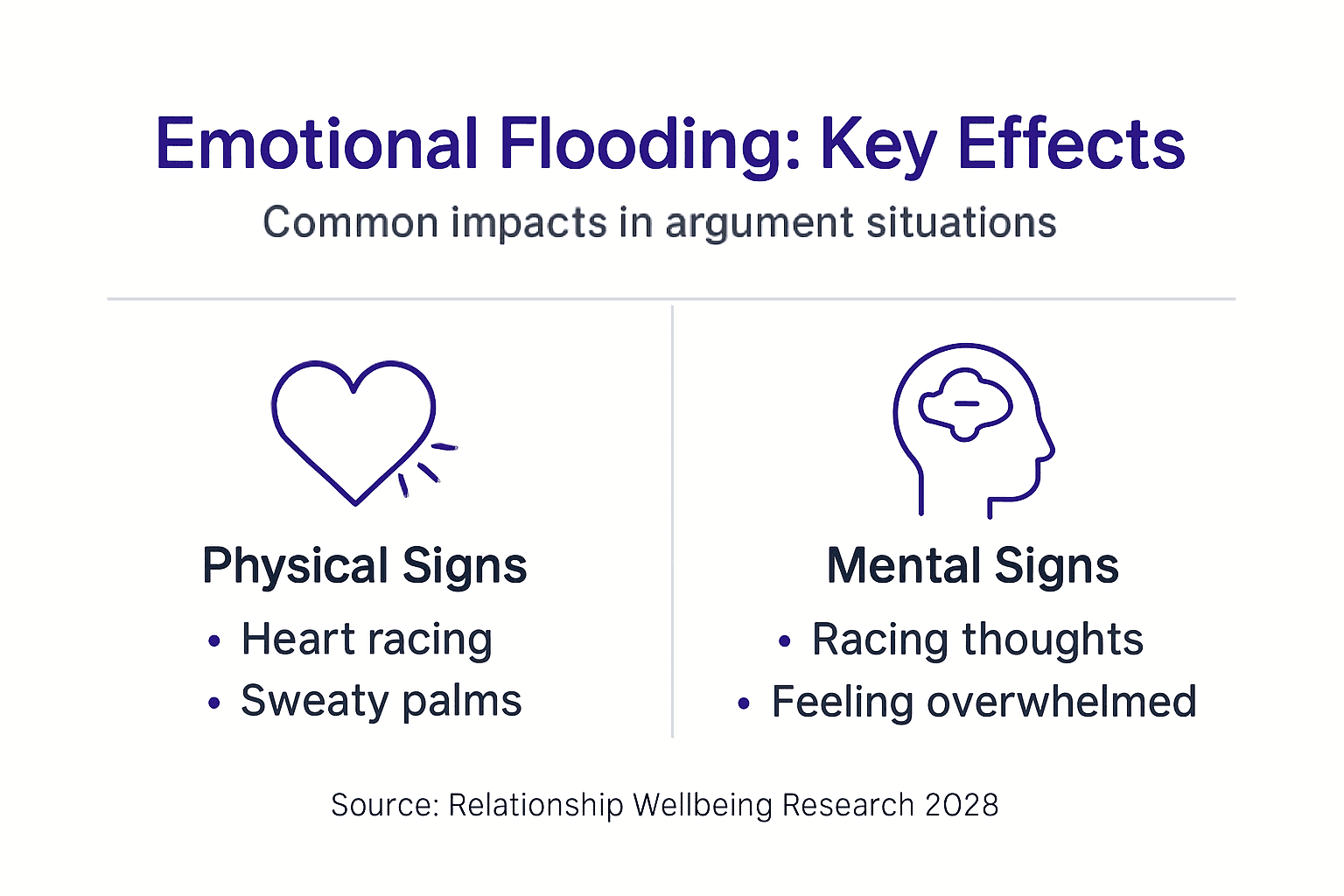
Identifying flooding early gives you power to intervene before communication completely breaks down. Your body sends clear signals when overwhelm takes over. Common physical symptoms include increased heart rate, shallow breathing, muscle tension, racing thoughts, and difficulty accessing language.
Physical manifestations often appear first. You might notice your chest tightening, palms sweating, or face flushing. Your breathing becomes rapid and shallow, limiting oxygen to your brain and intensifying the fog.

Mental symptoms create additional barriers to resolution. Your thoughts race without landing anywhere productive. Words you want to say feel stuck behind a wall. You might repeat the same points without hearing your partner’s perspective.
These symptoms overlap with signs of childhood trauma responses, particularly if past experiences conditioned your nervous system to perceive conflict as dangerous. Understanding why emotions feel overwhelming helps normalize these intense reactions.
Emotional indicators include:
- Sudden rage or panic disproportionate to the situation
- Feeling like you’re watching yourself from outside your body
- Overwhelming urge to cry, yell, or flee
- Complete shutdown where you can’t respond at all
The sooner you recognize these signs in yourself or your partner, the faster you can implement calming strategies. Self-awareness becomes your greatest tool for maintaining connection during difficult conversations.
Causes and Triggers
Emotional flooding doesn’t happen in a vacuum. Your history shapes how quickly and intensely your nervous system responds to conflict. Past trauma and insecure attachment styles create heightened vulnerability to flooding during relationship disagreements.
If you grew up in an environment where emotions felt dangerous or conflicts turned explosive, your nervous system learned to brace for threat. This conditioning means current arguments trigger old protective responses, even when your partner poses no real danger.
Understanding how childhood emotional neglect shapes adult attachment reveals why some conversations feel unbearably intense. Your nervous system remembers abandonment, criticism, or invalidation, responding as if those old wounds are reopening.
Common triggers that activate flooding include:
- Feeling criticized, blamed, or attacked by your partner
- Perceiving rejection or abandonment in their words or tone
- Accumulated stress from work, finances, or life demands
- Discussions about sensitive topics like money, parenting, or intimacy
- Tone of voice, facial expressions, or body language that signals danger
Recognizing your specific emotional triggers allows you to prepare coping strategies before flooding takes over. The goal isn’t eliminating triggers but building capacity to stay regulated when they appear.
Cultural context matters too. Emotional patterns in Canadian wellbeing reflect broader societal attitudes toward conflict and emotional expression. Some communities emphasize keeping peace over addressing problems directly, creating additional pressure during disagreements.
Remember that flooding is a biological reaction, not a character flaw. Your nervous system tries to protect you. The work involves teaching it that emotional intensity during conflict doesn’t equal danger.
Impact on Communication and Conflict
When flooding hits, effective communication becomes nearly impossible. Your prefrontal cortex goes offline, taking with it your ability to listen, empathize, and respond thoughtfully. Arguments escalate because neither person can access their rational brain.
Flooding creates a cascade of communication breakdowns. You might:
- Misinterpret neutral statements as attacks
- Respond defensively to perceived criticism
- Say hurtful things you don’t mean
- Shut down completely, leaving your partner frustrated
These patterns feed into the conflict escalation cycles that keep couples stuck in repetitive arguments. Without addressing flooding, you’re arguing about the same issues because you never truly resolve them. Each conversation reinforces the pattern instead of building understanding.
Emotional distance grows when flooding prevents genuine connection. Your partner feels unheard. You feel misunderstood. Resentment builds in the space where resolution should happen.
The absence of self-awareness in communication means you might not realize flooding has taken over until significant damage occurs. Developing awareness creates pause points where you can choose a different response.
Beyond immediate arguments, chronic flooding erodes relationship satisfaction. When every difficult conversation triggers overwhelm, couples avoid important topics. Problems fester. Connection weakens. What started as a biological response becomes a relationship pattern that requires intentional intervention to change.
Comparison with Stonewalling and Emotional Shutdown
Emotional flooding often leads to related defensive behaviours that further complicate conflict resolution. Understanding distinctions between flooding, stonewalling, and shutdown helps you identify what’s happening and respond appropriately.
Stonewalling occurs when someone withdraws from conversation to protect themselves from flooding. They might turn away, give short responses, or refuse to engage. This behaviour often gets labeled as manipulative, but it’s typically a desperate attempt to avoid emotional overwhelm.
Emotional shutdown represents a freeze response where your nervous system shuts down completely. Unlike active stonewalling, shutdown feels involuntary. You want to respond but can’t access words or emotions. Everything goes numb or blank.
| Behavior | Trigger | Impact on Partner | Regulation Approach |
|---|---|---|---|
| Emotional Flooding | Perceived threat activates fight-or-flight | Partner feels attacked or confused by intensity | Take breaks, breathe deeply, label emotions |
| Stonewalling | Overwhelm creates need to withdraw | Partner feels ignored, dismissed, or punished | Communicate need for pause, set return time |
| Emotional Shutdown | System overload causes freeze response | Partner feels shut out, anxious about silence | Gentle self-compassion, gradual re-engagement |
Key differences include:
- Flooding involves intense emotional activation
- Stonewalling is withdrawal while still somewhat engaged
- Shutdown represents complete nervous system freeze
- All three stem from overwhelm, not malicious intent
Recognizing which response you or your partner experiences guides your next steps. Someone stonewalling needs space. Someone shutdown needs gentle patience. Someone flooding needs grounding techniques. Tailoring your approach increases chances of productive resolution.
Therapeutic Approaches to Managing Emotional Flooding
Professional therapy offers structured support for understanding and regulating emotional flooding. Cognitive behavioural therapy helps couples understand how thoughts, emotions, and behaviours fuel conflict cycles and teaches strategies to interrupt flooding before it derails conversations.
Therapists help you identify the thought patterns that amplify emotional responses. You learn to challenge distorted thinking that interprets neutral comments as attacks. This cognitive work reduces the frequency and intensity of flooding episodes over time.
Couples therapy specifically addresses how partners’ flooding responses interact and escalate conflicts. A therapist guides you through:
- Recognizing early flooding signs in yourself and your partner
- Developing shared language for calling timeouts
- Building skills to soothe each other’s nervous systems
- Creating agreements about how to handle flooding when it occurs
Exploring various couples therapy approaches reveals options beyond CBT, including Emotionally Focused Therapy and the Gottman Method. Each approach offers unique tools for managing flooding within your relationship dynamic.
Pro Tip: Therapy works best when you practice techniques between sessions. Think of it like physical therapy for your nervous system. The exercises build strength over time, not overnight.
Professional counselling services provide accountability and expert guidance as you develop new patterns. Therapists spot dynamics you might miss and offer targeted interventions based on your specific triggers and responses.
The combination of professional support and personal practice creates sustainable change. You’re not just learning about flooding. You’re rewiring how your nervous system responds to conflict.
Practical Strategies for Managing Emotional Flooding
You can take immediate action when flooding begins. These strategies activate your parasympathetic nervous system, the calming counterbalance to fight-or-flight activation. Consistent practice makes them increasingly effective over time.
Take a minimum 20-minute break. Your stress hormones need at least 20 minutes to metabolize. Shorter breaks don’t give your nervous system enough time to regulate.
Practice deep belly breathing. Inhale slowly for four counts, hold for four, exhale for six. The extended exhale activates your vagus nerve, signaling safety to your brain.
Label your emotions aloud or mentally. Saying
Recommended
- Why Couples Argue Over the Same Issues
- Common Emotional Triggers – How They Affect Reactions
- Emotional Safety Matters – How It Shapes Relationships
- Therapy and Emotional Patterns: Building Self-Awareness