Joining a dialectical behavior therapy (DBT) group is less about rehashing the past and more about building a better future. Think of it as a practical, hands-on workshop where you learn the skills to handle intense emotions, build stronger relationships, and navigate life's toughest moments. It’s a supportive, educational space focused on helping you build emotional resilience. For more information, see our couples counselling.
What to Expect in a DBT Group
Have you ever felt like your emotions were a tidal wave, sweeping you away before you could catch your breath? It’s a common feeling, especially when dealing with overwhelming stress or complicated relationships. It can feel incredibly isolating, but this is exactly where a dialectical behavior therapy group can make a real difference.
A DBT group isn't your typical talk therapy session where you’re put on the spot. Instead, it’s set up more like a classroom for emotional well-being—a safe, structured place to learn and practice new strategies. The entire focus is on equipping you with practical skills to build a life that feels more stable and meaningful.
The Curriculum for a More Balanced Life
At its heart, a DBT group works through a curriculum built around four core skill sets. Each one gives you concrete tools to tackle different challenges, whether it's surviving a crisis without making things worse or simply asking for what you need from others.
Mindfulness: This is all about learning to stay present and grounded. You’ll practice observing your thoughts and feelings without getting swept away by them.
Distress Tolerance: These are your crisis survival skills. They teach you how to get through painful situations and intense emotions without reacting in ways you might later regret.
Emotion Regulation: Here, you’ll learn to understand your emotions—what triggers them, what they’re telling you, and how to change them when they aren’t helpful.
Interpersonal Effectiveness: This module focuses on relationships. You'll learn how to communicate your needs clearly, set healthy boundaries, and navigate conflict respectfully.
You can think of it like learning a new language. It feels a bit awkward at first, but with practice and the right guidance, you’ll soon find yourself navigating your inner world and your relationships in a completely new, more effective way.
The group facilitator acts like a teacher and a coach, guiding everyone through the lessons each week. The aim is to make therapy less mysterious and more practical, giving you tangible strategies you can use right away. Over time, you’ll build the confidence and resilience to handle whatever life throws your way. If you're exploring different therapeutic approaches, you can find information about counselling options here.
The Four Core DBT Skills You Will Learn
At the very heart of every DBT group is a practical, structured curriculum designed to build real-world emotional resilience. This isn't about diving into abstract theories; it’s about learning tangible skills you can start using in your daily life right away. Think of it as being handed a toolkit, where each tool has a specific job in helping you navigate both your inner world and your relationships with more balance and confidence.
The entire program is built around four key modules that work together. Each one tackles a different piece of the puzzle, from staying grounded when you feel like you're spiraling to communicating your needs without creating conflict. Together, they create a solid framework for building a life that feels more stable, meaningful, and true to who you are.
Mindfulness: Grounding Yourself in the Present
The first and most fundamental skill you’ll learn is mindfulness. This might sound a little intimidating, but it really just means learning to pay attention to the present moment without judging it. So many of us live our lives either replaying past hurts or rehearsing future worries, which can leave us feeling anxious and disconnected from what’s happening right now.
Mindfulness teaches you how to find your anchor, even when your thoughts and feelings feel like a chaotic storm. It’s about simply noticing what's happening inside and around you—a thought, a feeling, the sensation of your feet on the floor—and just observing it without getting swept away.
This practice isn't about emptying your mind or trying to stop your thoughts. It's about learning to sit with them as a calm observer, which gives you the breathing room to choose how you want to respond instead of just reacting on autopilot.
Distress Tolerance: Navigating Emotional Crises
Next up is distress tolerance. These are your go-to crisis survival skills—the practical tools you pull out when you’re hit with intense emotional pain and feel the urge to do something that might only make things worse. Life is full of tough moments, and this module starts by accepting that pain is an unavoidable part of it.
Instead of trying to escape or numb these feelings, distress tolerance shows you how to get through them without falling back on unhelpful behaviours. This might involve techniques to soothe yourself with your five senses, distract your mind just long enough to get through the worst of it, or simply accept reality as it is in that moment. It's all about empowering you to endure a crisis while staying in control.
Emotion Regulation: Understanding Your Feelings
The third module, emotion regulation, is all about building a healthier relationship with your feelings. For many, emotions can feel like unpredictable, overwhelming forces that run their lives. This part of the curriculum teaches you to see them not as enemies, but as valuable sources of information.
You will learn practical skills to:
Identify and name your emotions: Just knowing what you're feeling can immediately dial down its intensity.
Understand what your emotions are telling you: Feelings often act as clues, pointing to your needs and what’s happening in your environment.
Reduce your vulnerability to negative emotions: You’ll discover how daily habits can create a more stable emotional foundation.
Increase positive emotional experiences: This involves actively and intentionally building moments of joy, connection, and contentment into your life.
This map gives a simple visual of how a DBT group brings together skills, support, and a sense of safety.
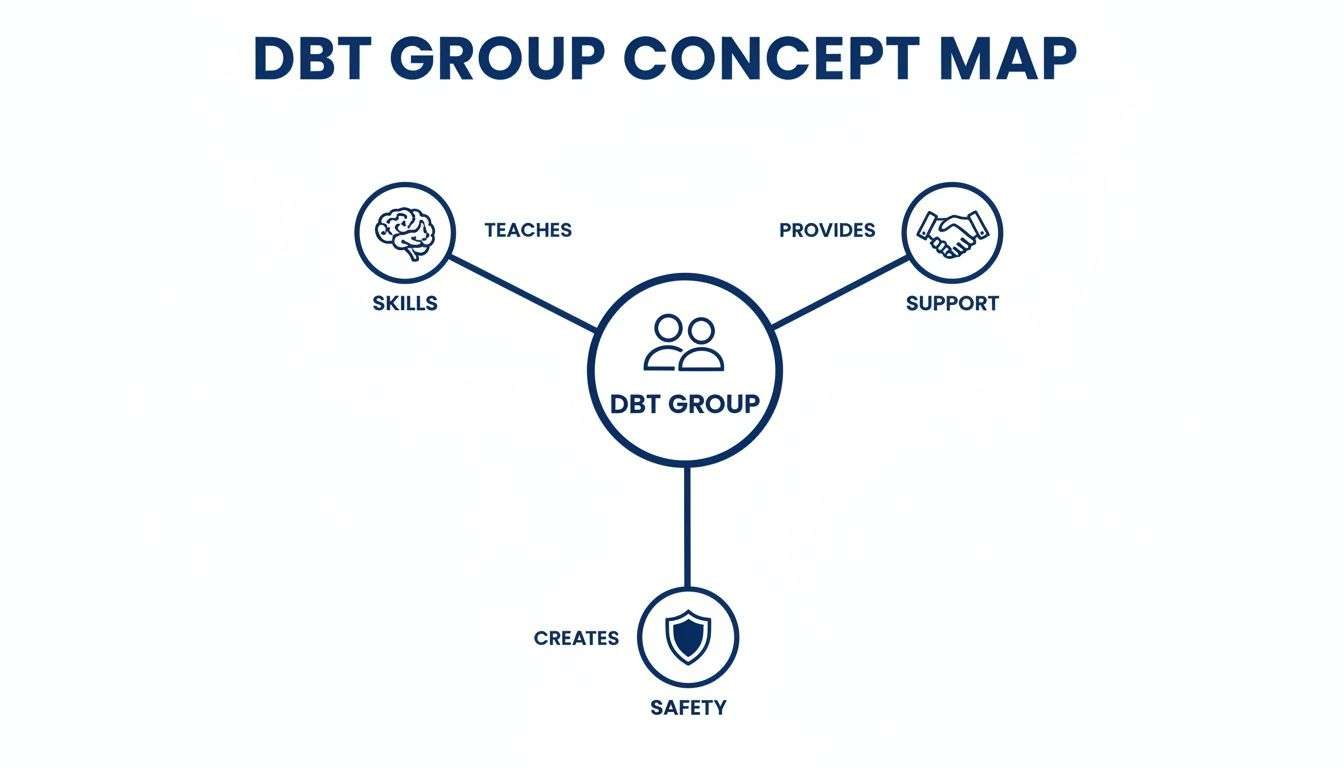
As the visual shows, practical skills are the core component, but they are taught in a safe group environment that encourages peer connection and validation. You can learn more about building these specific abilities in our guide to emotional regulation and resilience.
Interpersonal Effectiveness: Building Healthier Relationships
Finally, the fourth module focuses on interpersonal effectiveness. This is where you learn how to navigate your relationships in a way that is both authentic to you and respectful to others. It directly addresses common struggles like setting boundaries, asking for what you need, and handling conflict without burning bridges or sacrificing your self-respect.
These skills are invaluable for building and maintaining the kind of supportive relationships that are so crucial for long-term well-being. You’ll get to practice clear, direct communication that helps you express yourself effectively while also hearing and validating what others are saying.
The hands-on skills taught in DBT groups are a perfect example of how using effective patient education resources can boost understanding and engagement, which in turn leads to better treatment adherence and outcomes.
The table below breaks down these four modules, giving you a quick snapshot of what each one is all about.
An Overview of the Four DBT Skill Modules
| Skill Module | Core Purpose | Skills You Will Build |
|---|---|---|
| Mindfulness | To increase awareness of the present moment and gain control over your attention. | Observing, describing, and participating in the moment non-judgmentally. |
| Distress Tolerance | To survive crises and accept reality without making things worse. | Self-soothing, distraction techniques, and radical acceptance. |
| Emotion Regulation | To understand and manage your emotions, reducing emotional vulnerability. | Identifying emotions, problem-solving, and increasing positive experiences. |
| Interpersonal Effectiveness | To build healthy relationships and maintain self-respect in interactions. | Setting boundaries, asking for what you need, and navigating conflict effectively. |
By working through these four areas, you systematically build a strong foundation for lasting emotional wellness, fully equipped with the knowledge and practice you need to face challenges as they arise.
What a Typical DBT Group Session Looks Like
The idea of joining a new group can feel a little intimidating, and it's completely normal to wonder what you're walking into. One of the cornerstones of dialectical behavior therapy groups is creating a predictable, safe space, which is why every session follows a clear and consistent structure. Think of it less like unstructured "talk therapy" and more like a weekly class for building emotional strength.
Each session is designed to be a calm, educational, and supportive experience. The group leader acts as a compassionate teacher, guiding you and the other members through the material. You will never be forced to share anything you aren't comfortable with. The whole point is to learn practical skills, not to dissect your personal history in front of a group.

The Opening Mindfulness Practice
Just about every session kicks off with a short mindfulness exercise. This might be a simple guided meditation focusing on your breath or a quick practice of just noticing sensations in the present moment. This gentle ritual serves a big purpose: it helps everyone shift gears from the hustle of their day and become fully present in the room.
This grounding practice can help calm the nerves, reduce any lingering anxiety, and set a focused, gentle tone for the work ahead. It’s a soft landing that allows you to settle in before diving into the main part of the session.
Reviewing Skills Practice from the Week
After the mindfulness moment, the group transitions into reviewing the skills practice from the past week. This isn’t a test; it's a collaborative and completely non-judgmental discussion where members can talk about their experiences trying out a particular skill in the real world.
You might be invited to share things like:
What went well when you tried using a skill.
What challenges you ran into during the week.
Any questions you have about how to apply the skill to your own life.
This part of the session is incredibly valuable. It helps make the learning stick, gives you a chance to troubleshoot with the group leader, and shows you that learning new habits takes practice and patience for everyone. Hearing how others navigated their week often sparks new insights and creates a powerful feeling of shared experience.
The goal here isn't to judge performance but to learn together. The focus is on effort, not perfection. It’s a safe space to explore what works and what doesn't, so you can become more effective in managing your own emotional world.
Learning and Discussing a New Skill
The heart of the session is dedicated to teaching a new DBT skill. The group leader will break down the concept, give clear, step-by-step instructions on how to use it, and provide relatable examples that make sense. The material is always presented in a way that's easy to grasp.
To make the lesson interactive, the leader might use a whiteboard, provide handouts, or guide the group through exercises. The atmosphere is educational and supportive, with plenty of room for questions and discussion about how this new skill could be applied to different scenarios you face.
These structured programs are a serious commitment, often involving many sessions over several months, which shows how invested they are in building long-term resilience. You can learn more about these structured DBT programs and helpful resources available in some communities.
The session wraps up by assigning a new skill to practice for the upcoming week. This gives you a concrete way to take what you’ve just learned and weave it into your daily life—which is where real, lasting change truly happens.
How DBT Groups Help Create Lasting Positive Change
Learning new skills is one thing; putting them into practice in a safe, supportive space is where the real change happens. The group format in dialectical behavior therapy groups is designed to be much more than a classroom. It’s a community where you can see the skills come to life, not just for yourself but for others walking a similar path.
This shared experience is incredibly powerful. When you're overwhelmed by intense emotions, it's easy to feel like you’re the only one who struggles this way. Being in a DBT group gently dismantles that isolation.

The Power of Validation and Shared Experience
One of the most profound benefits of the group setting is validation. Hearing someone else describe a challenge that mirrors your own—and then watching them talk through how they tried using a new skill to handle it—is deeply reassuring. It makes the entire process feel more human and manageable.
This environment creates a unique kind of learning where you benefit from:
Seeing skills in action: You get to hear real-world examples of how others are applying mindfulness or distress tolerance in their daily lives.
Shared problem-solving: When someone shares a difficulty, the group collectively explores how different DBT skills could help, offering fresh perspectives.
Mutual encouragement: Celebrating small wins and supporting each other through setbacks builds a strong sense of camaraderie and keeps you motivated.
A DBT group acts as a gentle, real-world laboratory for your new skills. It’s a space to practice setting a boundary or asking for help with people who understand what you're working on, which builds your confidence to take these skills into your life outside the group.
From Learning Skills to Building a Fulfilling Life
The skills you learn aren't just abstract concepts; they are built to create real, tangible changes. By consistently practicing emotion regulation, for example, you might find yourself navigating disagreements with loved ones more calmly. By using interpersonal effectiveness skills, you can build stronger, more authentic relationships.
And these changes are backed by solid evidence. The use of DBT has been shown to lead to measurable impacts. You can learn more about these powerful findings on real-world change and the therapy’s lasting effects from authoritative sources like CAMH.
A Safe Space for Interpersonal Growth
For many people, challenges can arise in their relationships with others. The group provides a unique opportunity to practice interpersonal skills in a low-stakes setting. Here, you can experiment with new ways of communicating and receive gentle, constructive feedback from both the group leader and your peers. It's a chance to build the foundations for healthier connections in a supportive container.
This can be an especially helpful environment for those who struggle with anxious feelings in social situations. You can also read our guide on how to cope with anxiety for more strategies.
Ultimately, a DBT group is about helping you build a life that you genuinely find meaningful and fulfilling. It’s about moving from a state of surviving to one of thriving. The combination of practical skill-building and the validation of a shared human experience is what makes this therapeutic approach so effective.
Getting Ready for Your First DBT Group
Taking that first step to join a dialectical behaviour therapy group is a big one. It's completely normal to feel a mix of excitement and maybe a little bit of anxiety about what's to come. Let's walk through a few things that can help you feel more prepared and at ease as you start this journey.
The best thing you can bring to your first few sessions is an open, curious mind. You don't need to worry about getting everything perfect right away. Simply showing up with a willingness to listen and learn is more than enough. Like any new skill—whether it's learning an instrument or a new language—it’s a process. Be gentle with yourself.
It's Not Homework, It's "Skills Practice"
One helpful mindset shift in DBT is to reframe the work between sessions not as "homework," but as skills practice. This simple change in words makes a huge difference. It’s not about passing a test; it’s about taking what you learn in the group and trying it out in the real world. That’s where the most meaningful change happens.
Think of it this way: you can read a dozen books on how to swim, but you only really learn by getting in the water.
The point of skills practice isn’t to be perfect. It’s about integrating these new tools into your life, one moment at a time. It’s about catching an opportunity to try a new strategy and just noticing how it feels. Every attempt, no matter how it turns out, is a step forward.
This perspective takes the pressure off. Practice becomes less of a chore and more of a compassionate investment in yourself.
A Few Pointers for Your First Sessions
To help you settle in and get the most out of the experience, here are a few gentle suggestions:
Bring a notebook. It can be really helpful to have a dedicated spot to jot down notes, thoughts, or questions as they come up.
Be kind to yourself. You're learning entirely new ways of relating to your emotions and the world. That's hard work! Treat yourself with the same compassion you’d give a friend learning something new.
Trust the process. Building new habits takes time. The skills are designed to build on one another, week after week. Be patient and let it unfold.
At its core, a DBT group is a partnership between you, the facilitator, and the other members. Making sure you feel supported is a crucial first step, and finding the right support for you can build a strong foundation for the work ahead.
Compassionate Answers to Your Questions About DBT Groups
Stepping into something new, especially when it’s about your mental health, naturally brings up questions. It's completely normal to feel a bit hesitant, and getting clear answers can make all the difference in feeling comfortable and ready to start. Here are some compassionate answers to common questions about dialectical behavior therapy groups.
Do I have to share personal details about my past?
No, you absolutely do not. It's crucial to understand that a DBT skills group is not a traditional support group where people are expected to share deep, personal histories. The entire focus is on learning and practicing new skills to manage the present and build a better future. Think of it more like a practical workshop. While you might be invited to share examples of how you used a skill during the week, you are always in control of what and how much you share.
A group leader might ask, "Can anyone share an example of when they tried the 'STOP' skill this week?" You could simply say, "I used it at work when I felt overwhelmed by an email," without having to explain the email's content or the backstory. The spotlight stays on the skill, not your personal life.
What is the difference between a DBT skills group and a support group?
This is a great question. While both can offer a sense of community, they have different goals and structures. A support group is usually a less formal space for giving and receiving encouragement by sharing personal experiences. The main goal is to feel understood and less alone. A DBT skills group, on the other hand, is a highly structured, curriculum-based program. It’s a place for active learning, where a group leader teaches specific skills in mindfulness, distress tolerance, emotion regulation, and interpersonal effectiveness each week.
Do I need an individual therapist to join a DBT group?
For most comprehensive DBT programs, the answer is yes. The two parts of the therapy—individual and group—are designed to work together to give you the strongest possible foundation for change. The DBT skills group is where you learn the "what" (the skills themselves). Individual therapy is your private space to work on the "how" and "why"—figuring out how to apply those skills to your unique challenges and processing things that aren’t appropriate for a group setting.
Is DBT only for people with borderline personality disorder?
While Dialectical Behavior Therapy was first created to help people with Borderline Personality Disorder (BPD), its usefulness has grown far beyond that. The skills taught in DBT have proven incredibly effective for a whole range of challenges, including chronic anxiety, depression, post-traumatic stress, and general difficulties managing intense emotions. At their core, DBT skills are powerful life skills that can help anyone who wants to better understand their emotions, build healthier relationships, and handle stress without feeling overwhelmed.
Deciding to work on your emotional well-being is a courageous step. It’s a journey of learning and self-compassion, and you don’t have to walk it alone. If you feel ready to explore what support might look like for you, we invite you to learn more about our counselling services and find a path that feels right.
Clinically Reviewed By
Amy Mosset, MCP, RCC-S
Amy Mosset is a Master Practitioner in Clinical Counselling, Clinical Supervisor, and the owner of Interactive Counselling. She provides trauma-informed, evidence-based care and clinical supervision to registered therapists, with a focus on ethical practice, client safety, and high-quality therapeutic outcomes.