Feeling exhausted from always putting everyone else first is a reality for many Canadians shaped by childhood experiences of emotional neglect. The pressure to please others may seem normal, but it often hides deep emotional wounds where authentic needs have been suppressed to secure a sense of belonging. This article explains how emotional neglect fosters people-pleasing behaviours, highlights their impact on mental health, and explores paths toward lasting self-worth and healthier relationships. For more information, see our couples counselling.
Table of Contents
- People-Pleasing And Emotional Neglect Explained
- How Emotional Neglect Fosters People-Pleasing
- Warning Signs And Everyday Challenges In Adulthood
- Effects On Self-Worth, Boundaries, And Relationships
- Therapy And Recovery Strategies For Canadians
Key Takeaways
| Point | Details |
|---|---|
| Emotional Neglect Roots | People-pleasing arises from childhood emotional neglect, where children learn to suppress their feelings to gain acceptance. |
| Adaptive Survival Strategy | People-pleasing behaviours are sophisticated strategies developed to avoid rejection and secure minimal emotional connection. |
| Impact on Well-Being | These patterns lead to chronic anxiety, difficulty establishing boundaries, and significant disconnection from one’s authentic self. |
| Therapeutic Approach | Recovery involves therapy focused on emotional intelligence, boundary-setting, and fostering self-worth independent of external validation. |
People-pleasing and emotional neglect explained
People-pleasing and emotional neglect represent deeply interconnected psychological patterns that emerge from childhood experiences of inadequate emotional support. Childhood emotional neglect fundamentally shapes attachment dynamics, creating complex survival mechanisms that persist into adulthood.
At its core, emotional neglect occurs when children do not receive consistent emotional validation, empathy, or meaningful connection from their primary caregivers. This subtle yet profound form of childhood trauma creates an internal landscape where emotional safety becomes synonymous with meeting others’ expectations. Children learn early that suppressing their authentic feelings and prioritizing others’ needs represents their safest pathway to potential connection.
The psychological adaptation of people-pleasing emerges as a sophisticated survival strategy with several key characteristics:
- Constant hypervigilance about others’ potential emotional reactions
- Difficulty expressing personal boundaries or authentic needs
- Chronic anxiety about potential rejection or disapproval
- Persistent feelings of unworthiness or inadequacy
- An automatic tendency to prioritize external validation over internal emotional experiences
These patterns develop as protective mechanisms, where children unconsciously learn that maintaining harmony and anticipating others’ requirements increases their chances of receiving minimal emotional attention. By becoming “low maintenance” and accommodating, they hope to secure whatever limited emotional connection is available.
The following table distinguishes between people-pleasing as a survival response in childhood and its complex impact in adulthood:
| Aspect | Childhood Development | Adult Manifestation |
|---|---|---|
| Core Motivation | Seeking emotional safety | Avoiding rejection and criticism |
| Primary Behaviour | Adapting to caregivers’ needs | Overextending to please others |
| Emotional Cost | Suppressed authentic feelings | Chronic anxiety and burnout |
| Impact on Identity | Self-worth tied to compliance | Difficulty expressing real desires |
Pro Tip: Recognize that your people-pleasing behaviors are not character flaws, but intelligent survival strategies developed during challenging childhood environments.
How emotional neglect fosters people-pleasing
Emotional neglect creates a profound psychological landscape where children develop intricate survival strategies, with people-pleasing emerging as a primary mechanism of emotional adaptation. Emotional isolation dramatically impacts psychological development, compelling children to construct complex emotional coping mechanisms that persist into adulthood.
In environments characterized by emotional absence, children quickly learn that their emotional needs are secondary or irrelevant. This realization triggers a sophisticated psychological response where emotional survival becomes predicated on anticipating and meeting others’ expectations. By becoming hyper-responsive to potential emotional signals, these children unconsciously develop a finely tuned emotional radar designed to prevent rejection and secure minimal emotional connection.
The developmental process of people-pleasing involves several critical psychological adaptations:
- Intense emotional hypervigilance
- Suppression of personal emotional experiences
- Prioritizing external validation over internal needs
- Developing chameleon-like social adaptability
- Chronic self-monitoring of potential interpersonal reactions
Children raised in emotionally neglectful environments essentially become emotional detectives, learning to read subtle cues and modify their behaviour to maintain relational stability. This adaptive strategy transforms people-pleasing from a mere behaviour into a sophisticated survival mechanism, where personal authenticity is sacrificed in exchange for potential emotional safety.
Emotional neglect teaches children that their authentic self is less important than maintaining external harmony and avoiding potential emotional abandonment.
Pro Tip: Learn to recognize your people-pleasing patterns as intelligent childhood survival strategies, not personal failures.
Warning signs and everyday challenges in adulthood
People-pleasing behaviours manifest in complex ways during adulthood, transforming from childhood survival strategies into deeply ingrained patterns that significantly impact personal relationships and mental well-being. Emotional exhaustion becomes a persistent challenge, as individuals continually prioritize others’ needs over their own fundamental emotional requirements.

Adults with people-pleasing tendencies often experience a profound disconnection from their authentic selves, struggling to recognize and communicate their genuine feelings and desires. This internal conflict creates a constant state of psychological tension, where emotional authenticity feels simultaneously desired and terrifyingly vulnerable. The unconscious fear of potential rejection or disapproval drives these individuals to maintain an external persona that rarely reflects their true emotional landscape.
Key warning signs of people-pleasing in adult life include:
- Chronic difficulty saying “no” to requests
- Persistent anxiety about others’ potential negative perceptions
- Overwhelming need to be liked and validated
- Frequent feelings of emotional burnout
- Suppressing personal opinions to avoid potential conflict
- Experiencing resentment while simultaneously maintaining an agreeable exterior
- Neglecting personal boundaries in professional and personal relationships
These patterns create a cyclical dynamic where individuals sacrifice their emotional well-being to maintain superficial harmony. By continuously adapting to others’ expectations, people-pleasers inadvertently reinforce their childhood learned behaviour of emotional self-suppression.
People-pleasing is not a character weakness, but a sophisticated survival mechanism developed in response to early emotional environments.
Pro Tip: Start tracking moments when you automatically prioritize others’ needs over your own, creating awareness as the first step towards meaningful change.
Effects on self-worth, boundaries, and relationships
People-pleasing fundamentally undermines an individual’s sense of intrinsic self-worth, creating a deeply destructive psychological pattern where external validation becomes the primary measure of personal value. Adult attachment patterns reveal profound relational challenges, demonstrating how early emotional experiences persistently reshape an individual’s capacity for authentic connection.
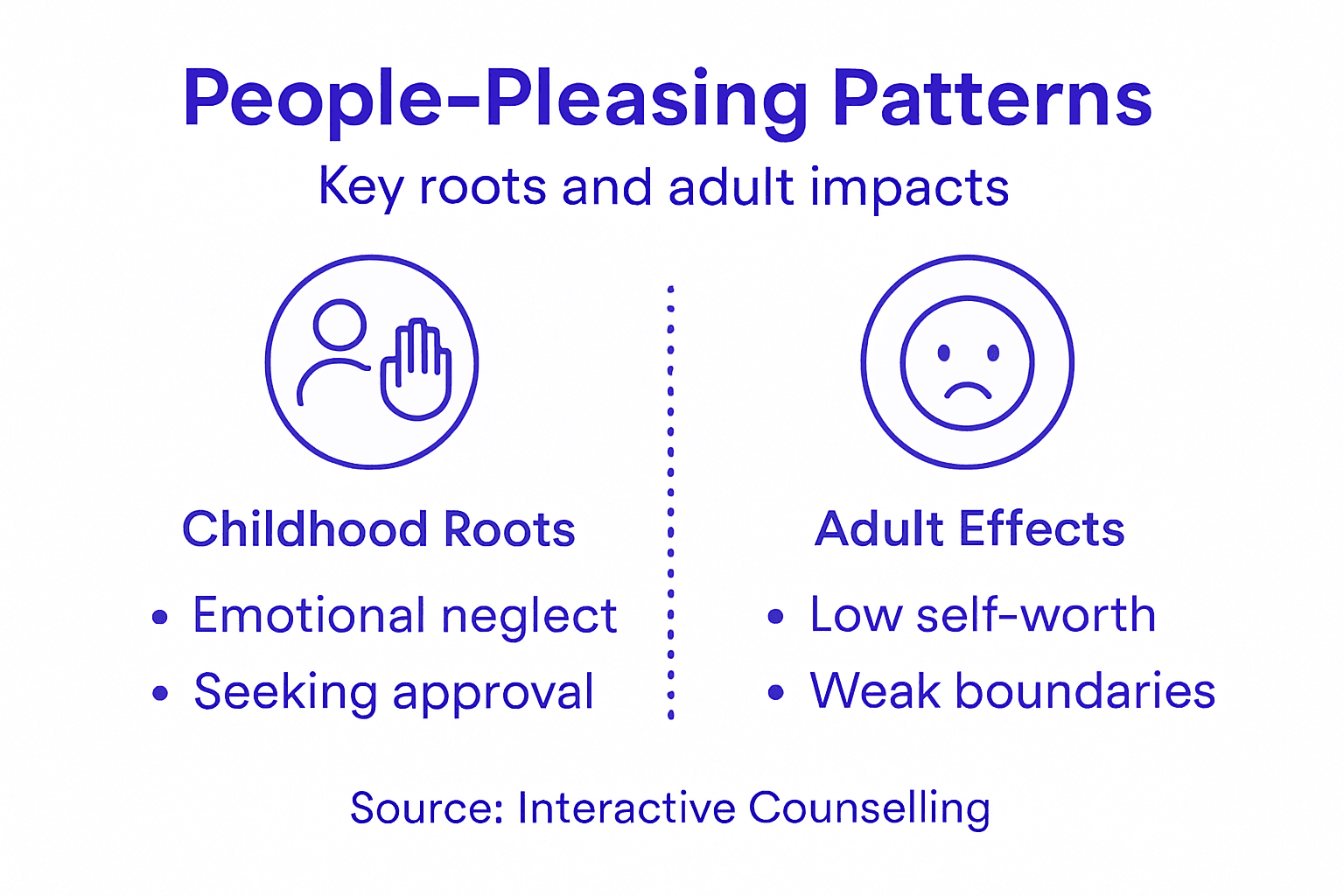
The erosion of personal boundaries represents one of the most significant consequences of chronic people-pleasing behaviours. Individuals learn to compromise their emotional integrity systematically, trading genuine needs for momentary acceptance. This continuous self-abandonment generates a corrosive internal narrative where personal desires are perceived as secondary, insignificant, or even burdensome to others.
Key impacts on self-worth and relationships include:
- Complete disconnection from authentic emotional experiences
- Perpetual feelings of inadequacy and unworthiness
- Difficulty establishing meaningful, reciprocal relationships
- Chronic internal conflict between desired authenticity and learned compliance
- Increased vulnerability to manipulation
- Persistent anxiety about potential rejection
- Reduced capacity for emotional intimacy
Relationships become transactional landscapes where people-pleasers unconsciously negotiate their value through constant accommodation. They develop intricate psychological mechanisms that prioritize external harmony over personal emotional sovereignty, ultimately sacrificing genuine connection for perceived safety.
Your worth is not determined by how well you manage others’ emotions or expectations, but by your commitment to your authentic self.
Pro Tip: Practise setting one small, manageable boundary each week, gradually rebuilding your sense of personal agency and self-respect.
Therapy and recovery strategies for Canadians
Recovering from people-pleasing patterns requires a comprehensive and compassionate therapeutic approach that acknowledges the deep-rooted survival mechanisms developed during childhood. Navigating therapy options in Canada involves understanding personalised treatment strategies that address the complex psychological landscape of emotional neglect and people-pleasing behaviours.
Therapeutic interventions for people-pleasing typically focus on rebuilding emotional intelligence and developing authentic self-connection. Professional counsellors help individuals deconstruct ingrained patterns by creating a safe, non-judgmental environment where clients can explore the origins of their people-pleasing tendencies and learn healthier relational strategies.
Key recovery strategies include:
- Identifying core childhood emotional neglect experiences
- Developing robust personal boundary-setting skills
- Learning emotional self-regulation techniques
- Practising assertive communication
- Challenging internalized negative belief systems
- Cultivating self-compassion and emotional validation
- Building intrinsic self-worth independent of external approval
The recovery journey involves gradually dismantling protective mechanisms while simultaneously building genuine self-trust. Therapists employ various evidence-based approaches such as cognitive behavioural therapy, inner child work, and attachment-focused interventions to support clients in healing and transformation.
Here is a summary of evidence-based therapy strategies commonly used in Canada for overcoming people-pleasing:
| Therapy Approach | Key Focus | Typical Benefit |
|---|---|---|
| Cognitive Behavioural Therapy | Challenging unhelpful beliefs | Builds healthier self-perception |
| Attachment-Focused Therapy | Exploring early emotional bonds | Improves relational security |
| Inner Child Work | Reconnecting with unmet needs | Fosters self-compassion |
| Assertiveness Training | Developing boundary-setting | Increases confidence to say “no” |
Healing is not about eliminating your survival strategies, but understanding and transforming them with compassion.
Pro Tip: Schedule a free initial consultation with a therapist specializing in emotional neglect to begin your personalised healing journey.
Break Free From People-Pleasing and Emotional Neglect Patterns with Expert Support
If you recognize the challenging patterns of people-pleasing and emotional neglect described in this article you are not alone and help is available. These deeply ingrained behaviours often leave you feeling overwhelmed by anxiety chronic burnout and a loss of genuine self-worth. Understanding that these responses are survival strategies rather than personal flaws is the first step toward healing.
At Interactive Counselling we offer compassionate therapy tailored to your unique journey. Our licensed therapists across Canadian locations including Kelowna Vernon Grande Prairie and Penticton provide flexible in-person and online sessions designed to help you reconnect with your authentic emotions set healthy boundaries and build lasting self-esteem. Explore how our personalized therapy solutions can empower you to transform these survival mechanisms into sources of resilience and authentic connection.
Do not wait to reclaim your sense of self and thrive in your relationships. Visit Interactive Counselling today and schedule your first session to start your healing journey with trusted professionals who understand the impact of emotional neglect and people-pleasing behaviours.
Frequently Asked Questions
What is people-pleasing and how is it related to emotional neglect?
People-pleasing is a behavioral pattern where individuals prioritize others’ needs and expectations over their own, often stemming from experiences of emotional neglect in childhood where they lacked consistent emotional support and validation.
How can emotional neglect in childhood affect adult relationships?
Emotional neglect can lead to difficulty establishing meaningful connections, as adults may struggle with authenticity, feel unworthy, and exhibit poor boundary-setting in their relationships due to ingrained people-pleasing tendencies.
What are some signs that I might be a people-pleaser?
Common signs include chronic difficulty saying ‘no,’ anxiety about others’ perceptions, suppressing personal opinions to avoid conflict, and feeling resentment while maintaining an agreeable exterior.
What are effective strategies for overcoming people-pleasing behaviors?
Effective strategies include identifying childhood experiences of emotional neglect, developing boundary-setting skills, practicing assertive communication, and engaging in therapy to rebuild emotional intelligence and self-worth.
Recommended
- How Childhood Emotional Neglect Shapes Adult Attachment: A Guide to Healing
- How Emotional Patterns Shape Canadian Wellbeing
- Emotional Roles in Families – How They Change Over Time
- Mother Wounds: How Early Care Shapes Emotional Safety in Adulthood