When your mental health makes day-to-day life feel like you’re wading through mud, it’s easy to feel lost about where to find help. Occupational therapy in mental health offers something a little different—a practical, hands-on way to get back to the meaningful activities, or occupations, that make up your life.
It’s less about simply talking through problems and more about actively doing things to rebuild a sense of purpose, confidence, and control.
What Exactly Is Occupational Therapy for Mental Health?

First things first, let’s clear up a huge misunderstanding. The word “occupation” here doesn’t just mean your 9-to-5 job.
In the world of occupational therapy (OT), an “occupation” is any meaningful activity that occupies your time. Think about it:
- Getting dressed in the morning
- Making breakfast for yourself or your family
- Playing with your kids
- Walking the dog
- Engaging in a hobby you love
- Even just meeting a friend for coffee
These are all occupations. When you’re dealing with anxiety, depression, burnout, or trauma, these seemingly simple tasks can feel monumental. This is exactly where an occupational therapist (OT) steps in. They are highly trained healthcare professionals who help you bridge the gap between how your life feels now and how you want it to be.
A Practical and Personalized Approach
At its heart, occupational therapy is deeply personal. There’s no cookie-cutter formula here. Instead, an OT works alongside you, as a partner, to truly understand your unique circumstances, your specific struggles, and what genuinely matters to you.
This partnership is all about building skills for the real world. While there are many incredible therapeutic options out there, understanding the different types of therapy explained for better mental health helps clarify OT’s unique, action-oriented role.
The goal isn’t just to feel better during a therapy session; it’s to live better every single day. OT empowers you with practical strategies to manage symptoms and engage more fully in a life you value.
To make this even clearer, let’s look at what OT is and what it isn’t.
Occupational Therapy for Mental Health At a Glance
| What It Is (The Reality) | What It Is Not (The Misconception) |
|---|---|
| A client-centred therapy focused on real-life activities. | Just about finding a job or vocational training. |
| A practical, hands-on approach to skill-building. | Only talk therapy. |
| Focused on all meaningful “occupations” (self-care, leisure, etc.). | Only for physical injuries or disabilities. |
| A collaborative partnership with a healthcare professional. | A therapist telling you what you “should” do. |
Ultimately, OT meets you exactly where you are, helping you find a way forward that feels authentic and achievable for you.
What Does This Look Like in Real Life?
So, how does this all translate into practice? An OT helps you pinpoint the barriers that mental health challenges have put in your path and then co-creates practical, often creative, solutions to get around them.
Here are just a few examples of what you might work on together:
- Building sustainable routines: If your days feel chaotic or empty, an OT can help you craft a gentle, supportive daily schedule that honours your energy levels and weaves in activities that actually bring you joy.
- Developing coping strategies: They help you build a personalized toolkit of sensory strategies, mindfulness techniques, or grounding exercises to use when you feel overwhelmed, anxious, or triggered.
- Breaking down big tasks: Does grocery shopping or cleaning the kitchen feel like climbing a mountain? An OT helps you break it down into tiny, manageable steps so it feels less daunting.
- Rediscovering your passions: Together, you can explore how to reconnect with hobbies and interests you once loved, helping you find those crucial moments of purpose and pleasure again.
Building Meaning Back into Your Daily Routines
When you’re struggling with your mental health, the days can start to blend together. That sense of structure, purpose, and even simple enjoyment can feel like a distant memory, leaving your daily routines feeling unstructured and empty.
This is where the heart of occupational therapy in mental health truly shines. It’s a gentle, supportive process of rediscovering meaning, not by chasing huge, overwhelming goals, but by focusing on small, achievable actions that slowly weave purpose back into your life.
It’s all about finding what we call occupational balance. Think of your life as a pie chart divided into different slices: work or school, rest, self-care, hobbies, and connecting with others. When mental health challenges take over, some of those slices might disappear entirely while others become way too large, throwing everything off-kilter. An OT helps you thoughtfully redesign that pie chart so it feels balanced and fulfilling for you.
Finding Your Why Again
So, how does this actually work? It starts with a conversation about what truly matters to you deep down. We’re not just talking about what you feel you should be doing, but what genuinely lights a spark inside you.
Is it creativity? A quiet moment with a good book? The sense of accomplishment that comes from tending to a small garden? Or the simple connection of a weekly phone call with a friend? Your “why” is unique, and it becomes the compass for all our work together.
The most meaningful activities are often the first to go when we’re struggling. Occupational therapy is about gently and intentionally bringing them back, celebrating every small victory along the way.
Practical Steps to Reclaim Your Day
Once we have a good sense of what fuels you, an occupational therapist helps translate that into practical, everyday steps. This process is kind and always honours your energy levels—there’s absolutely no pressure to do it all at once.
We’ll work together to:
- Break down overwhelming tasks. Does making dinner feel like a monumental effort? We can break it down into tiny steps, like just deciding on a recipe one day and getting the ingredients the next. Tracking your thoughts and feelings during these tasks can also be a game-changer; you can learn more about this by using a CBT thought record to notice unhelpful patterns.
- Design a compassionate schedule. Instead of a rigid, demanding to-do list, we’ll create a daily or weekly rhythm that includes non-negotiable time for rest, things you enjoy, and essential self-care.
- Rediscover lost hobbies. We can explore gentle ways to re-engage with activities you once loved but have set aside, modifying them to fit where you are right now.
- Explore new, meaningful activities. Sometimes, finding purpose means trying something new. An OT can help you identify activities that align with your values and support your mental health journey.
For individuals exploring alternatives or complements to medication, developing practical, non-medication strategies can be crucial for building these meaningful daily routines.
The focus is always on creating a life that feels authentic and supportive, one small, meaningful action at a time. This journey is about replacing feelings of emptiness with a quiet, growing sense of purpose.
The Real-World Impact of This Practical Approach
It’s one thing to talk about theories and approaches, but what does progress actually look and feel like when you’re working with an occupational therapist for your mental health? The impact goes far beyond just talking about your feelings. It’s about seeing real, tangible changes in your everyday life, and that’s where the hands-on nature of OT really shines.
We’re talking about measurable improvements that build genuine momentum. Think of it as laying a solid foundation for long-term well-being, not just searching for a quick fix. You start to notice a little more space between an anxious thought and your reaction to it. Or maybe you find just enough energy to do one small thing that brings you a flicker of joy.
These small wins stack up, creating a powerful ripple effect that touches every part of your life.
More Than Just Feeling Better
The outcomes of occupational therapy are often practical and deeply personal. It’s about reclaiming a sense of control and competence in the activities that truly matter to you. The entire point is to empower you with skills that stick with you long after our sessions end.
Here are some of the real-world changes you might experience:
- Building confidence in social settings. We could work on a step-by-step plan to make joining a community group—or even just running errands—feel less overwhelming.
- Creating a supportive home environment. An OT can help you organize your living space in a way that actively reduces stress, making daily tasks like cooking or cleaning feel more manageable.
- Sticking with your wellness plan. If you’re on a medication plan, an OT can help you build a simple, effective routine around it, which makes staying consistent and feeling your best that much easier.
- Rediscovering your energy for life. By focusing on activities that genuinely align with your values, you can slowly start to reclaim the energy and motivation that mental health struggles so often drain away.
This infographic shows how OT helps create a healthier mix of life’s core activities, fostering a much-needed sense of balance.
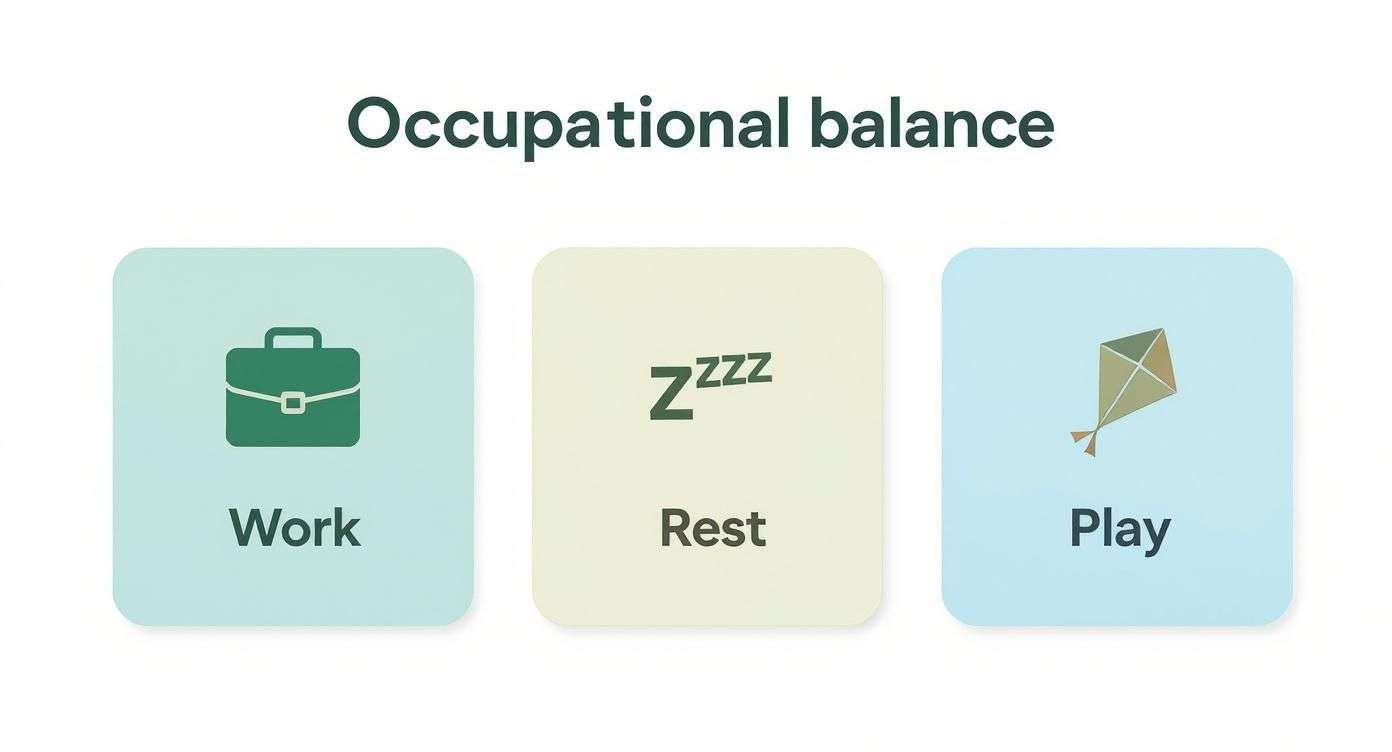
By mindfully balancing work, rest, and play, you build a sustainable routine that supports your mental health instead of depleting it.
The Numbers Tell a Powerful Story
This compassionate, skill-building approach isn’t just felt by clients; its impact is backed by some serious data. Published research shows that OT interventions can lead to significant reductions in depression and anxiety symptoms. What’s more, by helping clients build supportive routines, OT can improve medication adherence and reduce hospital readmissions. For those interested in the data, scholarly databases like PubMed or Google Scholar are great resources for finding studies on OT effectiveness.
A practical approach like occupational therapy is especially effective in integrated care models. A good example is dual diagnosis outpatient treatment, which addresses both mental health and substance use disorders at the same time.
The goal is to build resilience. It’s about equipping you with the tools and strategies you need to actively manage your health, so you feel more prepared to handle life’s inevitable challenges.
Building a Foundation for Lasting Change
Ultimately, occupational therapy is about empowerment. It helps you shift from feeling like a passive victim of your symptoms to becoming an active participant in your own recovery. That change in perspective is incredibly powerful.
You learn that you have agency, that your small daily actions matter, and that you are absolutely capable of building a life that feels meaningful and supportive.
This practical, real-world focus helps build a sturdy foundation for resilience—one that supports you for the long haul.
What an Occupational Therapy Session Actually Looks Like

Stepping into any new kind of therapy can feel a bit uncertain. That’s totally normal. So, let’s peel back the curtain on what an occupational therapy in mental health session is really like.
Forget the image of a sterile clinic. Think of it more like a collaborative workshop—a creative space where we figure things out together. You’re the expert on your life, and the occupational therapist (OT) is your guide, equipped with tools and fresh perspectives to help you navigate the challenges.
The whole process is built on trust and a genuine connection. It’s a space where you can be completely open about what you’re going through, without any fear of judgment.
It’s About ‘Doing,’ Not Just Talking
Here’s where occupational therapy really stands apart: it’s all about action. While talking through your experiences is crucial, we don’t stop there. The real magic happens when we turn those conversations into practical, real-world skills.
Everything we do is built around your goals. Your OT listens carefully to what you want to change or achieve, then helps you break it down into small, manageable steps. It’s an empowering feeling because you’re always in the driver’s seat.
An OT session is a judgment-free zone where we figure things out together. The focus is on finding what works for your brain and your life, not on following a rigid set of rules.
To give you a better idea, here are a few things we might work on together:
- Building a personal ‘sensory diet’. We’d create a unique toolkit of textures, sounds, movements, or scents that help ground you when anxiety or overwhelm kicks in.
- Breaking down a daily challenge. Feeling intimidated by the grocery store? We could map out a step-by-step plan to make the whole experience feel less daunting.
- Rehearsing social skills. We can safely role-play a tough conversation or practice setting boundaries, building your confidence for when it really counts.
- Organizing your space for a calmer mind. We could rearrange your desk for better focus or design a “calm-down corner” in your home to help you de-stress.
Collaboration Is Key
This is a team effort, through and through. An OT won’t just give you a worksheet and send you off. We’re in it with you, troubleshooting roadblocks and celebrating every win, no matter how small.
This side-by-side approach helps build more than just skills; it builds self-trust. You start to see just how capable you are of making real, positive changes. While OTs are specialists in daily functioning, a great mental health counsellor can also provide complementary support for emotional processing.
The beauty of occupational therapy is how it adapts to you. It meets you exactly where you are, respecting your energy and helping you build momentum in a way that feels supportive and sustainable.
Why Access to This Vital Care Is Expanding
Let’s be honest: one of the biggest roadblocks in mental healthcare is simply getting the right support when you need it. The good news? The tide is starting to turn, especially for occupational therapy in mental health. There’s a growing realization that this hands-on, real-world approach isn’t just a bonus—it’s a core piece of a solid care plan.
Healthcare systems are finally catching on to the unique value OTs bring. At a time when many mental health professionals have long waitlists, occupational therapists offer a different—and incredibly effective—way forward. After all, they’re the experts in daily function, which is often the first thing to unravel when our mental health takes a hit.
This shift in thinking is leading to some really important changes in how care is delivered.
Weaving OTs into Mental Health Teams
More and more, you’ll find occupational therapists working right alongside psychologists, psychiatrists, and social workers as part of a formal mental health team. This is a massive step in the right direction. It means that when you reach out for help, you’re far more likely to get a full spectrum of care, not just a single approach.
This kind of collaboration makes sure your practical, day-to-day struggles are addressed at the same time as your emotional and psychological needs. It’s about treating the whole you, not just a list of symptoms.
This shift validates a powerful pathway to recovery. It acknowledges that rebuilding your daily life through meaningful activities is just as crucial as processing your thoughts and feelings.
This growing integration is getting a major boost from policy changes that finally recognize the critical role OTs play.
How Policy Changes Are Opening Doors
For care to be truly accessible, it has to be recognized by the systems that govern healthcare. Thankfully, we’re seeing important policy shifts that formally acknowledge the scope and impact of occupational therapy.
These aren’t just minor adjustments on paper; they directly change people’s lives. When a policy is updated, it often means that services become easier to find and may be covered by more insurance plans, which can remove a huge financial barrier for many individuals and families.
A perfect example comes from California, which has been dealing with a significant shortage of behavioural health professionals. To tackle this, a key policy was changed to officially recognize how occupational therapy helps people improve their daily functioning. This reform is a game-changer because it allows OTs to provide services that are reimbursed, helping to fill the workforce gap and improve outcomes for countless people. You can read more about this specific policy change on AOTA’s research site.
Forward-thinking policies like this one are unlocking access and ensuring more people can benefit from this life-changing support.
What This All Means for You
Ultimately, this expansion is about giving you more choices and a better shot at finding the help that actually works for you. Here’s what it boils down to:
- More complete care: You’re more likely to get well-rounded support that addresses both the ‘why’ behind your struggles and the ‘how’ of your recovery.
- Better availability: With OTs recognized as key mental health providers, there are more professionals available to help, especially in areas where support is scarce.
- A focus on real life: This shift puts your ability to live your life—to work, manage your home, and find joy—front and centre in your mental health treatment.
This growing recognition is a powerful sign of hope, making occupational therapy in mental health a much more visible and accessible option for anyone on the path to recovery.
So, Is Occupational Therapy Right for You?
This is probably the most important question. How do you know if this is the right path for your own journey? Choosing the right kind of support is a huge, personal decision. This section is here to help you figure that out.
Let’s do a quick check-in. As you read through the next few points, just notice if anything makes you think, “Yep, that’s me.”
Signs This Could Be the Support You’re Looking For
Does any of this ring a bell?
- Your daily routines have gone completely off the rails. That basic rhythm of your day—waking up, eating, sleeping—feels jumbled, chaotic, or has disappeared altogether.
- You can’t muster the energy for things you used to enjoy. Hobbies, seeing friends, or the little things that once lit you up now just feel like a heavy lift.
- Simple, everyday tasks feel impossible. Things like making dinner, cleaning the kitchen, or even getting dressed can feel like climbing Mount Everest.
- You’re looking for therapy that’s less about talking and more about doing. You know conversation is important, but you have a gut feeling you need practical, hands-on strategies to see real change.
- You feel trapped between what you want to do and what you can actually do. There’s a big, frustrating gap between your intentions and your actions.
If you found yourself nodding along, please know you are not alone. These are the classic signs that mental health struggles are getting in the way of life. They’re also precisely the kinds of challenges where occupational therapy in mental health shines.
At its heart, this is a therapy for anyone who feels like their mental health is putting up a roadblock to living a life that feels good and meaningful. The whole point is to close that gap between where you are and where you want to be, one small, manageable step at a time.
Who This Approach Can Help
This practical style of therapy isn’t just for one specific diagnosis or age group. It’s all about helping people get back to functioning, finding purpose, and improving their quality of life, no matter the label. Research shows time and again that a wide range of people get a lot out of this kind of support. If you want to dive into the evidence, the American Occupational Therapy Association has great resources on how OT boosts daily functioning.
Ultimately, this is about taking back your days, your activities, and your sense of self, with a skilled and compassionate guide right there with you. It’s about building a life that feels more like your own, using real tools that actually work.
A Few Common Questions
It’s completely natural to have questions when you’re thinking about starting any kind of therapy. Getting a clear picture of what to expect is a great first step. Let’s walk through a few of the most common questions people ask about occupational therapy for mental health.
How Is This Different From Psychotherapy or Counselling?
That’s a brilliant question, and the answer really highlights the unique role of occupational therapy (OT). While both OT and psychotherapy are fantastic supports for your mental well-being, they approach it from different, yet complementary, angles.
Think of it this way:
- Psychotherapy, often called ‘talk therapy’, focuses on exploring your thoughts, emotions, and past experiences. It’s about digging into the why behind what you’re feeling.
- Occupational therapy is all about action. It’s hands-on and practical, focusing on the how. An OT is your partner in figuring out how to navigate the daily activities that have become challenging because of your mental health.
So, a psychotherapist might help you understand the roots of your social anxiety, while an OT would help you create a gentle, step-by-step plan to actually practice going to a coffee shop without feeling completely overwhelmed. One helps you process, the other helps you do.
Do I Need a Formal Diagnosis to See an Occupational Therapist?
Not at all. While OTs are absolutely skilled in helping people with diagnoses like depression, anxiety, or PTSD, you don’t need a label to get support.
The focus is always on your personal experience, not a specific diagnostic code. If your mental health is getting in the way of you living your life, that’s all the reason you need to reach out.
It really comes down to what you’re struggling with. If you’re having a hard time with work, taking care of yourself, enjoying your hobbies, or connecting with others because of how you feel, an OT can help you find a path forward.
What Kind of Goals Can I Work On With an OT?
Honestly, the goals are as individual as you are. There’s no such thing as a goal that’s “too small” or silly. If an activity is meaningful to you and you want to get back to it, that’s a perfect goal for OT.
Just to give you a feel for it, here are some things people often work on:
- Creating a consistent, calming morning routine to start the day on the right foot.
- Learning sensory strategies to manage feeling overloaded in busy places like the grocery store.
- Figuring out how to break down household chores so they don’t feel so draining.
- Gently rediscovering a creative hobby that used to bring you joy.
- Building the confidence and skills to start volunteering or join a local group.
At the end of the day, it’s all about what matters to you. It’s about finding practical ways to reclaim a sense of purpose and participation in your own life.
At Interactive Counselling, we’re passionate about providing real-world support that helps you build a more meaningful life, one step at a time. If you’re ready to see how our compassionate approach can help, we’d love to connect with you.
Learn More About Our Counselling Services