Over half of couples say communication problems are their biggest challenge in relationships. Whether you are facing daily misunderstandings or deeper emotional struggles, relationship dynamics can quickly feel overwhelming without the right support. Therapists bring not just a listening ear but expert guidance to help transform unhealthy patterns into stronger, more trusting connections—giving individuals and couples practical pathways toward lasting growth and healing. For more information, see our couples counselling.
Table of Contents
- Defining Therapists’ Role In Relationships
- Types Of Relationship Therapy Approaches
- Core Functions And Therapeutic Processes
- Key Benefits For Individuals And Couples
- Common Misconceptions And Limitations
Key Takeaways
| Point | Details |
|---|---|
| Therapists Create Safe Spaces | Relationship therapists provide a non-judgmental environment for clients to explore emotions and communication patterns. |
| Diverse Therapeutic Approaches | Various strategies, including Emotionally Focused Therapy and Cognitive Behavioral Therapy, are used to address unique relational challenges. |
| Empowerment Over Side-Taking | Therapists support clients in making informed decisions without taking sides, fostering individual and relational growth. |
| Misconceptions About Therapy | Common myths include the belief that therapy is only for crises or that all therapists employ the same methods; understanding these can improve client readiness. |
Defining Therapists’ Role in Relationships
Relationship therapists serve as skilled navigators who help individuals, couples, and families understand, repair, and strengthen their interpersonal dynamics. These mental health professionals are trained to provide objective, compassionate guidance through complex emotional landscapes, offering strategies that transform communication, heal wounds, and rebuild trust.
At the core of a therapist’s role is creating a safe, non-judgmental space where clients can explore their relationship patterns, emotional triggers, and communication barriers. Therapeutic intervention goes beyond simply listening – it involves actively helping clients develop healthier relationship skills, recognize destructive behavioural cycles, and learn constructive ways of expressing needs and resolving conflicts. Our guide to couples therapy offers deeper insights into these transformative techniques.
Therapists employ multiple sophisticated approaches tailored to each unique relationship scenario.
 These might include:
- Identifying underlying emotional dynamics
- Teaching effective communication strategies
- Helping partners understand each other’s perspectives
- Breaking negative interaction patterns
- Developing emotional intelligence and empathy
- Supporting individual and collective healing processes
Crucially, relationship therapists do not take sides or prescribe specific relationship outcomes. Instead, they empower clients to make informed decisions, understand themselves and their partners more deeply, and create meaningful, sustainable connections. Their professional training allows them to remain neutral while providing compassionate, evidence-based guidance through some of life’s most challenging interpersonal journeys.
Types of Relationship Therapy Approaches
Relationship therapy encompasses diverse approaches designed to address unique interpersonal challenges and dynamics. Interpersonal psychotherapy, for instance, is a structured method that focuses on resolving specific relationship problems while directly addressing emotional symptoms and communication barriers.
Person-centered therapy, developed by Carl Rogers, represents another powerful approach in relationship counselling. According to Wikipedia, this method emphasizes creating a therapeutic environment grounded in unconditional positive regard, where clients feel genuinely heard and understood. The core principles include:
- Providing unconditional positive acceptance
- Maintaining therapeutic congruence
- Developing deep empathetic understanding
- Encouraging client self-discovery
- Supporting personal growth and autonomy
Additional relationship therapy approaches include:
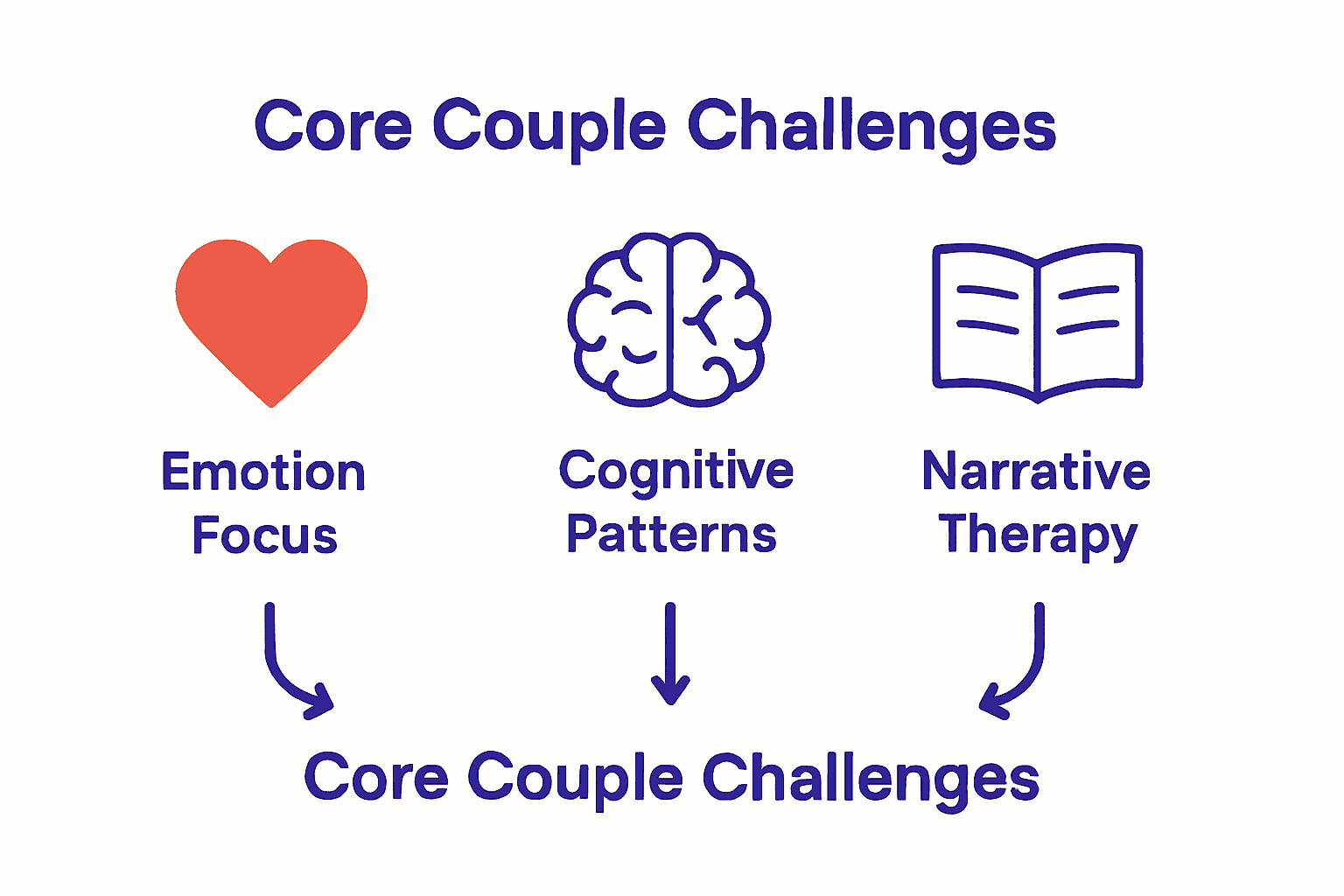
- Emotionally Focused Therapy (EFT): Concentrates on attachment patterns and emotional connections
- Cognitive Behavioral Therapy (CBT): Addresses destructive thought patterns affecting relationships
- Narrative Therapy: Helps clients reframe their relationship stories
- Gottman Method: Focuses on building communication, conflict management, and shared meaning
Find the right couples therapist who can help you navigate these diverse therapeutic approaches and select the most appropriate strategy for your unique relationship needs.
Core Functions and Therapeutic Processes
Relationship therapists engage in complex, nuanced processes designed to facilitate profound interpersonal understanding and healing. Collaborative language systems, a contemporary therapeutic approach, emphasizes a reciprocal relationship between therapist and client, utilizing dialogical conversations to help clients reframe and understand their relational challenges.
Therapeutic processes are structured yet deeply empathetic interventions that go beyond simple conversation. Integrative behavioral couples therapy exemplifies this approach by simultaneously pursuing two critical goals: helping partners accept each other’s differences while creating meaningful change. The core functions of relationship therapy typically involve:
- Active listening and emotional validation
- Identifying destructive communication patterns
- Exploring underlying emotional triggers
- Teaching conflict resolution skills
- Developing emotional intelligence
- Rebuilding trust and intimacy
Therapists employ sophisticated techniques to create transformative experiences. These might include:
- Guided communication exercises
- Emotional mapping and trigger identification
- Role-playing challenging interactions
- Individual and joint reflection sessions
- Homework assignments to practice new relational skills
Our comprehensive guide to therapy in relationship issues offers deeper insights into these intricate therapeutic processes and how they can help rebuild and strengthen interpersonal connections.
Key Benefits for Individuals and Couples
Relationship therapy offers transformative benefits that extend far beyond traditional problem-solving. According to EBSCO research, a strong therapeutic relationship can significantly enhance treatment effectiveness by providing a non-judgmental space that encourages openness, honesty, and personal empowerment.
Therapeutic interventions create profound opportunities for personal and relational growth. Research from the Sydney Symposium highlights that therapists serve as a secure base from which clients can explore painful experiences, ultimately improving emotional well-being and developing robust coping skills.
Key benefits for individuals and couples include:
- Enhanced communication skills
- Deeper emotional understanding
- Improved conflict resolution strategies
- Increased relationship satisfaction
- Healing from past emotional wounds
- Building stronger, more resilient partnerships
Specific therapeutic benefits manifest across multiple dimensions:
- Emotional healing and trauma processing
- Developing healthy relationship patterns
- Strengthening individual and collective self-awareness
- Learning effective communication techniques
- Creating sustainable relationship frameworks
Our guide to marriage counseling benefits provides further insights into how targeted therapeutic approaches can transform relationships and individual emotional landscapes.
Common Misconceptions and Limitations
Relationship therapy is often misunderstood, with many people holding misconceptions about its purpose, process, and potential outcomes. Research from arXiv underscores a critical point: therapeutic relationships cannot be replaced by technology or automated systems, as the human element is fundamental to effective counseling.
Therapeutic limitations are an important consideration for anyone exploring relationship counseling. While therapy can be profoundly transformative, it is not a magical solution that instantly resolves all interpersonal challenges. According to online counseling research, assessing therapeutic effectiveness requires nuanced understanding, particularly in evolving contexts like text-based counseling.
Common misconceptions about relationship therapy include:
- Therapy is only for couples in crisis
- One session will solve all relationship problems
- Therapists will take sides or assign blame
- Seeking help is a sign of weakness
- All therapists use identical approaches
- Therapy guarantees relationship survival
Key limitations of relationship therapy involve:
- Requiring active participation from all involved parties
- Success depends on individual commitment
- Progress can be slow and nonlinear
- Not all relationship issues can be resolved
- Therapy cannot force fundamental changes
Our comprehensive guide to couples counseling provides additional insights into realistic expectations and potential therapeutic outcomes.
Take Control of Your Relationship Journey with Expert Guidance
Relationships can be complex and challenging to navigate on your own. This article highlights how skilled therapists help couples and individuals improve communication, rebuild trust, and heal emotional wounds by creating a safe, supportive space. If you are facing difficulties like conflict resolution, emotional disconnect, or simply want to strengthen your bond, understanding these therapy roles and approaches is the first important step.
At Interactive Counselling, we offer personalized therapy solutions tailored to your unique relationship needs. Whether you prefer in-person visits in Kelowna or Vernon or convenient online sessions across Canada, our licensed therapists use evidence-based methods to support healthier, more resilient connections. Start your journey today by exploring our General – Interactive Counselling category for insights and resources. Take the decisive step now to build the relationship you deserve with compassionate professional support. Visit https://interactivecounselling.ca to book your appointment and begin transforming your relationship.
Frequently Asked Questions
What is the primary role of a relationship therapist?
Relationship therapists help individuals, couples, and families navigate their emotional dynamics, providing guidance to repair and strengthen interpersonal relationships through effective communication and conflict resolution strategies.
What types of therapy approaches do relationship therapists use?
They utilize various approaches such as Emotionally Focused Therapy (EFT), Cognitive Behavioral Therapy (CBT), and Person-centered therapy, adapting techniques to suit each unique relationship scenario.
How can relationship therapy benefit individuals and couples?
Therapy can enhance communication skills, deepen emotional understanding, improve conflict resolution strategies, and ultimately lead to greater relationship satisfaction and healing from past emotional wounds.
Are there any misconceptions about relationship therapy?
Common misconceptions include the belief that therapy is only for couples in crisis and that one session can solve all issues. Therapy requires ongoing commitment and does not guarantee immediate results.
Recommended
- Complete Guide to Therapy in Relationship Issues – Interactive Counselling
- 7 Types of Couples Therapy and How They Can Help Relationships – Interactive Counselling
- How to Find the Right Couples Therapist for Your Needs – Interactive Counselling
- What Is Couples Counseling? Complete Relationship Guide – Interactive Counselling