TL;DR: How to deal with divorce starts with four priorities: let yourself feel what you feel, avoid rushed big decisions, get organised around money and paperwork, and protect your children from conflict. In Canada, lifetime divorce risk is around 38%, and 65% of divorced mothers receive no child support, which is one reason steady planning and support matter so much for emotional and financial stability. For more information, see our grief counselling.
If you’re reading this while your stomach is in knots, your sleep is off, or you keep checking your phone and replaying the same conversation, you’re not overreacting. Divorce can make ordinary tasks feel strangely hard. You may need to answer emails, feed your kids, or show up for work while part of you feels stunned, angry, relieved, guilty, or all four within the same hour.
"To deal with divorce, focus on the next right step: steady your emotions, protect your legal and financial footing, shield children from conflict, and get support for the parts you shouldn’t have to carry alone."
Navigating the First Wave Emotional First Aid for Separation
The first days and weeks after separation often feel disorienting. Even if the divorce was your decision, grief can still hit hard. Many people expect to feel one clean emotion. In reality, divorce usually brings a pileup of reactions that don’t match each other.
You might feel grief in the morning, rage by lunch, and calm by evening. That doesn’t mean you’re unstable. It usually means your nervous system is trying to catch up to a major life change.

Give your feelings somewhere to go
A common mistake is trying to “be strong” by shutting everything down. That usually works for a few hours, then the emotions come back louder. A better approach is to give your feelings a container.
Try this for the next few days:
- Name the emotion plainly. Say, “I feel rejected,” “I feel scared,” or “I feel relieved and guilty.” Specific words calm the mind more than vague distress.
- Set a short feeling window. Give yourself ten or fifteen minutes to cry, write, pray, pace, or sit in silence. You’re not spiralling. You’re making room.
- Choose one safe person. Not a committee. One grounded friend, therapist, elder, or family member who can listen without fuelling conflict.
You don’t have to feel better today. You only need to feel safely.
If journalling helps, keep it simple. Two prompts are enough: “What hurts most right now?” and “What do I need tonight?” If you want more structure, these mental health journaling prompts can help you sort through thoughts that keep looping.
Create a temporary decision free zone
When people are hurt, they often want immediate relief. That can show up as impulsive texting, dramatic ultimatums, sudden financial moves, or saying yes to arrangements they haven’t thought through. The urge makes sense. The timing usually doesn’t.
For a short period, give yourself a decision free zone for any choice that isn’t urgent.
That might mean delaying:
- changing schools
- moving out without advice
- agreeing to custody details on the fly
- dividing possessions during an argument
- posting about the divorce online
Practical rule: If a decision will affect your housing, children, money, or legal position, pause before agreeing in the middle of an emotional conversation.
This doesn’t mean avoiding reality. It means protecting yourself from choices made in survival mode.
Think in 24 hour blocks
People often get overwhelmed because they jump mentally into six months of legal issues, parenting questions, and lonely holidays all at once. Your brain can’t solve all of that today.
Bring the timeline in close. Ask only: what does the next 24 hours require?
A useful mini-plan looks like this:
- Body first. Drink water. Eat something with protein. Shower. Rest if you can.
- One practical task. Call a lawyer, gather one folder of paperwork, or tell one trusted person.
- One calming action. Walk around the block, sit outside, turn off your phone for an hour, or breathe slowly for five minutes.
Here’s where many readers get confused. Focusing on today isn’t denial. It’s emotional triage. Once your body is less flooded, clearer thinking returns.
Your Practical Checklist First Steps for Legal and Financial Clarity
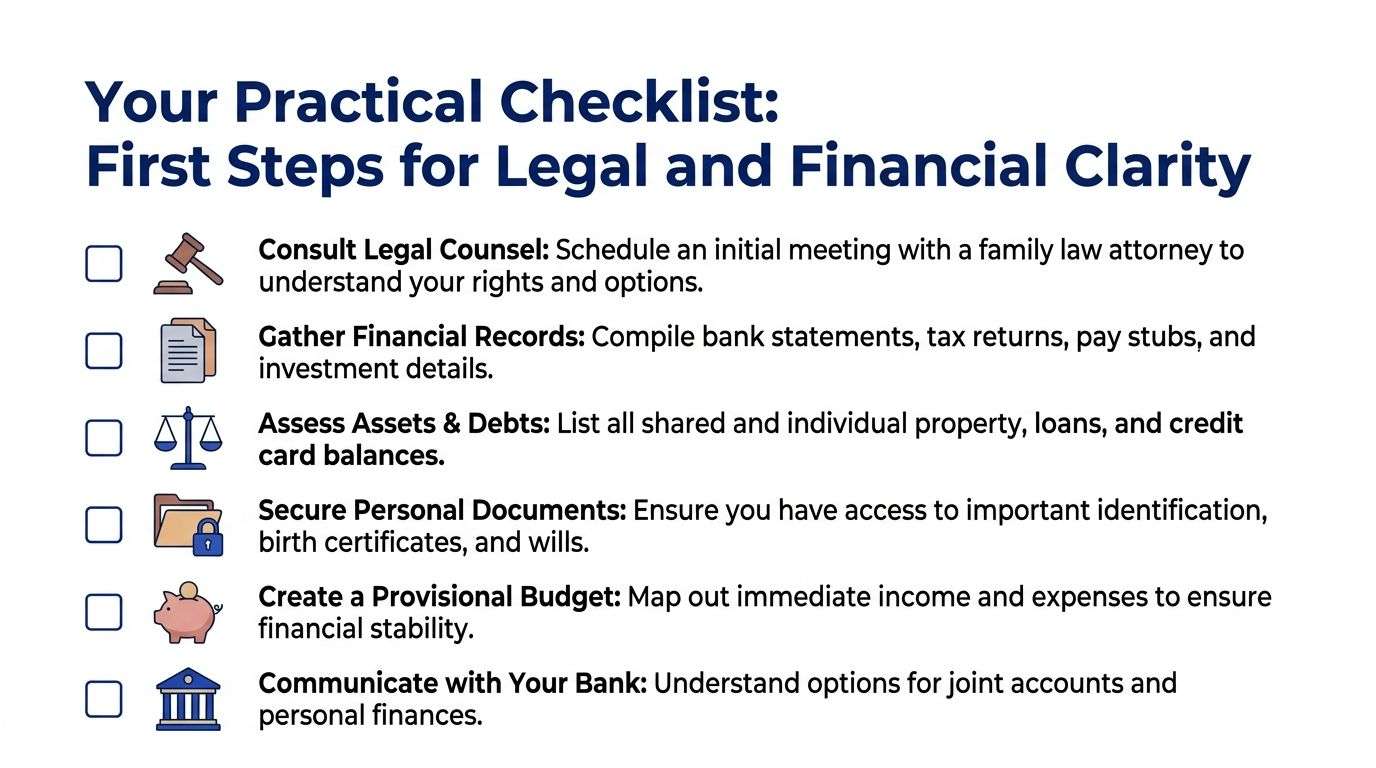
When your personal life feels chaotic, organisation becomes a form of self-protection. You do not need to solve the whole divorce this week. You do need to start creating a record of your life as it exists now.
In Canada, lifetime divorce risk is around 38%, and 65% of divorced mothers receive no child support, which can deepen financial stress after separation, as noted in this Canadian research summary on divorce, poverty risk, and co-parenting conflict. That’s one reason practical preparation matters early.
Gather before you negotiate
Don’t rely on memory when stress is high. Start a paper folder, a secure digital folder, or both.
Collect what you can access safely:
- Income records. Pay stubs, tax returns, benefit statements, and business income documents.
- Banking and debts. Joint account statements, personal accounts, credit cards, lines of credit, and loan balances.
- Property records. Mortgage papers, lease agreements, vehicle ownership, insurance documents, and pension information.
- Household essentials. Birth certificates, passports, health cards, SIN records, marriage certificate, and any existing wills or powers of attorney.
If you’re unsure how to think about shared finances, this plain-language article on joint bank accounts and financial pros and cons can help you sort what needs immediate attention.
Make a household inventory
People often think “assets” means only the house or savings account. In practice, it also helps to list everyday property. Stress makes it easy to forget what exists until later conflict starts.
A simple inventory can include:
| Category | Examples to list |
|---|---|
| Home | furniture, electronics, appliances, jewellery, artwork |
| Vehicles | cars, bikes, trailers, payment details |
| Financial | savings, pensions, investments, insurance policies |
| Debts | credit cards, tax debt, personal loans, student loans |
Take photos if that feels appropriate and safe. Save copies somewhere private.
Protect access, privacy, and cash flow
This part can feel uncomfortable, especially if you’re trying to stay amicable. It’s still wise.
Take calm, non-dramatic steps:
- Open a personal bank account if you don’t already have one.
- Change passwords for email, cloud storage, banking apps, and social media.
- Review shared subscriptions and devices so you know what can still be accessed.
- Check your mailing address settings for banks, benefits, and legal correspondence.
- Create a provisional budget for the next month, not the next year.
Your provisional budget only needs three columns:
- money coming in
- fixed essentials
- immediate unknowns
That’s enough to help you stop guessing.
Getting organised isn’t cold or adversarial. It’s how you reduce panic and make clearer decisions.
Book the right professional conversations
Not every divorce needs a court battle. But nearly every divorce benefits from informed advice early on. If children, housing, immigration status, disability, a family business, or significant debt are involved, early guidance is especially important.
Start with:
- A family lawyer consultation to understand your rights and obligations
- A financial advisor or accountant if your finances are complex
- A mediator if both people are willing to work toward practical agreements
- A therapist if your nervous system is too activated to think clearly
If your ex is pressuring you to “just keep it friendly and skip paperwork,” pause. Friendly and documented is ideal. Friendly and vague often becomes stressful later.
Co-Parenting With Compassion Protecting Your Childrens Well-being
For many parents, this is the most painful part. You may be grieving your marriage while also trying to make breakfast, answer hard questions, and decide what to say when your child asks, “Are you and Dad getting back together?” or “Is this my fault?”
Children don’t need perfect parents during divorce. They need steady ones. They need honesty in language they can understand, and they need protection from adult conflict.

How to tell the children
If it’s safe to do so, tell them together. Keep the message short and aligned. A child doesn’t need the history of the marriage. They need the core truths.
Something like this is often enough:
- we’ve decided not to live together as partners
- this is an adult decision
- it is not your fault
- we both love you
- we will keep taking care of you
Children usually ask practical questions first. Where will I sleep? Who takes me to school? Will I still see Grandma? That’s normal. Predictability feels safer than abstract reassurance.
Say less about why the marriage ended, and more about what will stay reliable for your child.
Do this, not that
When parents are hurt, children often get pulled into tension without anyone meaning to. A simple contrast can help.
| Do this | Not that |
|---|---|
| Speak respectfully about the other parent in front of the child | Use your child as a messenger or spy |
| Share schedule changes directly with the other parent | Tell the child to inform the other household |
| Keep adult legal and financial issues private | Discuss support, betrayal, or court details within earshot |
| Prepare children for transitions calmly | Create rushed, chaotic handoffs full of visible anger |
Many families find that a more structured style helps reduce friction. If direct teamwork isn’t realistic right now, this overview of parallel parenting vs co-parenting explains how lower-contact arrangements can still support children well.
Why shared parenting matters
Canadian families often hear mixed messages about custody. The most useful starting point is this: children generally do better when they can maintain meaningful relationships with both parents, provided safety is not the concern.
Research summarised in this review of 54 studies on shared parenting after divorce or separation found that children in joint physical custody had better outcomes than children in sole physical custody across several areas, including academic achievement, emotional health, and parent-child relationships. The same summary notes that British Columbia’s Family Law Act promotes maximum contact with both parents after separation, which fits with this child-centred approach.
This point can confuse parents in high conflict. Shared parenting does not mean constant togetherness between adults. In many families, it works best when routines are clear, communication is brief, and children aren’t asked to manage their parents’ emotions.
Build a simple parenting plan first
A parenting plan doesn’t need to begin as a long legal document. Start with the basics your child experiences directly.
Focus on:
- School week rhythm. Pickups, drop-offs, lunches, homework, activities.
- Sleep routines. Bedtime expectations, comfort items, medications.
- Communication rules. How you’ll share school updates, illness, or schedule changes.
- Special dates. Birthdays, holidays, and family events.
- Transition support. What helps your child move between homes with less distress.
A child who becomes quiet, clingy, angry, or more tearful may be telling you the transition feels big, not that the plan is failing. Kids often need help naming anxiety in their bodies. For parents who want a practical tool, Soul Shoppe offers a helpful guide on anxiety coping skills for kids with simple strategies you can practise at home.
What children remember most
Years later, most children won’t remember every legal detail. They remember tone. They remember whether they were free to love both parents. They remember whether home felt tense, stable, cold, or warm.
That means one of the strongest ways to deal with divorce as a parent is to lower the emotional burden your child carries. You do that by keeping them out of the middle.
Rebuilding Your Life Self-Care and Resilience Strategies
After the paperwork starts and the urgent conversations happen, many people hit a quieter phase. This can be the point when friends assume you’re “doing better” because you’re functioning again. Sometimes that’s exactly when the loneliness lands.
Rebuilding isn’t about pretending the divorce was easy. It’s about creating a life your nervous system can live inside without constant alarm.

Make self-care more practical
During divorce, self-care is often described in ways that feel too polished to be useful. What helps most is ordinary structure.
Try building your week around these anchors:
- Sleep protection. Keep a basic bedtime routine, reduce late-night conflict texting, and avoid making major decisions when exhausted.
- Food that steadies you. Aim for regular meals, even if they’re simple. Emotional swings hit harder when you haven’t eaten.
- Body movement. Walk, stretch, lift groceries, garden, or go to the gym. It doesn’t need to be impressive.
- Phone boundaries. Pick one or two times a day for divorce-related messages rather than checking constantly.
Recovery often looks boring from the outside. Repeated basics are what help your body trust the day again.
Rebuild identity in small pieces
One quiet grief in divorce is the loss of identity. You may not only be losing a partner. You may be losing routines, future plans, shared friends, or the version of yourself that existed in that relationship.
Instead of asking, “Who am I now?” ask smaller questions:
- What parts of me went quiet in this marriage?
- What used to make me feel capable?
- Which relationships feel nourishing instead of draining?
- What do I want my home to feel like now?
This can be a season for tiny experiments. Join a class. Rearrange one room. Restart a hobby. Reconnect with one friend. Change doesn’t have to be dramatic to be meaningful.
Don’t ignore layered trauma
Some people aren’t only dealing with divorce. They’re also carrying unresolved trauma from grief, abuse, illness, migration stress, or a motor vehicle accident. In British Columbia, that overlap matters.
For people whose separation stress is intensified by accident-related trauma, ICBC may cover counselling for MVA-related mental health concerns such as PTSD or anxiety, even while they’re also coping with divorce. Many people don’t realise these issues can overlap in treatment.
That matters because divorce can stir up old survival responses. If your body reacts as if every text, form, or disagreement is a full threat, there may be more than grief underneath.
Let support become part of your routine
Support doesn’t need to mean talking about the divorce every day. It can mean building a life where you’re not carrying everything alone.
Consider a support map with four categories:
- One practical person for forms, logistics, or childcare help
- One emotional person who can listen well
- One stabilising activity you attend regularly
- One private outlet such as prayer, journalling, therapy, or time outdoors
If your current circle minimises your pain or pushes you to “move on,” that’s useful information. Healing usually goes better in the company of people who can tolerate reality with you.
When and How to Seek Professional Support
People often wait too long to get help because they think they should be able to manage divorce on their own. But divorce can involve grief, trauma activation, parenting strain, legal stress, and communication breakdown all at once. Different supports do different jobs.
A good first question isn’t “Do I need help?” It’s “What kind of help fits the problem I’m facing right now?”
Therapy, co-parenting support, and mediation are not the same
Here’s a simple comparison:
| Support type | Best for | Main focus |
|---|---|---|
| Individual therapy | grief, panic, trauma, sleep problems, anger, shame | emotional processing and coping |
| Co-parenting counselling | reducing child exposure to conflict | parenting communication and child-centred planning |
| Mediation | practical agreements about parenting or separation issues | negotiation and structured problem-solving |
People sometimes expect mediation to heal emotional wounds. It usually won’t. It can help with agreements. Therapy helps with the pain, patterns, and overwhelm that make those agreements harder.
Co-parenting support sits in the middle. It keeps returning the conversation to one question: what arrangement best supports the child?
Signs it’s time to involve a professional
You don’t need to wait for a crisis. Consider reaching out if any of these are happening:
- You can’t settle physically. You’re not sleeping, eating, concentrating, or functioning at a basic level.
- Every interaction becomes explosive. Simple logistics turn into hours of accusation, defensiveness, or panic.
- Your children are showing distress. Big behaviour changes, clinginess, shutdown, school difficulty, or intense loyalty conflicts need attention.
- You feel stuck in loops. Same fights, same fears, same texts, same regret.
- You’re agreeing to things out of fear. Especially around money, parenting, or housing.
- Old trauma is flooding back. The divorce is activating earlier wounds in a way that feels disproportionate and hard to control.
High conflict needs structure
In high-conflict divorce, goodwill usually isn’t enough. Parents often need boundaries, a clear communication format, and a professional who can keep the focus on the children.
Lower forgiveness tends to be linked with more co-parenting conflict, and mediation plus forgiveness-focused therapy can help reduce conflict and support children more effectively. Earlier in the article, I cited the Canadian source for that research. The practical point here is simple. If every exchange turns into a battle, outside structure can protect everyone involved.
Useful professional supports may include:
- a therapist for grief, trauma, and emotional regulation
- a mediator for practical agreements
- a co-parenting counsellor for schedules, boundaries, and child-centred communication
If you’re looking for a starting point with a Canadian practice that supports individuals, parents, and families through separation, professional counselling support can help you sort which kind of care fits your situation.
Seeking support is not a sign that you’ve failed at divorce. It’s a sign that you’re trying to handle it responsibly.
Navigating Unique Paths Divorce for 2SLGBTQIA+ Individuals
A lot of divorce advice assumes a straight, cisgender, traditional family structure. That assumption leaves many people unseen. For 2SLGBTQIA+ individuals, divorce can involve all the usual grief and logistics, plus identity-specific stress that mainstream guides often skip.
That may include legal gender markers on documents, custody language that doesn’t fit binary parent roles, worries about bias in mediation, or the painful reality that chosen family may be more supportive than legal systems. These concerns are not niche. They directly affect safety, dignity, and how supported a person feels during separation.
Recent Canadian data cited in this overview of coping with divorce and life transition notes that trans people face a 22% higher rate of divorce than cisgender individuals, and 65% report feeling inadequately supported by the court system regarding their identity. That points to a clear need for affirming legal, mediation, and counselling support.
For some readers, it may also help to look at legal commentary written specifically for same-sex divorce, even when it comes from another jurisdiction, because it names issues generic articles often miss. This piece on Same Sex Divorce Florida is one example of how identity-specific concerns can change the practical conversation.
If your grief feels invisible because other people don’t understand your relationship, family structure, or identity, it can help to learn more about disenfranchised grief support in Canada. Feeling unseen during divorce can deepen pain. Naming that experience is often part of healing.
Compassionate Answers to Common Divorce Questions
Is divorce always a personal failure
No. Sometimes divorce follows betrayal, incompatibility, chronic conflict, or long periods of pain. Sometimes it follows years of trying. Even when there’s regret, that doesn’t make the whole story a failure.
A healthier question is: what is this transition asking me to learn, protect, or rebuild? That shift often reduces shame and helps you make steadier choices.
How do I deal with an ex who keeps provoking me
Treat communication like a professional exchange. Keep it brief, factual, and focused on the issue at hand. Don’t answer every accusation. Not every message deserves a full emotional response.
If children are involved, communicate about parenting, health, school, and schedules. Save emotional processing for therapy, trusted support, or private reflection.
What if my child says they don’t want to go to the other parent’s home
Pause before treating the statement as a final verdict. Children may resist transitions for many reasons, including loyalty conflicts, anxiety, missing one parent, or discomfort with change.
Stay curious. Ask calm questions. Notice patterns. If the resistance continues, especially with signs of distress, get professional guidance rather than putting the child in the middle.
How long does it take to feel normal again
There isn’t one timeline. Some parts improve quickly once conflict lowers. Other parts, especially identity, trust, and grief, may take longer.
Try not to measure healing by whether you never think about the divorce. A more useful measure is whether the divorce is running your day less often, and whether you’re regaining steadiness, choice, and hope.
Should I start dating right away
Only if it’s right for you, not because you’re trying to numb pain or prove something. Dating too soon can sometimes complicate grief, co-parenting, and decision-making.
If you’re unsure, ask yourself: am I looking for connection, or escape? Honest answers tend to protect you.
If you want more guidance as you move through separation, Interactive Counselling offers information and support for divorce, co-parenting, grief, trauma, and life transitions in a warm, practical, non-judgmental setting.
Clinically Reviewed By
Amy Mosset, MCP, RCC-S
Amy Mosset is a Master Practitioner in Clinical Counselling, Clinical Supervisor, and the owner of Interactive Counselling. She provides trauma-informed, evidence-based care and clinical supervision to registered therapists, with a focus on ethical practice, client safety, and high-quality therapeutic outcomes.