Growing up without a father can be a lonely road, but it’s a journey so many women share. This experience, often called the ‘father wound,’ can profoundly shape how a daughter sees herself, her relationships, and her place in the world. This is a tender subject, and our hope is to offer validation, insight, and a gentle path toward understanding. For more information, see our couples counselling.
An absent father's effects on a daughter can range from struggles with self-worth and emotional regulation to difficulties forming secure, trusting relationships in adulthood, as this foundational bond shapes her earliest understanding of security and validation.
You’re not alone in this. This guide is a supportive space, designed to help you recognize emotional and relational patterns that might feel all too familiar. We’ll explore these themes with compassion, giving you a framework for making sense of your own story and moving forward with real strength.
The Unique Role of a Father
A father's role in his daughter's life is unlike any other. He is her very first model for a male relationship, the person who helps set the blueprint for her understanding of security, validation, and how she deserves to be treated.
When a father is consistently present and engaged, he provides a secure base from which she can confidently explore the world. This foundational relationship is a quiet force, shaping several key areas of her development:
- Self-Esteem: A loving father’s approval and belief in her can powerfully affirm a daughter’s worth, helping her build a core of confidence from an early age.
- Masculinity: He offers a template for healthy masculinity. This doesn't just influence her future choices in partners; it also shapes her ability to build trusting, platonic friendships with men.
- Resilience: His encouragement to take healthy risks and bounce back from setbacks teaches her to be brave, self-reliant, and sure of her own capabilities.
When That Connection Is Missing
When this crucial bond is broken—or never had the chance to form—it creates a void. This absence isn't just about an empty chair at the dinner table; it's the loss of a very specific kind of nurturing, protection, and guidance. Whether it's due to divorce, death, addiction, or emotional distance, the absence leaves its mark.
This experience can leave a daughter wrestling with painful questions about her own value and lovability. It's so important to understand that this is not a personal failing. It’s a completely understandable response to a significant loss.
Recognizing this is the first step toward compassionately understanding the real effects of an absent father and beginning the process of healing.
Throughout this guide, we'll gently unpack these impacts. The point isn’t to dwell on pain, but to shine a light on the path toward building a strong, unshakable sense of self. Understanding where these feelings come from is what empowers you to reclaim your narrative and build the fulfilling life you deserve. Exploring different therapeutic approaches can provide a clear roadmap for this journey.
The Emotional and Psychological Impact of Father Absence
When a father is absent from a daughter's life, the emotional ripples can run deep, quietly shaping her inner world in ways that are often felt long before they are ever understood. This experience isn't just about missing a person; it's about navigating the psychological space they were meant to fill, leaving behind a persistent echo that can touch everything from how she sees herself to her emotional stability.
For many daughters, this translates into a fundamental questioning of their own worth. A young girl might internalize her father's absence as a direct reflection of her value, wrestling with the painful question, "Was I not good enough to make him stay?" This can plant seeds of self-doubt that are incredibly difficult to uproot later in life, leading to a diminished sense of self that feels both pervasive and deeply personal.
This is a look at some of the core developmental hurdles a daughter might face when growing up without her father.
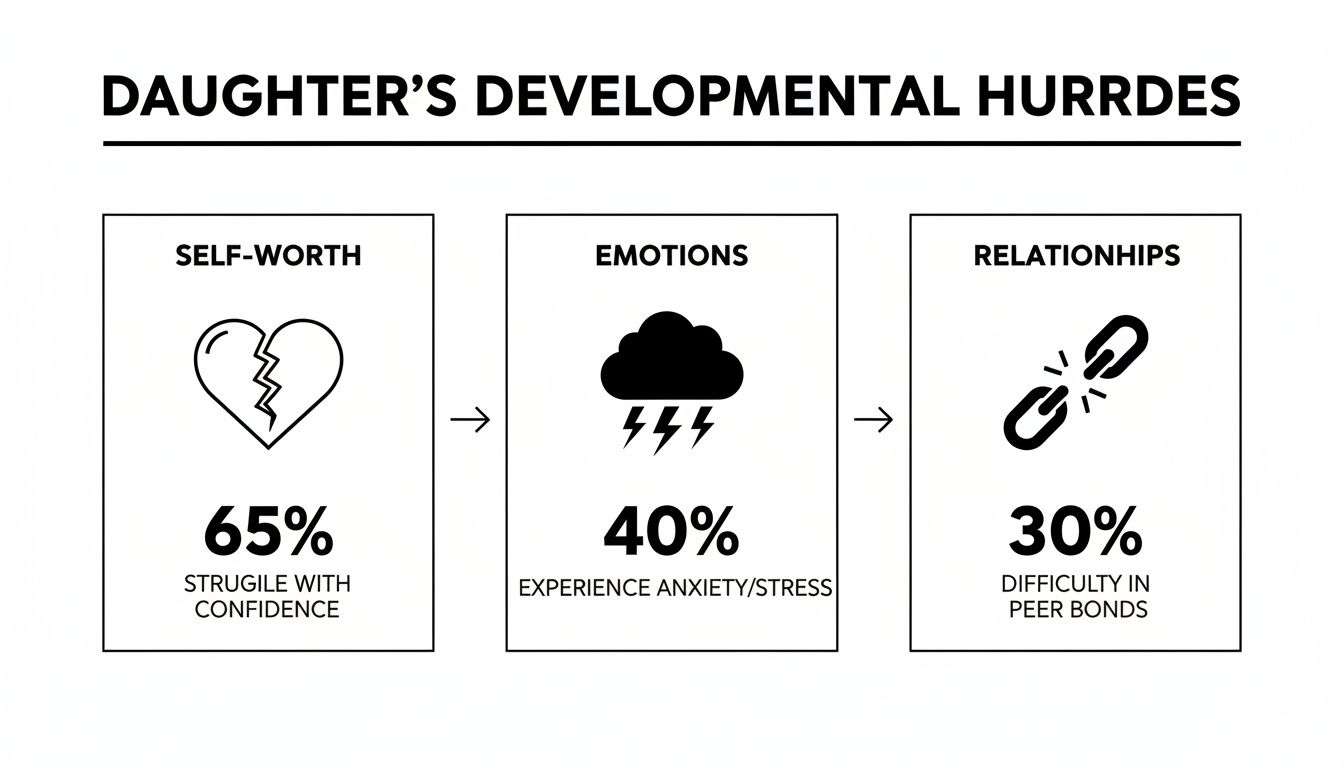
As the visual suggests, these challenges are deeply intertwined. A struggle with self-worth often fuels emotional difficulties, which in turn complicates her ability to form healthy, trusting relationships.
The Weight of Unseen Scars
The psychological toll of an absent father often shows up as a cluster of challenging emotions. It's not at all uncommon for feelings of abandonment and a profound sense of loneliness to become constant companions.
These feelings are valid. They are the natural consequence of losing a primary attachment figure—someone whose role is to provide a unique kind of security and affirmation. Over time, this emotional ache can contribute to more significant mental health challenges.
Research highlights this connection, showing that girls with absent fathers during middle childhood may experience higher levels of emotional problems at school. These issues can include profound sadness, social withdrawal, and persistent anxiety, illustrating how this early loss can cast a long shadow over a daughter's emotional well-being.
Common Emotional Patterns
While every daughter's story is unique, certain emotional and psychological patterns often emerge. Simply understanding them can be the first step toward healing, because it helps normalize what you might have felt was a personal failing.
- Pervasive Sadness or Depression: A lingering sense of grief for the relationship that never was can lead to a chronic, low-grade sadness or even symptoms of clinical depression.
- Heightened Anxiety: The lack of a stable, protective male figure can create a feeling of deep-seated insecurity, leading to heightened anxiety, especially in social situations or new environments.
- Difficulty with Emotional Regulation: Without a paternal figure to help model emotional expression and co-regulation, it can be tough to learn how to manage big feelings like anger, frustration, or disappointment.
- A Fear of Abandonment: This is one of the most common threads. The original loss can create a deep-seated fear that others will also leave, making it incredibly difficult to trust and form secure attachments later in life.
To make sense of these complex feelings, it can be helpful to map them out. This table shows some of the common emotional challenges, how they might appear in day-to-day life, and what a constructive path forward can look like.
| Navigating the Emotional Landscape of Father Absence |
| :— | :— | :— |
| Common Emotional Challenge | Potential Manifestation | Constructive Coping Strategy |
| Feelings of Abandonment | An intense fear of being left by partners or friends, leading to clinginess or pushing people away. | Practising self-soothing techniques and reality-testing anxious thoughts about abandonment. |
| Low Self-Esteem | A persistent inner critic, feelings of being "not good enough," and difficulty accepting compliments. | Engaging in positive self-talk, celebrating small achievements, and setting healthy boundaries. |
| Chronic Loneliness | Feeling isolated and disconnected from others, even when surrounded by people. | Building a supportive community of friends, joining groups with shared interests, and practising vulnerability. |
| Trust Issues | A reluctance to open up to others, especially in romantic relationships, due to a fear of being hurt. | Taking small, calculated risks in trusting safe people and learning to distinguish between healthy and unhealthy relationships. |
Seeing these patterns laid out can be an "aha!" moment. It clarifies that these aren't random struggles but interconnected responses to an early loss.
These emotional responses are often tangled together. For instance, a fear of abandonment might lead to social withdrawal, which then deepens feelings of loneliness and depression. Recognizing these connections is a key part of untangling them. Understanding how these early experiences shape your view of the world is crucial, and you can explore more about how childhood emotional neglect shapes adult attachment in our guide.
Healing isn't about erasing the past. It’s about integrating your experiences into a stronger, more self-aware sense of who you are today.
How Father Absence Shapes Future Relationships
The connection we have with our father isn't just a childhood memory; it's more like the first draft of a blueprint for all our future relationships. When a father is absent, that blueprint can have missing pieces or confusing instructions, profoundly shaping a daughter's romantic and even platonic connections as she grows up. It can quietly influence who she’s drawn to, how she acts in a partnership, and what she fundamentally believes she deserves from love.

At the very heart of this is something called attachment theory. Think of it this way: as babies, we're biologically wired to bond with our caregivers. It’s a survival thing. When a caregiver is consistently there for us and responds to our needs, we develop a secure attachment style. We learn that connection is safe, people are reliable, and we are worthy of being loved.
But when a key caregiver like a father isn't around, it can interrupt this natural process, often leading to an insecure attachment style. This isn't a defect or a flaw. It’s actually a brilliant adaptation to an environment where a major source of love and security was missing—a way of protecting a vulnerable heart from more pain.
Common Relational Patterns That Can Emerge
This insecure attachment can show up in a few distinct patterns in adult relationships. You might even see a bit of yourself in these descriptions. If you do, please know that this awareness is the very first step toward healing. This isn't about placing blame; it's about understanding the "why" behind your feelings and actions.
Common patterns often include:
- A deep-seated fear of abandonment: This can simmer as a constant, low-level anxiety in your relationships. You might find yourself needing constant reassurance, bending over backwards to avoid any conflict, or seeing a partner’s normal need for space as a sign they’re about to walk out.
- A tendency toward anxious behaviour: The original bond with your father felt unstable, so you might try to hold on incredibly tightly to new partners, terrified that if you loosen your grip even a little, they’ll disappear too.
- An opposing pattern of avoidant behaviour: For some, the early pain of abandonment teaches a different lesson: intimacy is dangerous. To stay safe, you might keep partners at arm's length emotionally, find it hard to be truly vulnerable, and even end relationships just as they start getting serious.
- Difficulty with healthy boundaries: Without a consistent model for healthy relationship dynamics, it can be tough to figure out where you end and another person begins. This can lead to becoming enmeshed with a partner or repeatedly allowing others to cross your personal lines.
These early experiences are formative. That "father template," whether present or absent, can influence our choice in partners for decades to come.
Seeking Validation and Repeating Cycles
One of the most common, and often unconscious, impacts of an absent father is a drive to heal that original "father wound" through romantic relationships. This can create a pattern of choosing partners who are emotionally unavailable, distant, or critical—subconsciously hoping to finally win the love and approval you missed out on as a child.
For example, a woman might find herself in a string of relationships with partners who need "fixing" or who refuse to commit. On the surface, it just feels like a run of bad luck. But underneath, it's often a reenactment of a familiar dynamic. She’s trying to rewrite an old story, seeking the validation from a partner that she never got from her dad.
Recognizing these cycles is incredibly empowering. It helps shift the question from, "What's wrong with me?" to "What did I learn about love back then, and how can I learn something new now?" It’s about gently untangling the past from your present so you can finally build the secure, loving connections you truly deserve. The goal is to stop looking for validation on the outside and start building an unshakable sense of worth from within.
Navigating Behavioural and Academic Challenges
The emotional weight of a father's absence doesn't always stay neatly contained. Often, it ripples outward, touching a daughter's behaviour at home and her life at school.
When a young person is trying to make sense of profound loss or abandonment, it's completely understandable that their focus and actions might shift. These changes aren't signs of a child being "bad" or "difficult." More often than not, they are simply coping mechanisms—a way of managing an internal storm that feels too big to handle.
It's so important to approach this with compassion. Acting out or struggling with schoolwork can be a young person’s way of sending up a flare, signalling a distress they don't yet have the words to express. This isn't a guaranteed outcome of father absence, but it is a potential challenge that deserves gentle understanding.
Understanding the Connection
When that foundational sense of security a father figure often provides is missing, a daughter might struggle with self-regulation. In the teenage years, this can sometimes look like impulsivity or a tendency to take more risks. Without a consistent paternal model for setting boundaries and navigating life’s hurdles, it can be tougher to build these skills independently.
In the same way, the emotional turmoil that comes with feeling left behind can make it incredibly hard to concentrate on schoolwork. When a child's mind is consumed with questions of self-worth and belonging, focusing on math problems or historical dates can feel just about impossible.
These challenges are never a reflection of a daughter's intelligence or her potential. They simply highlight the immense cognitive and emotional energy it takes to cope with this kind of loss. Many daughters show incredible resilience, and with the right support system in place, they can navigate these hurdles and thrive.
Potential Academic and Behavioural Hurdles
Research often shows a link between father absence and certain challenges, but it's crucial to remember that statistics are not destiny. They just help us understand the potential risks so we can be ready to offer better, more targeted support.
- Difficulties with Self-Regulation: This can show up as trouble managing big emotions like anger or frustration, sometimes leading to outbursts or impulsive decisions.
- Increased Risk-Taking: Some daughters might engage in risky behaviours as a way to feel in control, seek attention, or simply numb emotional pain.
- Challenges in School: This can range from difficulty concentrating and lower grades to a higher likelihood of disengaging from school altogether.
Here in Canada, the correlation between father absence and these outcomes is significant. Studies have found that girls from father-deprived homes may be more likely to struggle academically and exhibit behavioural disorders. For instance, they may have a higher chance of dropping out of high school and a lower chance of achieving top grades. You can learn more by reading about the powerful role of fathers in Canada.
It’s so important to see these as correlations, not certainties. Every young woman's journey is unique. Protective factors—like a strong bond with her mother, a supportive community, and other positive role models—play a massive role in building the resilience she needs to flourish.
Framing these behaviours as a response to loss rather than as a character flaw is the key. It shifts the entire focus from punishment to support, opening the door for healing conversations. If you're concerned about a young person in your life, understanding the options for support for youth and families can provide a clear path forward, offering a safe space to address these underlying challenges with professional, compassionate guidance.
Practical Pathways To Healing And Building Resilience
Understanding the impact of an absent father is a crucial first step, but the journey doesn't stop there. Knowing why you feel a certain way is one thing; learning how to move forward is another entirely. True empowerment comes from recognizing that your past doesn't have to write your future.
Healing is an active process. It’s about building strength, self-awareness, and resilience, one gentle step at a time. This path is yours to walk, focused on reclaiming your story and nurturing your own well-being. It involves real, practical tools that can help you process your emotions, build a solid sense of self, and cultivate the healthy connections you deserve. And while the journey is deeply personal, you don't have to walk it alone.

Actionable Strategies for Daughters
Healing really does begin from within. These strategies are designed to help you connect with yourself, process your feelings in a safe way, and lay a foundation of inner strength.
- Journaling to Process Emotions: Writing can be a powerful outlet for feelings you can’t quite say out loud yet. It creates a private, judgment-free space to explore anger, grief, or confusion. You can start with simple prompts like, "Today, I'm feeling…" or "What I wish I could have told him was…"
- Practising Mindfulness: Mindfulness is a simple but profound tool for staying grounded in the present moment, which can be a huge relief from anxious thoughts about the past or future. Simple breathing exercises or a brief guided meditation can do wonders to calm your nervous system and create a small pocket of peace in your day.
- Building a Strong Support Network: Intentionally cultivate relationships with people who make you feel seen, heard, and valued. This "chosen family" might include trusted friends, mentors, or community groups that offer the consistent support you may have missed out on.
Gentle Guidance for Mothers and Co-parents
Your role in supporting your daughter through this is incredibly important. Creating a safe, validating home environment can act as a powerful protective factor against the long-term effects of her father's absence.
Fostering open communication is absolutely key. Let her know that all of her feelings about her father's absence are valid—whether that’s sadness, anger, confusion, or even indifference. Simply saying, "It makes total sense that you feel that way," can be profoundly healing for her.
By validating her emotional experience, you send a powerful message: she is not to blame, and her feelings matter. This builds a foundation of trust and security that is essential for her to heal.
Another powerful step is helping her find positive and reliable male role models. This could be a grandfather, an uncle, a close family friend, or a coach. These relationships provide a healthy template for male connection, showing her that men can be dependable, caring, and present. It can also be helpful to explore resources that explain when a child might benefit from seeing a counsellor for additional insights and support.
How Therapy Can Help Pave the Way
Sometimes, the path to healing is clearer with a professional guide. Therapy offers a structured, non-judgmental space to explore the deep-seated impacts of father absence and learn new, healthier ways of thinking about yourself and relating to others.
One particularly effective, evidence-based approach is Cognitive Behavioural Therapy (CBT).
At its core, CBT is a practical form of therapy that helps you identify, challenge, and reframe the unhelpful thought patterns that often grow out of early experiences of loss. For instance, you might work with a therapist to address a core belief like, "I am not worthy of love," which may have taken root in response to your father’s absence.
CBT provides concrete tools to:
- Build Self-Esteem: By learning to challenge that negative inner critic, you can start to build a more compassionate and accurate view of yourself.
- Develop Healthy Relationship Skills: Therapy can help you recognize unhealthy relational patterns and practise setting boundaries, communicating your needs, and choosing supportive partners.
- Manage Difficult Emotions: You'll learn strategies to cope with anxiety, sadness, and anger in a constructive way, reducing their power over your daily life.
The goal of therapy isn't to erase the past, but to loosen its grip on your present. It’s about equipping you with the insights and tools needed to build a future defined by your own strength, resilience, and capacity for joy.
Frequently Asked Questions
As you navigate the complicated feelings that come with a father's absence, it's completely normal for questions to bubble up. This is a space for clear, compassionate answers to some of the most common concerns we hear. The core message here is one of hope: healing is always possible.
Can I have a healthy romantic relationship if I grew up without a father?
Yes, absolutely. While growing up without a father can certainly shape your relationship patterns, it doesn't determine your future. The journey often begins with a gentle awareness of those patterns—maybe a deep-seated fear of abandonment or a tendency to look to partners for the validation you never received. Through self-reflection and sometimes with professional guidance, you can learn to build your self-worth from the inside out. This empowers you to choose supportive partners and build the secure, loving relationships you truly deserve.
Is it too late to heal from my father's absence as an adult?
It is never too late. In fact, adulthood often brings the perspective and independence needed to address this core wound in a new, more empowered way. The healing process usually involves letting yourself grieve the connection you missed out on and understanding its ripple effects. A huge part of this is learning to give yourself the compassion you needed as a child. Therapy can be a powerful and safe space to navigate these big emotions and develop healthier ways of relating to yourself and the world.
How can I support my daughter struggling with her father's absence?
Your consistent, loving presence is the single most powerful protective factor she has. Create a safe, judgment-free zone where she can talk openly about whatever she's feeling. Validate everything—the sadness, the anger, the confusion. Reassure her, over and over again, that his absence is not her fault. It can also be incredibly helpful to intentionally foster relationships with positive, reliable male role models in her life, like a trusted uncle, grandfather, or family friend. If you feel you could both use more support, exploring family counselling can provide shared tools to navigate this together.
What if my father was physically present but emotionally absent?
This is a profound and often confusing kind of pain. An emotionally absent father—one who is physically there but checked out, distant, or unavailable—can leave a daughter feeling chronically invisible and unloved. The impact can be remarkably similar to physical absence, leading to low self-esteem, difficulties with intimacy, and a deep sense of loneliness. The path to healing is also quite similar. It’s about acknowledging the emotional neglect, grieving the lack of connection, and learning to build your sense of value from within, rather than waiting for it to be given to you by others.
The journey of healing is unique for everyone, but you don't have to walk it alone. This path of understanding belongs to you. The ripple effects of an absent father are real, and your feelings are valid—but they don't get to write your entire story. The emotional and mental health toll on Canadian daughters navigating father absence is significant. Research points to higher risks for depression, anxiety, and challenges with substance use, as a girl can internalize this absence as a profound personal rejection. You can explore data behind these findings on the Canadian Children's Rights Council website. Knowing this is empowering, as it’s the first step toward consciously carving out a different path.
Reaching out for support is a profound act of strength. If you're ready to learn more about how counselling can help you navigate these complex feelings in a safe space, our team is here to help.
Clinically Reviewed By
Amy Mosset, MCP, RCC-S
Amy Mosset is a Master Practitioner in Clinical Counselling, Clinical Supervisor, and the owner of Interactive Counselling. She provides trauma-informed, evidence-based care and clinical supervision to registered therapists, with a focus on ethical practice, client safety, and high-quality therapeutic outcomes.