That little voice in your head can be relentless, can't it? It’s the one that picks apart your decisions, second-guesses your skills, and puts your blunders on a constant loop. It often feels like its sole purpose is to make you feel small. But what if that voice—your inner critic—actually started out with the best of intentions? What if it was just trying to keep you safe?
Your inner critic is often a misguided protector; the key is to understand when its warnings help you grow versus when they hold you back.
We all have an inner monologue, but sometimes that internal chatter turns sharp and critical. This is what we call the inner critic—that part of your own mind that judges, doubts, and tears you down. It might sound like a disapproving parent, a tough teacher, or just a hyper-critical version of yourself, magnifying every single flaw.
As harsh as it sounds, this voice didn't just appear out of nowhere to make your life difficult. Psychologically speaking, it often grew out of a primitive defence mechanism meant to help us steer clear of danger, failure, and social rejection. It's the part of you that whispers, “Don’t even try that, you’ll probably mess it up,” because it’s trying to shield you from the sting of disappointment.
Understanding the Voice Inside Your Head
From Protector to Saboteur
At first, this protective instinct is actually pretty useful. It’s what prompts us to look before we leap and hopefully learn from our slip-ups. The problem is, this well-meaning mechanism can go into overdrive, especially when it's been shaped by difficult past experiences. It can morph from a helpful guide into a harsh saboteur, fuelling a constant cycle of self-doubt and anxiety.
You can dive deeper into this in our guide on where your inner critic comes from.
This shift happens when the critic’s feedback stops being constructive and becomes rigid and absolute. Suddenly, it sees threats everywhere, paralyzing you with fear rather than nudging you toward thoughtful action.
Just realizing this is happening is the first real step toward changing the dynamic. It's so important to remember that having an inner critic isn't some personal flaw; it’s a shared human experience. Learning to manage that voice is a skill, one you can develop over time to build a healthier, more compassionate relationship with yourself. You're not broken for having this voice—you're just human.
How to Tell a Protector from a Saboteur
It can be tough to tell the difference between a helpful inner nudge and a full-blown internal attack, especially when you're feeling stressed or full of doubt. The real giveaway is in how the thought makes you feel and what it pushes you to do. One guides you toward thoughtful action, while the other shoves you into a corner of paralysis and shame.
Think of it this way: a protective voice sounds like, "I should probably run through my notes one more time before the presentation. It'll help me feel more confident." It sees a potential challenge and offers a practical, constructive solution.
The saboteur, on the other hand, sounds more like, "You're just going to mess this up anyway, so why even bother trying?" It’s a dead end—just a harsh, sweeping judgment with no way forward. Learning to spot this difference is a massive step for your mental well-being.
Recognizing the Voice's Intention
A great way to tell these two voices apart is to tune into the tone and language used inside your head. Is it compassionate and specific? Or is it vague, cruel, and totally black-and-white?
This flowchart can be a really helpful tool for sorting through your inner dialogue in the moment, helping you figure out if you're listening to an ally or a critic.
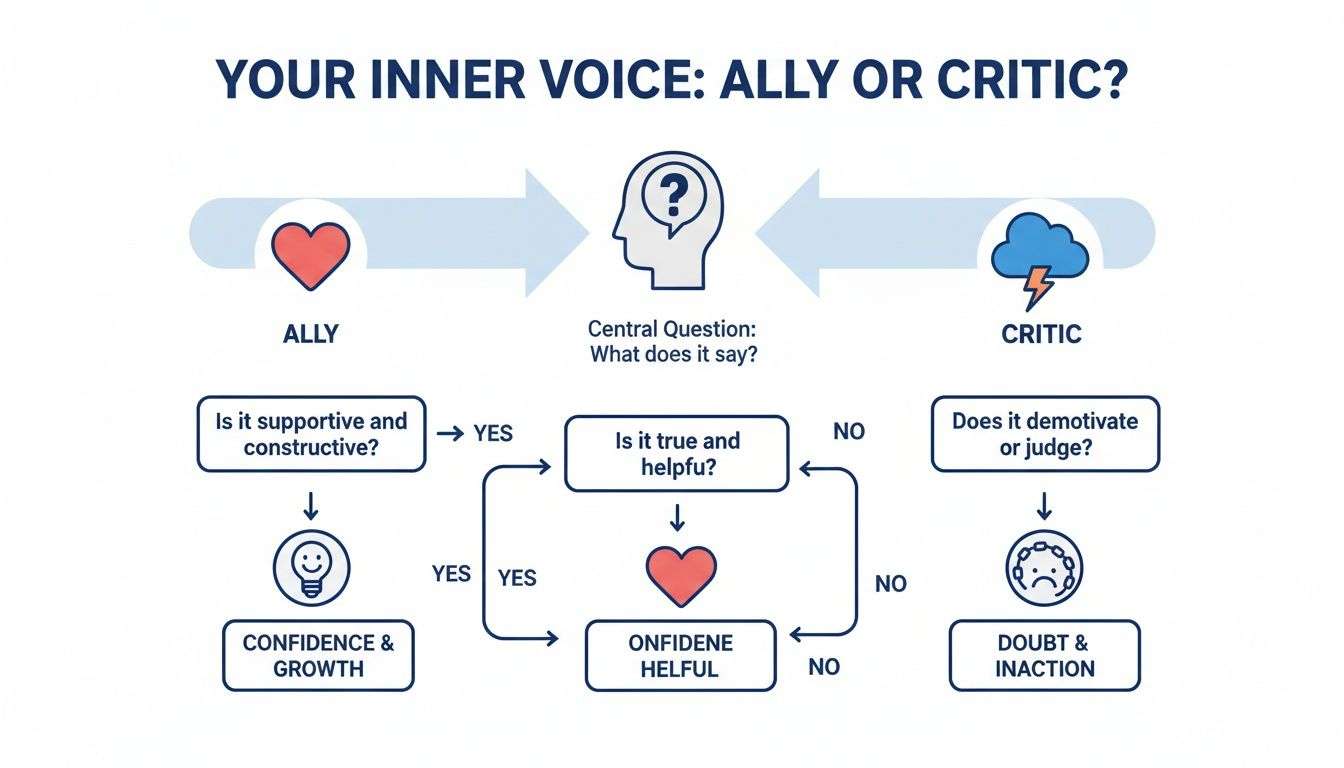
As the chart shows, a protective voice leads you toward growth and action. A critical one just keeps you stuck in self-doubt.
When that inner critic poses as a protector, it can cause significant distress. It's a big reason why so many people struggle in silence. According to the Canadian Institute for Health Information (CIHI), about two in five Canadians living with mental health conditions say their needs are only partially met or not met at all.
If your inner voice is encouraging you to take healthy actions, like reaching out for support, that's your protector. If it's just fueling a cycle of shame, that's your saboteur. You can learn more about these findings on the CIHI website.
Comparing Your Ally and Your Saboteur
Sometimes, just seeing the differences laid out side-by-side can make them much easier to spot in your own mind. A protective voice is usually grounded in reality. The hurtful critic, however, loves to operate in extremes, using words like "always" or "never."
Here’s a quick comparison table to help you identify the key differences between constructive self-guidance and destructive self-criticism.
| Characteristic | The Protective Voice (Your Ally) | The Hurting Critic (Your Saboteur) |
|---|---|---|
| Tone | Calm, compassionate, and encouraging. | Harsh, shaming, and demeaning. |
| Focus | On a specific behaviour or action ("I could have handled that conversation better."). | On your character or identity ("I am such a failure."). |
| Motivation | Inspires growth, learning, and positive change. | Causes fear, paralysis, and avoidance. |
| Perspective | Realistic and balanced, acknowledging both strengths and areas for improvement. | Absolute and one-sided, focusing only on perceived flaws. |
| Goal | To help you prepare, improve, and stay safe from genuine harm. | To punish you for mistakes and prevent you from taking risks. |
Once you start paying attention to these patterns, you can begin to separate yourself from the saboteur's harshness. Recognizing if your inner critic is protecting you or hurting you is the first real step toward taking back your inner world and treating yourself with the kindness you deserve.
The Inner Critic in Your Relationships
That voice inside your head rarely stays quiet, does it? Its harsh whispers often spill over, impacting your most important connections with others. The way you talk to yourself sets the tone for how you show up in your relationships, whether that’s with a partner, your children, or close friends. A relentless inner critic can create a ripple effect of insecurity, misunderstanding, and emotional distance.
Your internal dialogue doesn't just stay in your head. It shapes your perceptions and reactions, colouring how you interpret a partner's words or a child's behaviour. If your critic is constantly telling you that you're not good enough, you might find yourself becoming defensive or quick to assume the worst in others.

How Self-Criticism Affects Partnerships
In a romantic relationship, a harsh inner critic can be incredibly destructive. It often fuels behaviours that push connection away, even when that's the very last thing you want.
In a therapeutic setting, this often shows up in a few common ways:
- Assuming Rejection: If your inner voice insists you're unlovable, you may read into neutral actions from your partner. Them needing a quiet evening alone suddenly feels like proof that they're pulling away.
- Difficulty Accepting Compliments: You might brush off praise because your critic immediately chimes in to say it isn't true. This can leave your partner feeling unheard and unappreciated for their efforts to connect.
- Creating Conflict: That critical voice can make you overly sensitive to feedback. A simple request can feel like a major attack on your worth, turning a small issue into a huge argument.
This pattern of self-sabotage can lock you both into a painful cycle of conflict and withdrawal. Learning how to manage that inner voice is a crucial step toward building a more secure, trusting partnership. Professional guidance from a counsellor can give you the tools you need to finally break free.
The Impact on Parenting and Family Life
For parents, the inner critic can be especially loud, constantly second-guessing every decision. It might tell you you're failing your children or not living up to some impossible standard of the "perfect parent." This is a fast track to feelings of inadequacy, anxiety, and burnout.
When a parent's self-criticism is running the show, it can unintentionally shape their parenting style. You might become overly controlling out of a deep fear of making a mistake, or you might withdraw emotionally because you feel like an impostor.
This link between our internal world and family life is more common than you might think. Many Canadians are affected by mental health diagnoses, either personally or through a family member. For families navigating anxiety or depression, a parent’s inner critic can sabotage resilience by encouraging unhealthy coping mechanisms, like overworking to "prove" their worth. You can explore findings on mental health in Canada for more context.
Ultimately, building a kinder internal world isn’t just for you. It strengthens your bonds with the people you love most, allowing for more authentic and compassionate connections to flourish.
Practical Strategies to Manage a Harsh Inner Critic
Alright, so you’ve learned to spot the difference between your inner voice trying to help and one that’s just plain harmful. That’s a massive first step. Now, let’s talk about what to do next. Moving from simply noticing that voice to actively changing the conversation in your head is where the real work—and the real change—begins.
Here are a few practical, evidence-informed ways to start managing that harsh inner critic and build a more supportive relationship with yourself.

It's important to remember this isn't about declaring war on a part of yourself. That approach rarely works. Instead, think of it as learning to respond with curiosity and compassion, which, over time, gently loosens the critic’s grip.
Create Healthy Distance By Naming Your Critic
This might sound a little strange at first, but one of the most powerful things you can do is give your inner critic a name. Seriously. Call it "The Judge," "Gremlin," or "Mr. Perfectionist."
Doing this creates a tiny but crucial bit of space between you and that critical voice. It helps you see it as a separate character, making it much easier to observe its running commentary without automatically buying into it as the absolute truth.
This technique is all about "unblending" from the critic. So when a thought like, "You really messed that up again," pops into your head, you can meet it with something like, "Ah, The Judge is back with its usual opinions." This simple act of naming it is a reminder that the critic is just one voice, not the whole of who you are.
Fact-Check Your Critical Thoughts
Your inner critic is a master of exaggeration. It loves to deal in absolutes and uses distorted logic to make its case feel airtight. A great way to counter this is to become a gentle fact-checker.
When the critic makes one of its sweeping, negative claims, just pause. Ask yourself a few grounding questions.
- Is this thought 100% true? The critic says, "You always say the wrong thing." Is that really, truly, 100% accurate? Can you recall even one time you said the right thing?
- What's a more balanced perspective? A more honest thought might be, "I feel a bit awkward about what I said in that meeting, but I've had plenty of conversations that went really well."
- What would I say to a friend? If a friend came to you with this exact problem, you’d likely offer kindness and a dose of reality, not harsh judgment. Try offering that same grace to yourself.
This isn’t about starting an argument with yourself. It's about bringing a little reality to the critic’s dramatic narrative. Over time, you’re training your brain to question those automatic negative thoughts instead of just accepting them as fact. For a deeper dive, check out our guide on therapist-backed strategies that actually work.
Practice Self-Compassion
Perhaps the most healing strategy of all is to actively practice self-compassion. This means responding to your own stumbles and struggles with the same kindness and understanding you’d give a friend you care about.
When the critic starts its attack, you can make a conscious choice to comfort yourself instead of piling on.
True self-compassion involves three core elements:
- Mindfulness: Noticing your pain without getting completely swept away by it.
- Common Humanity: Reminding yourself that messing up is part of the shared human experience. Everyone does it.
- Self-Kindness: Actively being gentle and supportive with yourself when you feel you’ve fallen short.
By using these strategies, you can begin to transform that inner dialogue. It’s a journey toward achieving harmony within, not an overnight fix, but every small step you take toward self-kindness makes a world of difference.
How the Inner Critic Affects Children and Youth
That harsh inner voice we wrestle with as adults? It doesn't just show up out of the blue. For most of us, its seeds were planted way back in our childhood and teen years.
This internal voice can start quietly, fueled by a completely normal desire to fit in at school, make our parents proud, or keep up with our friends. But what starts as a helpful little nudge to study for a test can slowly morph into a relentless, harsh voice of self-doubt.
For kids and teens, the inner critic loves to zero in on their biggest anxieties. It might sound like intense stress before an exam, an all-consuming fear of making a mistake in front of the class, or a crushing need to be perfect. It’s that little whisper that says, "If you don't get an A+, you're a total failure," or "Don't even bother raising your hand, everyone will think your idea is stupid."
The Unique Pressures Young People Face
Let's be honest, the world kids navigate today is incredibly complex. It’s a mix of heavy academic demands, intense social pressures, and the 24/7 comparison game on social media. This environment can be a perfect breeding ground for a toxic inner critic.
- Perfectionism and School Anxiety: The pressure to achieve can easily twist the healthy drive for success into a paralyzing fear of failure. The inner critic convinces them their self-worth is tied directly to their grades, turning every assignment into a high-stakes referendum on their value.
- Peer Pressure and Social Comparison: Young people are in the messy process of figuring out who they are, and their inner critic often uses their peers as a measuring stick. It fixates on any perceived flaw, telling them they aren't as smart, popular, or attractive as everyone else seems to be.
- Family Dynamics: Even in the most loving homes, kids are sponges for parental stress or high expectations. A parent's own critical voice can be passed down without anyone even realizing it, modeling a pattern of negative self-talk for their child.
These challenges aren't just isolated incidents; they're incredibly common. Data from Statistics Canada has shown a rise in mental illness among Canadian youth. A relentless inner critic can be both a cause and a symptom of this trend, feeding anxiety and mood disorders, especially in young women. You can learn more about youth mental health trends and why accessible support is so vital.
Helping young people cultivate a more positive internal dialogue is one of the most important things we can do. Learning how to develop a growth mindset in children is a powerful counter-strategy. It teaches them to see a challenge not as proof of their flaws, but as a chance to learn and get stronger.
Ultimately, creating a home and school environment where mistakes are treated as normal, necessary parts of growth helps them build a healthier relationship with themselves right from the start.
Frequently Asked Questions
Can I ever get rid of my inner critic completely?
This is a question that comes up all the time, and the answer isn't what most people expect. The goal isn't actually to silence or banish your inner critic for good. A more helpful, and realistic, aim is to change your relationship with it. Try to see it less as an enemy you need to conquer and more as a part of you that’s trying to protect you, even if its methods are harsh and outdated. With practices like mindfulness and self-compassion, you learn to turn down the volume on its painful feedback and transform that voice from a relentless saboteur into a more balanced, constructive ally.
What if my inner critic feels like it's right?
That's an incredibly common and powerful feeling. The inner critic is an expert at finding a tiny grain of truth and blowing it up into a massive, painful story about who you are. For instance, you might have the factual thought, "I made a mistake on that project." The critic takes that fact and adds a toxic spin: "See? I’m a total failure and I can't do anything right." It’s that second part—the sweeping judgment—that causes all the pain. A great first step is learning to pull those two things apart: the neutral observation versus the harsh judgment. This allows you to see where you can grow without getting stuck in a shame spiral.
How do I help my child deal with their inner critic?
Start by modelling self-compassion yourself. When you make a mistake, talk about it openly and kindly (e.g., "Oops, I forgot the milk! That's okay, I'll grab it later"). Encourage a growth mindset by praising their effort and persistence, not just their achievements. Help them name their critical voice—"the Worry Monster" or "the Perfection Potion"—to separate themselves from the thought. Most importantly, create a safe space where they know mistakes are a normal part of learning, not a reflection of their worth.
If your inner critic is impacting your well-being or relationships, please know that you are not alone and support is available. Learning to manage this internal voice is a skill, and you don't have to do it by yourself. We invite you to explore professional counselling services to find guidance and build a kinder relationship with yourself.
Clinically Reviewed By
Amy Mosset, MCP, RCC-S
Amy Mosset is a Master Practitioner in Clinical Counselling, Clinical Supervisor, and the owner of Interactive Counselling. She provides trauma-informed, evidence-based care and clinical supervision to registered therapists, with a focus on ethical practice, client safety, and high-quality therapeutic outcomes.