Many women are first diagnosed with ADHD in their 30s and 40s because girls are 3 times less likely to receive a childhood diagnosis than boys, and because hormonal shifts in midlife can reduce dopamine availability by 20 to 30% during certain phases, making long-managed symptoms harder to compensate for. For many Canadian women, the delay also isn't only personal. It's shaped by diagnostic bias, life overload, trauma, and healthcare wait times that can exceed 6 to 12 months for adult ADHD assessment in several provinces.
"Many women are diagnosed with ADHD in their 30s and 40s because the demands of adult life finally overwhelm lifelong coping strategies, while hormonal shifts can intensify underlying symptoms that were missed in childhood due to gender-biased diagnostic criteria."
Introduction The Feeling of Falling Behind
You might be reading this after another day of trying so hard and still feeling behind. Maybe you remembered the school form but forgot the dentist call. Maybe you did well at work but cried in the car because you couldn't face the laundry, dinner, and the unopened messages on your phone. From the outside, your life may look full and functional. Inside, it can feel like chaos held together by sticky notes, alarms, guilt, and sheer force.
A lot of women describe this as feeling “bad at adulting.” They're capable, caring, and often high-achieving. Yet ordinary tasks seem to take far more energy than they “should.” That mismatch can create deep shame. It can also lead women to assume the problem is laziness, stress, anxiety, burnout, or some personal flaw.
Sometimes the missing explanation is ADHD.
Not the stereotype many people were taught. Not the image of a little boy who can't sit still in class. But a quieter, internalised version that can hide for years behind perfectionism, people-pleasing, overpreparing, and chronic self-criticism.
You can struggle significantly with ADHD and still look competent to everyone else.
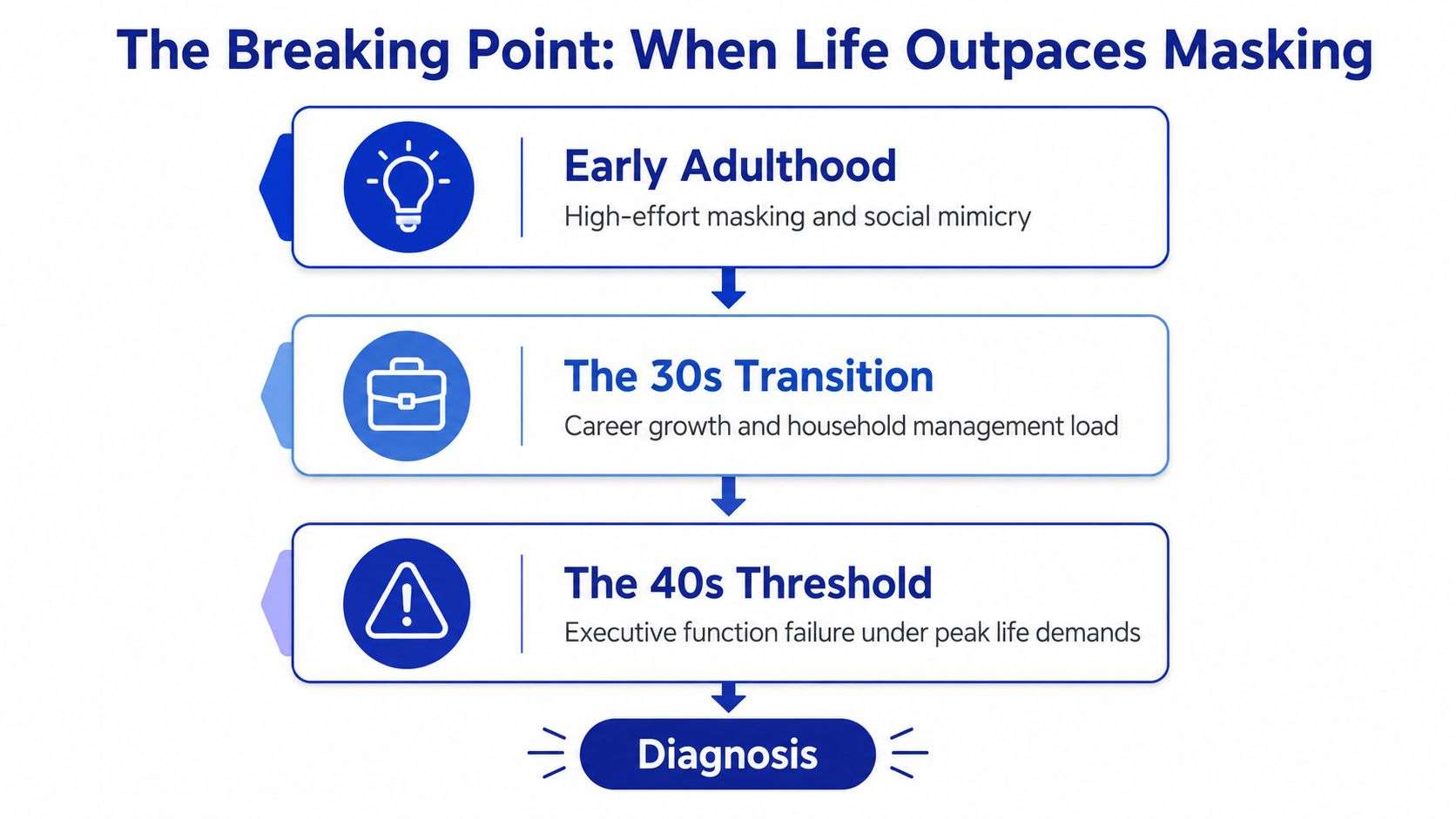
For many women, diagnosis happens only after a reaching a breaking point. A new baby, a promotion, perimenopause, caring for aging parents, or the cumulative load of being responsible for too many moving parts can make old coping strategies stop working. That can feel frightening, but it can also be clarifying.
If part of your stress shows up around body image, routines, motivation, or the emotional side of health goals, this piece on maintaining mental health while getting fit may also feel relevant. It speaks to the hidden mental load many women carry long before anyone asks whether ADHD might be part of the picture.
Why ADHD in Girls Is So Often Missed

The old picture of ADHD was too narrow
Many adults still picture ADHD as obvious hyperactivity. That image shaped who got noticed in school, who got referred, and who got dismissed. Girls with ADHD were often overlooked because their symptoms didn't always disrupt the classroom. They might have been daydreamy, chatty, disorganised, emotionally intense, forgetful, or inconsistent. Those traits were often labelled as immaturity, sensitivity, lack of effort, or “just being scattered.”
The result wasn't random. Diagnostic criteria were built around predominantly male, hyperactive samples. That created a blind spot for girls with inattentive ADHD.
Research indicates girls are 3 times less likely to receive a childhood diagnosis than boys, and women with inattentive ADHD often require a significantly higher symptom severity threshold to be referred for formal assessment, contributing to a delayed diagnosis mean age of late 30s to early 40s, as described in this review on late-diagnosed ADHD in women and why it was missed for decades.
What masking can look like in real life
Many girls don't stop struggling. They start compensating.
A child who forgets homework may become the teenager who stays up late overchecking everything. A student who can't focus in class may rely on adrenaline, last-minute cramming, or copying the habits of organised friends. A girl who feels internally chaotic may become very quiet because she's trying not to get in trouble.
Masking can look like:
- Being “good” at school but exhausted at home after holding it together all day
- Overachieving in bursts while privately battling procrastination and panic
- Using perfectionism as camouflage so no one sees how hard basic tasks feel
- Needing constant reminders but feeling too ashamed to ask for help
- Appearing mature because she's anxious, highly watchful, and afraid of making mistakes
Practical rule: A lack of childhood diagnosis does not rule out adult ADHD in women.
Why many women say no one connected the dots
Women often tell a similar story in hindsight. They weren't seen as disruptive enough. They did well enough. They looked responsible enough. They were often told they had “so much potential” but needed to apply themselves, be less emotional, be more organised, or try harder.
That's one reason the phrase adhd and women: why so many are diagnosed in their 30s and 40s resonates with so many readers. It names a pattern that was never just about personal oversight. It reflects a system that was better at spotting one kind of ADHD than another.
When Life Demands Exceed Coping Skills
The strategies worked, until they didn't
A lot of women make it through their teens and twenties by building complicated systems around their brains. They use calendars, panic, overwork, people-pleasing, and last-minute sprints. They choose jobs or roles where they can rely on intelligence, charm, crisis response, or flexibility. They may even look highly successful.
Then adult life becomes less forgiving.
The thirty-something and forty-something years often bring a pileup of executive-function demands. Work gets more complex. Home requires planning, not just reacting. Children need forms, snacks, appointments, emotional labour, and routine. Parents may start needing care. Relationships need follow-through. Nobody grades you on effort. You still have to remember what to buy for the class party.
What used to be barely manageable can start to collapse.
What compensatory collapse feels like
Some women describe this as “suddenly getting worse,” but it often isn't sudden in the deeper sense. The strain was there all along. The scaffolding just finally gave way.
Common signs of that breaking point include:
- Task initiation stalls out even for things you care about
- Time blindness becomes costly because there are now more deadlines with real consequences
- Mental load becomes unbearable when every family detail seems to live in your head
- Emotional regulation frays because you're depleted, ashamed, and constantly trying to catch up
- Performance becomes inconsistent in ways that others start to notice
One woman might manage her own schedule reasonably well, then become overwhelmed once she has to coordinate school events, work meetings, groceries, medication refills, and an aging parent's appointments. Another may have done fine in a creative, deadline-driven role, then struggle badly after moving into management where the job requires planning, admin, and sustained follow-through.
Sometimes the problem isn't motivation. It's that the number of moving parts has outgrown the coping system.
Why this can look like burnout
From the outside, the pattern can resemble stress or burnout. And sometimes burnout is part of the picture. But there's an important difference. Burnout often reflects overload in a particular season. ADHD usually leaves a longer trail.
That trail may include chronic lateness, lost items, unfinished tasks, impulsive yeses, difficulty prioritising, forgotten admin, intense hyperfocus on some things, and a lifelong sense that simple routines take an unreasonable amount of effort.
If your brain feels flooded most days, some readers also find it helpful to learn about practical fixes for cognitive overload. It can help put language around the feeling of having too many tabs open in your mind at once.
The Role of Hormones in Unmasking ADHD

Estrogen and dopamine are connected
Hormones aren't the whole story, but they're a major part of why many women first seek answers in midlife. Estrogen directly modulates dopamine availability in brain areas involved in attention, impulse control, and executive function. When estrogen becomes erratic, the brain may lose some of the chemical support that helped a woman compensate for ADHD symptoms earlier in life.
During perimenopause, erratic estrogen levels can reduce dopamine availability by 20 to 30% during certain phases of the menstrual cycle, removing the neurochemical “margin” that may have helped a woman compensate for inattentive ADHD symptoms throughout her 20s and early 30s, according to this medical overview of ADHD in women ages 30 to 45.
That doesn't mean ADHD suddenly appears in perimenopause. It means the brain may have less buffer.
Why symptoms can feel stronger at certain times
This is one of the places readers often get confused, so it helps to say it plainly. Hormonal change can unmask ADHD. It does not mean the condition is newly acquired.
A woman may notice that she can no longer keep track of conversations, hold multiple steps in mind, begin routine tasks, or regulate frustration the way she once could. She may also notice patterns tied to her cycle, postpartum changes, or the early stages of perimenopause.
A few examples can make this more concrete:
| Situation | What she may notice |
|---|---|
| Before, during, or after cycle shifts | More forgetfulness, more irritability, less focus |
| Postpartum period | Greater overwhelm, poor task management, feeling unable to recover mentally |
| Perimenopause | A sharp increase in disorganisation, brain fog, emotional intensity, and burnout |
What to pay attention to
If you're wondering whether hormones are part of your picture, it can help to track symptoms rather than relying on memory.
Notice things like:
- Timing patterns linked to your cycle or hormonal transitions
- Executive function changes such as planning, starting, sequencing, or remembering
- Emotional shifts including irritability, sensitivity, or rapid overwhelm
- Daily functioning at work, at home, and in relationships
A useful question is not “Why am I suddenly failing?” It's “When do my symptoms spike, and what has changed around my brain and body?”
This kind of tracking can help clinicians distinguish ADHD from a mood disorder, and it can help you make sense of why the same life that felt difficult before now feels impossible.
Common Misdiagnoses and Overlapping Conditions
When ADHD gets mistaken for anxiety or depression
A woman goes to her doctor because she is always on edge, crying more easily, forgetting basic things, and dreading one more dropped ball. She leaves with a label like anxiety, depression, or burnout. Sometimes that diagnosis fits. Sometimes it describes the smoke, while ADHD is part of the fire.
This confusion makes sense. ADHD often creates the kind of daily strain that can look like an anxiety disorder from the outside. If your brain regularly loses track of appointments, deadlines, conversations, or where you put your keys, your nervous system may start acting like danger is everywhere. You check, recheck, and brace for the next mistake.
Depression can grow in a similar way. After years of missed details, unfinished tasks, and criticism from other people or from yourself, it is easy to start believing the problem is a character flaw rather than a pattern of executive function difficulty.
That is one reason many women receive treatment for the emotional fallout of ADHD long before anyone examines the full picture.
A woman might say, “I'm anxious all the time,” when what she is really living with is constant uncertainty about what her brain may have dropped. Another may say, “I feel depressed,” when much of that heaviness comes from years of trying hard and still struggling with planning, follow-through, and mental overload.
Trauma can blur the picture too
Trauma adds another layer, and it is often overlooked in women.
Trauma can affect attention, working memory, sleep, emotional regulation, and the ability to feel settled in your body. ADHD can affect many of those same areas. From a distance, the two can resemble each other. Up close, they may also exist together.
That overlap matters. A woman with a trauma history may be hypervigilant, easily startled, forgetful under stress, or emotionally reactive. A woman with ADHD may also seem distractible, emotionally flooded, or unable to stay organised. If a clinician only looks through one lens, she may be treated for only part of what is going on.
In Canada, this is not only a personal issue. It is also a systems issue. Short appointments, long wait-lists, uneven access to adult ADHD assessment, and limited trauma-informed care can all push clinicians toward the most familiar explanation instead of the most accurate one. Women who have survived violence, chronic stress, or relational trauma are especially likely to be misunderstood if no one asks what symptoms were present in childhood, what appeared after trauma, and what gets worse under stress.
Statistics Canada has reported on the shrinking gender gap in violent victimization, which helps explain why trauma needs to stay in the conversation when women are being assessed for ADHD.
A careful assessment asks a few grounded questions. What has been lifelong? What changed later? What shows up mostly in situations of stress, threat, or overload? Those questions help separate overlapping conditions without forcing a woman into a single, too-simple label.
Signs the picture may be more layered
Sometimes the question is not which one is correct. It is how several patterns may be interacting at the same time.
A fuller assessment may help if you notice:
- Disorganisation or inattention that seems to go back to childhood, along with a trauma history
- Chronic forgetfulness or mental drifting, along with panic, hypervigilance, or shutdown
- Strong emotional reactions that intensify during conflict, stress, or perceived criticism
- Years of shame that seem connected to being misunderstood, dismissed, or called lazy
- Treatment for anxiety or depression that helped somewhat, but never fully explained your day-to-day struggles
If this is your experience, confusion does not mean you are exaggerating or failing to explain yourself well. It often means the picture is layered. And layered problems need careful, humane assessment, especially in a healthcare system where women are still too often filtered into the wrong category first.
Navigating the Path to Assessment and Support
The path can feel confusing for good reason
You finally decide to ask about ADHD. Then the process starts to feel like a maze. One clinic needs a referral. Another does not assess adults. A waitlist stretches for months. A doctor focuses on anxiety, sleep, or stress first. By the time you get home, it can be hard to tell whether you are dealing with normal red tape or whether you somehow explained yourself poorly.
For many Canadian women, late diagnosis is shaped by more than self-doubt or missed childhood signs. Access gaps in adult assessment, uneven provider training, cost barriers in private care, and long waits in public systems all slow the process. Trauma can add another layer. If a woman has spent years in survival mode, clinicians may focus on what is most visible in the room and miss the longer ADHD pattern underneath.
That can feel discouraging. It can also make perfect sense.
What helps when you speak with a doctor or assessor
A useful assessment is a bit like putting a timeline on the table. The goal is not to prove that you are struggling enough. The goal is to help someone see the pattern clearly across years, settings, and stressors.
You do not need a polished script. You need concrete examples.
It may help to bring notes about:
- Patterns that go back to childhood, such as losing things, forgetting instructions, daydreaming, starting projects and not finishing them, or needing last-minute pressure to get things done
- How life is affected now, including work, parenting, finances, household tasks, relationships, and emotional regulation
- Times when symptoms got worse, such as postpartum, perimenopause, major stress, or periods of burnout
- Past mental health treatment, including diagnoses you were given, what treatment helped, and what still never quite fit
- Trauma history or chronic stress, if that feels relevant, since attention problems can be shaped by both ADHD and nervous system overload
- Observations from someone who knows you well, especially if they can describe patterns that have been present for years
Some women find it easier to bring a one-page summary instead of trying to remember everything in the moment. That can lower the pressure and help the appointment stay focused.
You might say, “I have had problems with organisation, follow-through, and time management for as long as I can remember. They have become harder to manage in midlife, and I want an assessment that also considers hormones, stress, and trauma so the full picture is not missed.”
Support can start before a diagnosis is confirmed
Waiting for an assessment does not mean you have to wait for help. If daily life already feels harder than it should, support can begin now.
A therapist, coach, or support group can help you build steadier routines, reduce shame, and sort out which struggles look like ADHD, which look like overload, and which may connect to trauma. That matters because women are often told to fix the surface problem first. Be less emotional. Be more organized. Try harder. A better approach asks what the brain and nervous system are dealing with in the first place.
Helpful support may include:
- Practical systems for planning, reminders, task initiation, and reducing friction at home or work
- Emotional support for grief, anger, confusion, or relief after seeing your history in a new light
- Trauma-aware care if past experiences still affect concentration, safety, or self-trust
- Preparation for assessment, including organizing examples and questions before appointments
If you are looking for day-to-day help while you wait, these strategies for living with ADHD can offer a useful starting point. Sometimes the first step is not getting every answer at once. It is getting enough support to make the next step feel possible.
Frequently Asked Questions About ADHD in Women
Can I have ADHD if I did well in school or have a successful career?
Yes. Success does not cancel out struggle. Many women perform well because they're intelligent, anxious, perfectionistic, or highly motivated to avoid disappointing others. What often gets missed is the cost. They may be succeeding through overwork, sleeplessness, panic, or constant compensation.
How do I know if it's ADHD or just burnout?
Burnout usually has a clearer timeline. ADHD usually leaves a lifelong pattern, even if it became much more impairing later. If you look back and see chronic disorganisation, procrastination, time blindness, forgetfulness, or uneven performance across many years, that points to something more enduring than a difficult season alone.
Can trauma and ADHD exist together?
Yes, and that overlap matters. Trauma can mimic ADHD in some ways, and ADHD can make coping with trauma harder. A careful, trauma-sensitive assessment looks at both rather than forcing women into one explanation.
Why do so many mothers realise they may have ADHD after their child is assessed?
This is very common. Parents often recognise their own patterns while filling out forms, hearing symptom descriptions, or trying to support a child with similar challenges. The child's assessment can become the first time a mother sees her own history with more clarity and compassion.
What can I do while I'm waiting for assessment?
Start by reducing shame and gathering information. Track patterns. Externalise reminders. Simplify systems. Ask for help where you can. Some people also find practical reading useful, including this piece on strategies for living with ADHD, which offers everyday ideas for functioning with a neurodivergent brain.
A diagnosis can bring relief, but it isn't the only moment that matters. Understanding yourself more accurately is already a meaningful shift.
If this article felt uncomfortably familiar, you don't need to have everything figured out before reaching for support. Interactive Counselling offers compassionate, evidence-informed counselling for adults navigating anxiety, trauma, life transitions, parenting stress, and the emotional impact of feeling chronically overwhelmed. For many women, having a safe place to sort through patterns, ask better questions, and build practical supports can be an important next step.
Clinically Reviewed By
Amy Mosset, MCP, RCC-S
Amy Mosset is a Master Practitioner in Clinical Counselling, Clinical Supervisor, and the owner of Interactive Counselling. She provides trauma-informed, evidence-based care and clinical supervision to registered therapists, with a focus on ethical practice, client safety, and high-quality therapeutic outcomes.