A parent in Penticton may notice the change before anyone else does. Their teenager stops joining the weekend bike ride along the Okanagan Lake path, spends more time behind a closed bedroom door, or answers a simple question with an irritated “fine.” Nothing seems dramatic enough to call an emergency, yet the young person no longer seems like themselves. For more information, see our Penticton youth counselling.
Those quiet shifts deserve attention. Teen counselling in Penticton can give adolescents a private, respectful place to untangle worry, sadness, anger, grief, identity questions, family stress, or pressure at school. It can also help parents understand what support looks like when a concern is real but doesn't yet have a clear label. For more information, see our counselling in Penticton.
The right starting point may be a private counsellor, a free provincial intake clinic, Foundry Penticton, virtual support, or a crisis service. Thinking of care as a layered community system, rather than one appointment, helps families choose a door that matches the young person's needs. For more information, see our youth counselling.
What Teen Counselling Really Looks Like in Penticton
Teen counselling is a dedicated space where an adolescent can speak with a trained clinician about thoughts, feelings, and behaviours that feel too tangled to sort out alone. A friend may offer comfort, and a family doctor may check physical or medical concerns, but counselling provides consistent time to understand patterns and practise useful skills.
For one Penticton family, the first session might begin with the teen sitting still while a parent explains the recent changes. The counsellor may ask about sleep, school, friendships, mood, and what the teen wishes adults understood. The young person doesn't have to tell the whole story immediately. Trust develops through small, manageable conversations.
A quiet change isn't proof that something is wrong, but it's a good reason to become curious.
The Okanagan context matters. Penticton is a close community where teens may encounter the same classmates at school, work, sports, social events, and online. Academic stress can intensify through Grades 9 to 12, while team pressure, social comparison, family changes, and seasonal mood shifts can add to the load.
Counselling also differs from a one-time problem-solving conversation. A clinician can help a teen notice how thoughts, emotions, body sensations, and actions interact, then build responses that fit real situations, such as an exam, friendship conflict, panic, or difficult family conversation.
Families can access support through several routes:
- Private counselling: Often useful when a family wants a specific therapist, format, or schedule.
- Free provincial care: BC Child and Youth Mental Health intake clinics provide no-cost assessment and treatment for children and youth up to age 18. The province says there are more than 90 intake clinics across BC (BC Ministry of Children and Family Development).
- Foundry Penticton: A youth-centred option for ages 12 to 24, with in-person and virtual supports.
- Crisis pathways: Available when waiting for a routine appointment isn't safe.
That range means counselling can be a reachable first step, not a leap into an unfamiliar system.
How Therapy Approaches Fit Different Teens
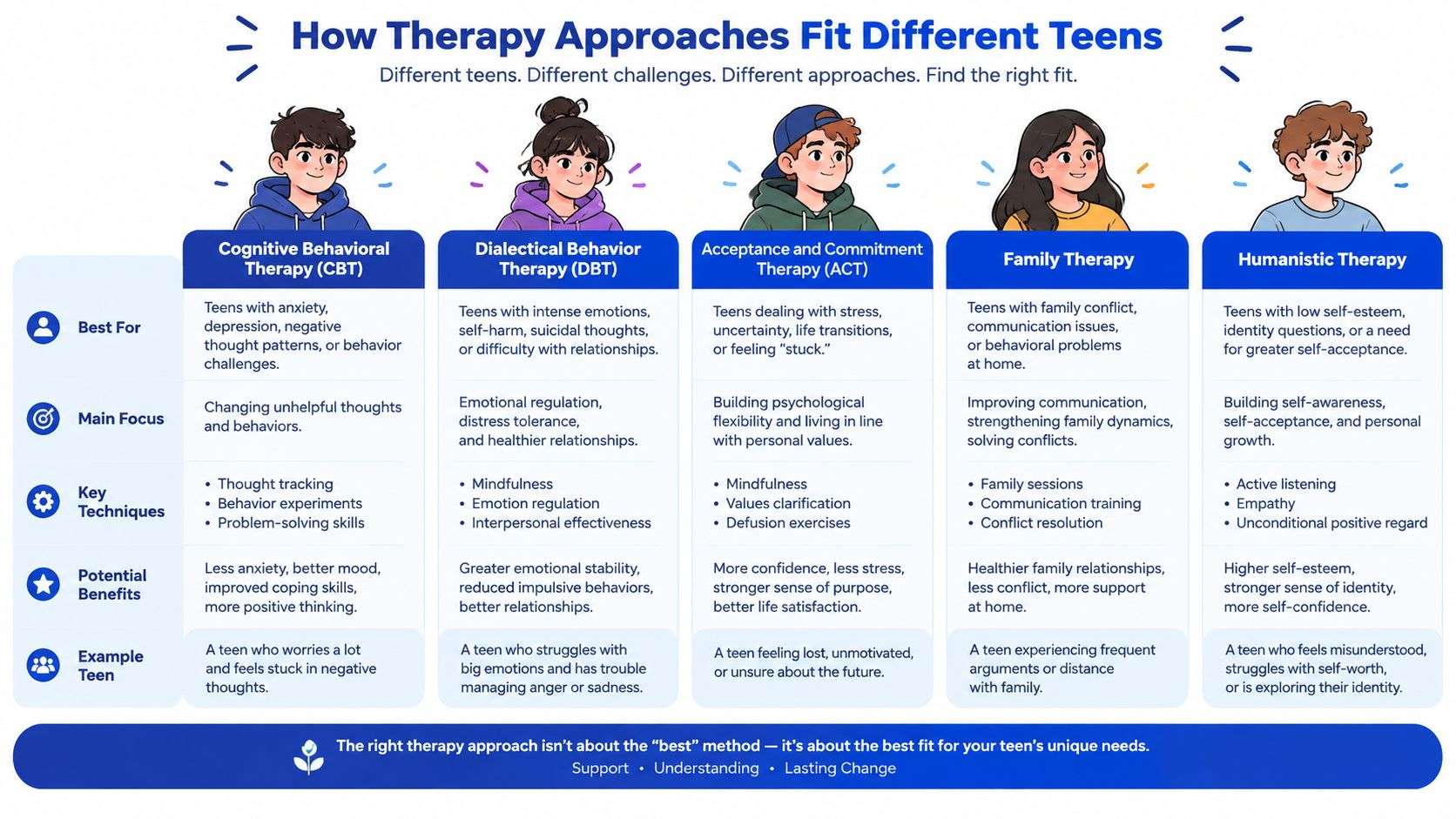
Therapy approaches are like tools in a repair kit. A screwdriver may be useful for one job, while a wrench is better for another. A thoughtful counsellor chooses methods according to the teen's concerns, age, personality, goals, and sense of safety.
Cognitive Behavioural Therapy, or CBT, helps young people notice links between thoughts, feelings, and actions. A teen who thinks, “If I make one mistake, everyone will know I'm a failure,” may feel anxious and avoid the task altogether. CBT can help them test that thought, tolerate discomfort, and practise a more balanced response. It's often relevant to anxiety, low mood, perfectionism, school stress, and performance pressure. Families wanting a broader explanation of CBT's use across mental-health concerns can explore CBT for addiction recovery.
Matching the method to the need
Trauma-informed therapy starts with emotional and physical safety. It recognises that a teen may have experienced frightening events, family loss, abuse, community disruption, or stressful wildfire seasons. The counsellor avoids pushing for details before the young person has enough stability and choice. Skills for grounding, boundaries, emotion regulation, and trust may come first.
Family therapy brings parents or caregivers into some conversations when household patterns are contributing to distress. The focus isn't on finding the person to blame. Instead, the family might practise listening without interruption, setting predictable boundaries, or repairing conflict after an argument.
DBT skills can help teens who experience emotions as intense, fast-moving, or difficult to control. A counsellor may teach distress tolerance, mindfulness, emotion regulation, and interpersonal effectiveness. Younger teens may respond better to drawing, games, movement, or other creative methods that make emotional work less abstract.
Approaches such as ACT, humanistic counselling, and strengths-based work can also help adolescents clarify values, accept difficult feelings without being controlled by them, and reconnect with what matters. Effective counselling usually blends methods rather than forcing every teen into one model.
Common Mental-Health Concerns That Bring Teens to Counselling
A teen doesn't need a diagnosis before asking for help. Counselling may begin with a practical concern, such as avoiding school, arguing at home, feeling unable to sleep, or losing interest in friends.
Anxiety often appears around assignments, exams, friendships, social media, athletics, or uncertainty after graduation. A teen may worry constantly, over-prepare, procrastinate, seek repeated reassurance, or avoid situations they once handled. The underlying fear may be less obvious than the behaviour.
Depression can look like persistent sadness, but it may also appear as irritability, numbness, exhaustion, or a loss of interest in activities. Some Penticton youth notice lower mood during winter, when shorter daylight and disrupted routines affect energy and motivation. In British Columbia, a 2023 report found that 38% of youth screened positive for moderate to severe depressive symptoms and 38% screened positive for generalized anxiety disorder (BC Medical Journal).
Concerns that may stay hidden
Identity and self-esteem questions can become more intense during the middle-school and early high-school years. Teens may be thinking about sexuality, gender, culture, belonging, appearance, peer acceptance, or whether they're “good enough.” A supportive counsellor makes room for exploration without imposing conclusions.
Grief can follow a death, illness, breakup, relocation, or community tragedy. Wildfires and other disruptions may also leave young people with fear, sadness, or a changed sense of safety. Family transitions, including divorce, blended households, and moves into or out of Penticton, can create losses that adults sometimes underestimate.
Body image concerns, disordered eating, and substance use are best understood as signals that a teen may be trying to cope with distress. They aren't character flaws or evidence that a young person is being difficult. Families looking for additional youth-focused ideas can review free tools from Kindness Community Foundation.
One concern is enough to reach out. Parents don't have to wait until every area of life is affected.
Gentle Signs a Teen May Be Struggling
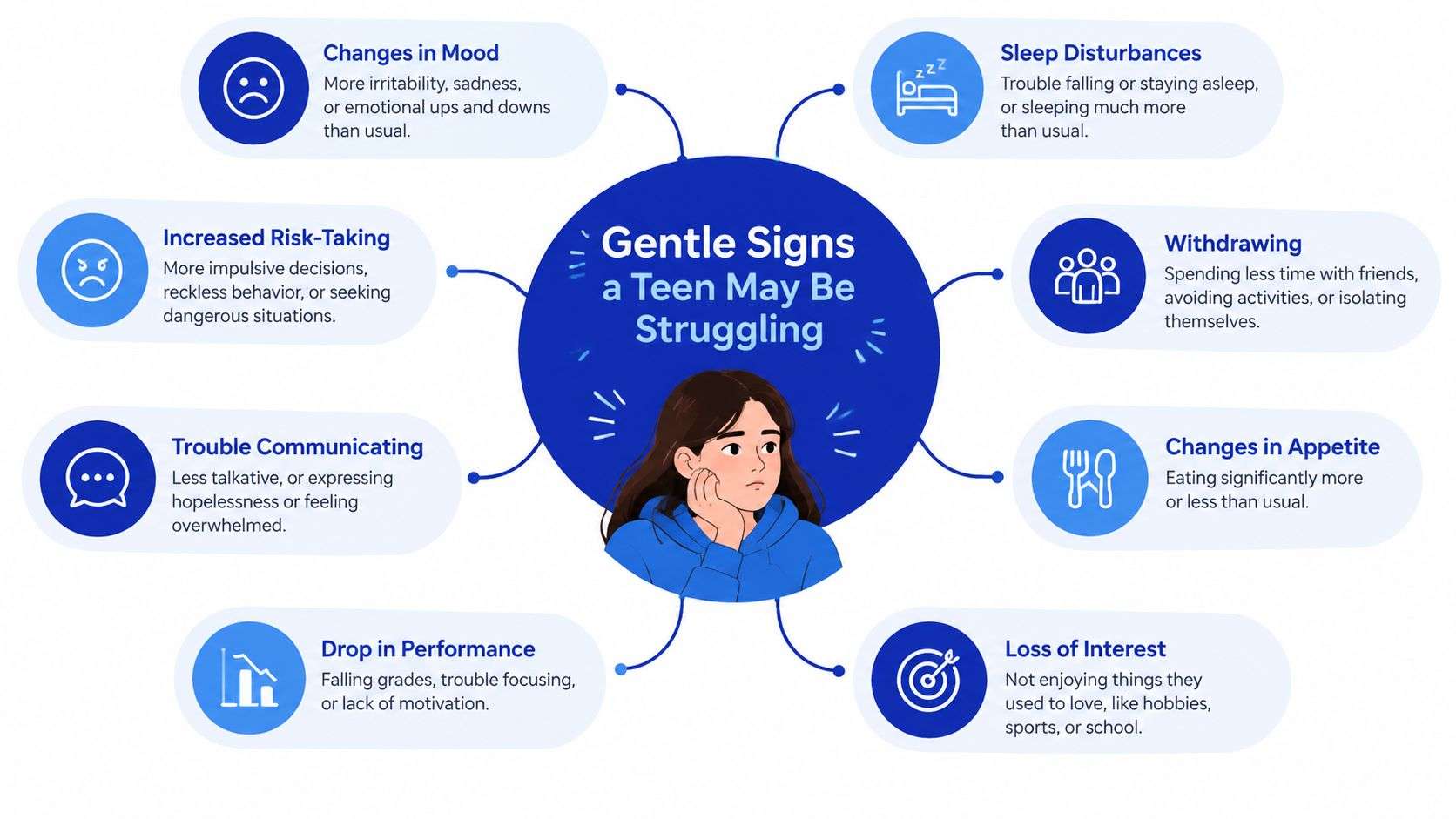
Parents often hesitate because the signs can resemble ordinary adolescence. Mood changes, privacy, sleep differences, and shifting friendships are common, but a noticeable pattern, a sharp change, or a loss of functioning deserves a calm check-in.
Emotional cues
A teen may pull away from family, lose interest in hobbies, become persistently sad, or seem unusually irritable. They might stop enjoying sports, music, gaming, or time with friends. Some young people talk about feeling empty or overwhelmed, while others become argumentative because anger feels safer than sadness.
Behavioural cues
Look for changes such as falling grades, avoiding school, reversing sleep habits, withdrawing socially, taking unusual risks, or becoming secretive in ways that feel different from their normal need for privacy. A teen may also stop answering messages, abandon routines, or appear unable to begin tasks that used to be manageable.
Physical cues
Headaches, stomach complaints, appetite changes, low energy, and frequent requests to stay home can reflect emotional strain as well as physical illness. These symptoms should be taken seriously without assuming their cause. A medical check may be appropriate alongside emotional support.
Stress rarely follows a neat checklist. One teen may cry often, another may become quiet, and another may work harder while privately feeling panicked. Even a sudden improvement after a long low period can be a reason to ask how things are going, especially if other concerns remain.
Notice the pattern, not the label.
A parent can begin with one calm sentence: “I've noticed you haven't wanted to ride with us lately, and you seem worn down. I'm not angry. I want to understand what it's been like for you.” Listening without immediately correcting, investigating, or demanding a solution can make the next conversation easier.
Walking Into a First Session Without Fear
Before the appointment, a parent may complete intake forms with basic information about the teen's health, school, family, and current concerns. The counsellor should explain consent and confidentiality in language both the parent and young person understand. The details vary by age, maturity, service, and clinical circumstances, so families should ask directly.
The first minutes are usually about comfort and orientation. The counsellor may introduce themselves, explain how sessions work, and ask what would make the room feel easier. A teen can say, “I don't know,” choose where to sit, or start with something small. There shouldn't be pressure to reveal everything immediately.
What the conversation may include
The clinician may gently ask about:
- Daily life: School, work, sports, friends, and home.
- Body and routine: Sleep, appetite, energy, and physical stress signals.
- Emotional experience: Worry, sadness, anger, numbness, or feeling overwhelmed.
- Safety: Thoughts of self-harm, suicide, harm to others, or feeling unsafe.
- Goals: What the teen would like to change, even if the goal is to feel less exhausted.
Confidentiality helps adolescents speak openly, but it has limits. Information generally stays private unless the counsellor believes there's a serious safety concern, a risk of harm, or another legal and ethical duty to act. A responsible clinician explains these limits before sensitive disclosures arise.
Parents can remain appropriately involved without receiving a detailed transcript of every session. The counsellor may share broad themes, safety information, goals, and ways to help at home, while protecting the teen's private therapeutic space. The exact arrangement should be discussed together.
The first appointment is a try-on, not a lifetime commitment. Afterward, the teen and parent can ask whether the counsellor felt respectful, understandable, and safe enough to meet again.
Finding the Right Door in Penticton
Penticton families have several entry points, and the best choice depends on urgency, age, cost, and the type of support needed. The following comparison uses only general service information available from provincial and regional sources. Actual availability and wait times can change, so ask the service directly.
| Option | Cost / Coverage | Typical Wait | Age Range | Best Fit For |
|---|---|---|---|---|
| Child and Youth Mental Health intake clinic | No cost | Varies by intake and local capacity | Ages 0 to 18 | Assessment and treatment through the public system |
| Foundry Penticton | Free services are available through Foundry's youth system | Varies | Ages 12 to 24 | Youth-centred in-person, virtual, mental-health, wellness, and substance-use supports |
| Private counselling | Coverage depends on the counsellor and extended health plan | Often depends on current openings | Varies by provider | Families seeking a particular fit, format, or schedule |
| Virtual counselling | Cost or coverage depends on the service | Varies | Depends on provider | Rural, busy, transportation-limited, or privacy-conscious families |
| Crisis pathways | Free crisis support | Immediate connection may be available | Depends on the service | Immediate safety concerns or distress that can't wait |
Penticton and Summerland are served by a Child and Youth Mental Health intake clinic at 740 Carmi Avenue. It serves ages 0 to 18, is offered at no cost, and uses intake and triage to guide young people toward assessment and treatment (BC Child and Youth Mental Health).
Foundry Penticton is listed by Interior Health for ages 12 to 24, with in-person and virtual supports. The regional service directory also identifies the Youth in BC Distress Line and Interior Crisis Line Network as crisis pathways (Interior Health child and youth mental-health directory).
For immediate danger or thoughts of suicide, call or text 988 in Canada. Foundry's virtual services, Help Starts Here, 8-1-1, and BC's 310-6789 mental-health and addiction support line are also identified as provincial youth-help resources (Youth in BC resources). Families don't need a diagnosis or referral to ask where to begin. The simplest safe door is often the right first door.
Choosing a Counsellor With Confidence
Credentials provide a starting point. Parents can look for designations such as RCC, RSW, or CCC, then ask whether the clinician has supervised experience working with adolescents. A credential doesn't guarantee a personal fit, but it helps confirm that the counsellor has relevant professional training and accountability.
Rapport matters just as much. After an initial call or session, ask the teen:
- Did the counsellor listen without rushing?
- Did they explain things clearly?
- Did you feel judged or pressured?
- Could you imagine telling them something difficult?
- Did the session feel useful, even in a small way?
Practical questions for the first call
Ask how confidentiality works, what the counsellor does if a teen discloses self-harm, and when parents participate. Find out how progress is reviewed and how the clinician communicates with caregivers. A clear answer should protect the teen's autonomy while recognising the family's role in safety and recovery.
Logistics can determine whether care continues. Consider location, parking near Main Street or the Eckhardt Avenue health corridor, evening availability, virtual sessions, and whether the service fits school, work, and sports schedules. Families should also clarify fees, insurance reimbursement, sliding-scale policies, and direct billing with their chosen provider. Coverage varies by plan, so don't assume a designation or insurer will apply automatically.
A counsellor should be able to discuss safety planning, family involvement, and treatment goals without becoming defensive. If the match feels wrong, switching counsellors is acceptable. The purpose of counselling is not to make a teen perform cooperation. It's to create a relationship where honest work becomes possible.
A Gentle Next Step for Your Family
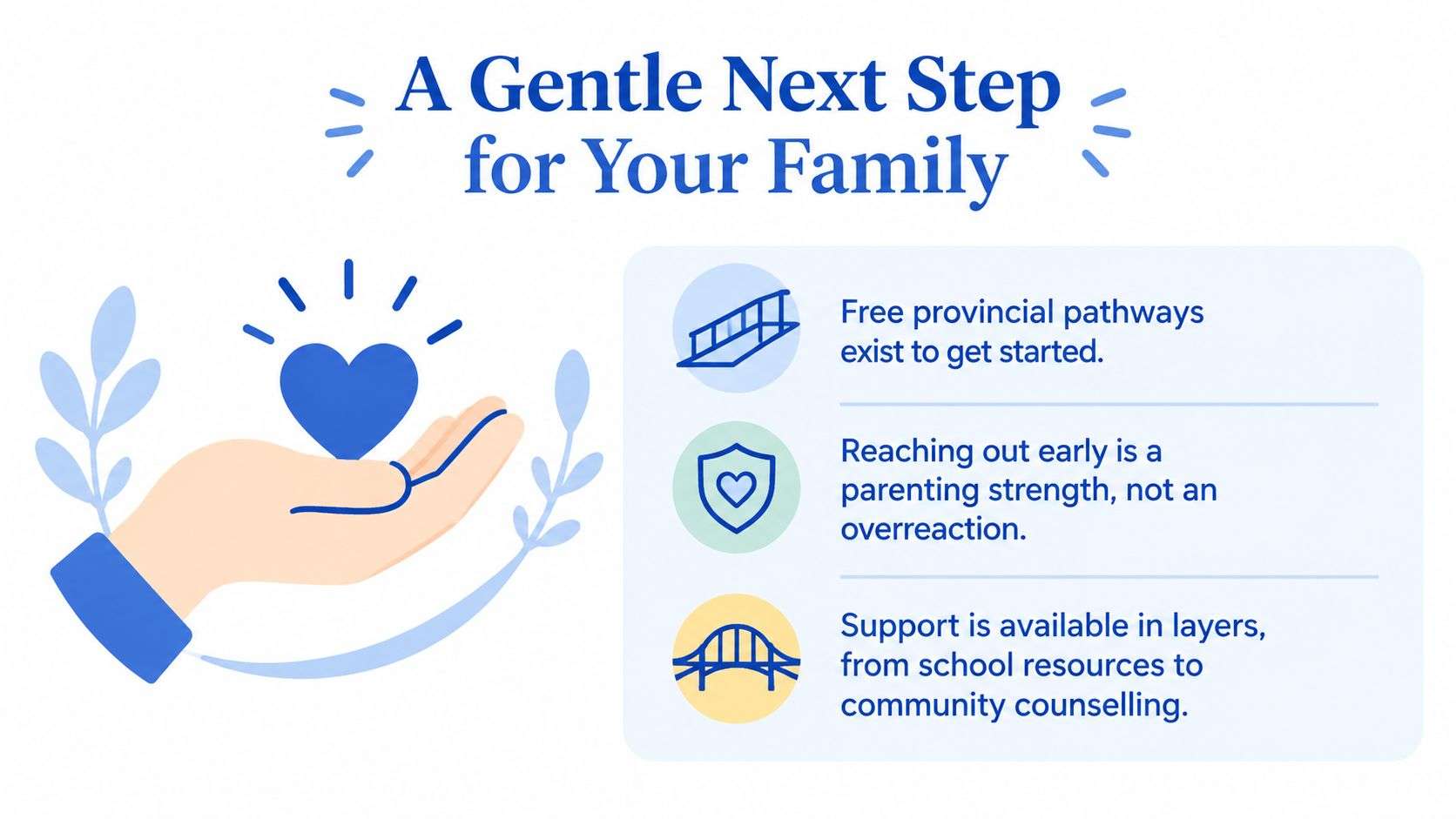
Reaching out early is a parenting strength, not an overreaction. In British Columbia, the need can be serious as well as gradual. A provincial guide citing the 2018 McCreary Centre Society Adolescent Health Survey reported that 17% of BC students in Grades 7 to 12 had seriously considered suicide in the prior year, 5% had made a suicide attempt, and 17% had engaged in self-harm (BC guide for working with children and youth at risk for suicide).
The same guide states that suicide is the leading cause of injury-related death among children and youth in BC, and cites an average of 19 youth suicide deaths per year, or 5.7 per 100,000 youth, over the most recent 20-year period available at that time. Those figures don't mean every withdrawn teen is in immediate danger. They do explain why a direct, compassionate safety question is appropriate when a young person's mood or behaviour changes significantly.
The public system offers an important foundation. Child and Youth Mental Health provides no-cost assessment and treatment for youth up to age 18 through intake clinics. Foundry Penticton adds youth-centred support for ages 12 to 24, while private counselling may offer another route when a family is looking for a particular clinician or schedule. Virtual options can help when transportation, privacy, health, or time makes in-person care difficult.
Crisis support belongs in the same map. A new Mobile Integrated Crisis Response Team in Penticton reflects the need for community-based responses to acute mental-health and substance-use situations. Across several communities, the teams responded to 3,840 mental-health and/or substance-use calls between April 2025 and September 2025 (Government of Canada community-based youth mental-health projects).
One small action is enough
This week, a parent or teen could:
- Book a free intake conversation through the local public pathway.
- Contact Foundry Penticton to ask which youth-centred service fits the concern.
- Write down three observations, such as sleep changes, withdrawal from activities, and irritability, to share with a clinician.
- Ask one counsellor about fit, confidentiality, safety planning, and parent involvement.
- Use crisis support now if the teen may be in immediate danger. Call or text 988, call 911 for an immediate emergency, or contact a local crisis service.
You don't need to solve the whole situation before making contact. You only need enough information to describe what you've noticed and enough courage to start the conversation.
Clinically Reviewed By
Amy Mosset, MCP, RCC-S
Amy Mosset is a Master Practitioner in Clinical Counselling, Clinical Supervisor, and the owner of Interactive Counselling. She provides trauma-informed, evidence-based care and clinical supervision to registered therapists, with a focus on ethical practice, client safety, and high-quality therapeutic outcomes.
Interactive Counselling offers youth and teen counselling for concerns such as anxiety, depression, bullying, school stress, and major emotional transitions, with in-person, phone, and secure online options. If you're considering support in Penticton, visit Interactive Counselling to learn more about available counselling services and decide on a comfortable next step.