A teen may mention feeling overwhelmed late at night, after school, or during a moment when leaving home feels impossible. A parent may want to help but wonder whether to call a crisis line, book a therapist, or wait until morning. The uncertainty can feel almost as heavy as the original problem. For more information, see our youth counselling.
Online teen counselling across Canada gives young people another way to reach support. It can offer a private conversation by video, phone, or another secure format without requiring travel to an office. It isn't a replacement for every kind of care, and it isn't the right response to a severe emergency, but it can be a meaningful access pathway when a teen needs regular emotional support.
Canada has built a broad youth virtual mental-health infrastructure. Kids Help Phone offers confidential support across Canada to people aged 5 to 29 through phone, text, and live chat, with access available around the clock. The Government of Canada's mental-health support directory also identifies online programs with telephone coaches for children and youth, along with support options for parents.
This guide is for teens, parents, caregivers, and trusted adults who want to understand how virtual counselling works, what consent and privacy can look like across provinces, how to assess a provider, and when online care may not be enough.
Introduction to Online Teen Counselling in Canada
A teen may feel safer sending a message than making a phone call. Another may prefer video after school, while a parent may want guidance without taking control. Across Canada, virtual counselling gives young people different ways to begin asking for help, depending on their province, age, privacy, and safety needs.
Ontario's One Stop Talk provides free virtual counselling for children and youth up to age 18. WES for Youth Online connects people aged 13 to 24 with a counsellor. In Alberta, Kickstand Connect provides free virtual therapy for youth aged 11 to 25 through a portal and mobile app. These examples appear in Ontario youth mental-health resources and Kickstand Connect.
These services show the range of options, not a guarantee that every program will fit every teen. Provincial eligibility rules, consent requirements, wait times, technology, and the provider's training all affect access. A secure platform matters, but so does a counsellor who listens carefully and explains confidentiality in plain language.
A useful starting point: Online counselling should make support easier to reach, not leave a young person responsible for managing risk alone.
Families can begin with a short checklist:
- Is the counsellor properly registered in the province where the teen is located?
- What information stays private, and when might it need to be shared?
- What role can a parent or caregiver have in care?
- How will the provider respond if the teen becomes unsafe?
- Is there a private place to talk, and what happens if that privacy disappears?
Those questions show thoughtful planning, not mistrust. A responsible provider should explain consent, privacy, local emergency procedures, and the limits of virtual care before regular sessions begin. Online support may help with ongoing concerns, but a severe or immediate safety crisis may require local emergency services, urgent medical care, or an in-person assessment.
What Online Teen Counselling Is and How Virtual Sessions Work
Think of a virtual counselling appointment as a secure office that opens through a device. The room is different, but the work still involves conversation, reflection, emotional regulation, goal setting, and a safety plan when one is needed.
A teen may join through a computer, tablet, or phone with a camera and microphone. A stable internet connection helps, but a phone appointment may be more suitable when video creates stress or the connection is unreliable. Headphones can support privacy, although they don't solve every problem if other people can still enter the room.
A typical virtual session
The first appointment often includes:
- Getting oriented. The counsellor explains their role, confidentiality, the limits of privacy, and what to do if the connection drops.
- Understanding the situation. The teen can describe what has been happening, what feels hardest, and what they hope might change.
- Agreeing on goals. Goals may involve sleep, anxiety, school pressure, relationships, grief, identity, family conflict, or coping with difficult memories.
- Choosing practical strategies. Depending on the assessment, a counsellor may use skills from cognitive behavioural therapy, trauma-informed care, emotion-focused work, or another evidence-informed approach.
- Reviewing safety. The provider confirms where the teen is located, who can help locally, and what steps to take if risk increases.
The teen doesn't have to tell their whole story perfectly. A pause, a short answer, or “I don't know where to start” is enough to begin. Counselling is collaborative, so the young person should have room to ask questions and say when a strategy doesn't feel useful.
Counselling is different from immediate crisis support
Routine counselling usually involves scheduled appointments and ongoing goals. A crisis line, text service, or emergency department serves a different purpose. Canada's national youth supports include several communication modes, including phone, text, and chat, so a young person can choose an entry point that matches the urgency and their comfort.
A therapist shouldn't present scheduled virtual counselling as a substitute for emergency help. If a teen faces immediate danger, cannot stay safe, or needs urgent medical attention, the family should use local emergency services or an appropriate crisis resource rather than waiting for the next appointment.
Consent Privacy and Provincial Considerations for Youth Across Canada
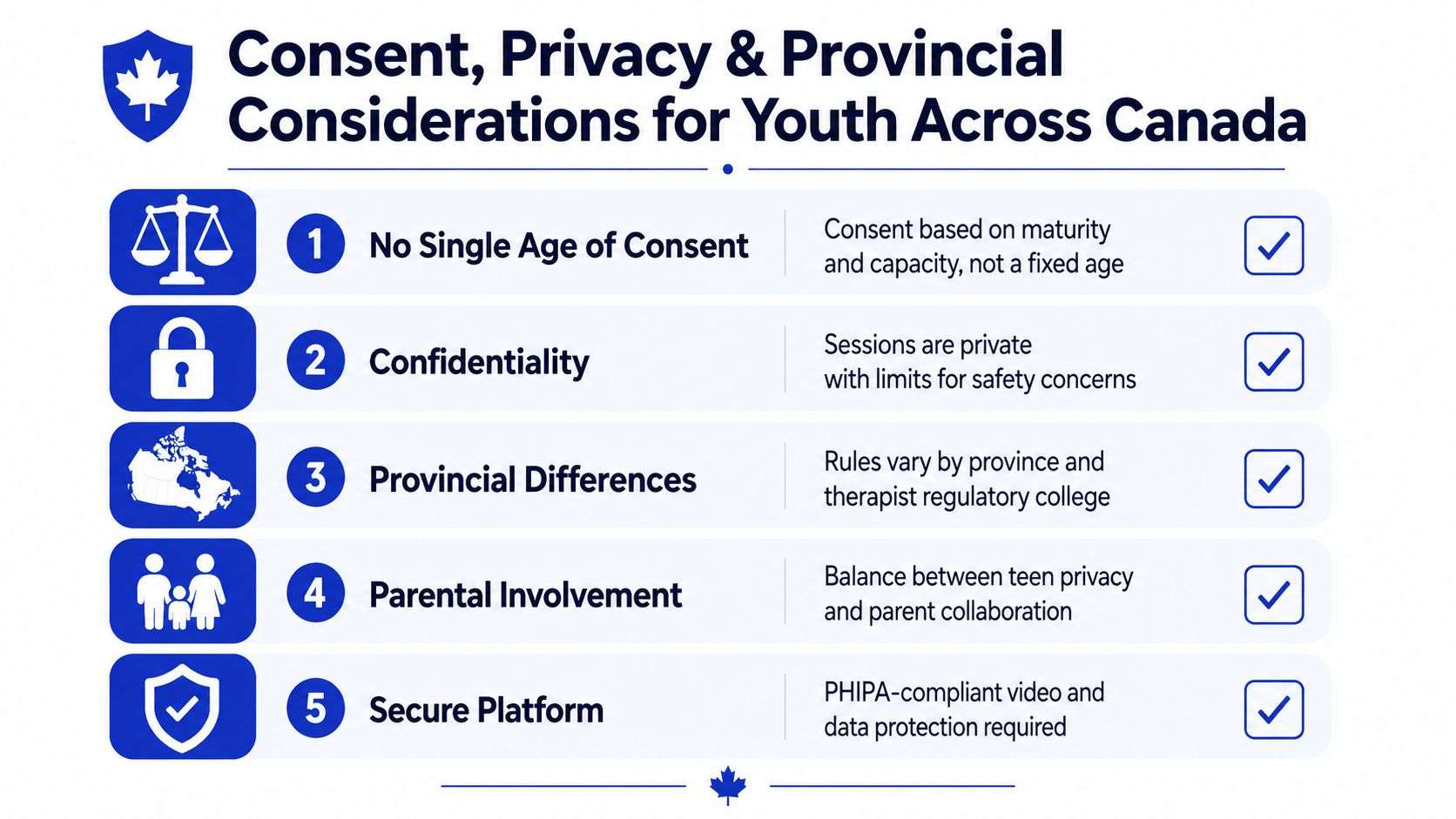
Consent in youth counselling isn't governed by one simple Canada-wide rule. Ontario child-and-youth mental-health guidance explains that there is no general age of consent to treatment or counselling. The central question is whether the young person can understand the information, appreciate the likely consequences, and make an informed decision. The Ontario guidance on legal issues in child and youth mental health explains why capacity matters more than applying one fixed birthday.
That can feel confusing for families. A parent may arrange an appointment, but that doesn't automatically mean the teen has no say. A capable young person can usually decide who receives access to their personal health information, including whether a parent is included. The counsellor should explain the arrangement directly to both the teen and caregiver rather than leaving everyone to guess.
What informed consent should include
Canadian counselling ethics guidance says clients need enough information to make an informed choice about online therapy. Before sessions begin, ask the provider to explain:
- Information collected: What personal and health information does the service request?
- Purpose: Why does the counsellor need each type of information?
- Access: Who can see notes, forms, recordings, or appointment details?
- Safeguards: How does the provider protect information during and after sessions?
- Retention: How long is information kept?
- Choice: Can the client refuse a particular technology or withdraw from virtual care?
- Third parties: Does any outside company receive or process information?
The Canadian Counselling and Psychotherapy Association's technology and internet guidelines provide the ethical foundation for these questions. A provider who answers clearly is helping the family consent meaningfully, not just asking them to click through a form.
Provincial differences still matter
Privacy and information-sharing practices can vary by province, profession, and the circumstances of the young person. British Columbia guidance says consent isn't always required for every disclosure, but clinicians should seek the individual's consent to share information and, with some exceptions, respect the person's right to object. For youth, parent or guardian consent should generally be sought unless the young person can consent under the applicable law. The British Columbia information-sharing guidance for children and youth explains this balance.
Families should ask how provincial rules apply to their specific situation, especially when parents live separately, a teen objects to information sharing, or safety concerns arise. Confidentiality is important, but it has limits when a provider believes someone faces serious and immediate risk.
Benefits and Limitations of Virtual Support for Teens
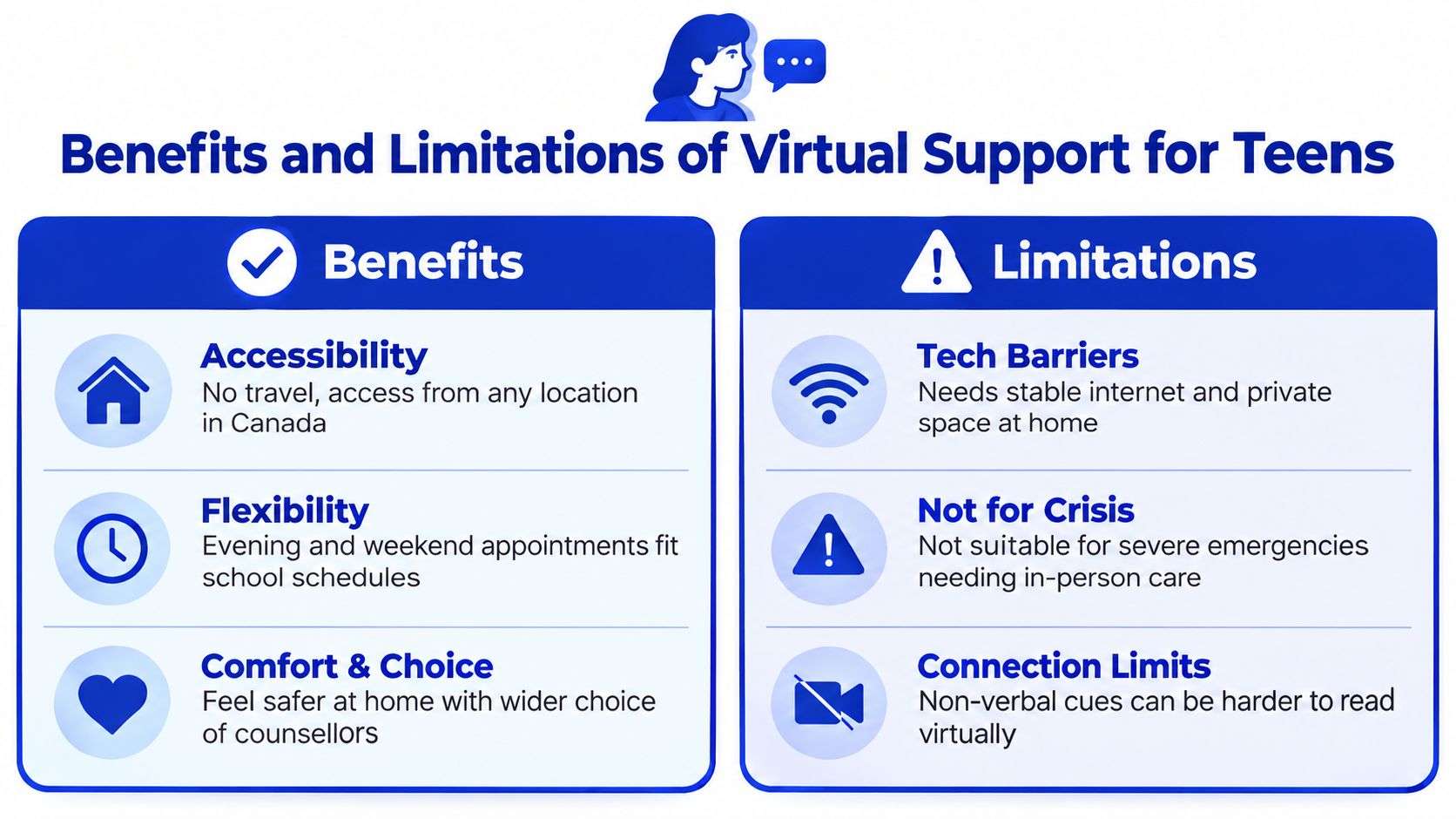
Virtual counselling can remove obstacles that stop young people from reaching care. A teen doesn't need to arrange transportation, sit in a waiting room, or explain an absence from school in the same way. A parent may find it easier to support an appointment when it fits around work, caregiving, or a long distance from a service centre.
Canadian youth and families have also shown a strong preference for virtual formats. In a Canadian mental-health study, 130 of 192 surveyed youth and family members, or 82%, chose virtual services. The most common formats were videoconferencing at 76%, telephone at 68%, and texting at 31%, as reported in the Canadian study on virtual mental-health services. A separate Canadian poll found that 40% of 2SLGBTQ+ youth accessed virtual mental-health services since the start of the pandemic, also described in that source.
Where online care can help
Virtual sessions may fit well when a teen:
- Feels safer at home: Familiar surroundings can reduce the stress of entering an unfamiliar building.
- Needs flexible contact: Phone, video, text, evening, or weekend options may fit school and family schedules.
- Lives far from services: Online care can reduce the burden of travel when a suitable provider is available in the teen's province.
- Wants a specific kind of support: Virtual access may widen the choice of counsellors with relevant adolescent, cultural, identity, or trauma training.
- Needs continuity: A secure online appointment can help maintain regular contact when travel or mobility becomes difficult.
Where online care can fall short
A home isn't automatically private. A teen may share space with siblings, a parent, a partner, or someone who makes them feel unsafe. Some young people also experience screen fatigue, dissociation, intense distress while looking at a camera, or difficulty expressing non-verbal feelings through a screen.
Digital media can also be part of the problem. A Canada-wide Mental Health Research Canada report collected from January 2024 to February 2025, alongside Statistics Canada research involving 13,600 adolescents aged 12 to 17 from the 2019 Canadian Health Survey on Children and Youth, connects adolescent mental health with online digital media use. The MHRC report on screen time and youth mental health supports a more careful question than “Is screen-based counselling good or bad?” The better question is whether the technology supports this teen's care or reinforces the distress being treated.
Virtual counselling may not be enough when a young person faces immediate danger, needs medical assessment, cannot participate safely from home, or requires a level of observation and support that remote sessions can't provide. A strong counsellor will discuss other services rather than trying to keep every concern inside the virtual appointment.
How to Find and Choose a Safe Evidence Informed Provider
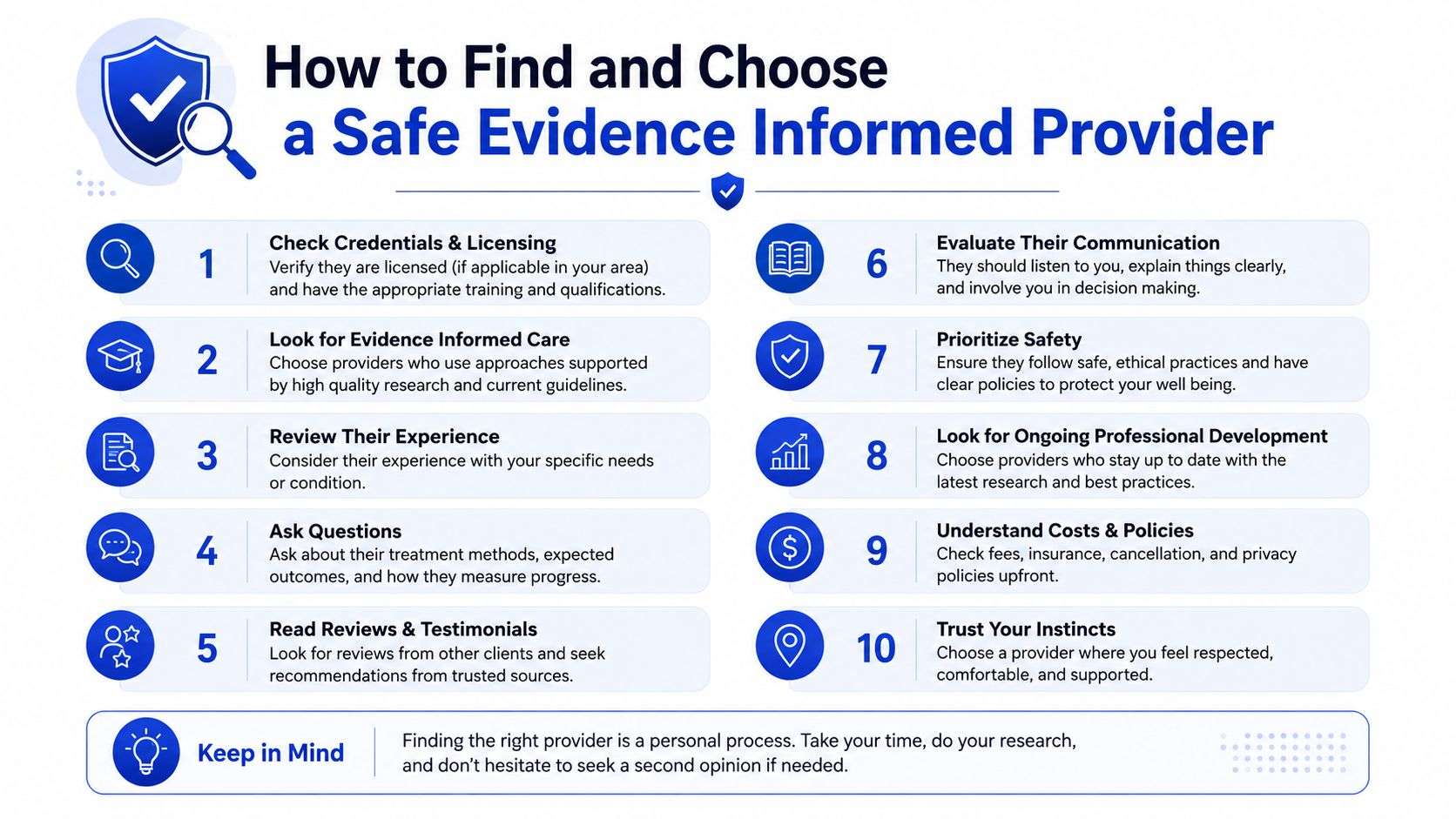
Choosing a provider begins with verification, not a polished profile. Look for the professional's registration, scope of practice, training, and location requirements. Canadian counsellors may belong to different regulated professions, and the relevant registration body depends on the person's title and province.
Ask direct questions before the first appointment:
- What credentials and provincial registration do you hold?
- What experience do you have with teenagers?
- Which approaches might you use, and how would you adapt them to my teen?
- What platform do you use, and how is information protected?
- What information is collected, retained, or shared with third parties?
- How will consent work between the teen and parent?
- What happens if the teen becomes unsafe?
- Who should we contact if the platform fails or a concern arises outside session time?
Use the first conversation to assess fit
A teen doesn't need to decide whether a counsellor is perfect after one conversation. They can notice whether the therapist listens without rushing, explains unfamiliar terms, respects identity and pronouns, and takes the teen's concerns seriously. Parents can notice whether the provider includes them appropriately without turning the young person's private session into a report.
Red flags include vague answers about privacy, pressure to begin before consent is clear, promises of guaranteed results, refusal to explain crisis procedures, or a counsellor who dismisses a teen's request for reasonable boundaries. A provider should also be able to say when virtual care isn't appropriate.
| Criteria | What to Ask | Green Flag |
|---|---|---|
| Registration | How can we verify your professional standing in this province? | The provider gives a clear registration path and explains their scope. |
| Youth experience | What adolescent concerns do you commonly support? | The answer includes relevant training and a respectful approach to rapport. |
| Consent | How will my teen and I understand our separate roles? | The provider explains capacity, confidentiality, and parent involvement plainly. |
| Privacy | What information is collected, retained, and shared? | The provider gives specific, understandable privacy information. |
| Technology | What happens if video fails or someone enters the room? | The provider has a backup communication and privacy plan. |
| Safety | What happens if risk increases between sessions? | The provider explains escalation, local supports, and emergency boundaries. |
| Therapeutic fit | How will we know whether the approach is helping? | The provider welcomes feedback and adjusts goals collaboratively. |
Good care isn't only about the software. It depends on ethical communication, clinical judgement, youth participation, and a plan that matches the teen's actual circumstances.
What to Expect in Sessions Accessibility and Emergency Protocols
Before the first appointment, the teen and caregiver should agree on a private location, a backup phone number, and the teen's physical address. The counsellor needs the young person's location during each session in case a serious safety concern develops. If privacy changes, the teen can use an agreed phrase, chat message, or another discreet signal to tell the therapist.
A first session may feel practical before it feels emotional. The counsellor usually confirms consent, confidentiality, technology limits, emergency contacts, and goals. Later sessions might include reviewing the week, practising a skill, exploring patterns, and choosing what to try next.
Accessibility should include a backup plan
Service directories and rapid-access programs, described earlier, can help families identify options that fit a young person's schedule and location. The next question is whether the plan still works when technology, privacy, or transportation creates a barrier.
A private room is not available in every home. The counsellor and teen can plan another safe location, switch to phone, use headphones, or choose a time when others are away. They should also decide what happens if the video freezes, the call drops, or someone unexpectedly enters the room. A backup contact method and a discreet privacy phrase make that plan easier to follow under stress.
Accessibility may include language support, culturally responsive care, accommodations for neurodivergence, or referral to another provider when the counsellor's experience does not match the teen's needs. These details belong in the care plan, not as an afterthought.
Know what happens in an emergency
Virtual counselling needs a clear escalation process. If a teen may act on suicidal thoughts, faces violence, experiences severe confusion, or needs urgent medical attention, the counsellor may involve emergency or local crisis supports within the limits of confidentiality. The teen and parent should understand these boundaries before a crisis occurs, including what information may be shared and with whom.
Families can keep contact details for a trusted adult, local emergency service, primary-care provider, crisis line, and nearby hospital. A written list reduces the number of decisions required during a frightening moment. Tools for creating shareable emergency lists can help families organise information that trusted people may need.
Safety question to ask: “If my teen becomes unsafe during or after a virtual session, exactly who do we contact, and what information will you need?”
Before booking, ask the provider to explain the backup plan, the local response process, and the point at which virtual care should give way to in-person or urgent support. Online counselling works best within a wider care network that can include family, school resources, primary care, crisis services, and in-person treatment. A scheduled screen-based appointment cannot replace immediate help when the teen's needs exceed what remote care can safely provide.
Canadian Resources Next Steps and Support from Interactive Counselling
A first step may be a simple question: “Would you rather talk by phone, video, text, or in person?” Offering a choice gives a teen some control without asking them to solve everything at once. Parents can ask what type of support feels safe, what privacy is possible, and whether there is immediate danger.
National services can help when support is urgent or local options are unclear. Kids Help Phone provides confidential support to Canadians aged 5 to 29 through phone, text, and live chat. The Government of Canada mental-health help page lists other youth and family programs. Provincial services may provide free virtual counselling, coaching, navigation, or referrals based on age and location.
Interactive Counselling offers youth and teen counselling through secure virtual, phone, and in-person sessions in British Columbia, with evidence-informed and trauma-informed care adapted to individual needs. Before choosing a service, families can ask about the counsellor's approach, privacy practices, consent process, professional registration, and response to urgent concerns.
Compassionate questions families often ask
Can a parent sit in the session?
Sometimes. A teen may request support, or the counsellor may recommend collaboration. Discuss the arrangement with the young person first. The provider should explain when the teen can speak privately and how parent involvement will work.
What if my teen refuses counselling?
Pressure can make help feel like punishment. Ask what feels uncomfortable. The concern may involve the counsellor, technology, privacy, or counselling itself. A brief consultation or different format may feel easier to try. Immediate safety concerns still require adult action.
Does online counselling address screen-time habits?
It can, when digital use connects with the teen's goals or distress. The counsellor may explore sleep, social media, online conflict, comparison, gaming, and compulsive checking without assuming every teen needs the same rules.
Can counselling continue if the family moves provinces?
That depends on the counsellor's registration, the teen's location, and provincial requirements. Ask before moving. Virtual care may not continue unchanged across provincial borders.
What if the first counsellor doesn't feel right?
A poor fit does not mean therapy cannot help. Tell the provider what is not working, request an adjustment, or seek another qualified professional. Respectful feedback supports collaborative care.
A teen deserves support that protects their dignity, explains its boundaries, and matches the level of care required.
Interactive Counselling offers trauma-informed, evidence-informed youth support through secure virtual, phone, and in-person counselling in British Columbia. Visit Interactive Counselling to learn about care options and consider which format may feel safest for your teen.
Clinically Reviewed By
Amy Mosset, MCP, RCC-S
Amy Mosset is a Master Practitioner in Clinical Counselling, Clinical Supervisor, and the owner of Interactive Counselling. She provides trauma-informed, evidence-based care and clinical supervision to registered therapists, with a focus on ethical practice, client safety, and high-quality therapeutic outcomes.