You may be sitting in your car outside a Vernon clinic, wondering whether your substance use is “serious enough” to justify asking for help. Perhaps you're still working, caring for family, or keeping up appearances, even though alcohol, opioids, stimulants, or another substance is taking more space in your life than you want it to. For more information, see our Vernon counselling.
You don't need to wait for a crisis, a diagnosis, or a decision to stop completely before speaking with someone. Addiction and substance use counselling in Vernon can begin with a confidential conversation about what's happening, what you want to change, and what kind of support feels manageable.
Understanding Outpatient Addiction Counselling in Vernon

Outpatient counselling means receiving structured addiction and substance-use support while continuing to live at home. You may keep working, attending school, parenting, or managing other responsibilities while meeting with a counsellor and, when needed, connecting with medical, housing, peer-support, or treatment services.
In British Columbia, outpatient treatment is formally defined as office- or clinic-based support that can include one-on-one counselling, group counselling, opioid agonist treatment, and connections to housing and peer-support services. The province reports that more than 380,000 free or low-cost counselling sessions have been provided since 2019, and that 46 Urgent and Primary Care Centres now provide mental health and addiction services. These figures are outlined in the province's overview of mental health and addictions care.
That makes outpatient care more than a lighter version of residential treatment. It's a layered front door to care, with repeat visits, referrals, and support that can fit around real life. A person might begin by discussing drinking patterns, then receive help with cravings, connect with a physician about withdrawal safety, and later work on relationships or relapse prevention.
Support can begin before you feel ready
Many people feel ambivalent. One part of you may want change, while another part worries about withdrawal, stigma, losing a coping strategy, or being pressured to make a commitment you aren't ready to make. A skilled counsellor won't treat that uncertainty as failure. They'll help you understand it.
Outpatient counselling is generally voluntary and confidential, subject to the usual safety and legal limits explained by the provider. You can ask what information is collected, who can access it, and how referrals work before you share more than feels comfortable.
A first conversation is not a moral test. It's an opportunity to understand your options.
Vernon residents can access local mental health and substance-use services through community entry points, urgent-care or walk-in services, and HealthLink BC's service-finder information. This guide looks at the therapy approaches used in outpatient care, how outpatient and inpatient treatment differ, what local service data tells us, and how rural access realities shape the path forward.
Evidence-Based Approaches That Guide Recovery
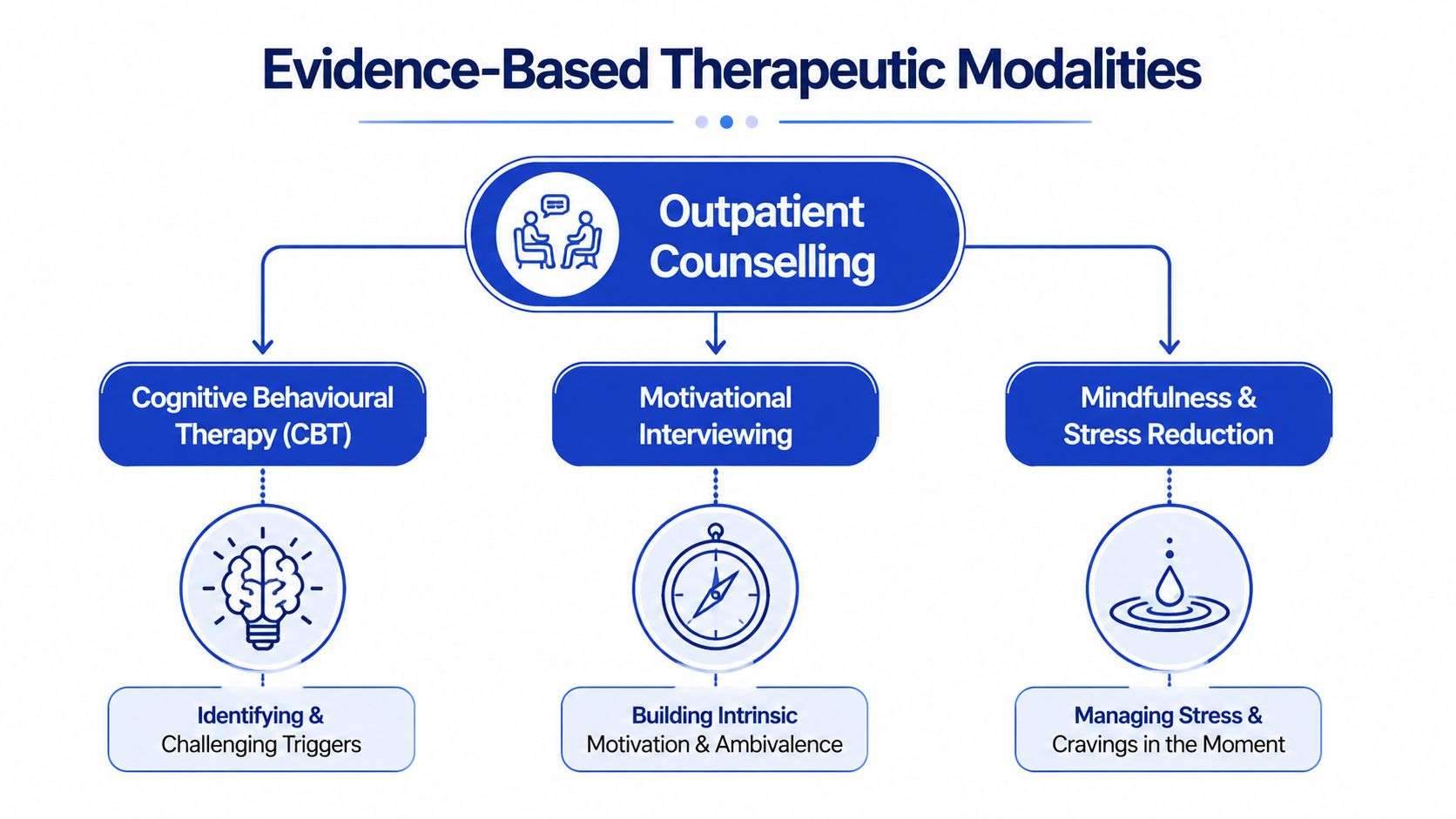
Outpatient addiction counselling works best when the approach matches the person, the substance-use pattern, and the goals they're ready to pursue. Counsellors may combine several methods rather than follow one rigid formula.
Cognitive Behavioural Therapy
Cognitive Behavioural Therapy, or CBT, helps you notice links among situations, thoughts, feelings, and actions. Substance use often becomes automatic. A difficult conversation, a payday, loneliness, physical pain, or a familiar route home may trigger thoughts such as “I can't handle this without using,” followed by a behaviour that brings short-term relief and longer-term difficulty.
A CBT session might map that sequence on paper. You and the counsellor could identify the trigger, examine the thought, test whether it's completely accurate, and create another response. The goal isn't forced positivity. It's developing more choices at the moment when an old pattern usually takes over.
Motivational Enhancement Therapy
Motivational Enhancement Therapy, often delivered through motivational interviewing, addresses ambivalence without confrontation. Instead of arguing that you must change, the counsellor helps you explore what substance use gives you, what it costs, and how your choices connect with your values.
For example, you might say that drinking helps you sleep but also keeps you distant from your partner. The counsellor may ask what kind of relationship you want and what small change would move you in that direction. This approach respects autonomy while making room for honest reflection.
Relapse prevention planning
Relapse prevention turns recovery into practical preparation rather than a promise to “try harder.” You may identify high-risk people, places, times, emotions, and physical states. Together, you can create a plan for cravings, decide who to contact, rehearse leaving a risky situation, and consider what to do after a lapse.
A counsellor might role-play a refusal skill, help you plan a substance-free evening, or create a written response for an unexpected trigger. The work focuses on learning, safety, and returning to support quickly rather than treating one setback as proof that change is impossible.
Family therapy and supportive relationships
Family therapy can help repair trust, improve communication, and reduce patterns that keep everyone distressed. It doesn't mean blaming relatives or requiring them to manage your recovery. A session might focus on setting boundaries, discussing how to respond to a craving, or agreeing on language that avoids shame and escalation.
These approaches draw on established clinical knowledge and can be adapted to smaller-community realities. Your counsellor may use CBT for triggers, motivational interviewing for uncertainty, family work for relationship strain, and mindfulness or grounding techniques for intense emotions. The plan should reflect your needs, culture, safety, and stage of change.
Outpatient Care Versus Inpatient Treatment
The choice between outpatient and inpatient treatment depends on medical risk, safety, stability, support at home, and the type of care required. It isn't a ranking of commitment. Some people need a residential setting for a period, while others can make meaningful progress with community-based support.
British Columbia's substance-use guidance notes that outpatient care is generally effective and more cost-effective than inpatient treatment. The BCCSU estimates that up to 80% of patients with alcohol use disorders can be managed safely in outpatient withdrawal settings, when appropriate clinical assessment and monitoring are in place. This information appears in the BC guideline for alcohol use disorder.
| Factor | Outpatient Counselling | Inpatient Treatment |
|---|---|---|
| Setting | You live at home and attend scheduled appointments. | You stay in a structured treatment environment. |
| Medical supervision | Medical support is coordinated when needed, but care isn't continuous on site. | The setting provides more intensive, ongoing supervision. |
| Daily responsibilities | You can often continue work, school, parenting, and family routines. | Daily responsibilities are paused or transferred while you're in treatment. |
| Skill practice | You practise coping strategies in the same environment where triggers occur. | You build early stability away from usual triggers. |
| Best fit | Often appropriate when withdrawal risk and home safety can be managed. | May be considered when acute withdrawal, serious instability, or a protected environment is needed. |
| Relationship to other care | Can include counselling, referrals, medication support, and follow-up. | Can provide stabilisation before a person returns to community care. |
Outpatient care may include planned withdrawal management in the home or community under the supervision of a care team. The Vernon service listing for outpatient withdrawal management distinguishes this from counselling alone.
A counsellor shouldn't ask you to manage dangerous withdrawal without medical guidance. Alcohol and some other substances can involve serious withdrawal risks, so an assessment matters. Outpatient and inpatient services can also work together as stepped care. Someone may begin with community counselling, move into a higher level of support if safety changes, and return to outpatient follow-up when stability improves.
The Local Need for Substance Use Support
Vernon already has a documented substance-use care infrastructure. Interior Health reported that the Vernon centre had more than 3,500 visitors since opening on May 12, 2020, with more than 400 drug-consumption events safely supervised and zero deaths at the site. The information is included in BC reporting on mental health and substance-use care.
A later Vernon overview recorded 3,828 total visits in 2023, including 511 new visits, 2,383 harm-reduction visits, 432 consumption visits, 232 nurse-service visits, and 88 assessment visits, from the same regional reporting source. The overview identified fentanyl in 248 occurrences and methamphetamines in 149 occurrences. These figures don't describe every person who needs counselling, but they show why assessment, education, referrals, and behaviour-change support must remain available alongside harm reduction.
What the local figures reveal
The Vernon centre's repeated contacts matter. Substance-use care often isn't a single appointment followed by a simple decision to stop. People may return for information, nursing care, safer-use support, treatment planning, or connection to another service. Outpatient counselling fits within that reality because it can support ongoing engagement rather than only one episode of crisis care.
Interior Health's Vernon local health area also reports substantial activity in Substance Use Counselling & Treatment Services and Treatment, Support & Recovery. The Vernon local health area profile shows these as established community service streams, not niche additions.
| Indicator | Regional Context |
|---|---|
| Vernon substance-use centre activity | More than 3,500 visitors since opening, with supervised consumption events and no deaths at the site reported in the cited overview. |
| Vernon visits in 2023 | 3,828 total visits, including new, harm-reduction, consumption, nursing, and assessment contacts. |
| Substances identified in the overview | Fentanyl appeared in 248 occurrences and methamphetamines in 149 occurrences. |
| Community care activity | Interior Health identifies counselling, treatment, support, and recovery services in Vernon's local health area. |
Smaller cities and surrounding communities can face limited transportation, fewer specialised providers, privacy concerns, and social isolation. That makes a nearby, repeatable outpatient pathway important. Seeking counselling is not an unusual response to a community problem. It's one ordinary way people access care within Vernon's broader health system.
What to Expect From Your First Session Onward
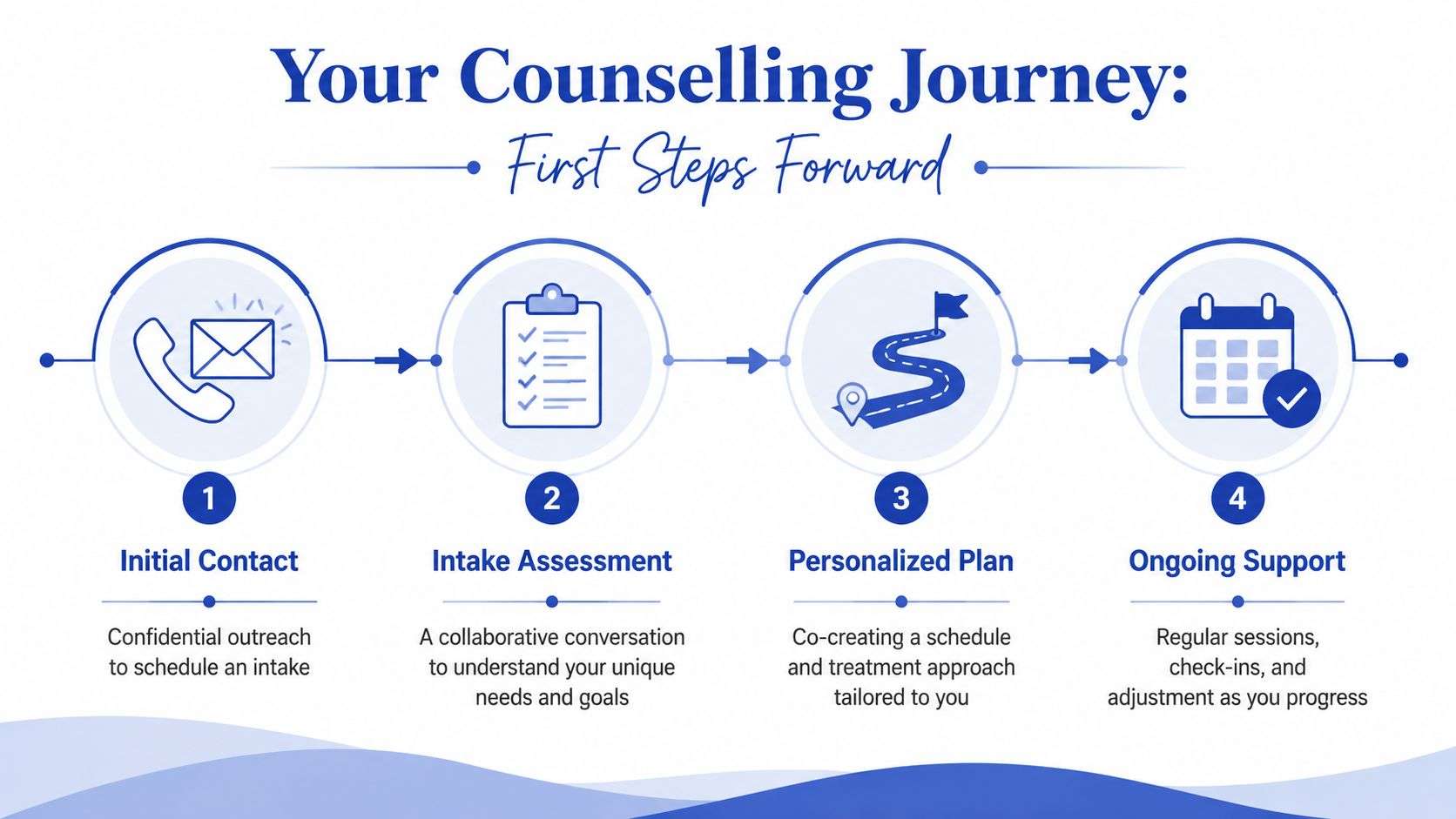
The first step may be a phone call, an online enquiry, or a referral from another service. You don't need a perfectly organised history. It helps to share what you're using, how often, what happens before and after use, any withdrawal experiences, other health concerns, and what you hope will change.
The intake is a conversation
An intake assessment usually helps the counsellor understand:
- Substance-use history: What you use, how patterns have changed, and what situations increase risk.
- Mental health: Anxiety, depression, trauma symptoms, sleep, stress, and emotional wellbeing.
- Safety: Overdose risk, withdrawal concerns, self-harm thoughts, medical needs, and supports available at home.
- Personal goals: Reducing use, stopping, improving safety, repairing relationships, managing cravings, or understanding what's happening.
The questions aren't designed to catch you out. Honest answers help the provider recommend a level of care that's safe and useful. You can ask why a question matters and what will happen with the information.
Building a plan you can use
Ongoing sessions may be weekly, biweekly, or arranged according to clinical need and availability. The counsellor and client decide which goals to address first. One person may start with craving management, while another may need support with trauma, grief, housing stress, family conflict, or medication coordination.
Appointments may be in person, by secure video, or by phone. Vernon Downtown Mental Health and Substance Use is listed at 3306A 32nd Avenue, Vernon, BC V1T 2M6, with published weekday hours of 9:00 am to 3:00 pm and the phone number 250-503-3737, according to the local service listing. HealthLink BC also lists community-based Substance Use Counselling and Treatment services with local locations and business hours.
Counselling supports psychological and behavioural change, but it isn't a substitute for medical withdrawal care. If detoxification, opioid agonist treatment, or another medical intervention is needed, counsellors can help coordinate with physicians, nurses, pharmacies, and specialised programs.
You can ask for a slower explanation, a written plan, or a referral if the first option doesn't fit.
If you need same-day opioid addiction support, the provincial HelpStartsHere portal directs people to call 1-800-588-8717. That rapid-access option is different from routine counselling, which is designed for continuing work over time.
Overcoming Access Barriers in Rural Communities
Vernon is not a major urban centre, and people in the North Okanagan may live outside the city in communities such as Armstrong, Enderby, or Lumby. Distance, limited public transit, work schedules, childcare, and concerns about being recognised can all affect whether someone starts care and whether they can continue.
BC's rural and remote substance-use toolkit says these barriers are more pronounced outside urban areas. Recent BC research also identifies geographic distance, housing instability, and clinic policy as consistent barriers to substance-use care in rural and northern communities. The evidence is summarised in this provincial rural access toolkit.
Access is more than having a clinic nearby
A local service may still be hard to use if its hours conflict with a shift, the bus route is unreliable, or attending in person feels unsafe. Medication access creates another layer for people with opioid use disorder. A qualitative study of rural and coastal BC found that opioid agonist treatment was easier to maintain when dispensing pharmacies were nearby, had extended hours, or offered delivery. Distance and limited transport made continuity harder, as described in the study's PubMed record.
Outpatient care can reduce some, though not all, of these obstacles through:
- Virtual and phone appointments: Useful when travel, mobility, weather, or privacy makes an in-person visit difficult.
- Flexible scheduling: Helpful for parents, shift workers, and people balancing treatment with employment.
- Coordinated referrals: Important when counselling needs to connect with medical care, medication, housing, or peer support.
- Local entry points: Vernon services and regional access pathways can help residents avoid navigating the system alone.
BC's Access Central is intended as a single point of access for the region, yet access still varies by location and service capacity. The practical lesson is to ask directly about appointment formats, hours, referral requirements, and options when travel is difficult.
Seeking help in a smaller community can feel exposing. That discomfort doesn't mean you're weak or causing trouble. It means privacy and logistics deserve to be part of the care plan from the beginning.
Funding Options and Next Steps for Vernon Residents
Funding depends on the service, provider, referral route, and your circumstances. Publicly delivered community services through Interior Health may offer access without the same payment structure as private counselling. Some people use extended health benefits, and counselling connected to a motor vehicle incident may involve ICBC coverage when eligibility requirements are met. Community programs may also offer free, low-cost, or sliding-scale pathways.
Ask before booking:
- Coverage: Is the service publicly funded, benefit-eligible, or privately paid?
- Credentials: What professional designation does the counsellor hold, such as RCC or CCC?
- Approach: Do sessions include CBT, motivational interviewing, relapse prevention, family work, or another method suited to your goals?
- Billing: What documentation does an insurer require, and who submits it?
- Access: Are phone, secure virtual, or in-person appointments available?
A good fit includes more than credentials. Look for a counsellor who explains confidentiality clearly, uses trauma-informed language, respects your autonomy, and can discuss medical referrals when counselling alone isn't enough. Interactive Counselling provides substance-use counselling in Vernon through evidence-informed approaches, with in-person and secure virtual appointments listed among its service options.
Frequently asked questions
Is outpatient counselling confidential?
Counselling is generally confidential, but providers should explain the limits before treatment begins. Those limits commonly relate to immediate safety concerns or legal obligations. Ask how records are stored, whether messages are private, and what information is shared during referrals.
What if I'm worried about the wait?
Ask whether there's an interim support, another local entry point, or a different appointment format. BC's service plan sets a median 32-day referral-to-access target for community bed-based treatment and recovery services and a 44% to 46% 12-month retention target for opioid agonist treatment for the 2024/25 to 2026/27 period, as described in the BC Ministry service planning information. These are system benchmarks, not a promise about an individual Vernon appointment.
Is outpatient care enough?
It can be appropriate for many people, but the answer depends on withdrawal risk, medical needs, home safety, and the support available around you. A proper assessment can identify whether outpatient counselling is suitable or whether another level of care should be added.
What should I say during the first call?
You can start with a straightforward approach: “I'm concerned about my substance use and want to understand my options.” Have your preferred contact method, general availability, substance-use concerns, and any immediate safety issue ready. You don't need to tell the whole story perfectly.
If you're unsure where to begin, HealthLink BC and local mental health and substance-use services can help identify a pathway. Asking for information doesn't lock you into treatment. It gives you a clearer next step.
Interactive Counselling offers substance-use counselling for Vernon residents through evidence-informed, non-judgmental support, with in-person and secure virtual appointments available. Visit Interactive Counselling to learn more about counselling options and decide what kind of first conversation feels right for you.
Clinically Reviewed By
Amy Mosset, MCP, RCC-S
Amy Mosset is a Master Practitioner in Clinical Counselling, Clinical Supervisor, and the owner of Interactive Counselling. She provides trauma-informed, evidence-based care and clinical supervision to registered therapists, with a focus on ethical practice, client safety, and high-quality therapeutic outcomes.