You may be looking for help while still trying to get through the day. Perhaps you're working in Kelowna, caring for family, attending school, or trying to keep life steady while alcohol or other substances are becoming harder to manage. You might not need, or feel ready for, residential treatment. You may just want to know who to call, what happens after that call, and whether counselling can fit into your existing routine. For more information, see our Kelowna counselling.
Outpatient addiction and substance-use counselling offers structured professional support while you continue living at home. It can include assessment, individual counselling, group support, medication-related care, withdrawal planning, education, and referrals to other services. The right starting point depends on your health, safety, goals, and the level of support you need.
Understanding Outpatient Addiction Counselling
Consider someone in Kelowna who has started missing work after drinking, using substances to cope with stress, or experiencing cravings that interfere with family life. They may recognise that something needs to change, but residential care could feel impossible because of employment, parenting, housing, or school responsibilities. Outpatient care creates a pathway into support without requiring the person to leave home and daily life.
Outpatient counselling means meeting with a qualified care provider in planned sessions while continuing to live in the community. The work may focus on understanding triggers, changing patterns, building coping strategies, strengthening relationships, and reducing risks. Some people work toward abstinence, while others begin with safer-use goals and gradually clarify what recovery means for them.
How outpatient care differs from residential treatment
Residential treatment provides accommodation and a more immersive level of support. Outpatient care takes place through scheduled appointments, which means clients practise new skills in the settings where their challenges occur. That can make sessions practical, but it also means the person needs enough stability and safety to manage between appointments.
Outpatient support can be:
- An early step: Someone may begin with assessment and counselling before deciding whether more intensive care is needed.
- A step-down option: A person leaving withdrawal management or residential treatment may continue with community follow-up.
- A continuing support: Counselling can help maintain progress, respond to setbacks, and address underlying concerns such as trauma, grief, anxiety, or depression.
Interior Health describes planned withdrawal and substance stabilisation as care that may happen at home, in the community, or as an outpatient, depending on the person's circumstances and clinical needs. Its substance-use services overview explains a model in which people can receive supervision while maintaining some daily functioning.
A useful starting point: Outpatient care isn't “less serious” care. It's a different level of support, chosen according to safety, medical needs, housing, motivation, and the person's ability to participate between sessions.
British Columbia has expanded publicly funded pathways that connect assessment, medication support, outpatient services, and community follow-up. In July 2024, the province announced the Road to Recovery expansion, including up to 100 new substance-use beds over three years, new or expanded outpatient services in all health authorities, and a single-access line in each region, as reported in the provincial drug-poisoning response factsheet.
Evidence-Informed Therapies Used in Outpatient Care
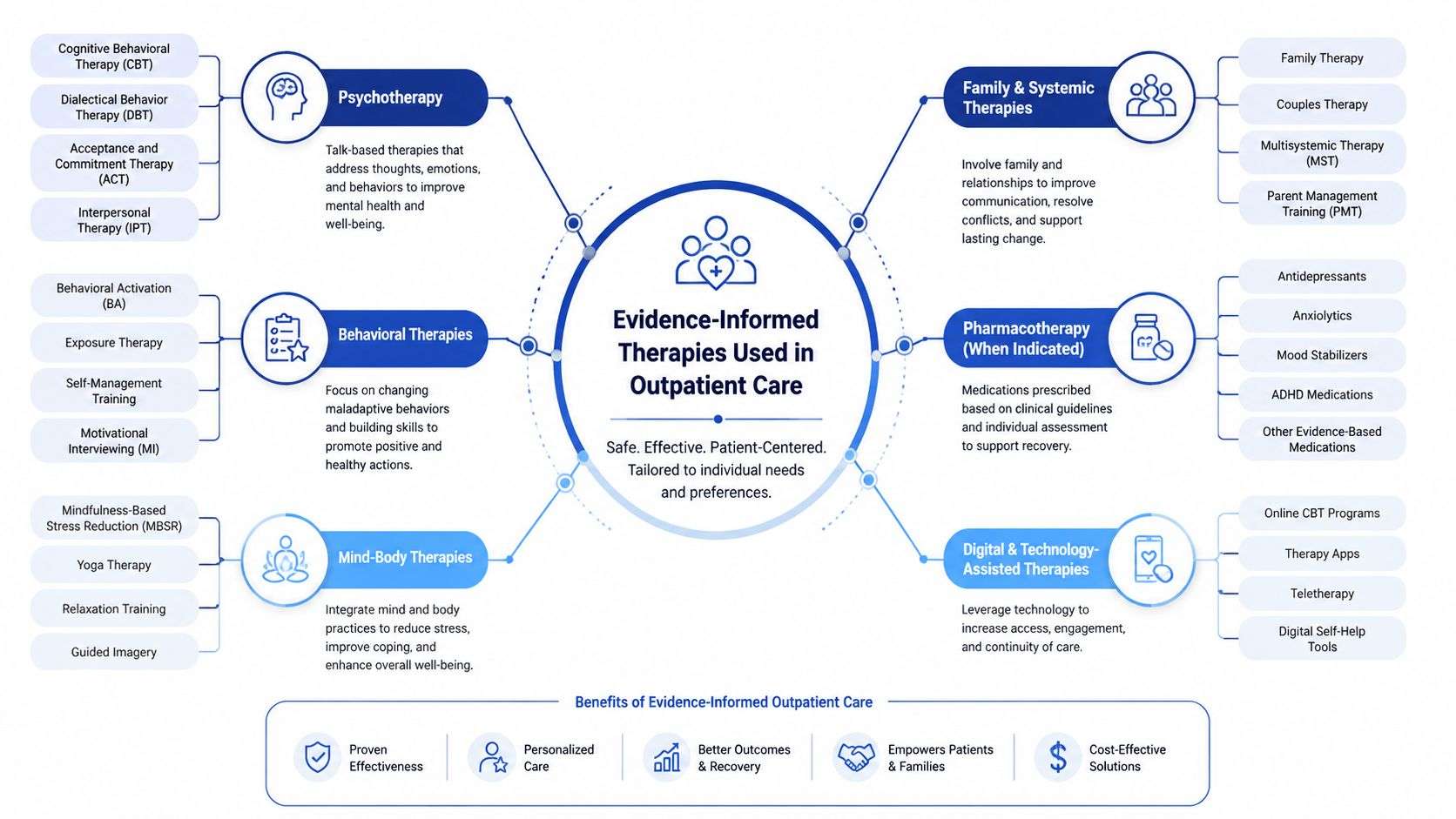
Effective outpatient counselling doesn't rely on one universal script. Clinicians choose approaches according to the client's substance use, mental health, trauma history, physical safety, relationships, and goals. The same person may use different tools at different stages.
Cognitive behavioural therapy
Cognitive behavioural therapy, or CBT, helps people examine the relationship between thoughts, feelings, physical sensations, and actions. A client might notice the thought, “I've already ruined the day, so there's no point stopping now.” CBT can help them test that thought, identify the choice available in the present moment, and create a more workable response.
Sessions may involve:
- Trigger mapping: Identifying people, places, emotions, times of day, or situations associated with use.
- Thought checking: Looking for all-or-nothing thinking, shame-based conclusions, or predictions that increase urges.
- Coping rehearsal: Practising what to do when a craving appears, such as leaving a high-risk setting, contacting support, or using a grounding exercise.
Motivational interviewing
Motivational interviewing is useful when a person feels uncertain. Many people experience mixed feelings, such as wanting better health while also fearing withdrawal, losing social connections, or facing painful emotions without substances.
Rather than arguing or applying pressure, the counsellor helps the client explore their own reasons for change. Questions may focus on what substance use makes easier in the short term, what it costs over time, and what the person wants life to look like. The aim is to support informed, self-directed decisions.
Trauma-informed care
Trauma-informed counselling recognises that substance use can be connected to experiences of violence, neglect, loss, discrimination, or ongoing danger. It avoids treating a person as a problem to be corrected and instead prioritises safety, choice, collaboration, trust, and control.
A trauma-informed clinician won't require someone to describe painful events before they're ready. Early work may focus on stabilisation, emotional regulation, boundaries, sleep, and present-day safety.
Harm reduction
Harm reduction starts with the person's current reality. It can include education about overdose risk, safer-use planning, reducing isolation, identifying warning signs, and connecting with medication or health services. These conversations don't mean the counsellor has given up on recovery. They recognise that keeping someone alive and connected to care is clinically important.
Interior Health's Kelowna services include assessment, counselling, rehabilitation, crisis intervention, outreach, advocacy, education, individual support, and support groups, as described in the Kelowna community information listing. A treatment plan may combine several approaches rather than treating them as competing choices.
What to Expect in Outpatient Sessions
The first appointment usually feels different from a regular counselling session. Instead of immediately asking you to change a behaviour, the clinician needs to understand what's happening, what support you already have, what risks are present, and what you hope will improve.
The first assessment
An assessment may cover:
- Current alcohol or other substance use
- Previous attempts to reduce or stop
- Withdrawal experiences and medical concerns
- Mental health, trauma, sleep, and physical health
- Housing, family, work, school, and safety
- Your preferred goals and the type of support you're seeking
You don't need a perfect explanation. It's acceptable to say, “I'm not sure how much I'm using,” or “I know it's affecting me, but I don't know what I want yet.” Honest uncertainty helps the clinician decide what should happen next.
Ongoing appointments
Later sessions are more focused. You might review a difficult week, identify the point at which a craving intensified, practise a communication skill, or plan for an upcoming situation. Some appointments may involve education about substance use, while others may focus on anxiety, trauma, grief, relationships, or practical routines that affect recovery.
Progress isn't measured only by whether substance use has stopped. Depending on the agreed goals, a clinician may look at safer decisions, fewer high-risk situations, improved sleep, more consistent attendance, stronger coping skills, better communication, or earlier help-seeking after a setback.
Counselling isn't a test you pass by reporting perfect weeks. The information from difficult weeks often helps you and your clinician adjust the plan.
The pace varies. Some people need regular appointments during a period of change, while others move toward less frequent follow-up as stability grows. If withdrawal may be medically risky, counselling alone isn't enough. A care team may recommend medical assessment, medication support, withdrawal management, crisis care, or a higher level of treatment.
In 2023/24, 4,649 adults accessed bed-based substance-use treatment and recovery services in British Columbia, an increase of 1,007 people from the previous year and 28% over 2022/23, according to the BC Ministry of Mental Health and Addictions annual report. Bed-based care is only one part of the system, but the broader pathway also includes outpatient assessment, counselling, medication support, and community follow-up.
Eligibility and How to Access Care in Kelowna
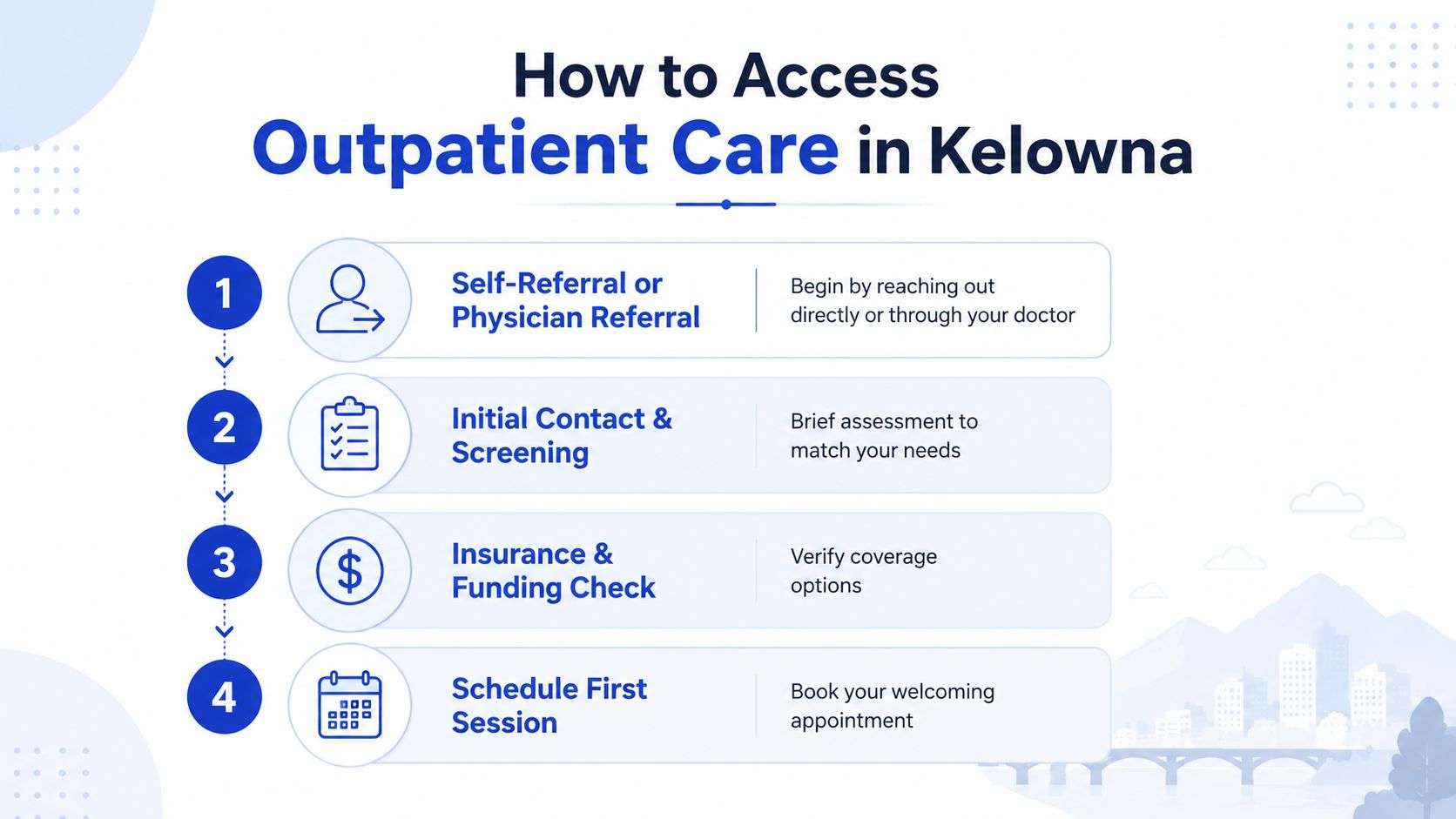
A first call can feel uncertain: you may know that substance use is affecting your health or relationships, but not know which service to contact. Publicly funded programs generally begin by assessing your needs, safety, and goals. You do not need a formal diagnosis or a complete recovery plan before asking for help.
Starting with a local service
Interior Health's Kelowna Mental Health & Substance Use office is at 505 Doyle Avenue, Kelowna, BC V1Y 0C5. Its listed weekday hours are Monday to Friday, 8:00 am to 4:30 pm. The Interior Health location page provides contact details and identifies the 24-hour Interior Crisis Line Network at 1-888-353-2273.
You can contact the service yourself, ask a physician or another health professional about referral options, or use a provincial entry point. Access Central connects people with assessment and treatment pathways. The provincial system reported that, from October 1, 2023 to September 30, 2025, it received 40,097 calls and completed 10,635 same-day clinical assessments. It also reported that routine wait time fell from 26 days before Road to Recovery to about 8 days, according to the BC government annual report.
What happens after the first call
The process usually works like a handoff from one stage of care to the next:
- Initial contact: You describe why you are reaching out and provide basic information about your situation.
- Screening or assessment: A clinician reviews safety concerns, substance use, health needs, and the level of care that may fit.
- Care planning: Options may include counselling, group support, medication-related services, withdrawal planning, or referral to another program.
- First appointment: The service explains whether sessions are booked directly, arranged through a team, or provided by another local organization.
Public services and private counselling use different entry procedures. A community clinic may accept self-referrals, while another service may require screening or a referral. UBC Okanagan's Problematic Substance Use Clinic, for example, accepts self-referrals and provides harm-reduction-focused treatment for alcohol and other substances. Confirm current availability, eligibility, and booking requirements with the service directly.
Interactive Counselling provides individual, couples, family, children's, and youth counselling, with in-person, phone, and secure virtual options. Ask whether the clinician's training and approach fit your concerns, and whether medical care, withdrawal support, or another service should be included.
Choosing Between In-Person, Virtual, and Phone Sessions
The best format is the one that allows you to participate safely, privately, and consistently. A person who has reliable transport and values face-to-face connection may prefer an office. Someone managing shift work, caregiving, mobility concerns, or distance may find virtual or phone sessions easier to sustain.
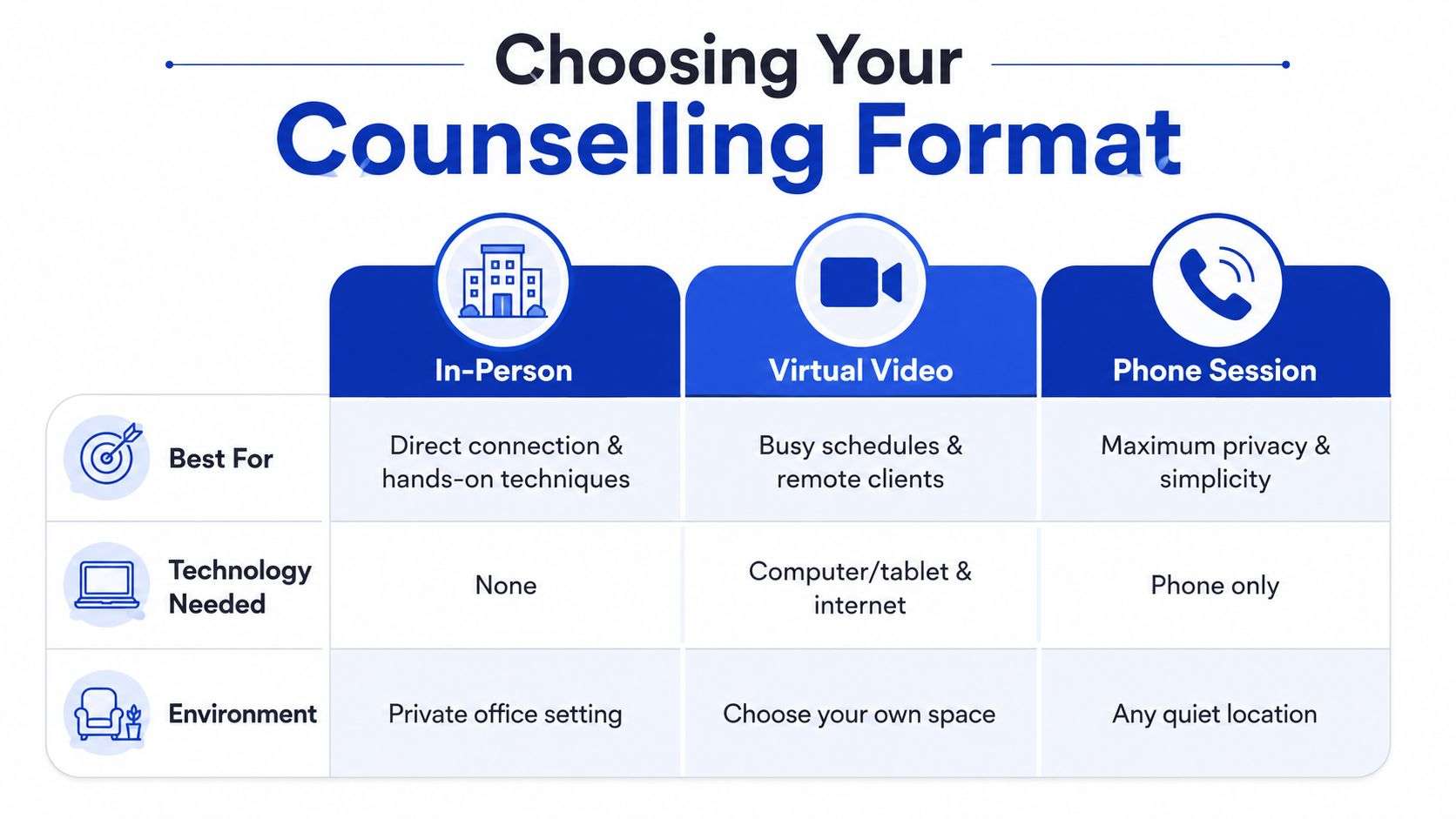
In-person sessions
An office appointment offers a dedicated therapeutic setting. You don't need to manage internet quality or find a suitable camera position, and some people find it easier to stay emotionally present when they leave home for an appointment.
The trade-off is travel, time, and privacy before and after the session. Think about whether getting to the office could become a barrier during difficult weeks.
Virtual video sessions
Secure video counselling can make it easier to attend from home or another private space. It may suit someone with a busy schedule or someone who feels more comfortable beginning from familiar surroundings.
Privacy matters. Choose a place where other people won't overhear, use headphones if appropriate, and avoid attending while driving or while you're responsible for an immediate safety task. Ask the provider what platform they use and what happens if the connection fails.
Phone appointments
Phone counselling removes the need for a camera and can work well when technology, bandwidth, or visual privacy is a concern. Some clients also find it less intimidating than video.
Because the clinician can't see facial expression or the surrounding environment, clear communication becomes especially important. Tell the counsellor if you're distracted, unsafe, intoxicated, or unable to speak privately.
Scheduling, fees, insurance coverage, and ICBC-funded counselling vary by provider and by eligibility. Confirm these details before booking rather than assuming that one format has the same funding arrangements as another. Daytime, evening, and weekend availability may also differ, so ask what appointment times are offered.
Local Resources and Crisis Support in Kelowna
Outpatient counselling is one part of a wider care network. After the first call, an intake worker may help connect someone with counselling, medication support, withdrawal planning, medical care, crisis intervention, family education, housing assistance, or peer support. The pathway may involve more than one service, because each addresses a different need.
Kelowna Mental Health & Substance Use at 505 Doyle Avenue offers outpatient assessment, treatment, counselling, rehabilitation, crisis intervention, advocacy, education, and youth substance-use services during its listed weekday hours. The location also provides Early Psychosis Intervention and support for adults and youth, according to the local service description. Call before attending so you can confirm the intake process and ask what happens after the initial assessment.
Support for urgent concerns
The 24-hour Interior Crisis Line Network is 1-888-353-2273, as listed in Interior Health's Kelowna service information. You can call when you feel overwhelmed, are concerned about someone's immediate wellbeing, or do not know which local service fits the situation.
If someone is in immediate danger, has severe symptoms, or may have overdosed, call 911 or go to the nearest emergency department. A scheduled outpatient appointment is not a substitute for urgent medical attention.
Community-based options
Kelowna's community care network also includes harm-reduction services. The Outreach Urban Health Centre provides supervised consumption and harm-reduction supplies, as described in the UBC Okanagan Psychology Clinic listing. These supports reduce immediate risks and create contact with care. Counselling can then address longer-term goals and the circumstances surrounding substance use.
Provincial information reported 23,924 people dispensed opioid agonist treatment in July 2024. The same factsheet reported 3,645 publicly funded adult and youth substance-use beds across BC, including 170 youth beds, and stated that 17 Foundry centres were operating province-wide, with Kelowna among them. Because these services have different roles, an assessment can help identify a suitable combination.
Common Questions About Outpatient Counselling
Is outpatient counselling walk-in?
Some Kelowna services accept direct contact or self-referrals. Others begin with a booked appointment, screening call, or referral. Interior Health's Kelowna office lists weekday operating hours, but those hours do not confirm that counselling is available without an appointment. Call first and ask whether you need an intake appointment, what information to prepare, and what happens after that call.
How quickly will I see a counsellor?
The timeline depends on the service, urgency, clinical needs, and available capacity. Access Central states that an assessment can occur within 24 hours after initial contact, according to the Find Help information. An assessment is the starting point for matching care, not necessarily the first ongoing counselling session.
Nationally, CIHI reported that in 2024–2025, half of Canadians referred to community mental health counselling received care within 30 days, while 1 in 10 waited longer than 4 months. That measure did not provide BC-specific wait-time data. Ask the local service what follows intake and whether another support is available during the wait.
What if I'm not ready to stop using substances?
You can still request help. Early counselling may focus on understanding risks, reducing harm, clarifying goals, or examining what makes change difficult. You do not need to promise a particular outcome before speaking with a clinician.
Do I need to know what kind of treatment I need?
No. Describe what has been happening and ask for direction. The assessment helps determine whether outpatient counselling, medication support, withdrawal management, crisis care, or another service fits your situation and safety needs.
Can family members seek guidance?
Family members can ask about education, support, and referral options, even if the person using substances is not ready to attend. Privacy rules may limit what a provider can share about an individual. They do not prevent relatives from asking general questions, explaining their concerns, or learning how to respond safely. A family member's call can provide useful information before the person seeking care makes direct contact.
Taking Your Next Step with Confidence
Seeking help may begin with a small action, such as writing down what has changed, calling a local office, or asking a doctor about referral options. You don't need to have every answer before you start, and uncertainty doesn't disqualify you from care. Outpatient counselling is a collaborative process that can meet you where you are while helping you build safer, more workable next steps.
Learn more about how Interactive Counselling provides in-person, phone, and secure virtual counselling for people seeking practical, compassionate support related to substance use and connected concerns. You can review the service information and decide whether reaching out fits your needs.
Interactive Counselling offers individual, couples, family, children's, and youth counselling through in-person, phone, and secure virtual sessions. Visit Interactive Counselling to learn more about available counselling options and consider which format may support your next step.
Clinically Reviewed By
Amy Mosset, MCP, RCC-S
Amy Mosset is a Master Practitioner in Clinical Counselling, Clinical Supervisor, and the owner of Interactive Counselling. She provides trauma-informed, evidence-based care and clinical supervision to registered therapists, with a focus on ethical practice, client safety, and high-quality therapeutic outcomes.