You may be reading this because meals have become tense, private, or exhausting. Perhaps someone who once enjoyed eating now feels anxious before dinner, avoids social plans involving food, or spends much of the day thinking about weight, control, or what they're allowed to eat. The change may have started in ways that were subtle, disguised as “being healthier” or explained away as stress. For more information, see our Kelowna counselling.
That uncertainty is common. Many people wonder whether their experience is serious enough for counselling, especially when they're still attending school, working, or appearing well to others. You don't need to wait for a crisis or a formal diagnosis to ask for support. Eating disorder counselling in Kelowna can provide a place to understand what's happening, restore flexibility, and build a recovery plan that respects both safety and autonomy.
When Food Starts to Feel Like the Hardest Part of Your Day
At first, the changes may seem manageable. A person might skip breakfast because mornings are busy, exercise a little more, or avoid a restaurant because choosing from the menu feels uncomfortable. Over time, those decisions can become rules. Meals require preparation and negotiation, social invitations feel threatening, and thoughts about food continue long after eating has ended.
Someone may still be functioning on the outside. They go to class, answer messages, complete work, and tell loved ones they're fine. Inside, they may feel consumed by food-related thoughts, ashamed of eating, frightened by changes in their body, or trapped in cycles of restriction, bingeing, purging, or compensatory exercise.
A useful question is not “Is this bad enough?” It's “Is this taking more from my life than I want it to?”
Counselling helps identify the pattern beneath the visible behaviour. A therapist may explore perfectionism, anxiety, trauma, grief, loneliness, body image, family stress, or the need for control. That work doesn't replace medical or nutritional care when those are needed, but it can help a person understand why the eating disorder became useful in the first place and how to develop safer ways to cope.
Early support can change the path
Eating disorders frequently begin in adolescence or young adulthood, according to the Canadian Psychological Association information shared by the Canadian Institutes of Health Research. The same source identifies Canadian lifetime prevalence estimates of 0.9% for anorexia nervosa, 1.5% to 2% for bulimia nervosa, and 3.5% for binge eating disorder.
The earlier a person receives appropriate support, the more opportunity there is to interrupt rigid patterns before they become firmly established. Counselling isn't a last resort. It can be an early, compassionate response that helps someone rebuild a peaceful relationship with food and with themselves.
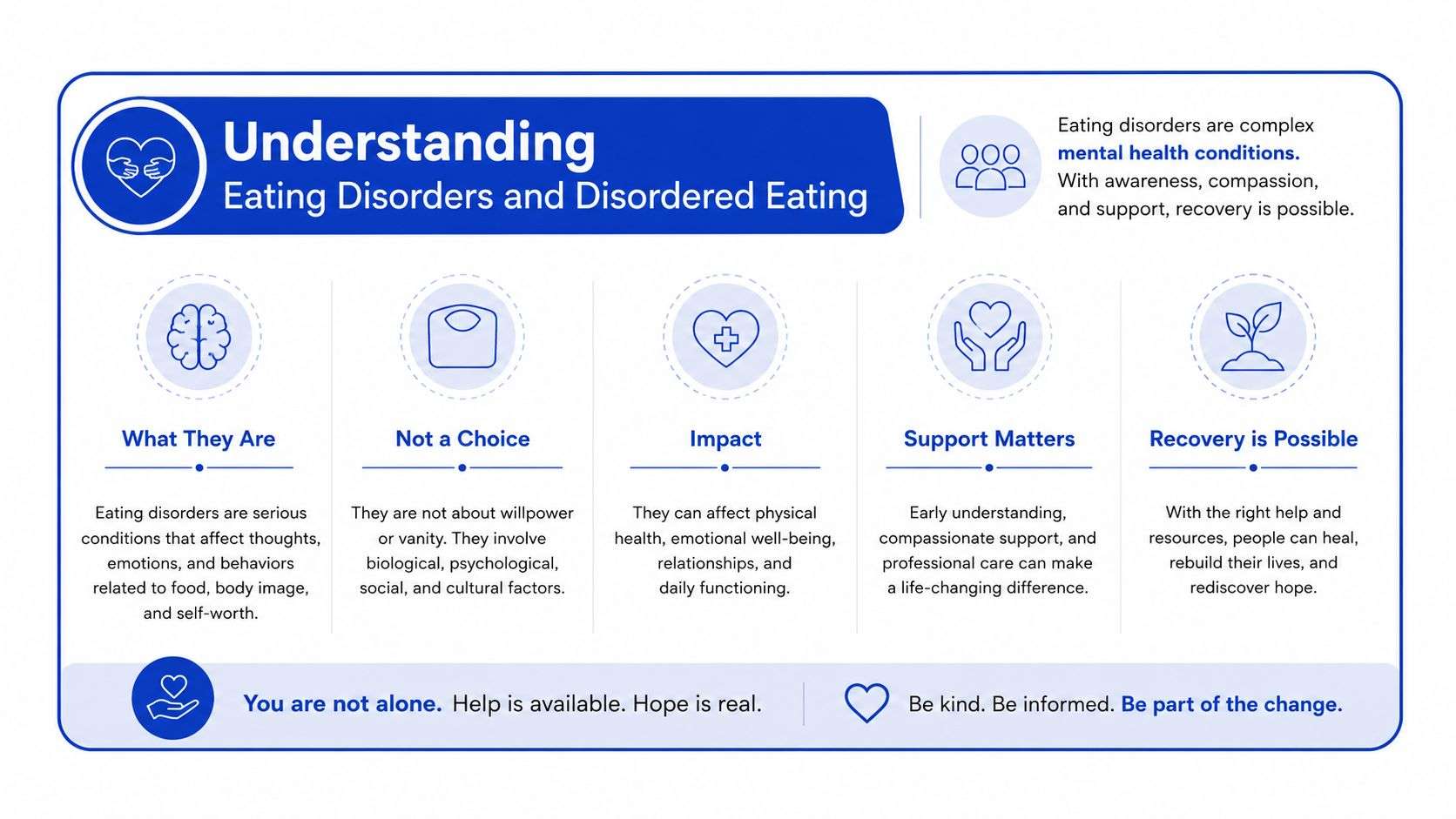
Understanding Eating Disorders and Disordered Eating
A teenager may eat with friends, attend school, and appear well while spending much of the day thinking about food, weight, or exercise. An eating disorder is a mental-health condition involving persistent thoughts, emotions, and behaviours connected with food, eating, weight, or body shape. Disordered eating is a wider term for harmful or distressing patterns that may not meet every diagnostic criterion, yet still affect health, relationships, mood, or daily life.
These concerns do not follow one body type or appearance. A person does not need to look unwell, receive a diagnosis, or match a familiar stereotype before asking for help. The Canadian Institutes of Health Research reports that 1.4 million Canadian youth are affected by eating disorders, while only 25% receive appropriate treatment. Its Canadian youth eating-disorder information also notes that these conditions commonly emerge during adolescence and young adulthood.
Common patterns and diagnoses
The labels describe patterns, not the whole person:
- Anorexia nervosa may include restriction, intense fear of weight gain, and a disturbed experience of body shape or weight.
- Bulimia nervosa commonly involves binge eating followed by attempts to compensate, such as vomiting, medication misuse, fasting, or excessive exercise.
- Binge eating disorder involves repeated episodes of eating with a sense of losing control, often followed by distress, shame, or secrecy.
- ARFID, or avoidant/restrictive food intake disorder, may involve limited intake because of sensory sensitivity, fear of consequences such as choking, or little interest in eating. Weight and body shape concerns do not have to be central.
- OSFED, previously associated with EDNOS, describes significant eating-disorder symptoms that do not fit neatly into another category.
Patterns below a full diagnostic threshold can still deserve attention. Examples include strict food rules, skipped meals, body checking, compulsive exercise, frequent weighing, avoiding whole food groups, private bingeing, or constant planning around eating. Like a warning light on a dashboard, these behaviours signal strain even when a crisis has not appeared.
Appearance cannot show how much mental energy these patterns consume. People may hide behaviours or minimise them because they continue working, studying, or caring for others. Counselling can clarify what is happening, help families respond early, and leave room for the person to decide what support feels manageable. Community counselling may be a useful starting point, while medical or more intensive care can be added if health or safety concerns increase.
Evidence-Informed Approaches Used in Counselling
Eating disorder counselling is most effective when the approach matches the person's age, symptoms, health needs, family situation, and readiness for change. In British Columbia, care is organised as a stepped, multidisciplinary system that may include individual counselling, nutritional support, group therapy, family-based treatment, medical monitoring, and referral to specialised inpatient or residential care when risk increases. Kelty Eating Disorders Resources explains the treatment pathway in BC.
What the main approaches involve
CBT-ED, including enhanced cognitive behavioural therapy, focuses on the thoughts and behaviours that maintain eating difficulties. In sessions, a therapist and client may review eating patterns, identify rigid rules, examine body-related beliefs, and plan small behavioural experiments. Clients often practise regular eating, challenge avoidance, and learn to respond differently to distressing thoughts. A plain-language overview of related methods is available in this guide to cognitive therapies.
Family-Based Treatment, often called FBT, gives parents an active role in supporting an adolescent's recovery at home. Rather than blaming the young person or the family, the approach treats the eating disorder as a problem the family can work together to overcome. Parents may provide meal support, respond calmly to resistance, and gradually return responsibility to the adolescent as recovery becomes more secure.
DBT skills can be useful when eating behaviours connect with intense emotions, impulsivity, self-harm, or relationship conflict. Sessions may include mindfulness, distress tolerance, emotion regulation, and interpersonal effectiveness. The aim isn't to suppress emotion. It's to help the person survive difficult moments without turning to behaviours that create further harm.
Trauma-informed care is a way of practising rather than one single treatment protocol. The therapist considers how past experiences, safety concerns, power differences, and current triggers may shape the person's coping. They ask permission, explain the purpose of interventions, and avoid pushing into traumatic material before the client has enough stability and choice.
| Approach | Core focus | What sessions can look like | Best fit |
|---|---|---|---|
| CBT-ED | Thoughts, behaviours, and maintaining patterns | Self-monitoring, cognitive work, meal-related experiments, relapse planning | Many adolescents and adults, depending on health and readiness |
| FBT or FBT-informed care | Family-supported recovery | Parent coaching, meal support planning, family problem-solving | Adolescents and families able to participate actively |
| DBT skills | Emotions, urges, and coping | Mindfulness, distress-tolerance practice, emotion regulation plans | People with intense emotions or self-harm concerns |
| Trauma-informed counselling | Safety, choice, and underlying experiences | Collaborative pacing, stabilisation, meaning-making | Clients whose symptoms connect with trauma or chronic stress |
These approaches are often blended. The therapeutic relationship matters as much as the model. A person needs to feel respected enough to discuss behaviours, including setbacks, ambivalence, and fears about recovery.
What Recovery Looks Like: Week by Week
A client arrives after a difficult week. They followed a meal plan on several days, then skipped dinner after a stressful conversation and felt ashamed. In counselling, the therapist looks at both parts of the week: the effort that worked and the pattern that returned. Recovery is measured by the growing ability to notice, respond, and repair, not by perfect eating.
The first contact
The first conversation covers the person's concerns, current eating patterns, mental-health history, medical supports, and immediate safety. The therapist explains confidentiality, consent, communication with family or healthcare providers, and what counselling can and can't provide. Together, they set goals and decide whether weekly community counselling fits the person's needs.
Early sessions often centre on education, trust, and steadier eating patterns. Sharing the problem can feel relieving because the client no longer has to organise it alone. Deeper work may wait until there is enough stability to examine triggers, beliefs, trauma, or relationship patterns without becoming overwhelmed.
What happens between appointments
Change grows through small, supported practice. A client might try one task, discuss what happened, and adjust the plan at the next appointment:
- Regular eating logs: Recording when and how eating feels, without turning the log into punishment or control.
- Mindfulness practice: Noticing sensations, urges, and thoughts without automatically acting on them.
- Behavioural experiments: Trying a small change, such as eating a previously feared food with support, then observing the result.
- Trigger mapping: Identifying situations, emotions, or beliefs that tend to come before restriction, bingeing, purging, or compulsive exercise.
These practices are experiments, not tests to pass. They help clients gather evidence from daily life, including evidence that distress can rise and fall without directing every decision.
For subclinical patterns, community counselling may involve several months of regular sessions. More entrenched illness may require a year or longer, followed by periodic check-ins and relapse-prevention planning. The timeline depends on medical risk, symptom severity, support at home, and the person's response to treatment.
Progress is reviewed through eating, daily functioning, distress, relationships, and safety. If weekly counselling no longer provides enough support, the therapist may adjust the plan, involve other providers, or recommend more intensive care. Asking for that change is part of responsible treatment, not a personal failure.
How Family Members Can Be Part of the Process
Family involvement should create support, not surveillance. The right role depends on the person's age, risk, preferences, family relationships, and treatment approach.
For adolescents, FBT places parents in an active position during an initial phase focused on restoring regular eating and physical stability. Parents may take responsibility for organising meals and staying present through distress. As the young person becomes stronger, control gradually returns to them. This structure protects health while keeping autonomy as a long-term goal.
Adults may invite a partner, sibling, friend, or parent into occasional sessions. The focus might be communication, conflict around meals, responses to setbacks, or ways to provide support without reinforcing the eating disorder. A family member doesn't need to understand every symptom to offer calm, consistent care.
Practical support that helps
Families can agree on predictable meal-time routines, use neutral language about food and bodies, and ask what kind of support is useful before stepping in. They can also learn distress-tolerance skills so they don't respond to fear with criticism, arguments, or frantic monitoring.
Family support works best when it separates the person from the illness. The eating disorder may create rigid rules, but the person remains more than those behaviours.
Confidentiality deserves an explicit conversation. A counsellor can explain what the client wants shared, what information family members need for safety, and when a clinician must act because of serious risk. This makes family participation collaborative rather than coercive.
The aim is family as a team, not family as a watchdog. Loved ones provide steadiness and encouragement while the client remains involved in decisions whenever their safety allows.
Knowing When More Than Weekly Counselling Is Needed
Weekly outpatient counselling can be a helpful starting point, yet some situations call for closer medical or therapeutic support. Choosing a higher level of care is not a failure. It is a way to match support with current risk, like adding more supervision when a bridge becomes less stable.
British Columbia's stepped-care approach can move a person between community counselling, specialised outpatient services, day treatment, residential care, and inpatient medical stabilisation. Counselling may continue alongside medical and nutritional care. Malnutrition, electrolyte instability, and severe compensatory behaviours require more than stand-alone talk therapy.
Signs that need faster medical attention
Same-day medical assessment may be needed after:
- Rapid physical decline: Noticeable weight loss over a short period or worsening weakness.
- Fainting or dizziness: Repeated episodes, or symptoms that make standing and daily activities difficult.
- Cardiac symptoms: Chest pain, an unusual heartbeat, or severe weakness.
- Persistent vomiting: Repeated vomiting can lead to serious medical complications.
- Dehydration: Very limited intake, inability to keep fluids down, or signs of severe dehydration.
Behavioural and emotional changes also deserve attention. Escalating purging or exercise, a shrinking list of safe foods, self-harm urges linked to eating, suicidal thoughts, or a sharp decline in school, work, hygiene, or relationships may indicate that weekly counselling is no longer enough.
Subclinical patterns matter too. A person may still be attending school or work while rigid food rules, avoidance, or compensatory behaviours are becoming harder to control. Early support can prevent a gradual problem from waiting until a medical crisis.
Caregivers should speak up if they cannot keep a young person safe between sessions, meals regularly become unmanageable, or the client cannot follow an agreed plan despite genuine effort. A counsellor can coordinate with a physician, dietitian, emergency service, or specialised eating-disorder program, helping the change in care feel planned rather than sudden.
National Canadian hospitalization data show why timely assessment matters. From 2010/11 to 2022/23, children and youth accounted for 18,740 eating-disorder hospitalizations, with 64.9% being first-time hospitalizations, according to a Canadian analysis of youth hospitalizations. Anorexia nervosa was the most frequent diagnosis at 51.3%. In BC, hospitalization rates rose from 17.7 per 100,000 in 2010/11 to 52.8 per 100,000 in 2022/23, according to federal Canadian public-health commentary on eating-disorder surveillance.
Choosing a Therapist in Kelowna and What to Ask First
Look for a registered clinician, such as an RCC, RSW, or equivalent, who has specific eating-disorder training. General experience with anxiety or depression can help, but eating-disorder treatment also requires an understanding of nutritional risk, compensatory behaviours, body image, relapse prevention, and coordination with medical care.
A first call should feel like a conversation, not an interrogation. You can ask:
- Training: What experience do you have with CBT-ED, FBT, DBT skills, or trauma-informed care?
- Coordination: How do you work with a family physician, nurse practitioner, or dietitian?
- Level of care: What signs would lead you to recommend day treatment, residential care, or medical assessment?
- Family involvement: How do you include parents, partners, or chosen supports while respecting confidentiality?
- Access: Do you offer in-person counselling in Kelowna, secure virtual sessions across BC, or phone appointments?
- Practical details: What are the session length, scheduling options, fees, and coverage considerations?
If symptoms followed a motor-vehicle accident, ask whether ICBC-funded counselling may apply. Extended benefits may also influence which registered providers are covered, so it's reasonable to confirm those details before beginning.
Pay attention to the clinician's response. Do they take subclinical symptoms seriously? Do they explain their approach in language you understand? Do they acknowledge that recovery involves both physical safety and emotional autonomy?
Interactive Counselling is one Kelowna option that offers counselling through registered practitioners, with in-person, online video, and phone sessions. A first appointment doesn't commit you to a particular treatment path. It gives you space to decide whether the clinician's pace, communication style, and understanding of eating concerns feel appropriate.
A Gentle Invitation to Take the Next Step
You don't need a crisis, a diagnosis, or complete certainty before reaching out. Perhaps you're noticing that food takes up more mental space, that meals create conflict, or that someone you love is withdrawing from eating and social life. Those early signs deserve attention because waiting for symptoms to become unmistakable can make the path more complicated.
Eating disorder counselling in Kelowna can begin with a simple conversation about what you've noticed and what support might be needed. A counsellor may work alongside a family physician or dietitian, involve family members when appropriate, and adjust the approach as safety, trust, and readiness develop.
The first step might be a phone call with a few questions, a consultation, or an initial session. You're allowed to ask for information before deciding. You're also allowed to move carefully, with a plan that respects your autonomy while making room for connection and practical support.
Lasting recovery often begins. One honest conversation can help turn a private struggle into something understandable, supported, and changeable.
Interactive Counselling offers evidence-informed, trauma-informed counselling for eating concerns, with registered practitioners and in-person, phone, and secure virtual session options. To learn what support could look like for you or your family in Kelowna, visit Interactive Counselling and begin with the questions that feel most important.
Clinically Reviewed By
Amy Mosset, MCP, RCC-S
Amy Mosset is a Master Practitioner in Clinical Counselling, Clinical Supervisor, and the owner of Interactive Counselling. She provides trauma-informed, evidence-based care and clinical supervision to registered therapists, with a focus on ethical practice, client safety, and high-quality therapeutic outcomes.