You're sitting in your car after work, hands on the steering wheel, trying to decide whether to go straight home or make one more stop because the thought of walking into the house feels like too much. That kind of moment is often where anxiety shows itself in Grande Prairie, not as a dramatic crisis, but as a tight chest, a restless mind, or a sudden urge to avoid the next thing on your list. When that happens, practical tools can help, and counselling can help too. They work best together. For more information, see our Grande Prairie anxiety counselling.
Anxiety Counselling in Grande Prairie: Practical Tools for Calm starts with a simple truth, anxiety is often more common, more persistent, and more disruptive than people admit out loud. In Alberta, among people aged 15+ who met criteria for a mood, anxiety, or substance use disorder, 58.8% said they needed counselling or psychotherapy, but only 43.8% received it, and 48.8% talked to a health professional about their mental health, which shows the size of the gap between needing care and getting it in this Alberta and Canada context. That same source notes that generalized anxiety disorder prevalence rose from 2.6% in 2012 to 5.2% in 2022 in one national comparison table, which fits what many clinicians are seeing, anxiety isn't a niche concern anymore, it's part of everyday life for many people.
When Anxiety Feels Bigger Than Your Coping Toolkit
A person might know all the usual advice, breathe deeply, ground yourself, challenge the thought, and still feel their body go into overdrive in the grocery store or at bedtime. That doesn't mean they're failing. It usually means the anxiety is louder than the coping tool they've been given, or that the tool doesn't match what's driving the anxiety in the first place. For more information, see our anxiety counselling.
Why the usual advice sometimes falls flat
Anxiety can show up as physical arousal, mental looping, avoidance, dread, or all of those at once. If the body is already in a high-alert state, “just relax” is too vague to be useful. If the mind is spinning through worst-case scenarios, a breathing exercise may settle the body for a few minutes but leave the thought pattern untouched.
That's why counselling and practical tools aren't competing options. They're different layers of support. One can help you get through the next 10 minutes, the other can help you understand why those 10 minutes feel so hard in the first place.
Practical rule: if a calming technique helps only when life is already quiet, it probably needs to be paired with something more structured.
The local care picture matters too. Alberta Health Services lists the Grande Prairie Aberdeen Centre's Integrated Crisis and Access Team as offering over-the-phone counselling Monday to Friday, 9:00 a.m. to 4:00 p.m., with walk-in services generally held every other Wednesday afternoon from 1:00 to 3:00 p.m.; emergency mental health services at Grande Prairie Regional Hospital are available 24/7 through the emergency department, and CIHI reports a median wait time of 24 days for community counselling in the provincial system. That mix of access points says something important, calm doesn't always come from one big solution. In real life, it usually comes from layered care.
Three Evidence-Informed Techniques for Immediate Calm
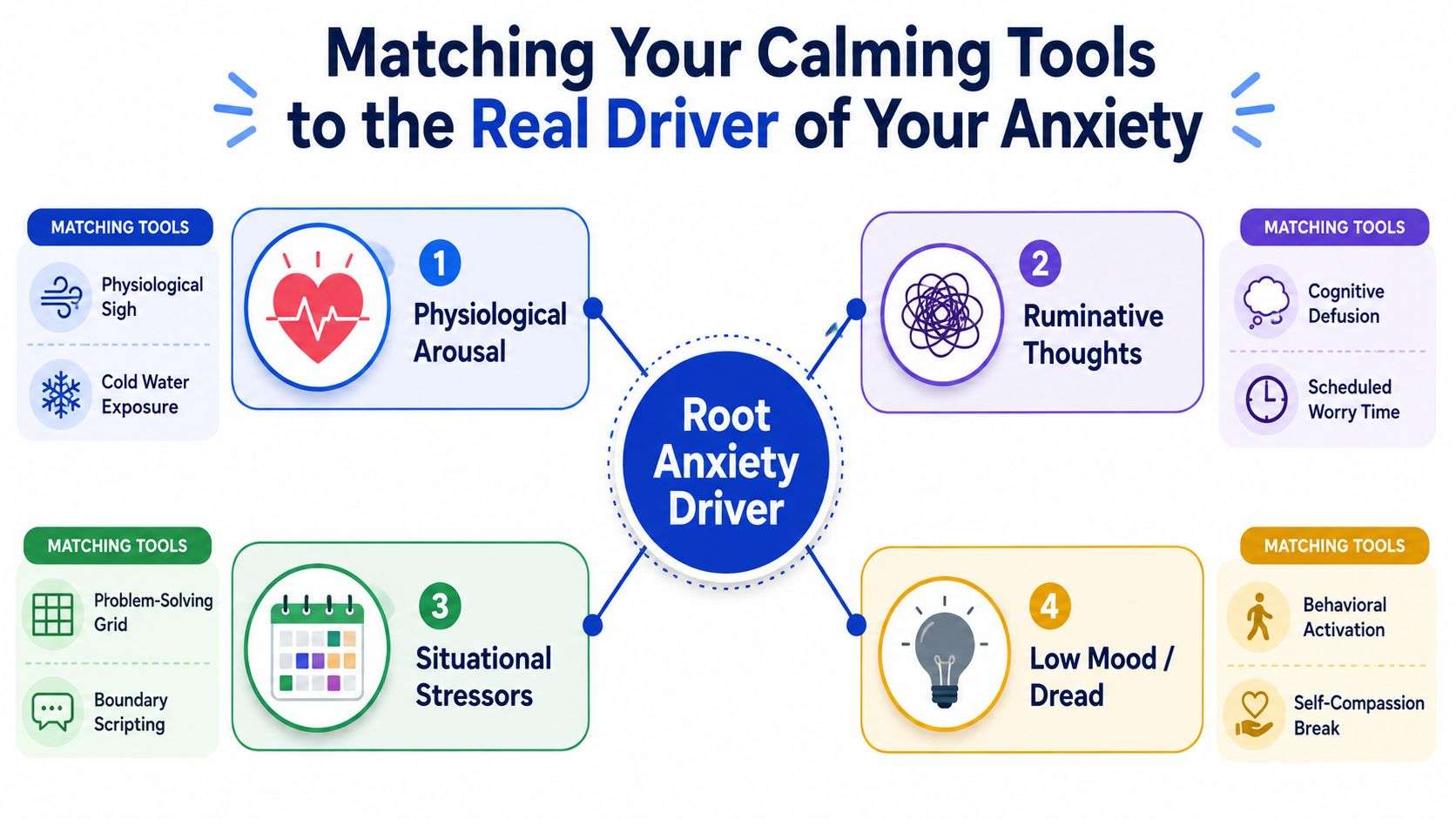
The most reliable immediate tools are the ones that interrupt the body's alarm response, pull attention back to the present, and create enough distance from anxious thinking to choose the next move. A useful way to think about this is not “Which trick is best?” but “Which tool fits the version of anxiety I'm having right now?”
Slow breathing that tells the body to stand down
Start with a simple count, inhale through the nose for 4, exhale gently for 6, and repeat for a few rounds. The longer exhale matters because it slows the rhythm of the breath and helps the nervous system shift out of emergency mode. If you feel dizzy, shorten the count, the goal is steadiness, not strain.
Use this when your heart is racing before a meeting, a school pickup, or a difficult conversation. It's especially useful when anxiety is mostly bodily, tight chest, shallow breathing, jittery muscles, or a sense that you can't settle.
Five-senses grounding to interrupt the spiral
Grounding works because it moves attention away from internal alarm and onto concrete information in the room. Name 5 things you can see, 4 things you can feel, 3 things you can hear, 2 things you can smell, and 1 thing you can taste. The sequence gives your brain a job that isn't panic.
This helps most when thoughts are racing ahead of you, for example, if you're driving home and suddenly become convinced that something awful is about to happen, even though nothing in the present moment supports that fear. Grounding won't solve the problem causing the anxiety, but it can interrupt the feedback loop long enough for you to think clearly.
Cognitive reframing that creates distance from catastrophic thinking
A simple thought-check can be enough. Ask, “What's the evidence?”, “What's a more likely outcome?”, and “What would I say to a friend in this situation?” That doesn't mean forcing a positive spin. It means replacing a panic prediction with a more balanced statement.
For many people, this is the step that turns vague fear into something workable. The thought goes from “I can't handle this” to “I'm overwhelmed right now, but I've handled hard moments before.” That shift is small, but it changes what you do next.
A common mistake is using one technique and expecting it to cover every kind of anxiety. Breathing helps the body, grounding helps attention, reframing helps thought patterns. In session, those usually work better as a sequence than as isolated fixes.
Matching Your Calming Tools to the Underlying Driver of Your Anxiety
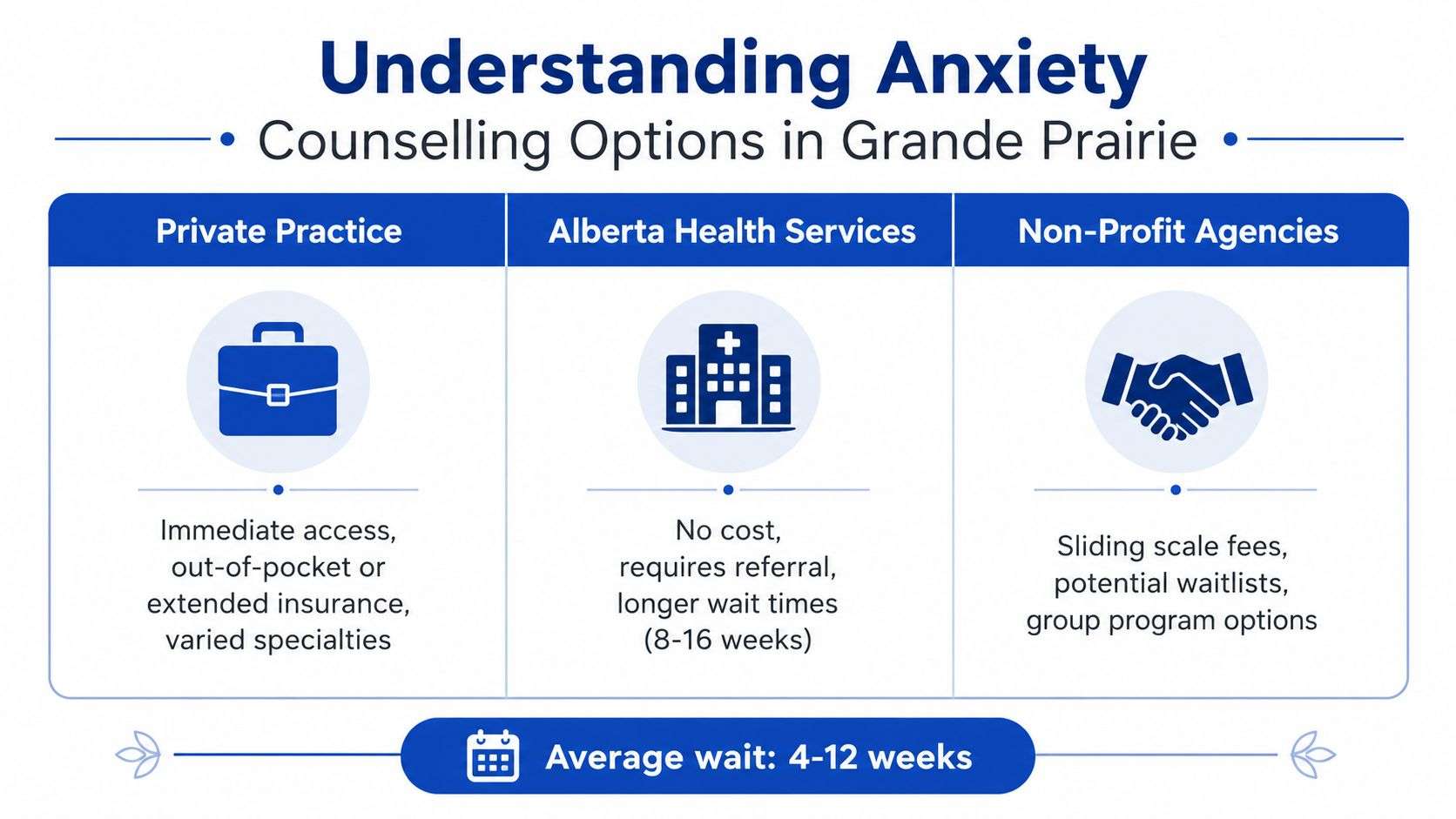
A person whose anxiety is tied to trauma usually needs something different from a parent who is running on chronic overload. The same is true for someone dealing with relationship stress or post-collision distress. Generic calming advice often misses that difference, which is why some people feel helped for a few minutes but not fully supported.
Trauma needs steadiness before insight
When anxiety is trauma-linked, the system often reacts as if the danger is still happening. Breathing and grounding can help with the immediate surge, but they rarely complete the job on their own. People in this situation often need slower pacing, more predictability, and therapy that helps them process what the body keeps remembering.
Relationship stress and parenting load need boundaries as much as calm
When the trigger is conflict, emotional labour, or never-ending responsibility, the answer is more than self-blame. It is usually a mix of grounding plus practical boundary-setting. If a parent is exhausted, a breathing exercise may lower arousal, but the bigger change often comes from reducing overload, naming limits, and asking for support without apologising for needing it.
Post-collision distress often needs both nervous-system tools and trauma-aware care
After a motor vehicle accident, people can become jumpy, avoid certain routes, or feel on edge in ways that do not make sense to them. If the body learned that driving or traffic equals danger, tools that calm the body can help, but persistent symptoms often call for structured counselling that understands trauma responses and recovery patterns.
In Grande Prairie, the Resource Centre for Suicide Prevention's Grande Prairie counselling directory shows that the local market includes multiple non-government counselling options, including services listed for anxiety and trauma. That matters because calm is not always a single relaxation skill. Sometimes it is the right match between the driver of anxiety and the support around it.
The local and regional area also includes digital and community supports. The GPREP directory lists Text4Hope, which sends daily text messages to help Albertans build coping skills and resiliency during stressful periods, and the YMCA of Northern Alberta's Y Mind program, a structured mental-health prevention and intervention option for youth and young adults through that regional directory. These options reinforce a skills-first approach, but they work best when the tools are matched to the reason anxiety keeps showing up.
Understanding Anxiety Counselling Options in Grande Prairie
A person looking for anxiety counselling in Grande Prairie usually needs more than a generic stress tip. They need an approach that fits the way anxiety shows up in daily life, whether that means in-person sessions for steady face-to-face support, phone sessions for privacy and simplicity, or secure virtual appointments that fit around work, family, distance, or weather.
What a first session usually feels like
A first appointment often starts with a conversation about what anxiety looks like from day to day. A counsellor may ask about sleep, avoidance, panic symptoms, stress triggers, and what you have already tried. The goal is not a polished explanation, it is a clearer pattern so the support matches the actual problem.
Therapy is different from talking to a friend because it is structured on purpose. A good counsellor listens, asks focused questions, and helps you leave with something concrete, whether that is a new coping strategy, a clearer goal, or a better understanding of what keeps the cycle going.
Clinical insight: if every session feels calming but nothing changes outside the room, the work may be too unstructured for the kind of anxiety you are dealing with.
Interactive Counselling's Grande Prairie office is at 10130 99th Ave, Suite 180, Grande Prairie, AB T8V 2V4, and clients can book online 24/7 or by phone at (780) 512-8462. The practice also offers in-person, phone, and secure virtual sessions, which can matter when anxiety makes scheduling feel harder than the counselling itself at this local page.
ICBC-funded counselling can also matter for clients recovering from motor vehicle accidents, especially when fear, hypervigilance, or driving-related avoidance are part of the picture. That support is different from general stress management because it addresses the event that changed how the nervous system is responding.
For people who want a practical map of the broader support options, mental illness support groups can be a useful complement to individual counselling, especially when they reduce isolation while formal therapy is getting underway.
How to Find and Access the Right Counselling Support
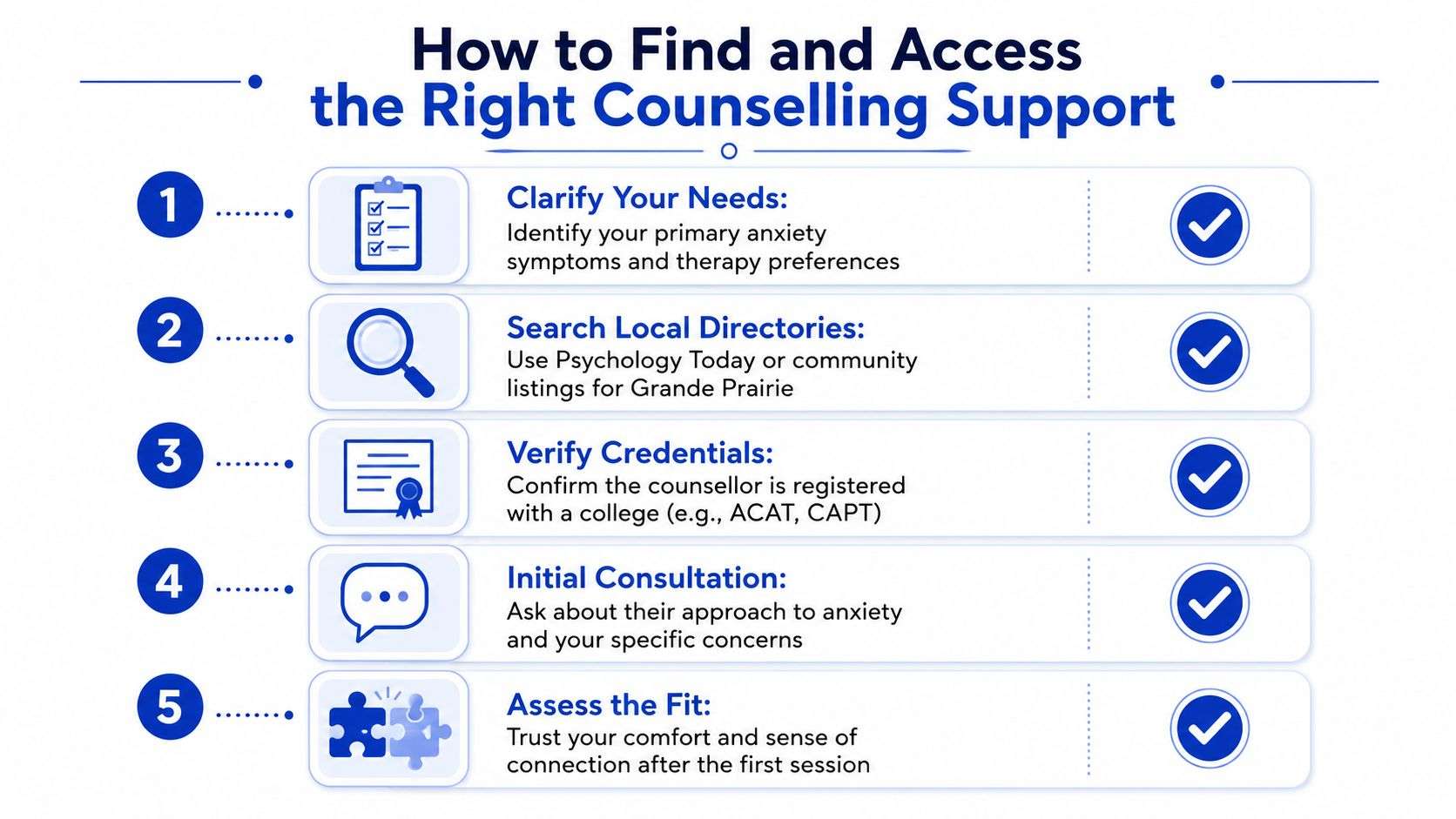
People often delay counselling because they worry they won't say the right thing or won't choose the right therapist the first time. That pressure is heavier than it needs to be. You're not making a permanent life decision, you're looking for a professional fit.
What to check before you book
- Clarify the problem first. Write down whether your main issue is panic, constant worry, avoidance, trauma reminders, sleep disruption, or stress overload. That helps you look for a counsellor who works with that pattern.
- Look for regulated credentials. If you're comparing options, check that the counsellor is registered with the appropriate college or association, such as ACAT or CAPT where relevant.
- Ask about session formats. In-person, phone, and virtual sessions all have different advantages. Pick the one you'll use consistently.
- Notice how the first contact feels. If the person answers clearly, explains their approach, and makes the next step easy to understand, that's a good sign.
- Pay attention to fit after the first session. You should feel respected, not judged. Comfortable enough to be honest matters more than sounding polished.
A counselling relationship works best when the plan fits your life, not when you have to reshape your life around the plan. That's especially true in a place where work schedules, family demands, and distance can all get in the way.
A neutral starting point is a main service page, such as the counselling services page, or a local directory if you want to compare options before deciding. The goal isn't to rush, it's to choose a support path you can realistically keep using.
If anxiety has been running your days for a while, that doesn't mean you've missed your chance. It usually means you've been carrying too much alone for too long.
Common Questions About Anxiety Support and Next Steps
A lot of people ask the same quiet questions before they book counselling. They usually sound like doubts, but they're really signs that someone is trying to make a careful, healthy decision.
Do I need counselling if I can still function?
If you can still get through the day but you're doing it with constant strain, avoidance, or exhaustion, support can still be worthwhile. Many people wait until things are severe, but earlier help often means less unlearning later.
How long until I feel calmer?
That depends on what's driving the anxiety and how often you practise the tools outside session. Some people feel relief from the first few skills, while deeper patterns take longer. Progress is usually uneven, and that's normal.
Are virtual sessions useful for anxiety?
Yes, for many people they are. If showing up in person feels like a barrier, secure virtual or phone sessions can make it easier to stay consistent, which often matters more than the format itself.
What if the calming exercises don't work right away?
That can happen, especially if the tool doesn't match the anxiety driver. It may mean you need a different technique, more repetition, or a therapist's help to work with what's underneath the symptoms.
If anxiety is making ordinary life feel smaller, that's enough reason to get support. You don't need to wait until you're in crisis to deserve care.
Interactive Counselling offers anxiety counselling in Grande Prairie with in-person, phone, and secure virtual options, so support can fit around real schedules and real stress. If you want a steady place to learn practical tools for calm and sort out what's driving your anxiety, visit Interactive Counselling to learn more about their services.
Clinically Reviewed By
Amy Mosset, MCP, RCC-S
Amy Mosset is a Master Practitioner in Clinical Counselling, Clinical Supervisor, and the owner of Interactive Counselling. She provides trauma-informed, evidence-based care and clinical supervision to registered therapists, with a focus on ethical practice, client safety, and high-quality therapeutic outcomes.