You might be reading this after a few hard weeks, when getting out of bed feels heavier than it should and simple decisions take more energy than usual. In Grande Prairie and across northern Alberta, that kind of quiet struggle is more common than many people realise, and it can leave you wondering whether what you're feeling is serious enough to bring up. For more information, see our Grande Prairie depression counselling.
"Depression counselling in Grande Prairie gives you a private, structured way to talk through what's been getting harder and learn practical support that fits life in northern Alberta." For more information, see our counselling in Grande Prairie.
Understanding the Weight of Depression in Northern Alberta
Depression often doesn't arrive with a dramatic moment. For many people, it shows up as a gradual narrowing of life, less energy, less interest, less patience, and more days that feel harder to start. If that sounds familiar, you're not failing. You're noticing a health concern that deserves attention. For more information, see our depression counselling.
Across Canada, the gap between need and care is real. Among people aged 15+ who met criteria for a mood, anxiety, or substance use disorder, 58.8% said they needed counselling or psychotherapy, but only 43.8% received it, and 48.8% talked to a health professional about their mental health (Statistics Canada). That tells us something important for Grande Prairie and northern Alberta, where access can take planning, patience, and flexibility.
Why the local context matters
Northern communities often depend on care that's short-term, triaged, or scheduled around limited clinic hours. That makes it even more important to recognise depression early, before everything piles up.
Practical rule: if your symptoms are making work, family life, or basic routines harder, you don't need to wait until things become extreme before reaching out.
The pressure isn't only national. Statistics Canada reported that in the territories, the share of residents aged 18+ who rated their mental health as excellent or very good fell from 58% in 2017/2018 to 47% in 2023/2024, and about one in ten people in Yukon and Nunavut reported moderate to severe depression symptoms in 2023/2024 (Statistics Canada). While that data is territorial rather than Grande Prairie-specific, it reflects the kind of sustained mental-health pressure northern systems have to respond to.
For someone living in Grande Prairie, that context matters because getting help shouldn't depend on having endless energy, perfect timing, or a clear path already mapped out. It should feel possible, even when you're overwhelmed. That's the heart of depression counselling, and it's why local access routes matter so much here.
Recognizing When It Is Time to Seek Support

Depression doesn't always look like sadness. Some people feel flat, numb, irritable, or detached from things they used to care about. Others keep functioning on the outside while struggling with sleep, focus, or a constant sense of being worn down.
Signs that deserve attention
A few common signs can include:
- Sleep changes, sleeping much more or much less than usual.
- Appetite changes, eating significantly more or less than before.
- Loss of interest, including hobbies, social time, or daily routines that used to feel normal.
- Persistent fatigue, where rest doesn't seem to restore your energy.
- Trouble concentrating, remembering things, or making decisions.
- Harsh self-talk, especially when it starts to feel constant or believable.
- Feeling stuck or hopeless, even if nothing obvious has changed.
A person doesn't need every one of these signs to benefit from counselling. Sometimes one or two changes, especially if they've lasted a while, are enough to make support worthwhile.
Helpful check-in: if you've started avoiding people, missing deadlines, or dreading ordinary tasks, your mind and body may be asking for more support than you're giving them.
This is also where work stress can blur the picture. Burnout, grief, isolation, and depression can overlap, which makes it easy to dismiss the problem as “just a rough patch.” A practical guide on professional stress reduction can help with the pressure piece, but if the low mood, loss of interest, or hopelessness keeps showing up, professional counselling may be the more important next step.
When to stop waiting
Waiting tends to make depression feel more convincing. The longer symptoms stay active, the easier it is to assume they're just part of who you are now. They're not.
A useful marker is this, if your mood is affecting how you parent, work, study, rest, or connect with other people, it's time to talk to someone. You don't need a crisis to deserve care. You only need a problem that's starting to limit your life.
What Depression Counselling Is and How It Can Help
Depression counselling is a structured conversation with a trained professional who helps you make sense of what you're carrying. It's not about being told to “think positive” or force your way out of a low period. It's about understanding what's happening, then building tools that make daily life more manageable.
Counselling offers the support of a skilled guide when the path is hard to read. You still do the walking, but you don't have to guess at every step.
What happens in the counselling relationship
A counsellor listens for patterns, not just symptoms. They pay attention to what seems to trigger low mood, what keeps it going, and what helps even a little. That can include thoughts, habits, relationships, sleep, stress, and the pace of your life.
Counselling can help you:
- Name what you're feeling, when everything has started to blur together.
- Notice unhelpful thought patterns, especially self-blame or all-or-nothing thinking.
- Build coping strategies, so the hardest days feel more workable.
- Improve communication, if depression has affected family or relationships.
- Reconnect with values and purpose, even if motivation is low right now.
The process is collaborative. You're not being studied. You're being supported.
Why this can feel relieving
Many people come in assuming they need to be “more together” before counselling makes sense. Usually, it's the other way around. Counselling is where you get help making sense of the chaos.
A good therapist won't rush your story. They'll help you separate what's depression, what's stress, and what's become a survival habit over time. That matters because once people can see the pattern clearly, they usually feel less ashamed and more capable of changing it.
If depression has made your world feel smaller, counselling can help you widen it again in realistic steps. Not overnight. Not perfectly. But steadily, with support.
Therapy Approaches Offered for Depression
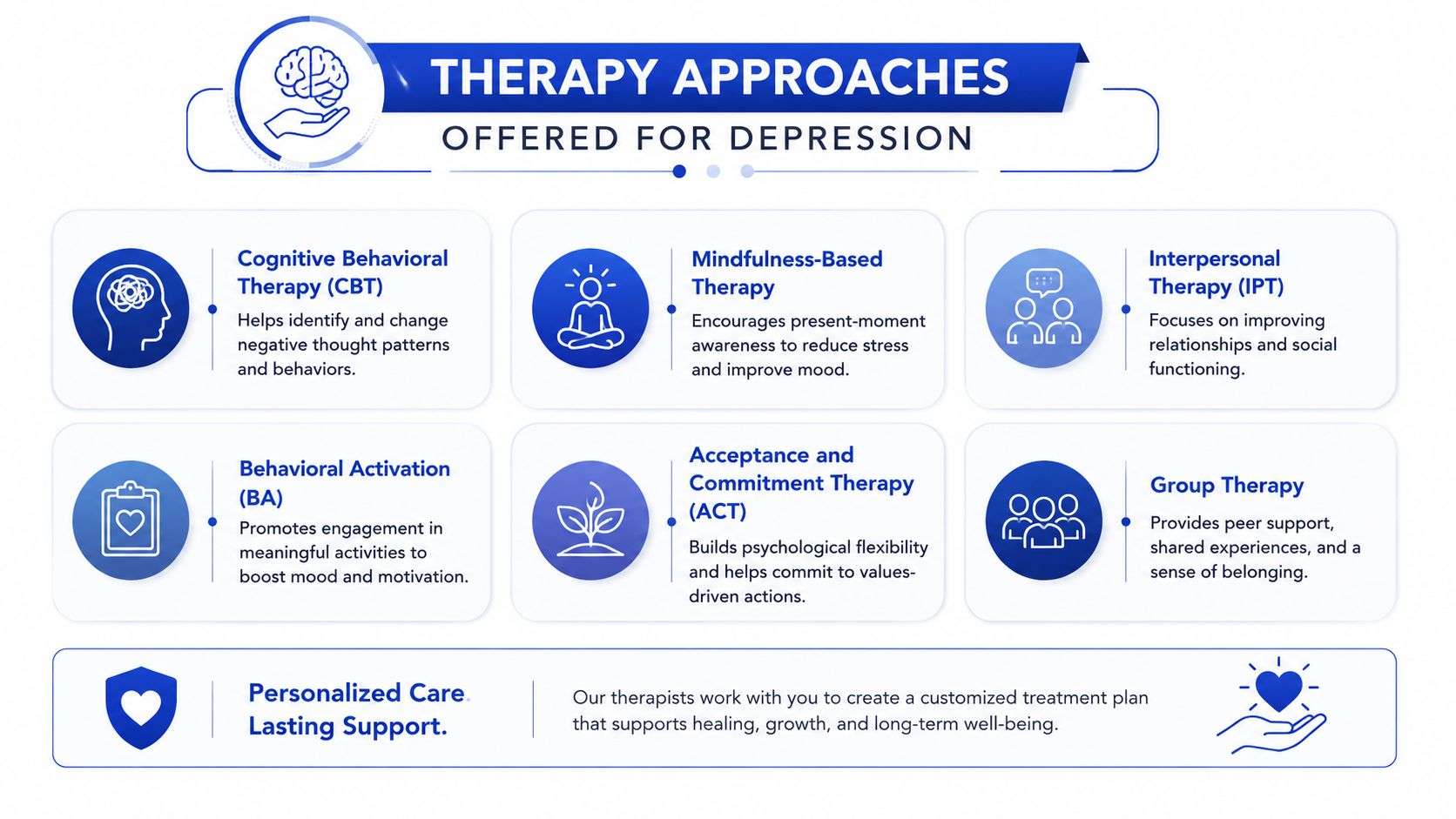
Different people need different kinds of support, and depression counselling isn't one-size-fits-all. A therapist may use one approach consistently or blend several methods depending on your symptoms, history, and goals.
Common evidence-based options
Cognitive Behavioural Therapy, or CBT, focuses on the link between thoughts, feelings, and actions. If your mind keeps telling you things like “I'm useless” or “nothing will change,” CBT helps you test those thoughts and replace them with more accurate ones. That doesn't mean pretending life is easy, it means reducing the mental habits that make depression heavier.
Dialectical Behaviour Therapy, or DBT, is often used when emotions feel intense or hard to regulate. It gives people concrete skills for coping with distress, staying grounded, and getting through emotional spikes without making things worse. Even when depression isn't the only issue, those skills can be stabilising.
EMDR, or Eye Movement Desensitization and Reprocessing, is often discussed in relation to trauma, but it can be relevant when depression is tied to painful experiences that still feel “stuck.” The work focuses on helping the brain process old material in a way that feels less overwhelming.
Why the approach matters less than the fit
The best method is often the one you can commit to. A person who's exhausted and discouraged may need a slower, steadier pace. Someone who wants practical tools may prefer a more skills-based approach. A therapist should explain the plan clearly and adjust it as needed.
Good therapy feels understandable. If the process is confusing, you should be able to ask questions until it makes sense.
If you're curious about broader, non-medication strategies, a thoughtful overview of Treating depression naturally can be useful as background reading. It's still important to remember that therapy and medical care are not the same thing, and the right support depends on your needs.
The goal isn't to force every person into the same model. It's to build a care plan that helps you function, reflect, and feel more like yourself again.
Navigating Your Path to Care in Grande Prairie

Grande Prairie uses a mixed-care model, which means people can access public intake, crisis support, and community counselling through different doors. That matters because depression doesn't wait neatly for business hours, and one route may feel easier than another depending on how overwhelmed you are.
Public directories in the city list multiple touchpoints, including AHS ICAT intake and adult or youth addiction and mental-health intake, alongside community providers in the same service corridor (Support Pathways in Grande Prairie). For someone with moderate depression, a practical move is to use public intake for triage while also booking with a community therapist if waiting is likely to slow care during a difficult stretch.
A simple way to think about the first step
You don't have to pick a perfect path on day one. Start with the route that matches your level of urgency and energy.
- If you want triage, public intake can help sort next steps and connect you to the right level of care.
- If you want a private therapy appointment sooner, community counselling can run in parallel.
- If speaking is easier than travelling, phone or virtual sessions may lower the barrier.
- If your schedule is tight, evening or weekend availability can make follow-through more realistic.
Interactive Counselling's Grande Prairie office is located at 10130 99th Ave, Suite 180, Grande Prairie, AB T8V 2V4, and clients can book online 24/7 or call (780) 512-8462. Sessions are offered in-person, online, and by phone, with evening and some weekend hours available. Those options matter in a region where distance, weather, work schedules, and family responsibilities can all affect whether someone receives care.
Why flexibility is part of good depression support
Depression can make logistics feel bigger than they are. A long commute, a difficult daytime appointment, or a full voicemail inbox can become enough to stop a person from reaching out at all.
Flexible access reduces that friction. If you can book online late at night, attend by phone during a break, or choose virtual care when driving feels impossible, the chance of staying connected to support goes up. In a northern context, that kind of accessibility is not a luxury. It's part of making care usable.
Common Questions About Starting Therapy
Starting counselling can bring up practical worries fast. People often wonder whether they'll know what to say, whether the therapist will judge them, or whether the whole thing will feel awkward. Those worries are normal.
Is everything I say in counselling confidential
In most cases, yes, counselling is private. Therapists explain the limits of confidentiality at the start, including the situations where safety concerns may require action. That conversation should feel clear, not rushed.
If you're nervous about saying too much, you can ask about confidentiality in the first session before sharing details. A good therapist won't act offended. They'll expect the question.
What happens in the first session
The first session is usually about getting oriented. You'll talk about what brought you in, what you're hoping will be different, and any history that helps the therapist understand your situation. You don't need to tell your whole life story on day one.
Many people leave the first appointment with a better sense of whether they feel understood. That matters, because therapy works best when the relationship feels safe enough to be honest.
How do I know if a therapist is the right fit
Fit matters more than many people realise. You're looking for someone who listens well, explains things clearly, and doesn't make you feel rushed or dismissed.
A helpful sign is that the therapist can answer your questions in plain language and help you understand a plan for care. If you leave feeling confused or pressured, it's reasonable to keep looking.
What if I feel too overwhelmed to start
Then start with the smallest possible step. That might be sending an online booking request, making one phone call, or asking a trusted person to sit with you while you reach out.
You don't need confidence first. You often get confidence after the first few steps.
That's especially true when depression has made everyday tasks feel bigger than they should. Taking one concrete action is often enough to break the freeze.
Finding Hope and Further Resources in Alberta
Depression can make support feel out of reach, especially when you have already spent a long time trying to handle things on your own. In Northern Alberta, where access can depend on where you live and how far you need to travel, that feeling can be even stronger. Yet one honest conversation can still be the starting point for change, and it does not matter whether you are in Grande Prairie itself or in a nearby community.
If you are looking for options through Interactive Counselling, you can find more information on their website. For immediate mental health support, call 9-1-1 in an emergency. If you're thinking about suicide, 9-8-8 is available 24/7 by call or text. Alberta also has a dedicated crisis line at 1-877-303-2642 (Public Health Agency of Canada).
If you are trying to figure out what kind of help exists near you, 2-1-1 can be a useful starting point for general support navigation. It can help you sort through services without needing to know the exact answer right away. If you are reading this for yourself or for someone you care about, reaching out is a steady, sensible step, and you do not have to do it alone.
A CTA for Interactive Counselling.
Clinically Reviewed By
Amy Mosset, MCP, RCC-S
Amy Mosset is a Master Practitioner in Clinical Counselling, Clinical Supervisor, and the owner of Interactive Counselling. She provides trauma-informed, evidence-based care and clinical supervision to registered therapists, with a focus on ethical practice, client safety, and high-quality therapeutic outcomes.