Some evenings feel heavier than they should. Dinner is quiet, someone leaves the table early, a teen answers in one-word replies, or two parents keep having the same argument in different forms. You might be trying hard to hold things together while wondering whether this is just a rough patch or a sign that your family needs support. For more information, see our Kelowna family counselling.
"Family counselling in Kelowna helps families understand painful patterns, communicate more clearly, and rebuild connection at home with practical, guided support." For more information, see our counselling in Kelowna.
If you're feeling worried, confused, or even a little intimidated by the idea of therapy, that's completely understandable. Family counselling often sounds bigger and more formal than it really is. In practice, it's often a structured conversation that helps people slow down, feel heard, and start responding to each other differently. If you're also looking for broader learning tools outside therapy, Nexus family education resources can be a helpful educational complement for families trying to understand relationship stress and recovery. For more information, see our family counselling.
When Family Life Feels More Challenging Than Connecting
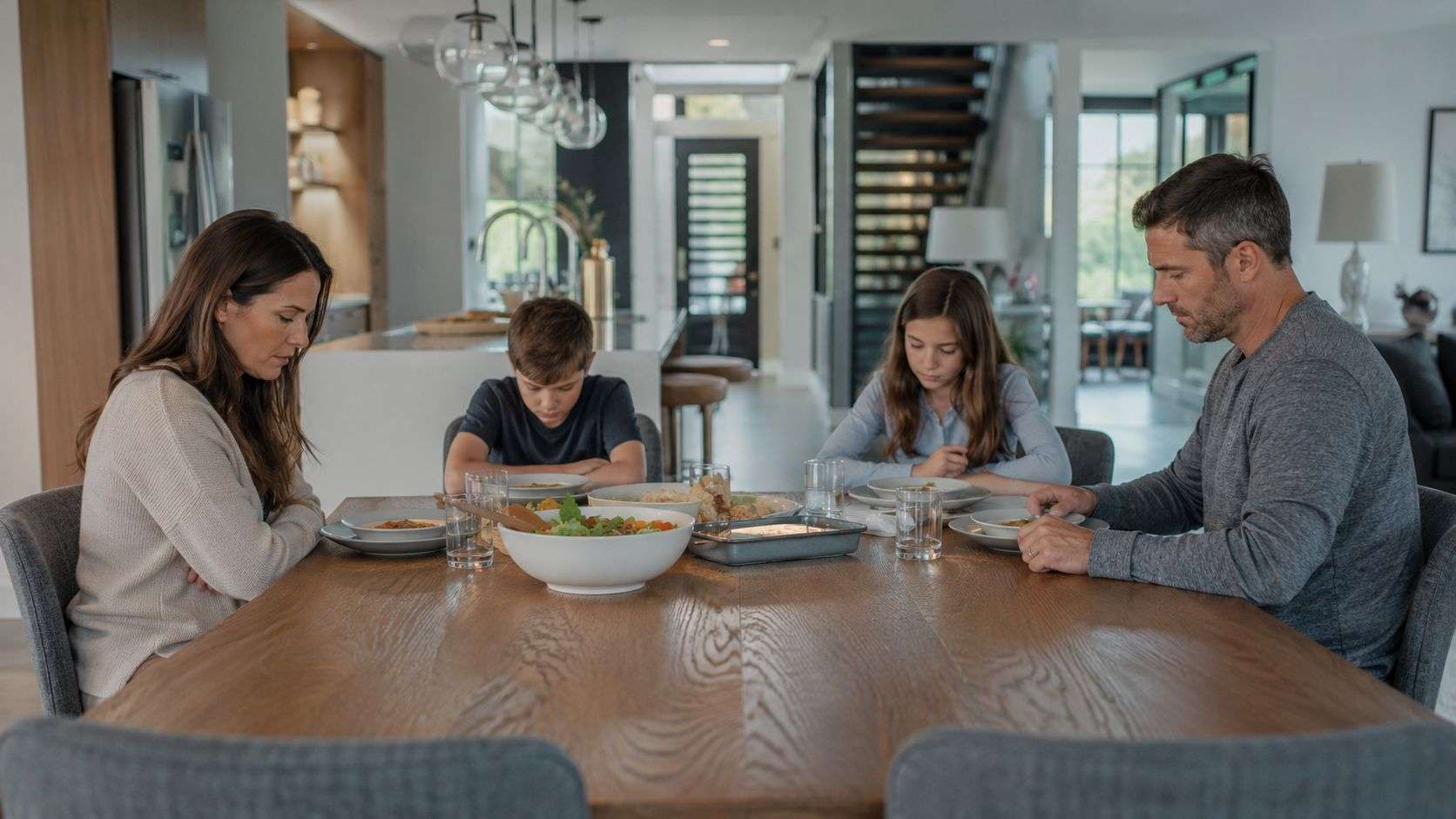
A lot of families arrive at counselling after months of trying to fix things on their own. They've had the talks. They've set the rules. They've promised to be more patient. Yet the same tension keeps returning. One child feels misunderstood, one parent feels blamed, and everyone starts bracing for the next difficult moment.
Sometimes the problem looks loud. Raised voices, slammed doors, constant conflict. Sometimes it looks quiet. Avoidance, distance, short answers, or a home that feels tense even when no one is speaking. Both can be painful.
Why this happens more often than people think
Families are systems. When one person is struggling, everyone adapts around it. A child's anxiety can increase parent stress. Separation can change routines, loyalty dynamics, and communication. Grief can make ordinary disagreements feel sharper. A motor vehicle accident can leave a family dealing with pain, appointments, and emotional exhaustion all at once.
That doesn't mean your family is broken. It usually means your family has fallen into patterns that no longer work.
Many caring families need support not because they've failed, but because the problem has become too tangled to solve from inside the same cycle.
What support can look like
Family counselling in Kelowna can help when home no longer feels calm, predictable, or connected. It gives each person a place to speak, but it also does something more important. It helps the family notice what keeps happening between people.
That shift matters. Once a family can see the pattern, they can start changing it.
You don't need to wait until things feel extreme. Many families come in because they want to protect closeness before resentment grows deeper.
What Exactly Is Family Counselling
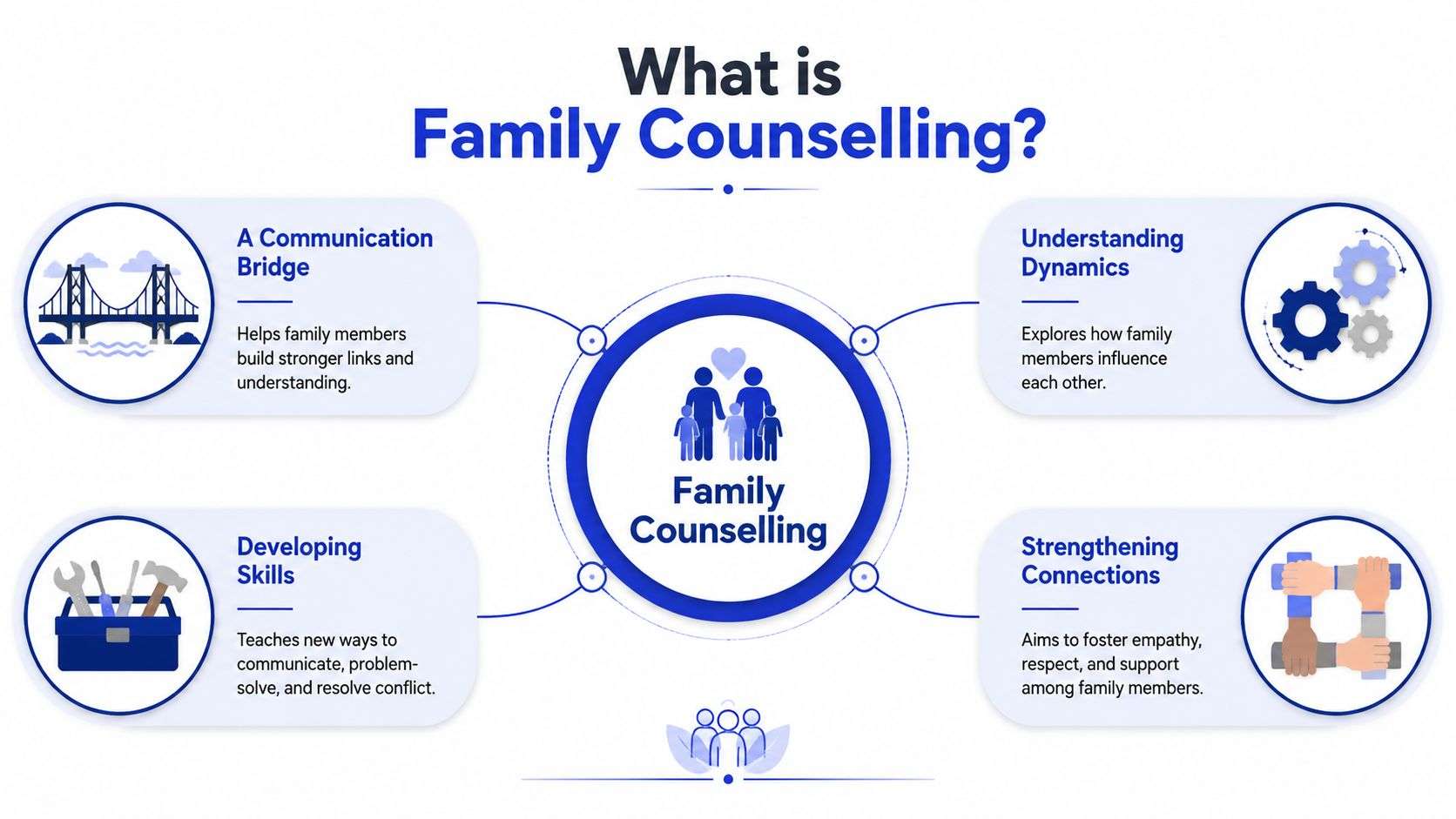
Family counselling is therapy that focuses on relationships between family members, not just on one person in isolation. Think of the counsellor less like a referee and more like a skilled team coach. Their job isn't to decide who's right. Their job is to help the family notice patterns, understand each other more clearly, and practise healthier ways of responding.
It's not about finding the one person to blame
One of the biggest worries parents have is this: “Is the therapist going to focus on my child?” Or, “Are we going to spend the whole time talking about my parenting?” Usually, no.
In family work, the focus is often on interaction. For example:
- A child shuts down. A parent pushes harder for answers.
- A parent gets stricter. A teen becomes more secretive.
- Two co-parents disagree. The child starts acting out during transitions.
The counsellor listens for these loops. Once the loop becomes clearer, the family can interrupt it.
What families actually work on
Family counselling can support many concerns, including communication problems, parenting stress, sibling conflict, separation, step-family adjustment, emotional distance, and recovery after difficult experiences. It may include everyone together, or a mix of group and smaller meetings depending on what's clinically appropriate.
Some sessions focus on practical tools. Others focus on emotional safety and repair.
A counsellor might help your family learn to:
- Slow conflict down before it escalates
- Speak more clearly about needs, limits, and feelings
- Listen without immediately defending
- Set steadier routines around transitions, school, or co-parenting
- Repair trust after rupture or prolonged stress
Why evidence-based approaches matter
Good family therapy isn't just a casual conversation. Counsellors often draw from structured methods such as EFT, EMDR, and IFS, depending on the needs in the room. According to the BC Family Counselling and Support Services outcome report, evidence-based modalities commonly used in family therapy are clinically validated to reduce trauma symptoms by 50 to 60 percent in family systems when applied across 6 to 10 sessions, with measurable improvements in family attachment scores.
Practical rule: Family counselling works best when people stop asking, “Who is the problem?” and start asking, “What keeps happening between us?”
That's often the turning point.
Signs Your Family Could Benefit from Support
Some families know right away that they need help. Others spend a long time wondering if their situation is “serious enough.” If that's where you are, try thinking less about whether your family qualifies for counselling and more about whether life at home feels harder than it needs to.
Common situations that often bring families in
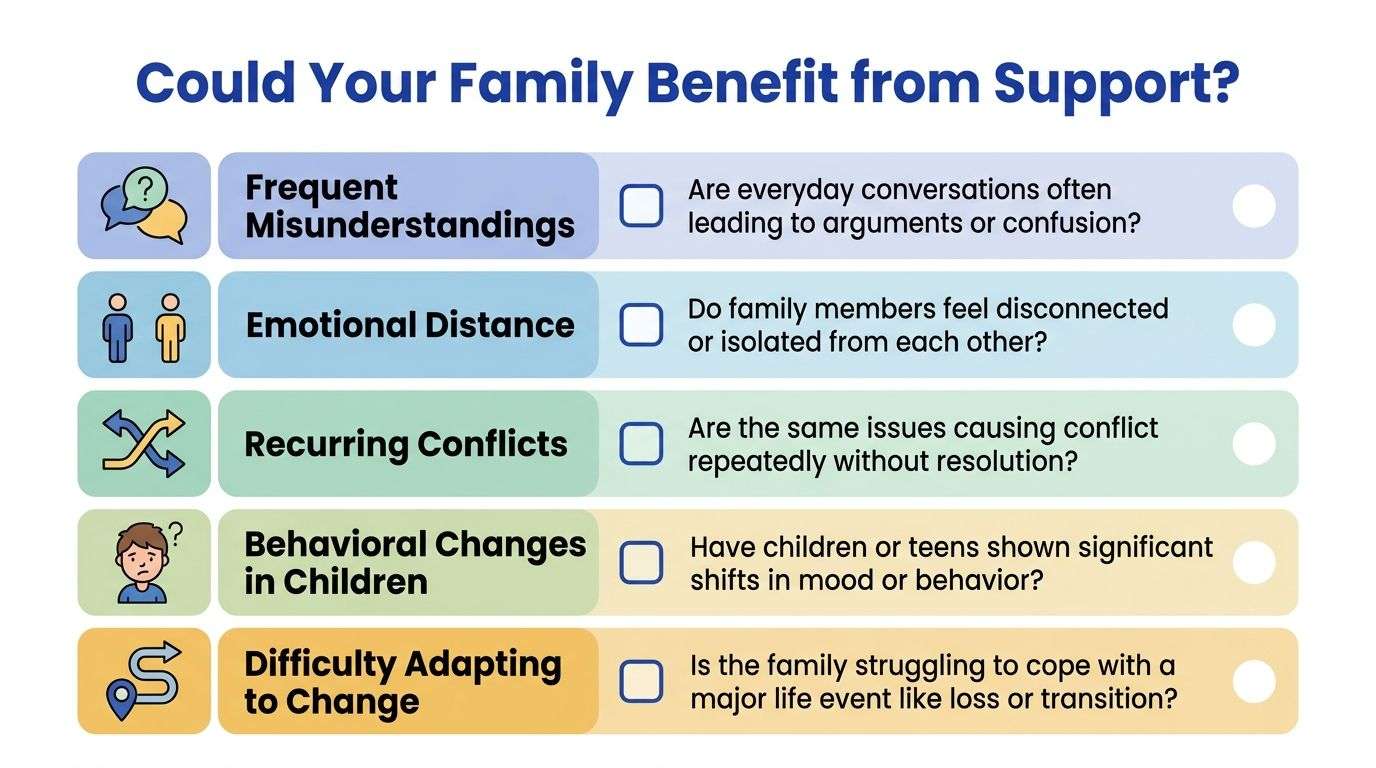
You may benefit from support if home feels stuck in one or more of these ways:
- The same argument keeps returning. It may start over chores, school, screens, bedtime, money, or respect, but the emotional pattern underneath never really changes.
- Someone in the family has pulled away. A child may be more irritable, a teen may isolate, or one parent may feel emotionally checked out.
- A major transition has shaken the household. Separation, blending families, grief, illness, relocation, or legal conflict can strain even strong relationships.
- Your child's behaviour has changed. Families may seek support when a child seems more anxious, angry, withdrawn, overwhelmed, or harder to reach.
- Co-parenting feels tense or inconsistent. Different rules across homes can leave children confused and adults exhausted.
When a relationship injury is affecting the whole home
Some family stress starts in the couple relationship and spreads outward. A breach of trust, secrecy, or repeated conflict between adults often changes the emotional climate for everyone in the home. If that's part of your situation, educational reading on couples therapy after infidelity can help you understand how relational repair may fit alongside family support.
A local reality many parents run into
Access can be confusing. Some services are free. Some require referrals. Some are easier to access for children than for the whole family. A Kelowna-area community information source notes that many local families struggle to tell the difference between public and private pathways, and that a 2024 BC government report indicates 32 percent of families in rural and semi-rural BC regions face delays of over 12 weeks for child and youth mental health services. The same source highlights that local information often doesn't clearly explain referral steps, wait times, or virtual access for families with transportation or internet barriers, as outlined in the Kelowna community information record.
If you've delayed reaching out because the system feels hard to navigate, that confusion is common. It isn't a sign that you've missed your chance to get help.
A Look Inside a Typical Family Counselling Session
The first session is usually less intense than people expect. It often begins with introductions, a review of privacy and limits to confidentiality, and a conversation about what brings your family in. The therapist will listen for each person's perspective, but also for the relationship pattern connecting those perspectives.
The first meeting
A parent might say, “My son won't talk to us.” The teen might say, “Every conversation turns into pressure.” Both statements matter. The counsellor helps the family move from competing stories toward a shared understanding of the cycle.
Early sessions often include questions like:
- What's been happening at home lately?
- When is the problem most likely to show up?
- What has your family already tried?
- What would feel different if counselling were helping?
- Who needs to feel safer, calmer, or more understood for things to improve?
The therapist may also ask about school stress, trauma history, separation, medical issues, grief, or other factors affecting the family system.
What later sessions often look like
Once goals are clearer, sessions usually become more active. The counsellor may pause conversations in real time and help family members say something in a new way. They may notice when someone becomes defensive, overwhelmed, or shut down and slow the pace so the discussion stays productive.
A session might include:
| Focus | What it can look like |
|---|---|
| Communication repair | Rephrasing criticism into clearer needs |
| Emotion coaching | Helping a parent respond to a child's distress without escalating |
| Conflict patterns | Mapping what happens before, during, and after recurring fights |
| Co-parenting support | Clarifying expectations, boundaries, and transition routines |
Some families worry that every session will feel like a confrontation. Usually, the opposite is true. A skilled therapist works to keep the room emotionally safe enough for honesty, but structured enough that people don't talk over one another or spiral.
“You don't have to arrive knowing exactly what to say. Part of the counsellor's job is helping your family find language for what's been hard to express.”
Does everyone attend every time
Not always. In family counselling, it can make sense to meet with everyone together, then occasionally with parents only, siblings together, or a co-parenting pair. That doesn't mean the work has stopped being family therapy. It means the therapist is using the format that best supports the family's goals.
For some families, that flexibility makes counselling feel much more manageable.
Navigating Your Counselling Options in Kelowna
A parent in Kelowna often reaches this stage with one practical question: where do we start? Once you know family counselling can help, the next hurdle is figuring out which door fits your situation, your budget, and your family's needs.
It helps to picture local support as a few different entry points rather than one long, confusing process. Some families begin with public child and youth services. Some start through separation and co-parenting supports. Others use extended health benefits, private counselling, or ICBC-approved treatment after a motor vehicle accident. The goal is not to find the perfect path on the first try. The goal is to choose the most workable first step.
Public and community pathways
If your concern centres on a child or teen, the Ministry of Children and Family Development offers a clear starting point in West Kelowna. Child and Youth Mental Health Services for Kelowna West, located at 15-2484 Main Street, West Kelowna, offers free services for children and teens, with drop-in intake on Tuesday mornings from 9:00 AM to 11:00 AM. Families are asked to arrive as close to 9:00 AM as possible, according to the BC government service information for Kelowna West.
If the main need is support for an adult family member, or for family stress affecting caregiving, CMHA Kelowna virtual counselling service may be another option. It offers free weekday virtual counselling for individuals, couples, families, and caregivers of youth, as described by CMHA Kelowna virtual counselling services.
Some families also qualify for targeted programs tied to income, family violence, or MCFD referral pathways. In the Central Okanagan, the Kelowna Family Centre's Stopping the Violence Program has provided couples counselling for low-income couples experiencing relationship problems who cannot afford private counselling. Its annual report also describes a Child and Youth Program funded by MCFD that accepts referrals for individual and family counselling through the Child and Youth mental health team, as noted in the Kelowna Family Centre annual report.
Separation, co-parenting, and legal transitions
Families dealing with separation often need more than emotional support. They may also need help with parenting plans, conflict reduction, and understanding what services exist alongside the legal process.
In that situation, the Kelowna Family Justice Centre can be a practical starting place. The centre is located at 119-565 Bernard Avenue and provides family justice services, including counselling support for families experiencing divorce and separation, with in-person and virtual hours during the week. Current schedule and contact details are listed on the BC government's Kelowna Family Justice Centre page.
Private counselling and ICBC-related support
Private counselling often makes sense when a family wants more choice in scheduling, a therapist with a specific approach, or support that can include different combinations of family members over time. It works a bit like choosing the difference between a general access clinic and a service customized to your household's exact concerns. Both can help. The best fit depends on what kind of flexibility and focus you need.
If your family is recovering after a motor vehicle accident, ICBC-funded counselling may also be available, depending on treatment approval and referral requirements. For worried parents, this can be one of the more confusing routes because the counselling is tied to the claim process, not only to the emotional impact on the family. Asking early about coverage, referral steps, and which family members can be included usually saves time and frustration.
If all of these options feel like a lot, that reaction makes sense. Many families do best when they start with one simple question: are we looking for free public support, claim-based support, or private therapy with more flexibility? Once that answer is clearer, the next step usually becomes much easier to choose.
How to Choose the Right Family Therapist for You
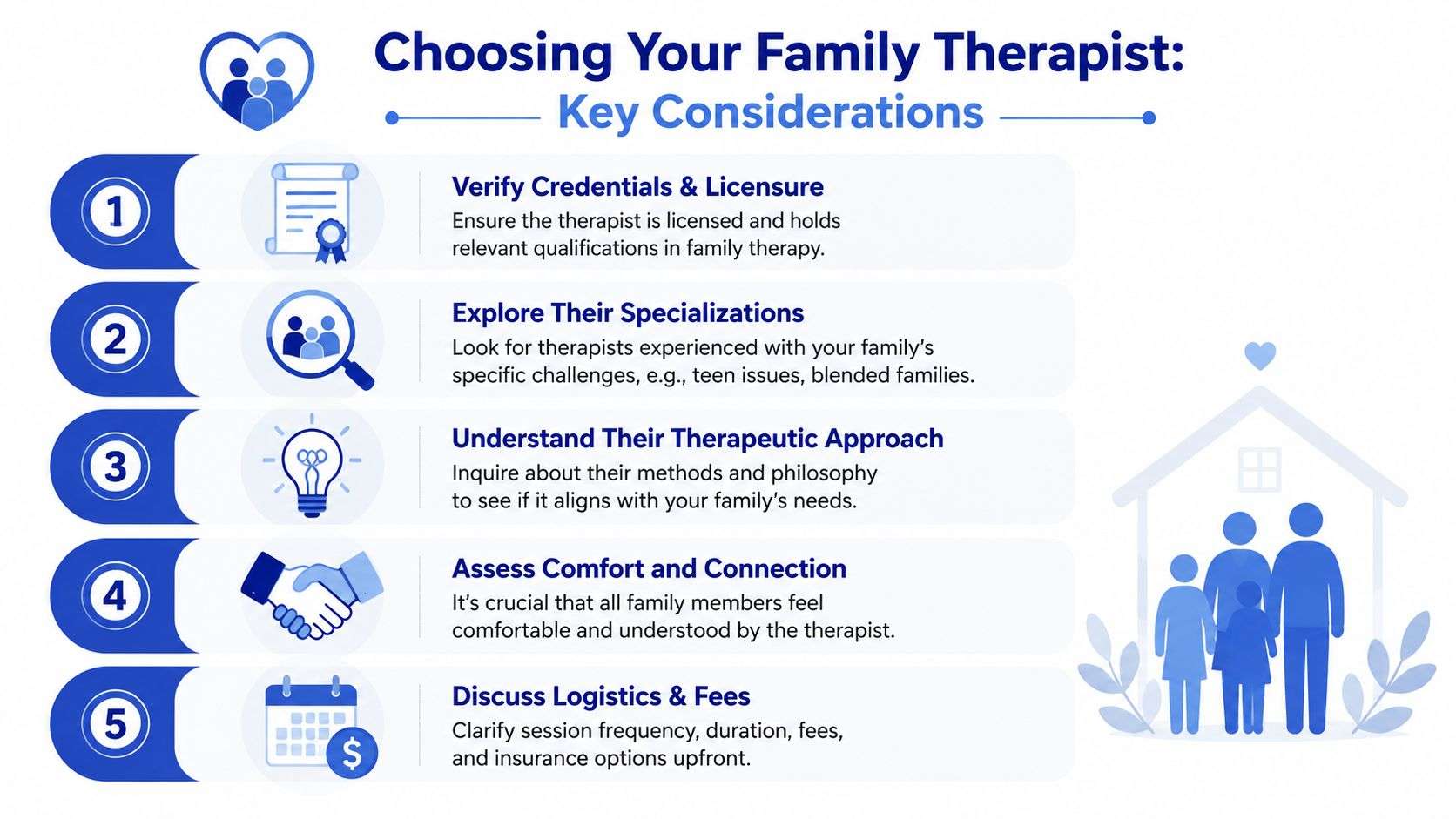
The right therapist needs more than training. They also need to feel like a good fit for your family's pace, values, and concerns. Credentials matter, but comfort matters too.
Questions worth asking
When you speak with a therapist or counselling office, consider asking:
- What credentials do you hold in British Columbia? Many families look for a Registered Clinical Counsellor (RCC) or another regulated, clearly identified professional.
- Have you worked with situations like ours? That might include parenting stress, blended family dynamics, teen conflict, trauma, or separation.
- How do you structure family sessions? Ask whether they usually meet with the whole family, parents separately, or a mix.
- How do you handle confidentiality in family work? This is especially important with teens and co-parenting situations.
- What if one family member is reluctant to attend? A thoughtful answer can tell you a lot about the therapist's approach.
Fit is a clinical factor, not a luxury
A therapist can be well trained and still not be the right person for your family. If family members leave the first contact feeling judged, confused, or pressured, it may be harder to build trust.
A good fit usually feels clear. You don't have to agree on everything, but you should feel respected, understood, and emotionally safe enough to keep going.
If you're unsure after an initial conversation, it's okay to ask more questions before booking.
Frequently Asked Questions About Family Counselling
How long does family counselling usually last
It depends on the concern, the goals, and how often your family attends. Some families come for short-term support around a transition or a specific conflict pattern. Others stay longer when there are layered concerns such as trauma, separation, co-parenting strain, or long-standing communication injuries.
Does everyone in the family have to attend every session
No. Family therapy often includes different combinations of people at different times. A counsellor may meet with the whole family, with parents only, with siblings, or with a co-parenting pair, depending on what will help most.
What if my teenager refuses to talk
That's common. A teen doesn't need to arrive eager or verbally open for counselling to be useful. Often the first goal is reducing pressure, building safety, and helping the family respond in ways that make conversation more possible over time.
Is family counselling confidential
Family counselling includes confidentiality, but the boundaries should be explained clearly at the start because more than one person is involved. Ask the therapist how they handle private disclosures, parent updates, and what happens if a safety issue comes up.
What if we're separated and trying to co-parent
Family counselling can still help. Some families attend together. Others focus on co-parenting sessions, transition planning, communication boundaries, or child-centred decision-making. If legal processes are also involved, counselling may sit alongside mediation or family justice services rather than replacing them.
If your home feels tense, disconnected, or harder to manage than it used to, learning more can be a steady first step. Interactive Counselling offers information about family, child, youth, co-parenting, and trauma-informed counselling options in Canada, including in-person and virtual formats, so families can better understand what kind of support may fit their situation.
Clinically Reviewed By
Amy Mosset, MCP, RCC-S
Amy Mosset is a Master Practitioner in Clinical Counselling, Clinical Supervisor, and the owner of Interactive Counselling. She provides trauma-informed, evidence-based care and clinical supervision to registered therapists, with a focus on ethical practice, client safety, and high-quality therapeutic outcomes.