You might be reading this in the parking lot after work, sitting on the edge of your bed at 2 a.m., or looking at a sink full of dishes that somehow feels too heavy to face. That kind of stuck feeling is common in depression. It can make ordinary life feel slow, distant, and harder than it should. For more information, see our Kelowna depression counselling.
Counselling can help you sort out what is happening, put words to feelings that have become foggy, and begin taking small, realistic steps again. For many people in Kelowna, the first question is not just "Do I need help?" It is "What happens next, how do I pay for it, and how do I find someone who uses methods that help?" For more information, see our counselling in Kelowna.
That practical side matters. British Columbia has a real gap between the number of people struggling and the number who get timely care, so it helps to know what to look for before you start contacting therapists. A good first step is finding someone who can explain their approach clearly, offer evidence-informed treatment for depression, and help you understand basics such as session format, fees, and whether coverage may apply through options like extended health benefits or ICBC when depression is connected to a motor vehicle accident. For more information, see our depression counselling.
Depression can blur important distinctions, too. If you are unsure whether what you are feeling is tied to a specific life event or something more persistent, it may help to compare clinical and situational depression.
A counselling office is not a place where you have to prove you are struggling enough. It is a confidential space where a trained professional helps you make sense of patterns, test practical tools, and figure out the next step that feels manageable.
The Weight of Depression and the Path to Feeling Lighter
Depression doesn't always look dramatic from the outside. Sometimes it looks like cancelled plans, unread texts, calling in sick because you can't face people, or doing everything you're supposed to do while feeling almost nothing. A lot of people describe it as moving through fog. Others say it feels like a heavy blanket they can't throw off.
You might still be going to work, caring for your children, showing up for other people, and still feeling empty. Or maybe you've stopped doing the things that used to make you feel like yourself. Both experiences are real. Both deserve care.
When people wonder if it is "bad enough"
One of the most common reasons people delay getting help is doubt. They tell themselves:
- "Other people have it worse." Pain doesn't need to win a competition to matter.
- "I should be able to handle this on my own." Depression often affects energy, concentration, sleep, motivation, and hope. It isn't a character flaw.
- "Maybe I'm just stressed." Sometimes stress, grief, burnout, and depression overlap in confusing ways.
If you're trying to sort that out, it may help to compare clinical and situational depression. That kind of distinction can make your experience feel less vague and less frightening.
You do not need to be at your worst before you ask for support.
Why counselling can make things feel more manageable
Good counselling doesn't force you to perform wellness. It gives you a place to slow down and tell the truth. That might mean saying, "I don't know why I'm crying all the time," or "I feel numb," or "I'm functioning, but barely."
A therapist helps you name patterns, notice what depression is doing to your thoughts and routines, and begin making changes that are small enough to be possible. Often, relief starts there. Not with a huge breakthrough, but with one clear conversation and one next step.
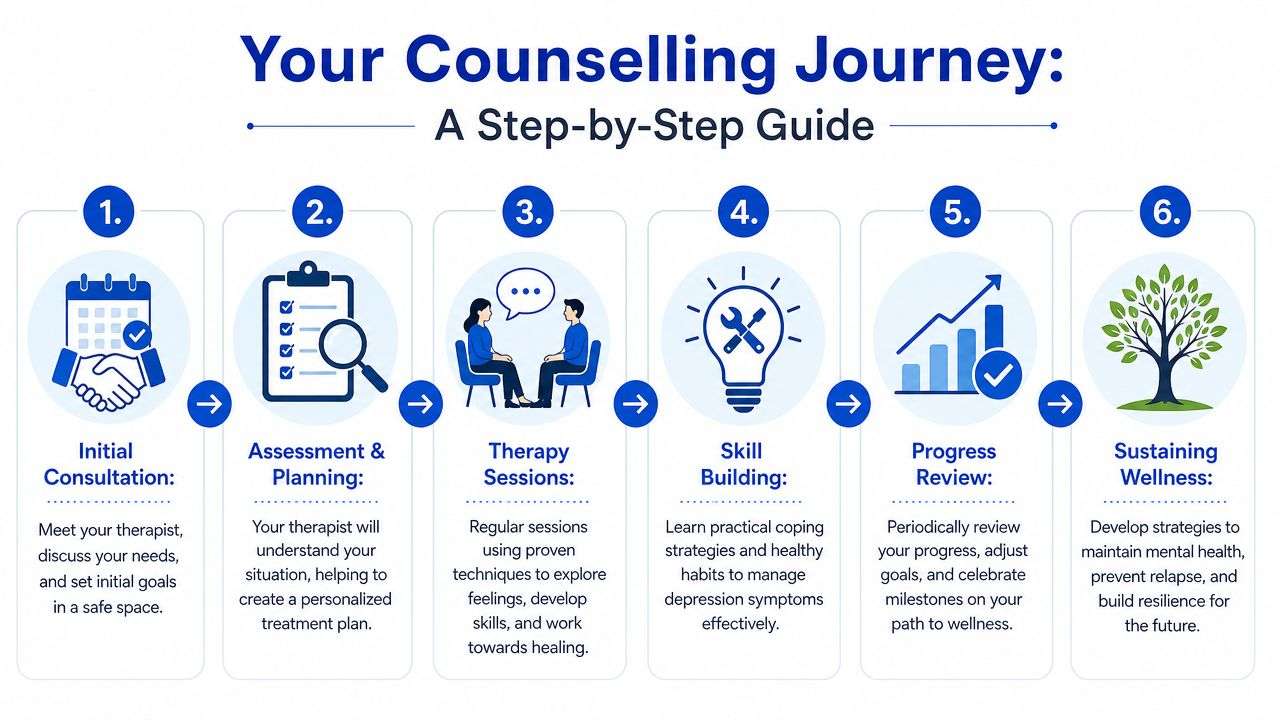
What to Expect from Your Counselling Journey
Starting therapy can feel awkward because many individuals haven't been shown what a session looks like. They worry they'll say the wrong thing, be judged, or be expected to open up instantly. That's not how good counselling works.
This process tends to be steadier and more collaborative than people expect.
The first contact
Your first step is usually a consultation, intake form, or first appointment booking. At this stage, people often ask practical questions:
- Availability: Do they offer in-person, phone, or virtual sessions?
- Focus: Do they regularly work with depression?
- Approach: Do they use structured, evidence-informed methods, or a more open-ended style?
- Fit: Do you feel at ease enough to try a first session?
You don't need to have your story organised. "I've been struggling and I don't know where to start" is enough.
What the first sessions usually involve
Early sessions often focus on understanding the full picture. A counsellor may ask about your mood, sleep, appetite, concentration, stress, health, relationships, work, losses, and what daily life currently feels like. They may also ask when things changed and what you've already tried.
The point isn't to interrogate you. It's to understand what depression looks like in your life.
A simple version of the process often looks like this:
- Check-in about how the week has been.
- Focus on one or two problems that feel most urgent.
- Explore patterns in thoughts, emotions, behaviour, or relationships.
- Practice a tool or discuss a strategy to try between sessions.
- Wrap up with a clear next step.
What a session feels like
Some sessions are emotional. Some are practical. Some may feel surprisingly ordinary, because healing often happens in repeated, grounded conversations rather than dramatic moments.
A therapist might help you notice things like:
| What you say | What a therapist may help you notice |
|---|---|
| "I can't get anything done." | Depression may be shrinking your energy and turning tasks into threats |
| "I don't enjoy anything anymore." | Loss of interest is a common symptom, not proof that nothing matters |
| "I keep avoiding people." | Isolation may be protecting you short term while worsening mood long term |
Practical rule: You don't need to trust the process all at once. You only need enough willingness to show up for one session.
The idea of a good fit
A good fit doesn't mean your counsellor has the exact same personality as you. It means you feel respected, understood, and safe enough to be honest. You should feel that your concerns are taken seriously and that the therapist can explain how they work.
If that fit isn't there, it's okay to keep looking. Therapy is personal. You are allowed to be selective.
Evidence-Informed Therapies That Help Treat Depression
If depression has been making everyday life feel heavy, it helps to know that counselling is not just a place to talk in circles. Good depression therapy usually has a map. You and the counsellor look at what is keeping the depression going, then you work on that pattern in a steady, practical way.
In Kelowna and across the Interior, structured approaches such as Cognitive Behavioural Therapy and Behavioural Activation are commonly used for depression care. They are often prioritized in public and community settings because research has shown they help many people, especially when treatment is focused and consistent. That matters in a region where many people need care and want to know what kind of help is likely to move the needle.
Cognitive Behavioural Therapy
Cognitive Behavioural Therapy, or CBT, looks at the loop between thoughts, feelings, and behaviour. Depression often bends that loop in a painful direction. A hard day turns into "I always fail." One unanswered text becomes "Nobody wants me around." A tired morning becomes "I will never get better."
CBT helps slow that process down. It teaches you to examine thoughts the way you might examine a weather forecast. Some forecasts are accurate. Some are overly dark. Some leave out important information. The goal is not to force cheerful thinking. The goal is to get closer to a fair and useful view of what is happening.
A counsellor using CBT may help you notice patterns such as:
- all-or-nothing thinking
- harsh self-judgment
- hopeless predictions
- assuming you know what other people think
- treating depression symptoms as proof about your character
Then you practice alternatives that are more balanced and more believable.
Behavioural Activation
Behavioural Activation, often shortened to BA, is especially helpful when depression has drained your drive. It starts with a simple idea. Mood and action affect each other. When depression lowers energy, people naturally pull back from routines, people, and activities. That withdrawal makes life smaller, and the smaller life gives depression more room to grow.
BA works like physical therapy for a stuck mood. You do not wait to feel ready first. You begin with small, planned actions that give your day a little more structure, contact, or meaning.
That might mean:
- getting out of bed at the same time three days this week
- standing outside with a coffee for five minutes
- texting one safe person back
- walking one block
- washing a few dishes, not the whole kitchen
These steps can look unimpressive from the outside. For someone who is depressed, they are often the first cracks in the wall.
Small actions matter because depression often improves through repetition, not through one dramatic burst of motivation.
Other therapies you may hear about
Some Kelowna counsellors also use interpersonal therapy, mindfulness-based cognitive therapy, acceptance and commitment therapy, or psychodynamic therapy. These approaches can be helpful, especially when they are matched to what is feeding the depression.
For example, interpersonal work may fit if your mood dropped after conflict, loss, or a major life change. Mindfulness-based approaches may help if you get caught in rumination and keep replaying the same painful thoughts. Acceptance-based work can help when the struggle with symptoms has become its own source of suffering.
How to tell whether a therapist's approach is evidence-informed
This part matters in Kelowna because finding a therapist is only half the job. You also want to know what happens next once you book. A good therapist should be able to explain their method in clear language, give you a sense of early goals, and describe how progress will be reviewed.
You do not need clinical vocabulary to ask good questions. Try these:
- "How do you usually treat depression?"
- "What methods do you use most often with low mood or loss of motivation?"
- "What would we specifically do in the first few sessions?"
- "How will we know if therapy is helping?"
Listen for answers that are concrete and understandable. If the explanation stays vague, or if the therapist cannot describe a plan beyond general support, it is reasonable to keep looking. In a region with long wait times and real gaps in access, choosing carefully can save energy, money, and weeks of uncertainty.
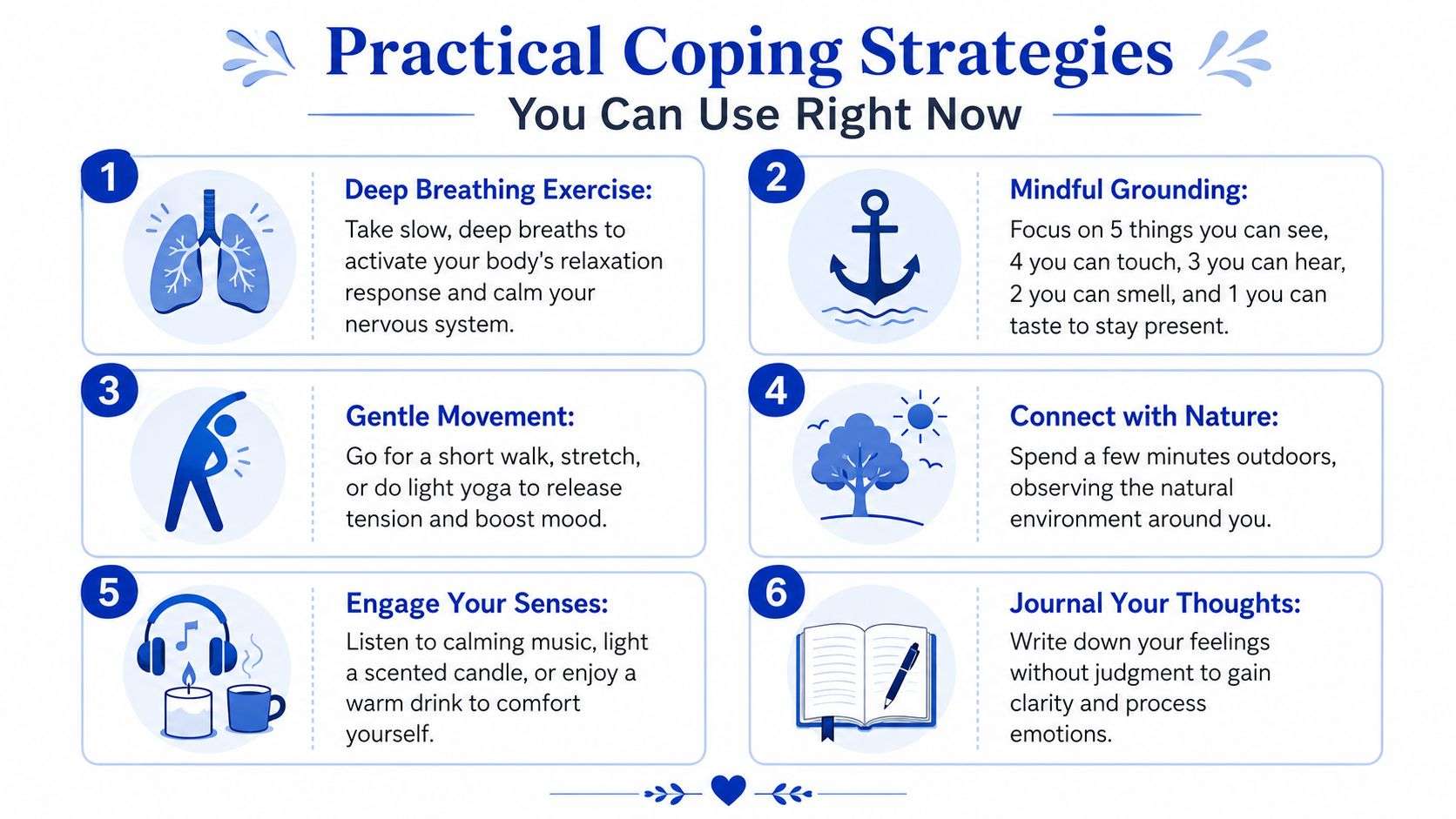
Practical Coping Strategies You Can Use Right Now
Counselling helps, but there are also things you can do today if you're having a hard hour or a hard evening. These aren't cures. Think of them as supports that can steady you until more help is in place.
They should be simple enough to use when your brain feels tired.
Start with your body
When people feel overwhelmed, they often try to think their way out first. Sometimes it's more useful to settle the nervous system.
A few options:
- Slow breathing: Inhale gently, exhale a little longer than you inhaled, and repeat for a few rounds.
- Grounding through the senses: Name 5 things you can see, 4 you can touch, 3 you can hear, 2 you can smell, and 1 you can taste.
- Gentle movement: Stretch, walk to the mailbox, or stand outside for a few minutes.
Use the smallest possible version
Depression often tells you that if you can't do everything, you should do nothing. Try answering that with the smallest version of the task.
Instead of "clean the kitchen," try:
- Put one plate in the dishwasher.
- Throw away obvious garbage.
- Wipe one counter.
- Stop there if that's all you've got.
That isn't laziness. That's pacing.
Build a basic rhythm for the day
A full self-care routine can feel impossible when you're depleted. A basic rhythm is more realistic.
Try choosing one anchor in each part of the day:
| Time of day | Simple anchor |
|---|---|
| Morning | Open curtains or drink a glass of water |
| Afternoon | Eat something with protein or step outside |
| Evening | Take a shower or plug in your phone away from the bed |
These anchors don't solve depression, but they can reduce the drift that often makes it worse.
If a coping strategy feels too big, it probably is. Make it smaller until it feels possible.
Reach for contact, not performance
You don't need to have a polished conversation. Sending "I'm having a rough day. Can you check in?" counts. Sitting in silence with someone counts. Letting another person know you're not okay counts.
If talking feels impossible, try writing down three sentences:
- What I'm feeling
- What I need most right now
- One thing I can do next
That can create enough structure to get through the next hour.
How to Find a Depression Counsellor in Kelowna
You finally decide to reach out for help, open a few therapist profiles, and then hit a wall. Everyone sounds kind. Many mention depression. The hard part is figuring out what happens next, and how to choose someone you can work with.
That confusion makes sense. Depression already drains focus and motivation. Sorting through credentials, approaches, fees, and availability can feel like doing paperwork with a weighted blanket on your chest.
There is a practical reason to slow down and choose carefully. A UBC study found that only 53% of British Columbians diagnosed with depression receive adequate treatment, which means many people are getting some support without getting enough of the right kind (CBC coverage of the UBC study). In other words, finding a counsellor is not only about getting an appointment. It is about finding care that is clear, appropriate, and realistic to continue.
Start with credentials, then look for clarity
A good first filter is registration with a recognised professional body in BC. That tells you the person meets baseline standards for training, ethics, and accountability.
After that, read their profile with one question in mind. Can this person explain how they help?
A therapist does not need to use a lot of jargon to be skilled. In fact, the opposite is often true. Clear explanations usually mean the clinician has a solid map of the work. If their description leaves you more confused than settled, that matters.
As you read, check for signs like these:
- They name depression as a regular area of practice
- They describe a specific therapy approach, not only general support
- They refer to evidence-informed methods
- They explain what sessions may involve in plain language
Ask a few direct questions before you book
You are allowed to screen a therapist. A brief consultation is not a test you have to pass. It is more like checking whether a pair of shoes fits before you commit to walking in them every week.
Useful questions include:
- "How do you usually treat depression?"
- "How will we decide what to work on first?"
- "What do you do when a client feels stuck, shut down, or low on motivation?"
- "How often do you usually recommend sessions at the start?"
- "Do you offer in-person, virtual, or phone appointments?"
Listen for answers that are concrete and understandable. You want to hear a process. For example, they might talk about setting goals together, tracking mood patterns, building routines, or working with negative thought cycles. Vague answers can leave you doing too much of the work alone.
Check the practical details that affect follow-through
The best therapy plan on paper will not help much if attending feels too hard to sustain. Depression treatment works a bit like physiotherapy. The approach matters, but so does whether you can realistically keep showing up.
In Kelowna, practical fit often includes:
- Location: Is the office easy to reach from your neighbourhood, work, or school?
- Format: Would virtual sessions make it easier to attend on low-energy days?
- Scheduling: Are appointment times available when you can consistently make them?
- Fees and coverage: Do they offer direct billing, receipts for extended benefits, or reduced-cost options?
- ICBC funding: If your depression began or worsened after a motor vehicle accident, ask whether they provide ICBC-funded counselling
- Style: Do you want a structured, skills-based approach, a gentler conversational approach, or a mix of both?
Explore different practices to compare their methods, availability, and formats. Interactive Counselling is one local option that offers counselling in person, by phone, and through secure virtual sessions, including ICBC-funded counselling for people recovering from motor vehicle accidents.
Pay attention to the first contact
The first email, phone call, or consultation often tells you a lot. You are not looking for perfection. You are looking for enough safety and clarity to begin.
Here is a simple way to assess that first interaction:
| Question | Why it matters |
|---|---|
| Did I feel heard? | Feeling respected makes it easier to be honest |
| Did they explain their approach clearly? | Clear explanations suggest a thoughtful treatment plan |
| Did they answer my actual questions? | Direct answers help you judge fit and competence |
| Did the logistics feel manageable? | Recovery is easier to support when attendance is realistic |
| Can I picture myself coming back next week? | Consistency often matters more than finding a perfect match |
A perfect fit is rare. A good enough fit can still help you feel lighter, steadier, and less alone. The first step is often very small. It may only be sending one email and asking one clear question. That is still a real start.
What to Do If You Need Immediate Help
It can happen late at night, or in the middle of an ordinary afternoon. The thoughts get louder, your body feels agitated or shut down, and it becomes hard to trust yourself to get through the next hour safely. In that moment, the goal is not to solve depression. The goal is to get support around you right now.
If you are in immediate danger, think you may act on thoughts of harming yourself, or cannot stay safe, call 911 or go to the nearest hospital emergency department now. You do not have to wait for things to get worse before asking for urgent help.
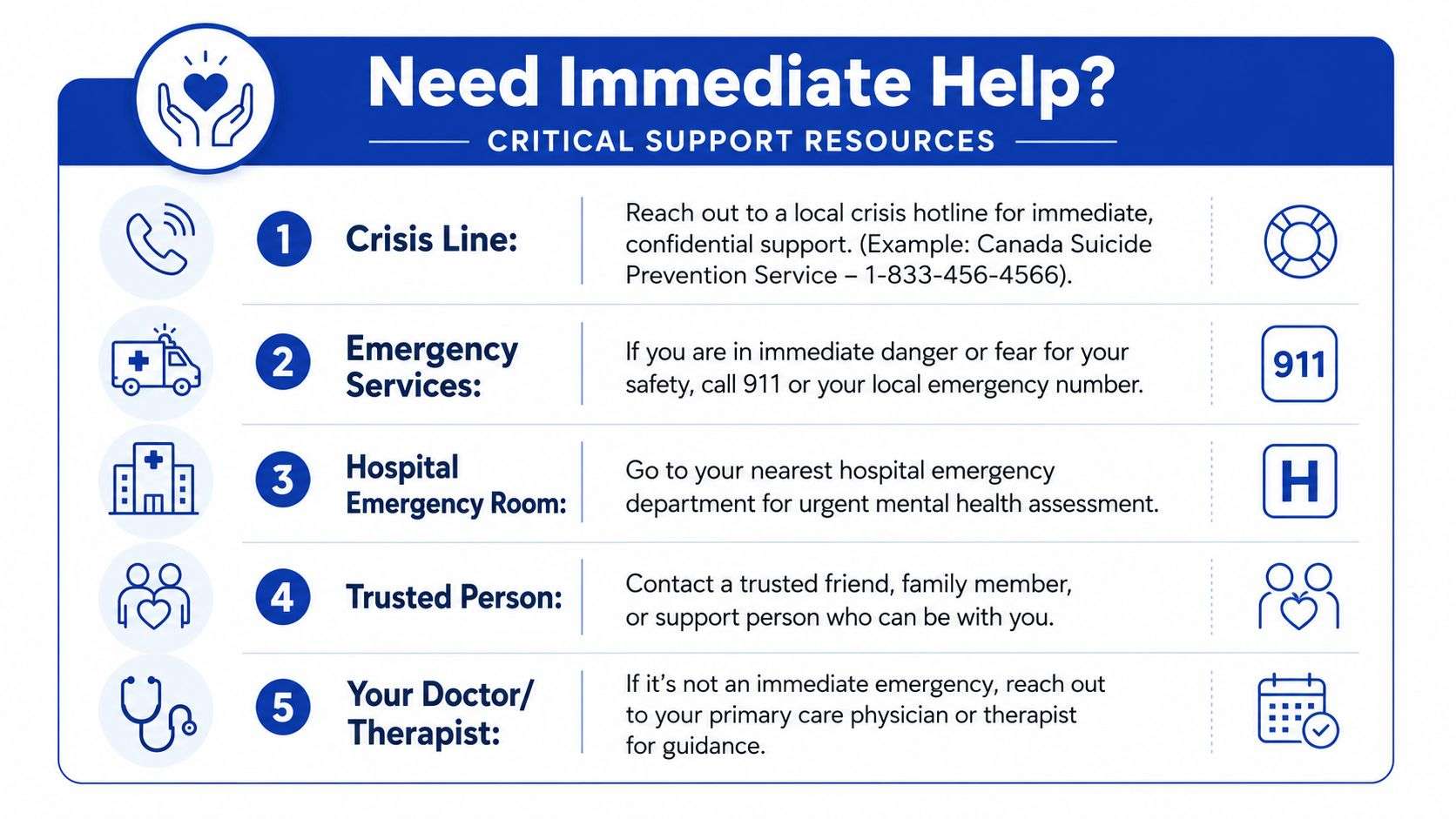
If it is not a life-threatening emergency but you need help soon, focus on the next small action. Depression often shrinks your field of view. A short crisis plan can work like a flashlight. It does not fix everything, but it helps you see the next step.
A simple safety plan for hard moments
Keep these options in your phone, wallet, or on paper near your bed:
- Call 911: If you are in immediate danger or fear for your safety.
- Go to the nearest emergency room: Hospital staff can arrange an urgent mental health assessment.
- Call Talk Suicide Canada at 1-833-456-4566: You can speak with someone right away.
- Call a trusted person: Ask them to stay on the phone, come over, or help you get to care.
- Contact your doctor or therapist: If you need urgent guidance and can stay safe while waiting for a response.
If you are in Kelowna or elsewhere in the Interior Health region
Adults in Kelowna can also call 310-MHSU (6478) to reach the nearest Community Mental Health and Substance Use team in the Interior Health region. If you are not sure whether your situation is "serious enough," call anyway. Triage exists for exactly that reason. The person on the line helps sort out what kind of support is needed next, whether that is crisis support, urgent follow-up, or direction to local services.
Reaching out during a crisis is a responsible step toward safety.
If calling feels hard, make the task smaller. Text a trusted person, "I do not feel safe being alone right now," and ask them to sit with you while you call. If words are hard to find, start with one clear sentence: "I'm not feeling safe with myself right now."
Frequently Asked Questions About Depression Counselling
Do I need a doctor's referral or a formal diagnosis to start counselling
Usually, no. Many people begin counselling because they know something feels wrong, even if they haven't named it yet. You can start with symptoms, not certainty. Saying "I've been feeling low, tired, and disconnected" is enough.
If a formal diagnosis becomes important for medical or administrative reasons, your counsellor can help you understand what kind of provider may be needed for that step.
How long does counselling for depression usually take
It depends on what you're dealing with, how long you've been struggling, and what kind of therapy you're using. Some people start to feel relief once they have structure, language for what they're experiencing, and a few practical tools. Others need longer-term support, especially if depression is tied to trauma, grief, relationship stress, or repeated episodes over time.
A good therapist should be able to talk openly about pace, goals, and how you'll review progress together.
Is what I say in counselling confidential
In most situations, yes. Counselling is designed to be private so you can speak openly. There are legal and ethical limits, especially if there is an immediate safety concern involving you or another person, or where records are required by law. Your counsellor should explain confidentiality clearly at the start, in plain language.
If you feel unsure, ask. You deserve to know how your information is handled.
What if I don't connect with the first counsellor I meet
That happens more often than people think. A poor fit doesn't mean therapy won't help. It usually means that particular relationship or style wasn't right for you.
You can say:
- "I think I need a different approach."
- "I'm looking for someone more structured."
- "I'd like someone with more experience in depression."
That isn't rude. It's part of finding care that works.
What if I'm functioning on the outside but still feel awful
You still deserve support. Many people with depression keep working, parenting, studying, and meeting obligations while struggling internally. Functioning isn't the same as feeling well. Counselling can help before things collapse, not only after.
If you'd like to learn more about what therapy can look like and what kinds of support are available, Interactive Counselling offers information about counselling services in a calm, straightforward way. You don't have to decide everything today. Sometimes the next right step is reading, reflecting, and letting yourself consider support.
Clinically Reviewed By
Amy Mosset, MCP, RCC-S
Amy Mosset is a Master Practitioner in Clinical Counselling, Clinical Supervisor, and the owner of Interactive Counselling. She provides trauma-informed, evidence-based care and clinical supervision to registered therapists, with a focus on ethical practice, client safety, and high-quality therapeutic outcomes.