
Yes, families in Vernon can get autism counselling direct-billed through BC Autism Funding. If your child is eligible, the program provides $22,000 annually for children under age 6 and $6,000 annually for children ages 6 to 18, and direct billing can be set up by submitting a Request to Pay (RTP) form through the My Family Services portal. For more information, see our Vernon autism counselling.
Navigating Support for Your Child in Vernon
You might be reading this after a diagnosis appointment, after a difficult school meeting, or after one of those late nights where you open too many tabs and end up more overwhelmed than when you started. Many families in Vernon reach this point carrying several feelings at once. Relief that there may be support. Grief for how hard things have been. Worry about getting the paperwork wrong. For more information, see our counselling in Vernon.
"Yes, families in Vernon can access autism counselling through BC Autism Funding by confirming eligibility, choosing an approved provider, and submitting a Request to Pay form through My Family Services." For more information, see our autism counselling.
That one sentence is the practical answer. The emotional reality is a little messier.
A lot of parents tell themselves they should already understand the system. But terms like MCFD, RTP, or direct billing are not everyday language. Of course it feels confusing. None of this is intuitive when you're also parenting, working, managing appointments, and trying to hold your child together through transitions, meltdowns, anxiety, or exhaustion.
When support feels urgent and paperwork feels heavy
A common moment goes like this. A parent hears that funding may cover counselling, feels hopeful for the first time in weeks, and then gets stuck on the next question. Who do we contact first? Do we need to pay upfront? Is family counselling included? What if we choose the wrong provider?
Those are good questions.
You do not need to solve the whole process in one sitting. You need the next clear step.
Autism counselling in Vernon, direct-billed through BC Autism Funding, can reduce one layer of stress because eligible sessions may be billed through the program rather than added to your family's immediate out-of-pocket load. That matters when your energy is already stretched thin.
A calmer way to approach this
Think of this less like passing a test and more like setting up support in the right order. First, you understand what the funding can do. Then you choose a counsellor who feels like a good fit. Then you complete the form that lets billing happen properly. After that, you can focus more on care and less on chasing paperwork.
By the end of this guide, you should have a clearer sense of:
- What the funding covers
- How direct billing works in plain language
- What to ask when choosing a counsellor
- How to complete the practical steps without extra confusion
- What counselling may look like once sessions begin
How BC Autism Funding Works for Your Family
A lot of families hit the same wall here. You finally learn that counselling may be covered, then the next page is full of categories, acronyms, portals, and forms. Hope goes up for a moment, then stress creeps back in because the system feels like it was written for administrators, not tired parents.
BC Autism Funding helps eligible families pay for approved autism-related supports, including counselling. The hard part is not usually the idea of the program. The hard part is understanding how the rules affect real decisions at home.
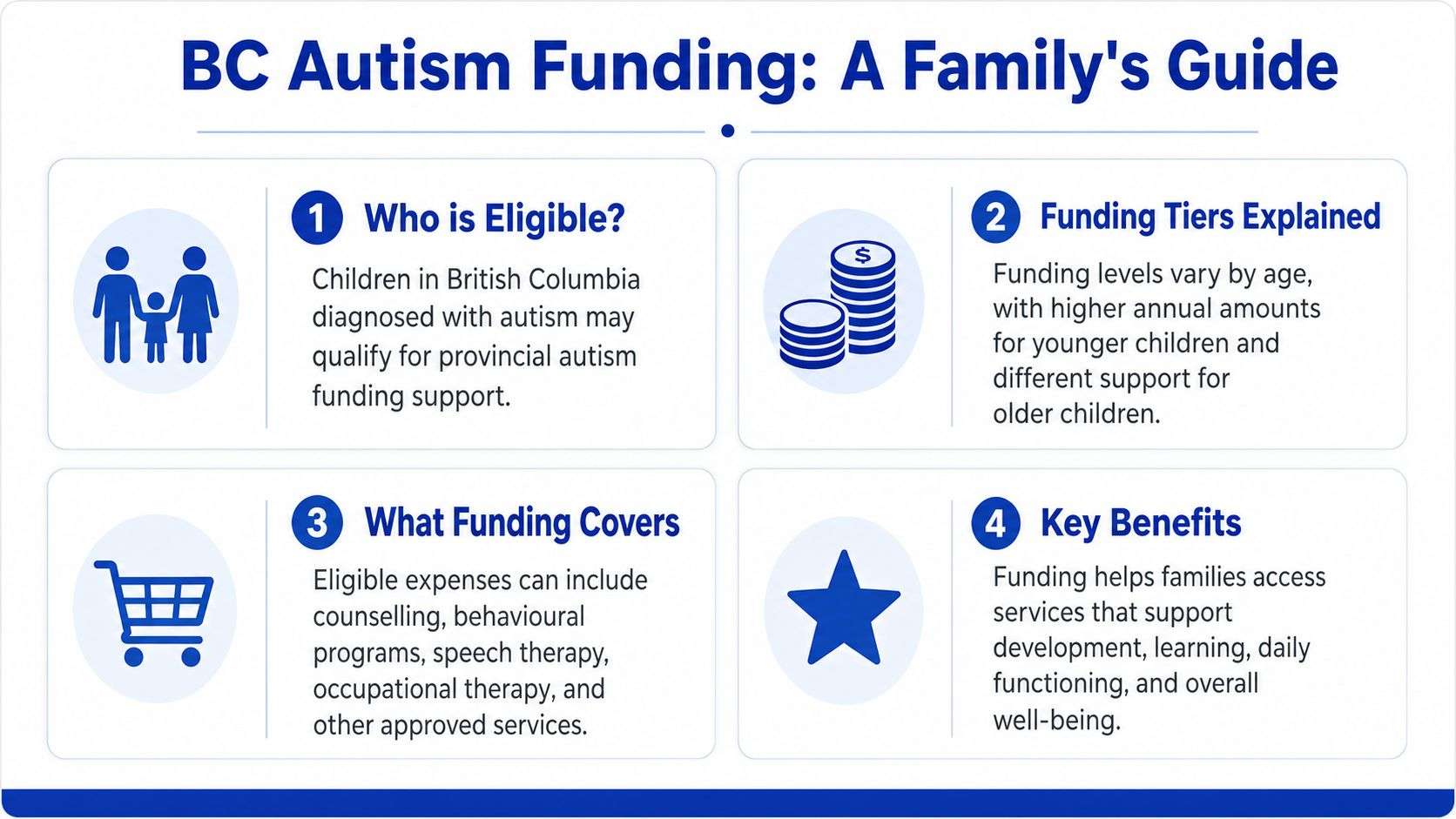
One helpful place to start is the age-based funding structure set by the province. The annual amount is different for younger children and for school-aged children and teens. The funding is also divided by use. A larger portion is meant for therapeutic services such as counselling, while a smaller portion may be approved for equipment.
What those funding categories mean in daily life
The funding works more like a set of labeled envelopes than one open bank account.
That distinction matters. If a family assumes all approved money can be used interchangeably, planning gets confusing fast. Counselling and other therapeutic services come from the therapy portion. Equipment requests follow a different path and are not handled in quite the same way.
A simple summary helps:
| Area | What it means for your family |
|---|---|
| Age-based funding | Your child's yearly amount depends on their age group |
| Therapy funding | Counselling and other approved services are paid from this portion |
| Equipment funding | Certain approved items may be covered under a separate portion |
| Yearly authorisation | Direct billing depends on the right provider being authorised properly |
If this feels picky, it helps to remember why the categories exist. They are the province's way of deciding how funding can be used. Families are still making choices, but within a framework.
The three terms that cause the most confusion
Government language can make a manageable process feel much bigger than it is. These are the terms families usually need first:
- MCFD is the Ministry of Children and Family Development. This is the ministry that oversees the program.
- RTP is the Request to Pay form. It authorises a specific provider to bill approved services to your child's funding.
- My Family Services is the online portal used for parts of the administrative process, including checking information and managing communication.
Direct billing becomes easier to understand once you strip away the jargon. It means an approved provider bills through the authorised process for eligible sessions, instead of asking your family to pay first and sort it out later.
Why the Request to Pay form carries so much weight
Many parents assume that once funding is approved, billing will happen automatically.
It does not.
The Request to Pay form is the permission slip that connects your child's funding to a specific provider. If that connection is missing, incomplete, or out of date, services can be delayed even when the child is eligible and the counselling itself fits the funding rules.
That is why this form matters so much emotionally as well as practically. Families are often already stretched thin. A missing authorisation can create one more phone call, one more follow-up, one more week of waiting when support already feels overdue.
A useful rule is simple: remember the provider name on your yearly authorisation, and remember the words Request to Pay.
About planned changes to the program
Families may also hear about future changes to autism funding in BC. As noted earlier from official program information and provider guidance, the current Autism Funding Program is scheduled to be phased out in 2027, with changes planned after that date. Planned government timelines can change, so it is wise to check the latest provincial information rather than rely on an older article or a second-hand summary.
What matters right now is the part you can control.
Keep your family details up to date with the program. Review your current funding status. Make sure the provider you want to use is the one properly authorised for payment. If your address, custody arrangements, or care situation changes, report that promptly through the usual program channels.
That kind of upkeep can feel like paperwork for paperwork's sake. In reality, it works more like keeping the rails clear so care can keep moving.
Finding the Right Counsellor in Vernon
It is a common moment for parents. You finally sort out the funding details, then a harder question lands on the table. Who is the right person to trust with your child, your family stress, and the parts of daily life that already feel tender?
For many families, this is the part that feels surprisingly heavy. A counsellor is not just a name on a list. This is someone your child may need to feel safe with, and someone you may need to speak to on the days when home feels stretched thin.

Look for fit in the room, not just qualifications on the page
Training matters, of course. Fit matters just as much.
A counsellor can have the right credentials and still feel wrong for your child. Some children connect through words. Others need drawing, movement, pauses, visual supports, or a slower start. Some parents are looking for help with emotional regulation. Others need support around routines, family conflict, school stress, sibling strain, or the exhaustion that builds when everyone is trying their best.
A good counsellor should be able to explain their approach in plain language, almost like translating a complex map into the next three turns you need.
You might ask:
- How do you build trust with autistic children or teens?
- How do you adapt if my child communicates indirectly, uses few words, or needs more processing time?
- Do you include parents or caregivers in the work when that would help?
- What usually happens in a first session?
- How do therapy goals connect back to life at home or school?
These questions are useful for two reasons. They help you learn what the counsellor does. They also show you how the counsellor responds when a parent is trying to understand something important.
Notice how you feel after the first conversation
This part is easy to overlook.
After a phone call or consultation, many parents focus on the facts they heard. Try to notice your own nervous system too. Did you leave the conversation feeling clearer? Did the counsellor answer directly? Did they make room for your knowledge of your child?
The right fit often creates a sense of steadiness. Not perfection. Just a little more room to breathe.
Ask about the practical side early
Administrative questions belong in this conversation. They are not rude, and they are not a distraction from care.
For a family already carrying school concerns, appointments, paperwork, and everyday parenting, confusing billing can feel like one more stone in an already full backpack. A provider who works with autism funding should be able to explain their process calmly and clearly.
Useful questions include:
- Are you set up to work with BC Autism Funding direct billing once authorisation is approved?
- What forms or intake documents do you need before the first appointment?
- What happens if an authorisation is incomplete or expires?
- Who helps with billing questions if paperwork is still being processed?
Clear answers here often tell you something important about the whole practice. Organized billing usually reflects organized communication.
Signs a counsellor may be a good match
Families often feel pressure to get this choice exactly right the first time. It helps to look for a few grounded signs instead of chasing certainty.
A promising fit often looks like this:
- They explain things clearly. You do not have to decode jargon.
- They adjust their style. They can respond to sensory needs, communication differences, and changing energy levels.
- They see the family context. They understand that supporting a child may also involve parent coaching, caregiver check-ins, or work around routines and relationships.
- They respect your expertise. You are treated as the person who knows your child best.
- They have a clear process. Intake, consent, scheduling, and billing are explained in a way that makes sense.
Give yourself permission to choose the next right step
You are not choosing a perfect counsellor for every season ahead.
You are choosing the next supportive relationship that fits your child and your family right now. That is a much more human decision, and usually a more realistic one. If the fit is not right, it is okay to reassess. Families do this all the time.
Sometimes the best choice is the counsellor who helps your child feel safe enough to begin, and helps you feel less alone while you do.
Your Step-by-Step Guide to Direct Billing
You have finally found a counsellor who seems like a good fit. Your child may be ready, or at least as ready as anyone can be for something new. Then one more task lands on your plate. A portal login, an authorisation form, a question about whether you can book now or need to wait.
This is often the point where families feel their energy drop.
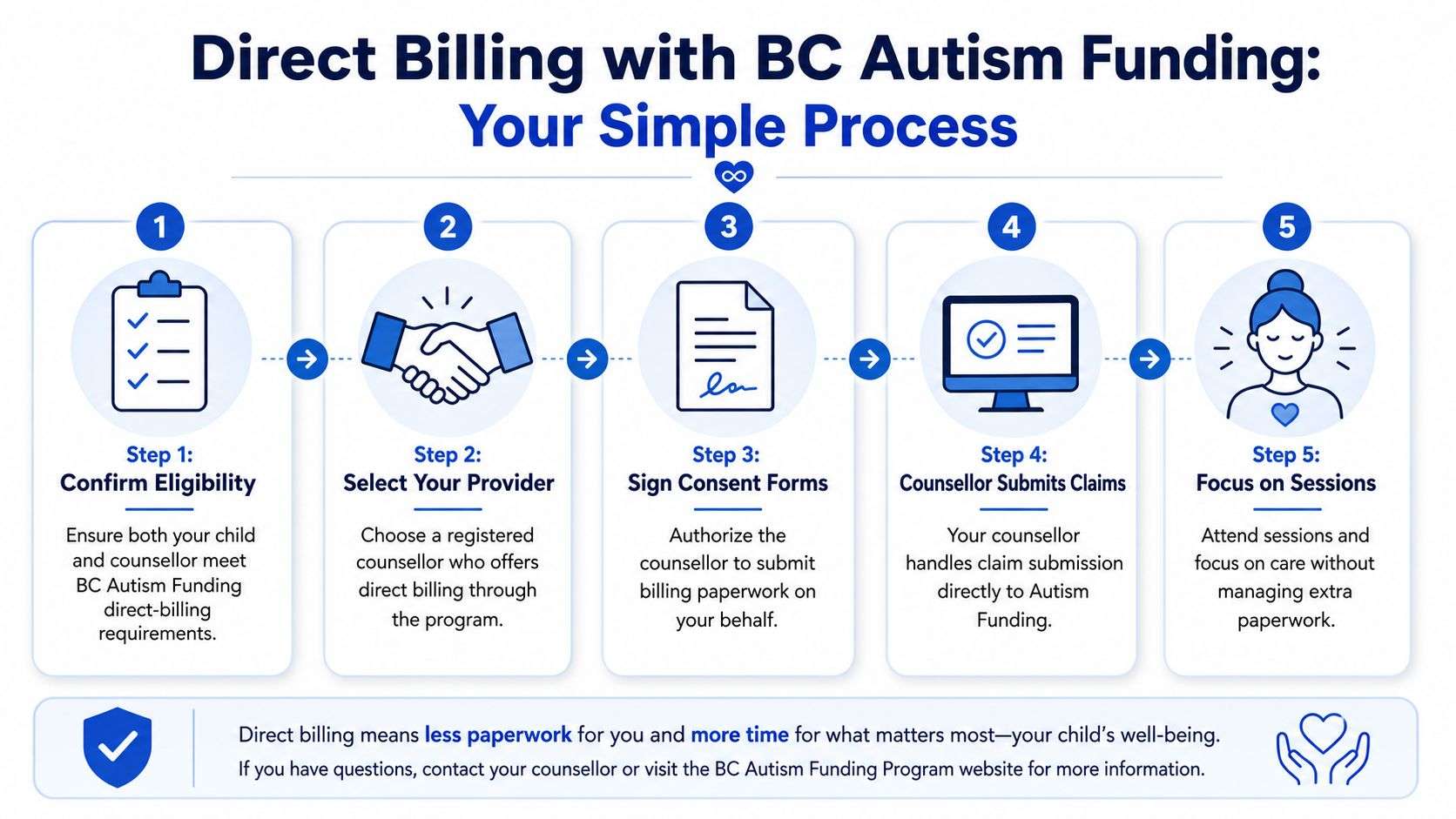
It helps to treat direct billing like packing for a short trip. You do not need to solve everything at once. You just need the right items in the right order.
Step one: confirm your child's current eligibility
Start with the part that feels least emotional. Check that your child is still set up under the correct funding stream and that you can access the My Family Services portal.
If your family details have changed, pause here and sort that out first. Changes to address, custody, or care arrangements can affect paperwork. Families often want to push ahead because they do not want to lose momentum, but this is one of those moments where ten extra minutes now can save weeks of back-and-forth later.
Step two: choose the provider before filing the authorisation
The Request to Pay form is tied to a specific provider. It is not a general approval for any counsellor you may decide to try later.
That detail trips people up.
Before you submit the form, confirm a few practical points with the clinic:
- The provider name is exactly the one you plan to use
- Their billing or administrative details are current
- They have told you what paperwork they need from you
- They have explained whether to wait for activation before booking
This step matters because changing providers right after submitting an authorisation can create delays that feel confusing and unnecessary.
Step three: submit the Request to Pay form
Once your provider is chosen, complete the annual Request to Pay authorisation through My Family Services. This is the approval that lets the provider bill through your child's funding.
As noted earlier in the article, the current program is scheduled to be discontinued after March 31, 2027, so families using the present system should make sure the yearly authorisation is completed and up to date.
Missing the yearly authorisation does not always end support. It often means services pause until the paperwork is active.
Step four: wait until billing is active
This is usually the hardest part emotionally, because it can feel like nothing is happening.
Something is happening. It is just administrative.
If you are unsure whether the setup is complete, ask for a direct answer instead of guessing. A short email is enough:
- Has my RTP for this provider been received?
- Is direct billing active for counselling sessions yet?
- Should I wait before confirming the appointment?
Clear questions often lead to clear timelines, and that alone can lower stress at home.
Step five: keep a simple record
Your record system does not need to be fancy. One folder on your phone, one email folder, or one paper envelope is enough.
Keep copies of:
- Your child's funding information
- Screenshots or confirmations of submitted authorisations
- Emails about billing or approval dates
- Session dates and any summaries you receive
These notes give you something solid to return to if dates get blurred together, if a provider changes, or if you need to check what was approved and when.
If you are also weighing different formats of support, including remote options that may feel easier on busy or overloaded weeks, Insight Diagnostics Global's counselling options offer a helpful general overview.
What to Expect in Your Counselling Sessions
Once the forms are sorted, many parents feel a new wave of uncertainty. The paperwork is one thing. Sitting in the room is another. People often wonder whether their child will talk, whether the therapist will "get" them, or whether the first session will feel awkward.
That's normal.

The first appointment is usually about understanding, not judging
A first session often feels more like orientation than treatment. The counsellor may ask about your child's strengths, stress points, routines, sensory needs, communication style, and what home life has been feeling like lately. Parents or caregivers are often part of that conversation, especially at the beginning.
If your child is young, counselling may include play, movement, visuals, or shared activities rather than long verbal discussion. If your child is older, the therapist may move slowly, giving them space to decide how much they want to share and when.
Goals often sound more ordinary than families expect
Many families arrive thinking they need to describe a major clinical goal. Usually, the most useful goals are everyday ones.
Examples might sound like this:
- Mornings feel chaotic and end in tears
- My child shuts down after school
- Transitions between homes are rough
- We want less conflict and better recovery after hard moments
- Our teen needs a safe place to talk about school, stress, or feeling misunderstood
Those are meaningful therapy goals because they connect directly to daily life.
Counselling doesn't need to begin with polished language. "We're all exhausted and need help" is a valid starting point.
Family involvement can be part of good care
Autism counselling often works best when it supports the child's environment, not only the child in isolation. That can include parent conversations, family sessions, or caregiver coaching when those supports help life outside the therapy room feel steadier.
Some families also like reading about different formats before they start. If you're comparing options such as remote support or phone-based sessions, Insight Diagnostics Global's counselling options offer a general example of how counselling can be delivered in flexible ways.
Progress may feel quiet at first
The earliest changes are often subtle. A child may enter the room more easily. A parent may understand one trigger more clearly. A sibling conflict may de-escalate faster than it used to. Those small shifts matter because they often build the foundation for larger change.
Trust usually comes before visible progress. That's not a sign therapy isn't working. It's often how therapy starts.
Your Questions Answered
Can BC Autism Funding be used for counselling that helps parents or the wider family?
It can, when the counselling is part of supporting the child's needs and environment. Many families are surprised to learn that helpful care isn't always limited to child-only sessions. Parent support, family sessions, and work on routines or communication can all be relevant when they help create a steadier home life for the child.
What if my child doesn't want to talk to a counsellor?
That happens often. Counselling doesn't depend on immediate verbal openness. A therapist may begin with play, visual supports, shared activities, shorter interactions, or parent sessions that help build trust and reduce pressure.
What if we submitted nothing yet and feel behind?
You're not the only family in that position. The most useful move is usually the simplest one. Pick the next concrete task and do that first. For most families, that means confirming the provider choice and completing the annual authorisation through My Family Services.
Can we change counsellors if the fit isn't right?
Families sometimes do. If that happens, the administrative side matters as much as the clinical side. Because direct billing depends on provider-specific authorisation, you'll want to make sure the paperwork matches the provider you intend to see.
How should we prepare for a first session?
Bring the basics. A simple summary of your concerns, school or home stress points, past supports, and what you're hoping will feel better is enough. You don't need a perfect script. Honest, plain language is usually the best starting point.
If you're feeling worn down by the process, that doesn't mean you're doing anything wrong. It means you've been carrying a lot. Autism counselling in Vernon, direct-billed through BC Autism Funding, can be one way to reduce both emotional and practical strain when the pieces are set up carefully.
Support is allowed to be practical. It is also allowed to feel human.
Learning more about counselling approaches can be a gentle next step when you're ready.
If you'd like to explore support in a calm, straightforward way, Interactive Counselling offers information about counselling for children, youth, parents, couples, and families, including practical, evidence-informed care designed to meet people where they are.
Clinically Reviewed By
Amy Mosset, MCP, RCC-S
Amy Mosset is a Master Practitioner in Clinical Counselling, Clinical Supervisor, and the owner of Interactive Counselling. She provides trauma-informed, evidence-based care and clinical supervision to registered therapists, with a focus on ethical practice, client safety, and high-quality therapeutic outcomes.