Online anxiety counselling has become a normal part of care in Canada. During the pandemic, approximately 30% of Canadians used virtual mental health services, and nearly 70% of users reported high satisfaction with the convenience and effectiveness of online therapy for concerns such as anxiety, depression, and trauma, as noted in reporting on Canadian telehealth adoption. If you're sitting at home wondering whether support can really happen through a screen or a phone call, the short answer is yes, for many people it can. For more information, see our anxiety counselling.
'Online anxiety counselling offers Canadians confidential, effective mental health support from a licensed therapist through secure video or phone calls, making professional care accessible from the comfort and privacy of home.'
Anxiety often shows up in ordinary moments. You might be answering emails with a tight chest, replaying a conversation from yesterday, or waking in the night convinced you've forgotten something important. Some people spend months telling themselves they should be able to manage it alone. Others want help, but the idea of travelling to an office, sitting in a waiting room, or trying to fit appointments into an already packed day feels overwhelming.
That's one reason online therapy has become such a meaningful option across Canada. It brings support closer, not by making therapy casual or watered down, but by making it easier to reach.
Finding Calm in a Connected World
It is 10:30 at night. The house is finally quiet, but your mind is not. You are replaying a conversation, scanning for what you might have said wrong, and feeling that familiar mix of tension and exhaustion. Part of you wants support. Another part immediately starts listing obstacles. How would you get to an office? Who would need to know? What if the effort of arranging help feels harder than the help itself?
For many Canadians, that is the moment online counselling starts to make sense. The value is not only convenience. It is the fact that care can fit into real life when anxiety has already drained so much energy.
Getting help from home can soften the hardest part, which is often the beginning. Instead of adding a commute, a waiting room, or extra planning, online therapy lets you begin in a place your nervous system already knows. A familiar chair, a closed door, a parked car on a lunch break, or a quiet room after the children are asleep can be enough.
That sense of familiarity matters. Anxiety often acts like an alarm system set a little too sensitively. Even small logistical demands can feel bigger than they are. Meeting a therapist from a private space you choose can lower some of that pressure and make it easier to speak openly.
Why this option feels more workable for many people
Virtual care is now a normal part of mental health support across Canada, and that shift reflects something practical. Many people have found that therapy can still feel personal, focused, and useful without being in the same room.
In Canada, the details also matter. Therapy is not offered the same way in every province, and rules around provider licensing, insurance receipts, and coverage can differ depending on where you live. Some people also need to check whether their situation involves specific systems, such as workplace benefits, extended health plans, or motor vehicle claims like ICBC in British Columbia. Online care can fit within those realities, but it helps to understand the setup before you book.
That is part of what makes informed choice so important here. A therapist may be an excellent fit in approach and personality, but they also need to be licensed to work with clients in your province or territory when required. Online therapy is still real healthcare. In many cases, it follows the same professional and ethical standards as in-person care.
Online therapy often feels less intimidating because the first conversation happens in a space that already feels familiar.
For some people, anxiety shows up in dreams as well as during the day. If recurring dream themes leave you unsettled, a reflective resource like this personalized analysis of teeth dreams may offer a starting point for self-reflection. It is not therapy, but it can help you notice patterns you may want to bring into counselling.
What people often need to hear first
When anxiety is loud, even simple choices can feel foggy. Questions are common, and they are reasonable.
- Is this real therapy? Yes. If you are meeting with a qualified therapist through a secure video or phone platform, the work is still therapy.
- Will it feel awkward at first? It might. New things often do. Many people settle once the conversation begins.
- Do I need to be in crisis before I reach out? No. Support can be useful when anxiety is affecting sleep, concentration, work, relationships, driving, school, or your general sense of ease.
- What if I am not sure whether online care fits my situation in Canada? That uncertainty is normal. It often helps to ask practical questions early, such as where the therapist is licensed, whether they provide receipts for insurance, and whether they have experience with concerns linked to systems like ICBC or other claim processes.
You do not need perfect certainty before taking the first step. You only need enough clarity to choose an option that feels safe, workable, and appropriate for your life.
What Online Anxiety Counselling Really Is
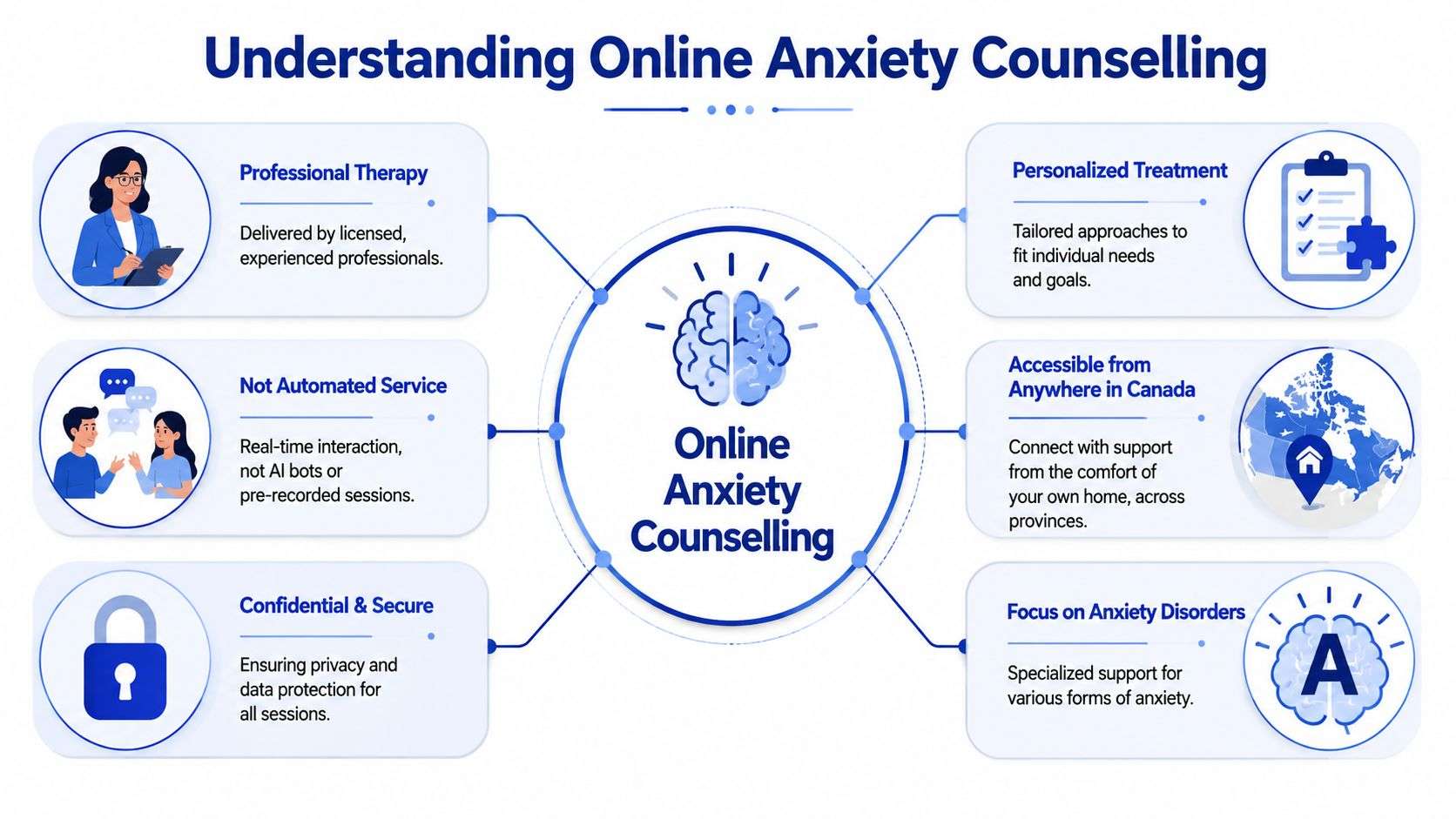
You sit down at your kitchen table after a long day, open your laptop, and talk with a licensed therapist about the anxiety that has been building for weeks. The setting is home. The work is still therapy.
Online anxiety counselling is professional mental health care provided through secure video or phone sessions. Your therapist listens carefully, asks questions, notices patterns, and helps you make sense of what is happening in your mind and body. That may include panic, constant worry, social anxiety, trauma-related fear, perfectionism, avoidance, or the exhausting physical side of anxiety, such as a racing heart or tight chest.
What happens in an online session
The format is usually simple. You meet by secure video if seeing each other helps you feel connected and focused. You meet by phone if being off camera feels easier or more private.
The conversation itself is purposeful. A therapist may help you slow down a spiral, identify triggers, notice body cues, and test new responses. If anxiety works like a smoke alarm that goes off too often, therapy helps you understand why it is getting triggered and what to do when it does.
Sessions also include practical details that matter in Canada. The therapist should be clear about where they are licensed to practise, whether they can work with clients in your province or territory, and what kind of receipts they provide for extended health benefits or claim processes. If your anxiety is tied to a car accident, for example, you may need to ask whether the therapist has experience with documentation or treatment connected to ICBC or another insurer.
What it is, and what it is not
Online counselling has the same clinical intention as in-person counselling. It is structured care, guided by professional training and ethical standards.
It also helps to clear up a few common misunderstandings:
- Therapy includes a plan. You and your therapist may set goals, track patterns, and review what is helping.
- Care is personalized. Two people can both have anxiety and need very different support.
- The screen does not make the work shallow. Many clients talk about very personal fears, grief, shame, or trauma in virtual sessions.
A good practical check is this. Before booking, look for clear information about privacy, credentials, fees, consent, and how emergencies are handled if you are in a different location from the therapist.
Approaches often used for anxiety
Many therapists use Cognitive Behavioural Therapy, or CBT, in online anxiety counselling. CBT helps you see the links between thoughts, feelings, body sensations, and actions. If your mind says, “Something will go wrong,” your body may tense and your behaviour may shift toward escape or over-preparing. Therapy helps you interrupt that chain and practise a different response.
Depending on the therapist and your needs, online sessions may also include:
- Psychoeducation about how anxiety works
- Grounding and nervous system regulation skills
- Exposure work done gradually and with your consent
- Trauma-informed care when anxiety is connected to difficult experiences
- Relationship-focused support when anxiety affects family, dating, or partnership stress
If you'd like a neutral overview of therapy options and support areas, you can explore online counselling services to get a clearer sense of what this kind of care can include.
The Proven Effectiveness of Virtual Therapy
A common question, often considered or posed directly, is simple. Does it work?
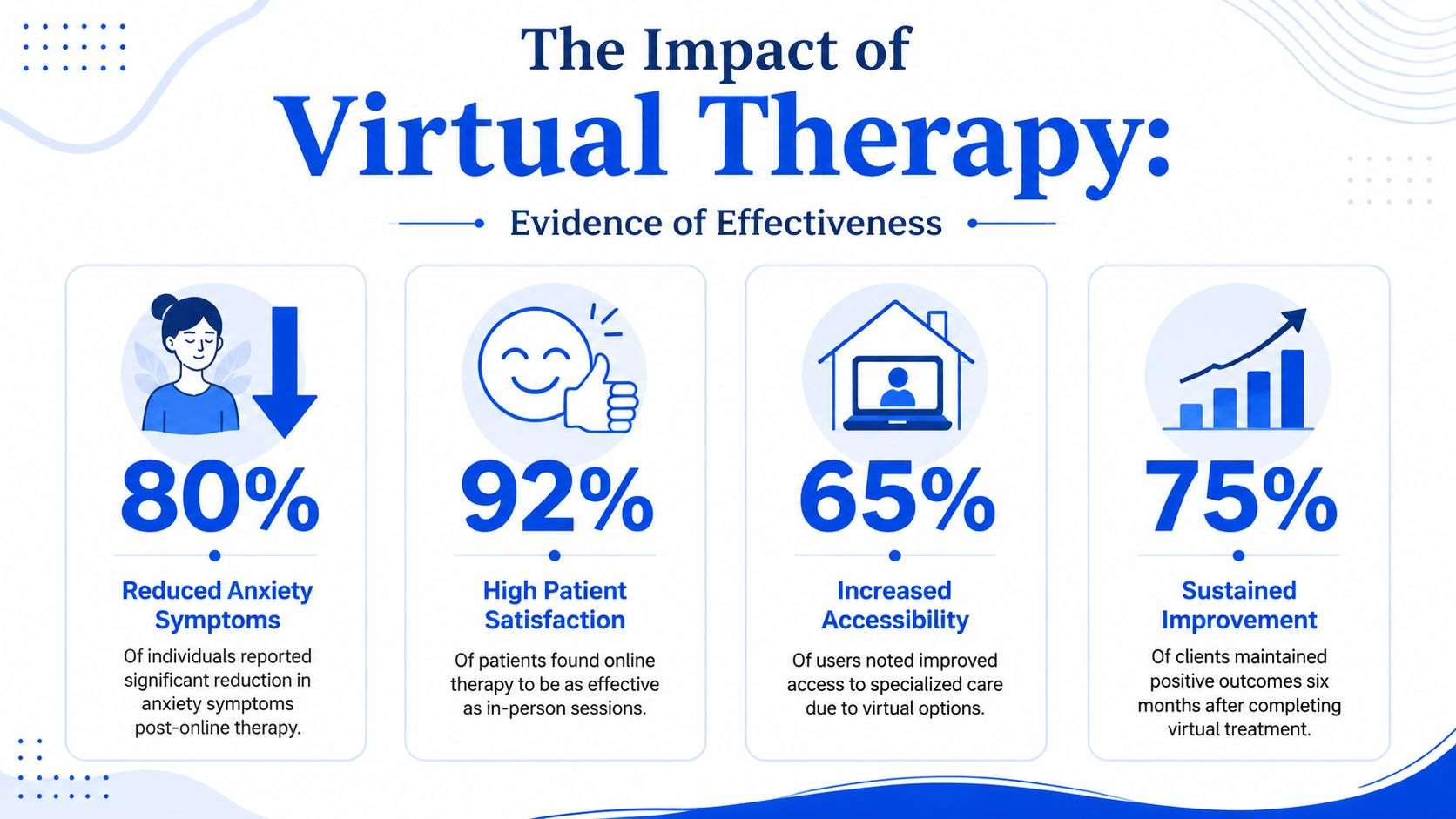
The evidence says that for many people, yes, it does. Large Canadian research has found that online therapy can produce outcomes that are very close to in-person treatment. In one summary of large-scale clinical findings, 56% of patients diagnosed with generalized anxiety disorder achieved recovery, and researchers from McMaster University found “moderate-certainty evidence” that internet-delivered cognitive behavioural therapy is as effective as traditional treatment (Canadian evidence on online therapy effectiveness).
What those findings mean in everyday life
Research language can feel distant when you're living with real anxiety. Recovery rates and effect sizes matter because they answer a practical concern. They suggest that if you choose online counselling, you are not choosing a second-rate version of therapy.
For many clients, this matters most in the first few weeks. They want to know whether learning coping tools online, talking through avoidance patterns on video, or processing fear during a phone session can lead to real change. The evidence supports that possibility.
Why online therapy can work so well
There are a few reasons virtual therapy can be effective:
- Consistency is easier: When there's no commute, people may find it easier to attend regularly.
- Comfort helps openness: Being in a familiar setting can reduce some of the stress of starting therapy.
- Evidence-based methods still apply: Techniques like CBT don't lose their value because they're delivered through a screen.
- Therapeutic connection still matters: What helps most is often the quality of the relationship and the fit of the treatment, not only the room where it happens.
Good therapy is not defined by a couch or an office. It's defined by safe, skilled, collaborative care that helps you move through anxiety in a different way.
This doesn't mean every person will prefer online work, or that every concern is best handled virtually. But it does mean that online anxiety counselling across Canada stands on a strong clinical foundation.
Benefits and Considerations of Therapy at Home
You close your laptop after a long workday, glance at the clock, and realize you could either spend the next hour driving across town for an appointment or use that same hour to begin talking with a therapist from a quiet room at home. For many Canadians, that difference is not small. It can determine whether therapy fits into life at all.
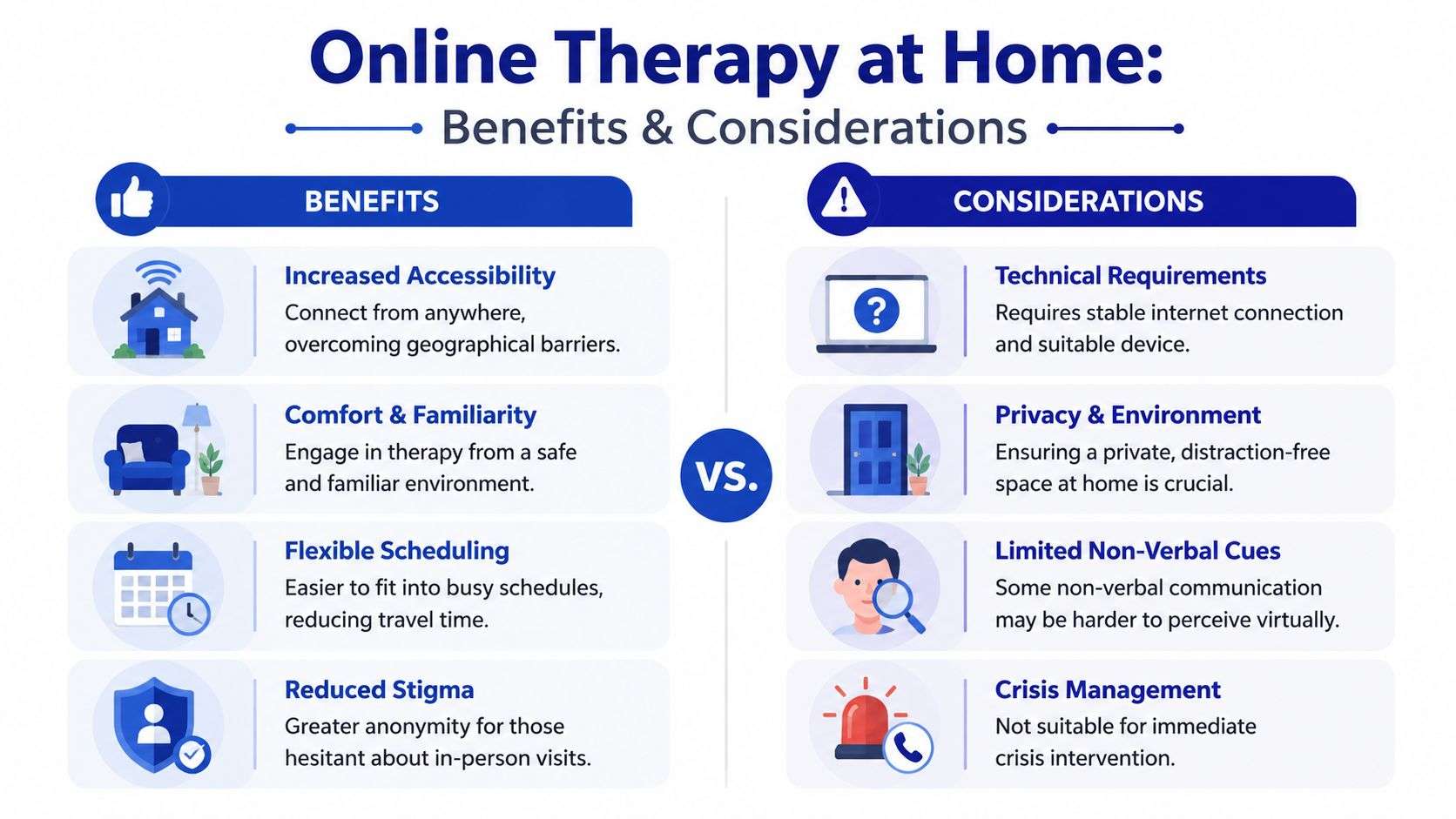
Therapy at home often helps because it removes friction around getting care. You do not need to account for traffic, weather, parking, or the stress of arriving late. If anxiety already makes ordinary tasks feel heavy, taking away those extra steps can make starting therapy feel more possible.
The benefits are practical, but they are also personal.
- Less disruption to your day: A session may fit more easily between work, school, caregiving, or rest.
- Comfort in familiar surroundings: Some people speak more openly when they are sitting on their own couch with a blanket, tea, or notebook nearby.
- Access beyond your postal code: If you live in a smaller community, online care can widen your options, as long as the therapist is licensed to work where you live.
- More privacy in daily routines: You may prefer not to sit in a waiting room or explain an appointment to others in your household or workplace.
That last point matters in Canada for another reason. Virtual care can expand your choices, but it does not erase the details of the system. A therapist still needs to be authorized to practise with clients in your province or territory, and coverage can differ depending on whether you are using workplace benefits, private insurance, or a program tied to a specific claim. If you are seeking counselling related to a motor vehicle accident, for example, you may also need to check whether the provider meets ICBC or other provincial insurer requirements before you book.
Home can also make therapy easier to tailor to your life. A parent may keep a baby monitor nearby. A shift worker may book from a parked car before heading home. A midlife client noticing body changes and rising worry may want support that considers both emotional and physical factors. In that situation, learning more about perimenopause and anxiety symptoms can give useful context for therapy conversations.
Still, online therapy asks something from your setting. A good video session works a bit like a good conversation in a quiet room. You need enough privacy, enough focus, and enough technical reliability for the work to feel steady rather than scattered.
| Consideration | Why it matters |
|---|---|
| Privacy | You need a place where you can speak without being overheard |
| Technology | A stable connection and working device make sessions smoother |
| Focus | Home can feel comforting, but it can also include pets, children, roommates, or notifications |
| Safety needs | Urgent crisis situations may call for local, in-person, or emergency support instead |
Some people worry that therapy from home will feel too casual. Often, the structure still holds. The appointment has a start time, a purpose, and clear boundaries. The difference is that the room is yours.
Before you book, pause for a short self-check:
- Can I reliably get 50 minutes of privacy?
- Would I feel more at ease on video, by phone, or in person?
- Will being at home help me settle, or make it harder to focus?
- Do I need a therapist who understands a Canadian insurance process, provincial licensing rules, or claim-related paperwork?
Therapy at home works best when convenience supports reflection, honesty, and steady follow-through.
Cost deserves honest attention too. Virtual therapy can reduce travel and expand provider choice, especially outside major urban centres, but affordability may still be a barrier because counselling by non-physician therapists is not publicly funded in the same way across Canada. Access and coverage are connected, but they are not the same thing.
Who Can Benefit from At-Home Therapy
Online counselling can support many kinds of people, not just one type of client with one type of schedule. Anxiety shows up differently across life stages, and the flexibility of remote care often makes it easier to meet people where they are.
A busy professional who can't keep adding one more commute
One person may be functioning well on the surface. They meet deadlines, answer messages, and look composed to everyone around them. Inside, they live with constant tension, worry, and a mind that never seems to switch off. A midday video session from a private office or parked car may be the difference between getting support and putting it off for another year.
A parent who needs support without arranging the whole day around it
For parents, the barrier isn't always willingness. It's logistics. Childcare, school pickups, meals, and work can leave very little room for an office appointment. Therapy from home can allow a parent to speak with a therapist during a quieter part of the day without building an entire travel plan around the session.
Sometimes anxiety is also tied to body changes and life transitions. If that sounds familiar, a clear educational resource on perimenopause and anxiety symptoms can help put words to what you may be noticing and bring more direction to therapy conversations.
A youth who feels safer starting behind a screen
For some young people, the thought of sitting face to face with a stranger and immediately talking about fear, panic, or shame feels too exposed. Research on online counselling notes that it can increase accessibility for people with extreme social anxiety or agoraphobia who fear in-person disclosure, and that online chat-style support may align with how many youth naturally communicate.
That doesn't mean every youth prefers the same format. It means some may feel more able to begin when the entry point is less intense.
Couples and families trying to reduce friction
At-home therapy can also help couples or family members who are already juggling conflicting schedules, stress, and emotional exhaustion. Joining from home can remove a practical layer of strain and make it easier to show up together.
People often assume virtual care is mainly for mild concerns. That's too narrow. Online therapy can be a strong fit for people managing persistent anxiety, social fears, avoidance, stress reactions, or the emotional fallout of major transitions. The question isn't whether your life looks “serious enough.” The better question is whether this format makes it easier for you to begin.
How to Find the Right Canadian Therapist for You
You finally decide to reach out for help, open three therapist websites, and suddenly feel more anxious than when you started. One says “registered clinical counsellor.” Another says “psychotherapist.” A third looks promising, but you are not sure whether they can legally see clients where you live. That confusion is common, especially in Canada, where rules can differ by province and territory.
A simpler way to approach the search is to treat it like finding the right guide for a hike. You want someone qualified for the terrain, allowed to work where you are, and able to explain the route in a way that makes you feel steadier.
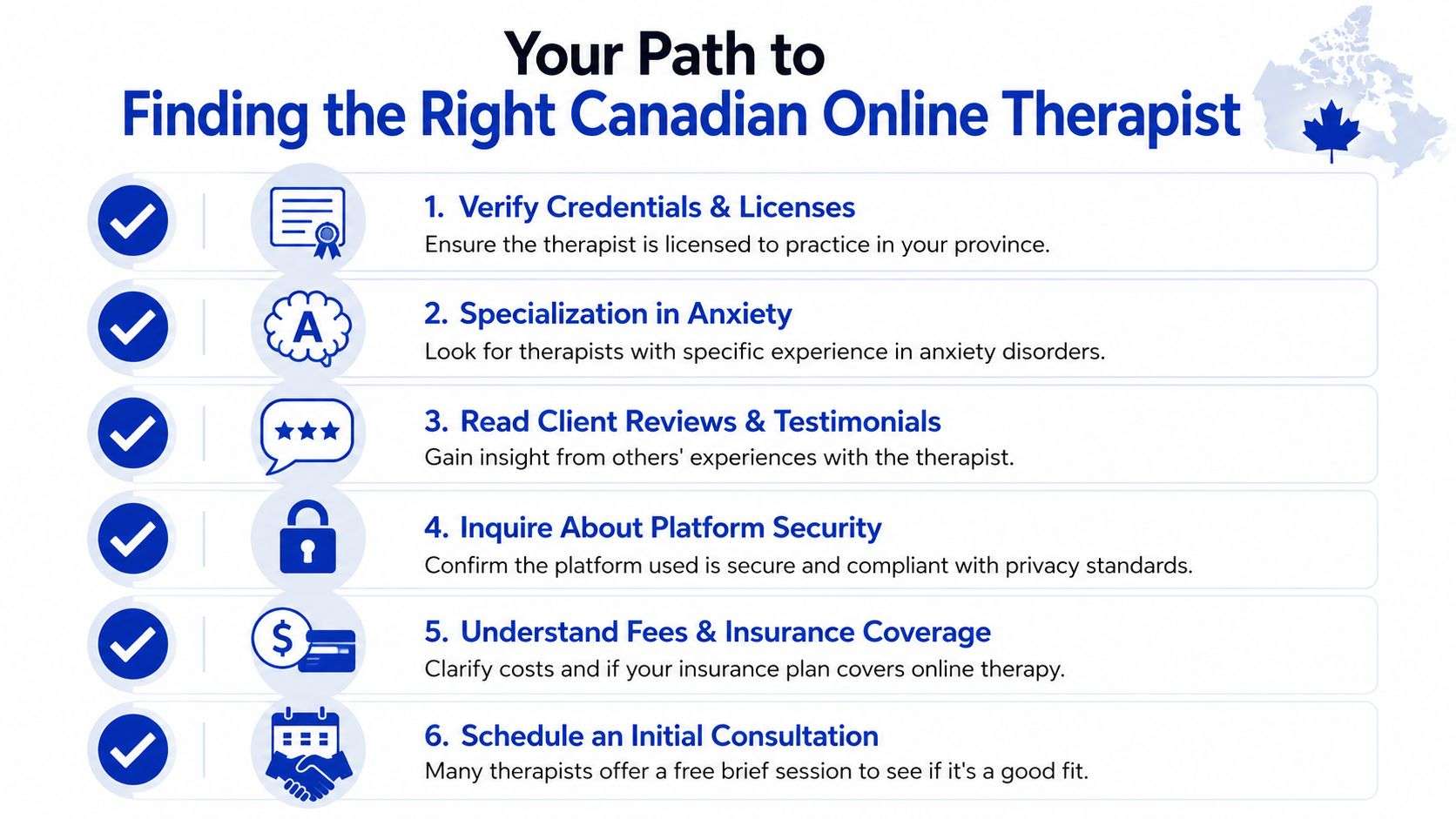
Start with province, profession, and problem
Before you focus on personality fit, check the practical basics. In Canada, a therapist may be well trained and still not be able to work with you if they are not authorized to practise in your province or territory. Online care still follows local professional rules.
Then look at whether they regularly help with the kind of anxiety you are dealing with. “Anxiety” can mean panic attacks, health anxiety, OCD-related fears, trauma reactions, social anxiety, or constant worry that never seems to switch off. A therapist who names your concern clearly is often easier to trust than one with a very broad profile and little detail.
It also helps to read how they work. Some use CBT and give structured tools. Some take a trauma-informed approach and move more gently. Some are skilled in couples counselling when anxiety is affecting communication at home. The goal is not to pick the “best” method in the abstract. The goal is to choose an approach that makes sense to you and feels workable.
A final practical check matters too. Their site should explain privacy, consent, and the platform they use in plain language.
Ask questions that fit Canadian realities
A brief consultation can save you time, money, and frustration. You do not need to sound polished. You only need enough information to decide whether this person is a safe and realistic option.
Useful questions include:
- Are you licensed or registered to work with clients in my province or territory?
- Do you often work with my main concern, such as panic, OCD-related anxiety, trauma, or health anxiety?
- Do you offer video and phone sessions, or only video?
- How do you handle privacy and what platform do you use?
- Can you provide care in the language I am most comfortable using?
- Do you work with practical needs that matter in Canada, such as extended health benefits, workplace claims, or ICBC-funded counselling if that applies to me?
That last point is easy to miss. For some Canadians, the right therapist is not only a clinical match. They also need a provider who understands insurance receipts, provincial coverage limits, motor vehicle injury claims, or the difference between private pay and publicly connected services. Those details can affect whether therapy is sustainable, not just whether it sounds helpful.
Notice how the first conversation feels
The first consultation is not a test you can fail.
You are listening for a few simple signs. Does the therapist answer questions clearly? Do they explain their approach without hiding behind jargon? Do you feel rushed, talked over, or subtly pressured to book, or do you feel like you have room to think?
A good early fit often feels steady rather than dramatic. You may still feel nervous. That is normal. What usually matters more is whether the anxiety comes from opening up, or from sensing that the therapist is not really meeting you where you are.
If the fit feels off, you are allowed to keep looking. Choosing carefully is part of good care, especially with online therapy, where practical factors such as licensing, coverage, and format matter alongside warmth and skill.
Your Questions About Online Counselling Answered
A lot of people reach this point with practical questions, not philosophical ones. They are wondering whether online therapy will fit into daily life in Canada, whether it will stay private, and what happens if the technology does not cooperate. Those are sensible questions. Therapy is easier to begin when the process feels clear.
Do I need special technology for online therapy
Usually, no.
A phone call needs only a phone and a quiet place. A video session usually needs a phone, tablet, or computer with a stable internet connection, plus a camera and microphone. If tech feels stressful, say that at the start. A good therapist or clinic can walk you through the setup step by step, the way someone might explain a new route before you start driving it.
Is online therapy private
It should be, and you deserve to ask exactly how that privacy is protected.
A regulated Canadian therapist should explain consent, confidentiality, record keeping, and the limits of privacy in plain language. Your part matters too. Headphones can help. A parked car, a private room, or even a quiet corner with a white noise machine can make a session feel safer if home is busy. Privacy in online therapy works a bit like closing both sides of a door. The platform needs to be secure, and your physical space needs to support the conversation.
What if my internet cuts out or the session gets interrupted
This happens. It is inconvenient, but it is usually manageable.
Many therapists set a backup plan before the first appointment, such as switching to phone if video fails or reconnecting through the same secure link. Ask about that early. Knowing the plan often lowers anxiety because you are not left guessing in the middle of a hard moment.
What if I don't feel a connection with the therapist
That can happen online or in person.
Therapy depends a lot on fit. You do not need instant comfort, but you do need enough trust to speak openly. If something feels off, you can say so, ask whether a different approach would suit you better, or choose another provider. That is not being picky. It is part of finding care that truly works for you.
Why does online counselling matter so much right now
Because access is still a real problem for many Canadians.
As noted earlier, a large share of Canadians who need counselling or psychotherapy do not receive it. Online care helps close part of that gap. It can make therapy more reachable for people in rural or remote communities, people with limited time off work, parents arranging care around children's schedules, and people who need a provider licensed in their province and familiar with practical concerns such as extended health receipts or ICBC-related counselling.
Sometimes the biggest barrier is not willingness. It is distance, scheduling, cost, fatigue, or not knowing where to start. Online therapy does not solve every problem in the mental health system, but it can make the first step feel possible.
If you have been unsure whether therapy from home can feel real and useful, it can. The best format is the one that gives you a genuine chance to begin, keep going, and get support that fits your life.
If you'd like to learn more about therapy options in a calm, low-pressure way, Interactive Counselling offers information about secure virtual, phone, and in-person support across a range of concerns, including anxiety, trauma, relationships, parenting, and ICBC-funded counselling. Taking a closer look doesn't commit you to anything. It can be a way to understand what kind of support might fit your life right now.
Clinically Reviewed By
Amy Mosset, MCP, RCC-S
Amy Mosset is a Master Practitioner in Clinical Counselling, Clinical Supervisor, and the owner of Interactive Counselling. She provides trauma-informed, evidence-based care and clinical supervision to registered therapists, with a focus on ethical practice, client safety, and high-quality therapeutic outcomes.