To access ICBC-funded counselling in Penticton after a car accident, you first need to report the crash to ICBC to get a claim number, then you can directly contact an ICBC-approved counselling provider to book your first of 12 pre-approved sessions at no cost to you. If your claim is filed within 12 weeks of the accident, those initial sessions are fully funded and you don't need a doctor's referral to begin. For more information, see our Penticton ICBC counselling.
After a crash, many people find themselves trying to act normal while feeling anything but normal. You might be dealing with poor sleep, jumpiness in traffic, replaying the accident in your mind, or a strange fog that makes even simple admin feel harder than it should. That reaction is common, and it deserves care just as much as physical pain does. For more information, see our counselling in Penticton.
"ICBC counselling in Penticton starts with opening your ICBC claim, getting your claim number, and then booking directly with an ICBC-approved counsellor for 12 fully funded sessions." For more information, see our ICBC counselling.
The Unseen Impact of a Car Accident
A lot can change in a few seconds on the road. The confusing part is that the emotional impact often shows up later, when the tow trucks are gone, the paperwork starts, and everyone expects life to return to normal.
You might notice that you're avoiding the route where the accident happened. You may feel irritable with people you care about, or anxious every time you hear brakes screech. Some people feel tearful. Others feel numb. Many feel both, depending on the day.
Recovery after a collision isn't only about the body. It can also involve fear, grief, anger, shame, and loss of confidence.
That can be especially disorienting if you were told you're "lucky" because your injuries weren't worse. Emotional distress after an accident doesn't need to look dramatic to be real. If driving now feels hard, if your concentration is off, or if your nervous system feels stuck on high alert, counselling can be an appropriate part of recovery.
Why people often delay getting help
Many people don't reach out right away because they're trying to be practical. They focus on car repairs, appointments, work, and family. Counselling falls to the bottom of the list.
Others worry that their symptoms aren't serious enough, or that they won't qualify. Some feel embarrassed talking about panic, nightmares, or fear of driving. That hesitation makes sense. It also means people often carry distress longer than they need to.
If you're also trying to understand psychological harm after a collision in a broader legal and educational context, this overview of Colorado psychological injury lawyers gives a useful plain-language explanation of how accident-related trauma can affect people beyond visible injuries.
A clearer path than it first appears
The good news is that the process for ICBC counselling is more straightforward than many people expect. Once you know the order of the steps, it becomes much easier to move forward.
Many readers often feel relief. You don't need to solve everything today. You just need to know what to do first, what to have ready, and what happens if you still need support after the first round of sessions.
Confirming Your Eligibility for ICBC Counselling
A lot of people get stuck at this stage for one reason. They are trying to answer a question that feels bigger than it is: "Do I qualify?"
For many people in British Columbia, the starting point is simpler than expected. If you were involved in a motor vehicle accident and opened an ICBC claim within the required timeframe, counselling is often available early in the recovery process. ICBC guidance explains that 12 fully paid counselling sessions are generally pre-approved for eligible people injured in a crash, and that this can include drivers, passengers, pedestrians, and cyclists. A doctor's referral is not required to begin.
Who can access counselling
Eligibility is broader than many people assume. The system is set up more like a doorway than a prize for the least-at-fault person.
- Drivers may qualify: Access to counselling is not limited to the person who was "not at fault."
- Passengers may qualify: You do not need to have been behind the wheel for the accident to affect you.
- Pedestrians and cyclists may qualify: Support is based on the accident's impact, not on whether you were inside a vehicle.
- Fault does not automatically block care: These health benefits can still apply even if you were at fault.
What is included at the start
The first stage of coverage is designed to get care started without a long approval process.
- Twelve sessions are pre-approved: You can begin with a set block of support while you and your counsellor assess what recovery looks like for you.
- The sessions are fully funded: With an approved provider, these sessions are generally covered without extra user fees.
- No referral is needed to begin: You can contact a counsellor directly.
- Your claim number is the main administrative key: Once you have it, the rest of the process usually becomes much clearer.
Where confusion usually happens
People often assume counselling is only for severe trauma, panic attacks, or symptoms that look dramatic from the outside. Psychological injuries rarely work that neatly. Trouble sleeping, fear of driving, irritability, poor concentration, or feeling constantly on edge can all be valid reasons to seek support after a crash.
A useful rule is simple. If the accident has changed your mood, sleep, sense of safety, concentration, or day-to-day functioning, it is reasonable to ask whether ICBC counselling applies to you.
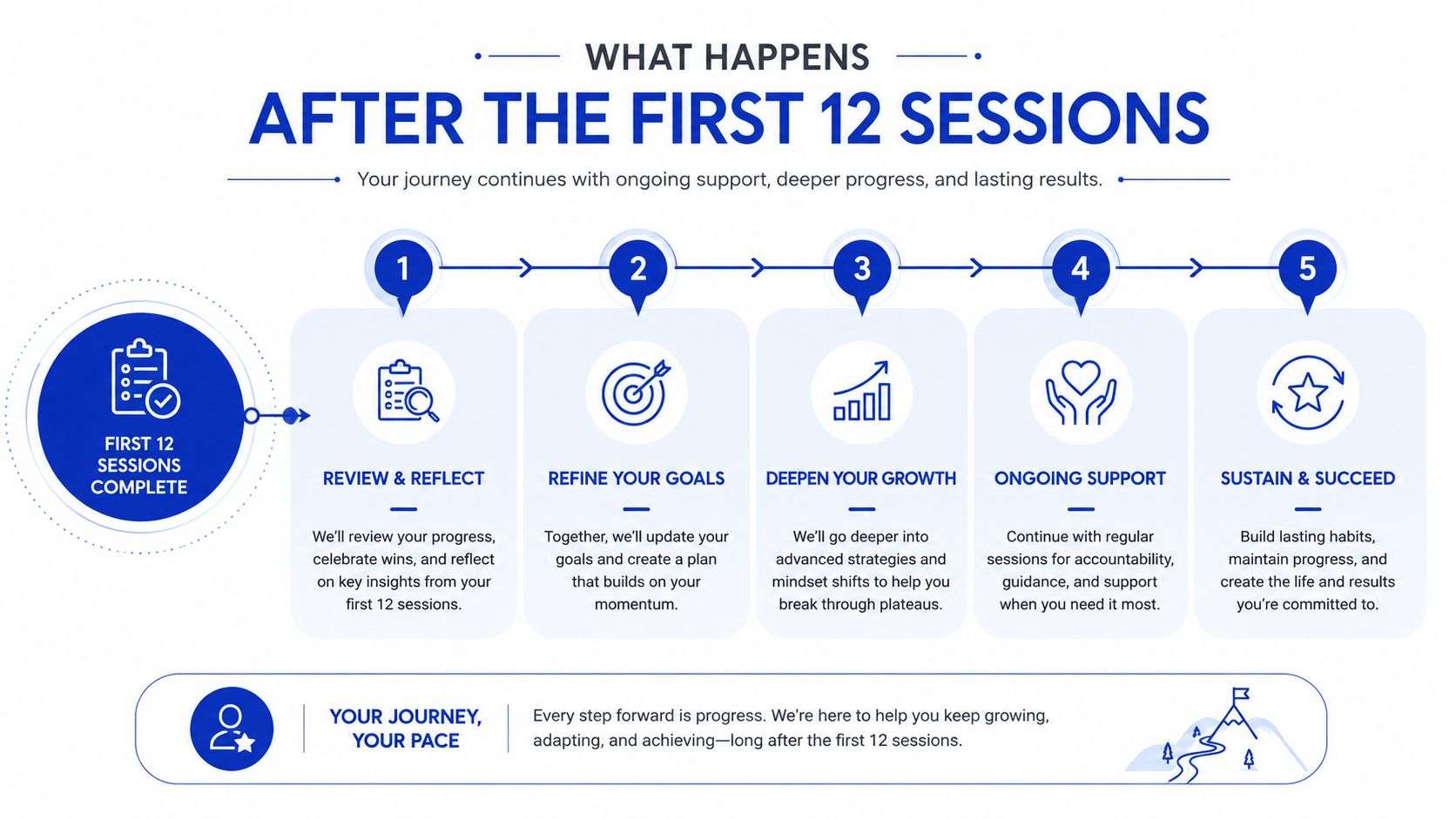
Another point that causes anxiety is the number 12. People sometimes read it as a finish line. It is better understood as the first block of care. Recovery from a collision often works more like physiotherapy than a one-time fix. You start with an approved course of treatment, then your progress helps show whether more support should be requested.
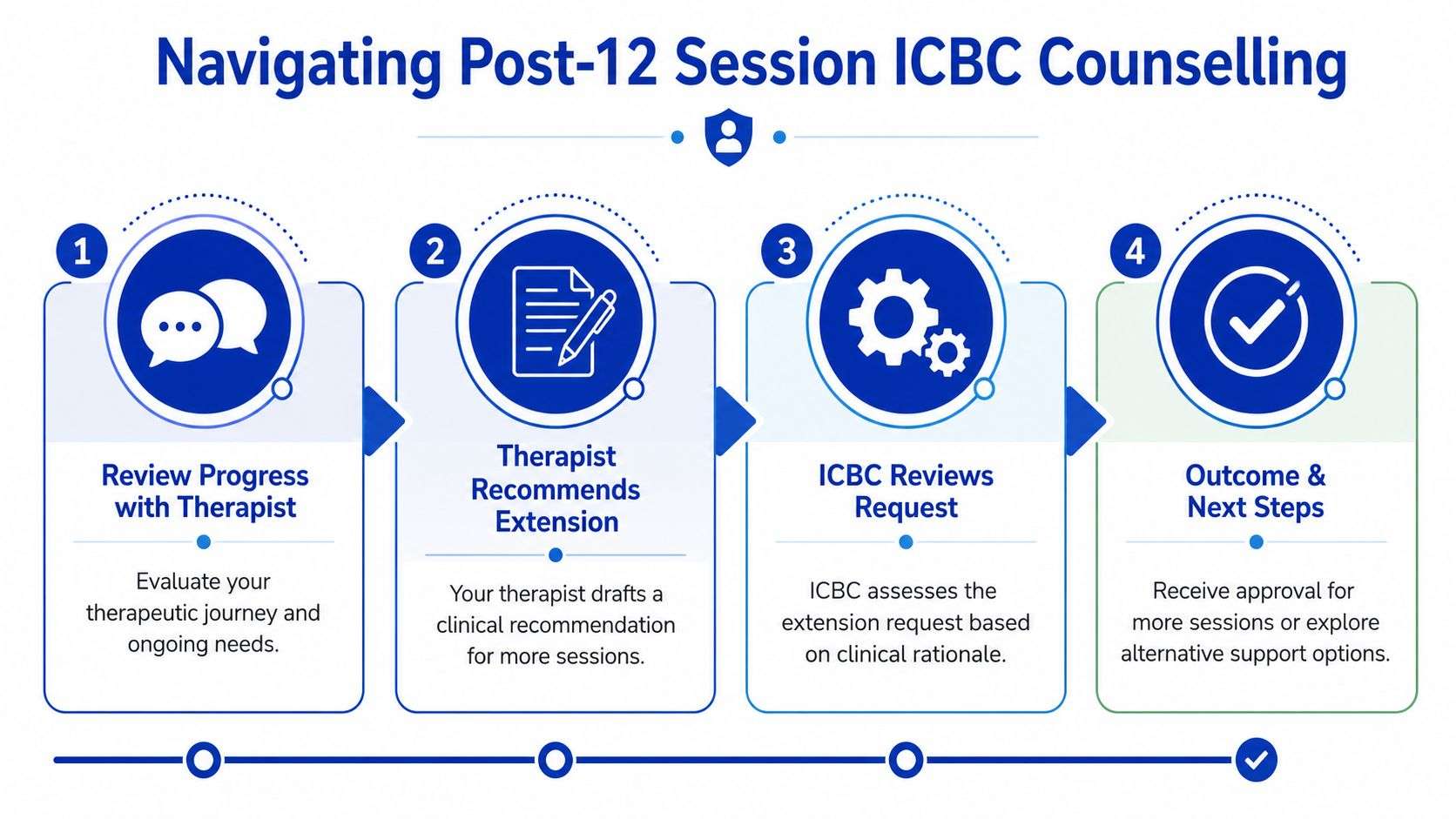
That distinction is important because a fixed number on paper does not always match the actual pace of emotional recovery. If symptoms are still affecting daily life near the end of those first sessions, your counsellor can usually document what is continuing and request additional approval from ICBC. For many people, knowing there is a process after session 12 lowers a lot of stress.
How to Book Your First Counselling Session in Penticton
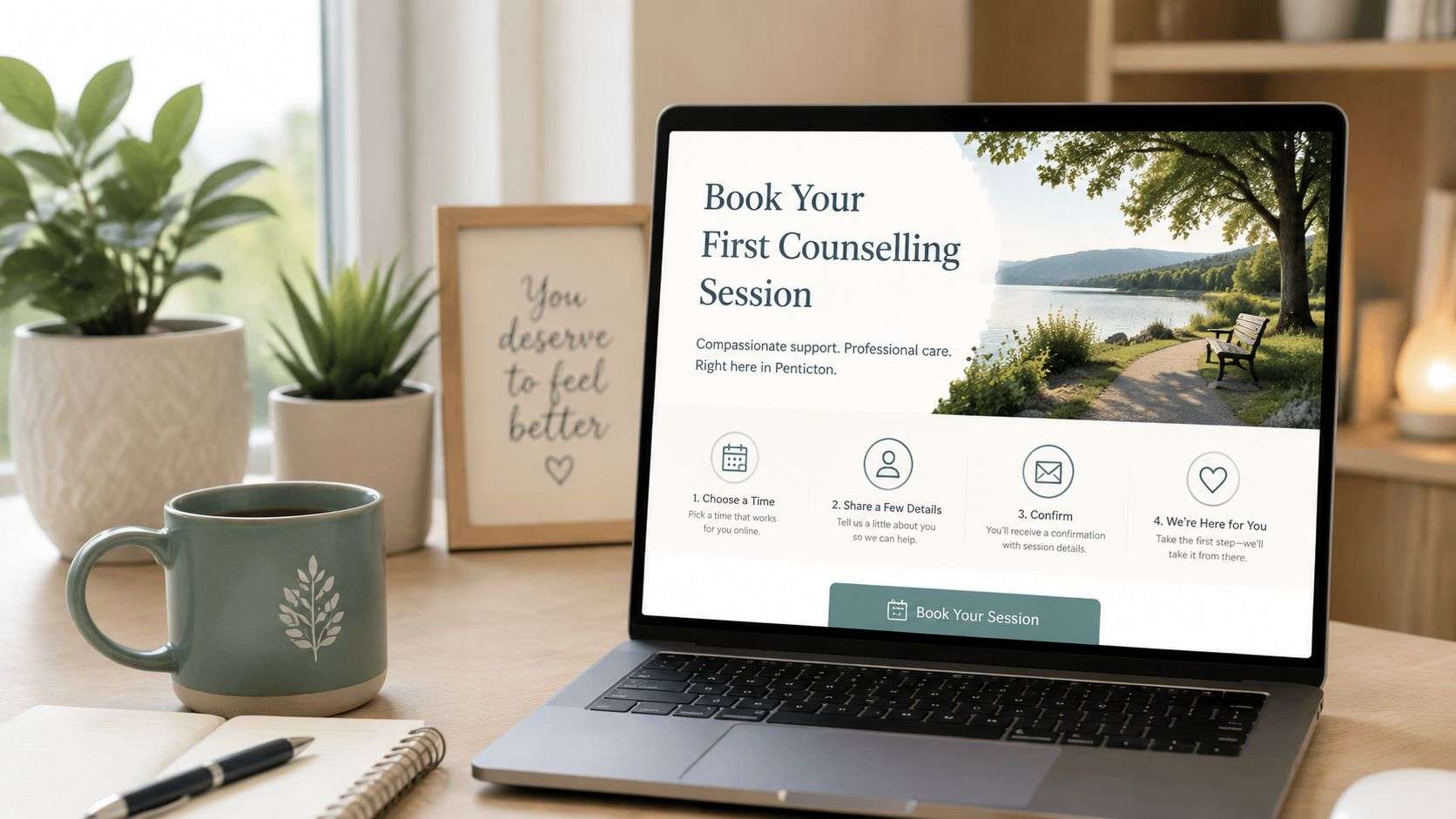
You have your claim number. You are tired, distracted, and trying to decide what to do first. At this stage, booking counselling can feel like one more task in a pile. It helps to treat it like a short checklist rather than a big decision.
Step one is getting your claim number
Your claim number is the file that connects you to funded care. Without it, a clinic usually cannot confirm whether ICBC will cover your sessions.
If you have not reported the accident yet, start there. Once ICBC gives you a claim number, keep it somewhere easy to find, like your phone notes or wallet. That one number tends to make the rest of the process much simpler.
What to have ready before you contact a counsellor
The first call or intake form usually goes more smoothly if a few details are close at hand.
A practical checklist includes:
- Your ICBC claim number
- Your Personal Health Number
- A short description of the accident
- A few notes about what has changed since the crash, such as fear of driving, jumpiness, sleep problems, low mood, or trouble concentrating
- Your availability and format preference, including in-person, phone, or virtual sessions
You do not need to prepare a polished story. A few plain notes are enough. The goal is to help the clinic understand what kind of appointment to offer and how to set up billing correctly.
How booking usually works
Interactive Counselling is an ICBC-approved provider. That means covered sessions are billed directly to ICBC, so eligible clients in Penticton are usually not paying out of pocket for those approved appointments.
In practice, booking often works like this. You contact the clinic, share your claim number, answer a few intake questions, and choose a session time and format. The administrative side should feel more like checking in at reception than arguing a case. You are not expected to prove everything in that first contact.
That direct billing piece matters for another reason. It sets up a paper trail from the beginning. If you later need support beyond the initial block of sessions, clear records from your first appointment onward can help your counsellor explain why continued care is being requested.
Choosing in person, phone, or virtual
There is no perfect format. The better option is the one you can realistically attend while you are recovering.
| Session format | May suit you if | Why it can help |
|---|---|---|
| In person | You want face-to-face support in Penticton | Some people find it easier to settle in a quiet office away from daily distractions |
| Phone | Speaking feels easier than being on camera | This can reduce pressure when you feel tense, tired, or emotionally raw |
| Secure virtual | Travel, pain, childcare, or work schedules make office visits hard | You can still get care without adding another difficult trip |
If you are unsure, pick the format with the fewest barriers. Counselling only helps if you can show up for it consistently.
A note about the medical step
This part often confuses people. A doctor's referral is generally not required to start the pre-approved counselling sessions. At the same time, medical documentation can still matter in the larger recovery process, especially if your care needs continue or overlap with other treatment plans.
A simple way to understand it is this. Booking the first sessions and documenting the full impact of the accident are related, but they are not the same step. One gets care started. The other can support what happens if symptoms continue and an extension needs to be requested after those first sessions.
If paperwork feels unusually hard right now, that often reflects stress after the accident, not a personal failing.
What to Expect in Your Therapy Sessions
Many people are more nervous about the first session than they are about the paperwork. That's understandable. If you've never had counselling before, you might wonder what you're supposed to say, whether you'll be judged, or whether you'll be pushed to talk before you're ready.
The first session is usually much gentler than people expect. It often starts with the therapist asking what happened, how you've been feeling since the accident, and what has changed in daily life.

What the first appointment often covers
You don't need to arrive with perfect words. You can describe what has felt different since the crash.
That may include:
- Driving fear: You tense up at intersections or avoid certain roads.
- Body-based stress: Your heart races when you're a passenger.
- Sleep changes: You wake during the night or dread going to bed.
- Mood shifts: You feel flat, angry, tearful, or unlike yourself.
- Cognitive strain: Focusing at work or remembering details feels harder.
The therapist will usually help organise those experiences into a clearer picture. Together, you may discuss goals such as sleeping better, feeling safer in the car, reducing panic, or coping with accident-related pain and stress.
What kinds of support can be included
ICBC-funded counselling can include individual therapy, group therapy, and specialized services for psychological or emotional distress after an accident. Counselling must be provided by registered therapists trained in trauma and injury-related recovery, and this kind of specialized care is available in Penticton with flexible availability.
That means the work isn't generic. It's meant to address the kinds of struggles that often follow collisions, including trauma responses, anxiety, and the emotional impact of physical injury.
What therapy often feels like in practice
A helpful session usually doesn't feel like being analysed from a distance. It feels more like sitting with someone who understands how the nervous system reacts after something frightening, and who can help you make sense of what's happening.
"You don't have to prove that you're distressed enough. You only need to talk honestly about what has changed."
Over time, sessions may focus on noticing triggers, understanding trauma responses, building coping skills, and regaining confidence in situations that now feel difficult. If you're attending virtually, the same goals still apply. The format changes. The support doesn't have to.
Confidentiality also matters here. People often worry that every personal detail will be shared widely because the claim involves insurance. In counselling, privacy remains an important part of ethical care. Your therapist can explain what information is needed for claim-related administration and what stays within the therapeutic space.
What Happens After the First 12 Sessions
For many people, this is the most stressful question. They finally start feeling supported, then they realise the first block of sessions has an endpoint. That can create a second layer of anxiety right in the middle of recovery.
The most important thing to know is that the initial 12 sessions are not always the end of care. If trauma symptoms continue, additional sessions can be requested when there is clinical need.
How extensions usually happen
This part is often less dramatic than people fear. You don't usually need to make a legal-style argument on your own.
For severe PTSD or chronic pain, additional sessions can be requested. A recovery specialist or counsellor supports that continued care by documenting clinical necessity, so support isn't cut off arbitrarily.
In practical terms, that often means your therapist reviews how you're doing, notes what symptoms remain, explains what progress has been made, and identifies why more treatment is still appropriate.
What your role is
Your role is simpler than many people expect. Be honest about what's still hard.
That may include saying things like:
- You're still avoiding driving
- You're still having flashbacks or panic
- Pain is keeping your stress level high
- You've improved somewhat, but not enough to function well day to day
That information helps your therapist document an accurate picture. If you minimise what you're going through because you don't want to seem dramatic, the request may not reflect your actual needs.
What if you're worried about being cut off
That fear is understandable. Administrative deadlines can feel very personal when you're vulnerable.
Keep in mind: A pre-approved block is a starting point for care, not a promise that recovery must be finished by a fixed session count.
The strongest approach is to bring up your concerns before the last session arrives. If you're worried about the end of coverage, say so early. That gives your therapist time to plan, submit what is needed, and talk through next steps with you calmly instead of in a rush.
Compassionate Answers to Common Questions
What if I didn't start counselling right away
A lot of people wait because they think they should be coping better on their own. ICBC allows direct access to counselling within 12 weeks of the accident without a doctor's referral. If that window is missed, coverage may still be possible with a doctor's note, based on the guidance cited earlier in this article.
Are there hidden costs in the pre-approved sessions
For approved care within the covered period, the verified guidance says those initial sessions are fully funded with no user fees, hidden charges, or administrative costs when working with an approved provider. If you're unsure whether a provider is approved, ask that question directly before you book.
Do I need to be the driver to qualify
No. Eligibility can extend to drivers, passengers, pedestrians, and cyclists involved in a BC motor vehicle accident when there is an active claim and related psychological impact.
What if I don't connect with the first counsellor
That concern is more common than you might think. Fit matters in therapy. If the relationship doesn't feel comfortable or helpful, it's reasonable to ask about changing providers. The practical steps can vary, but you're allowed to care about whether the support feels right for you.
Will I have to talk about the accident in detail right away
Usually not. A trauma-informed therapist should help pace the conversation. Early sessions often focus on safety, symptoms, and stabilising day-to-day life, not forcing a detailed retelling before you're ready.
If you're looking for calm, practical support as you sort through next steps, Interactive Counselling offers more information about ICBC-funded therapy and how counselling can fit into post-accident recovery without adding more confusion or pressure.
Clinically Reviewed By
Amy Mosset, MCP, RCC-S
Amy Mosset is a Master Practitioner in Clinical Counselling, Clinical Supervisor, and the owner of Interactive Counselling. She provides trauma-informed, evidence-based care and clinical supervision to registered therapists, with a focus on ethical practice, client safety, and high-quality therapeutic outcomes.