
Many people mistake the intense feelings in trauma bonds for deep love or healthy attachment. These two relationship patterns feel vastly different in your nervous system, yet confusion between them keeps countless individuals trapped in harmful cycles. Understanding the distinct features of trauma bonds versus healthy attachment is crucial for healing, building genuine connections, and recognising when a relationship supports your wellbeing rather than eroding it. For more information, see our trauma counselling.
Table of Contents
- What Is A Trauma Bond? Understanding Its Formation And Impact
- Defining Healthy Attachment: Trust, Safety, And Emotional Growth
- Childhood Trauma’s Role In Attachment: Insecurity And Relationship Satisfaction
- Practical Strategies For Healing And Fostering Secure Attachment
- Explore Professional Support To Heal And Strengthen Relationships
- What Is The Main Difference Between Trauma Bonds And Healthy Attachment?
- Can Childhood Trauma Affect My Ability To Form Healthy Attachments?
- How Can I Tell If I Am In A Trauma Bond Or A Healthy Relationship?
- What Therapies Help Break Trauma Bonds And Build Secure Attachments?
Key takeaways
| Point | Details |
|---|---|
| Trauma bonds rely on abuse cycles | These attachments form through intermittent reinforcement combining punishment with occasional affection, creating dependency |
| Healthy attachment prioritises safety | Secure connections are built on consistent trust, mutual respect, and emotional stability without fear |
| Childhood trauma affects adult bonds | Early traumatic experiences often lead to insecure attachment styles that reduce relationship satisfaction |
| Body signals reveal attachment type | Physical sensations like hyperarousal or relaxation help differentiate trauma bonds from secure connections |
| Professional support aids recovery | Therapy and social networks foster secure attachments and help individuals break free from harmful patterns |
What is a trauma bond? understanding its formation and impact
Trauma bonds represent one of the most misunderstood relationship dynamics, often mistaken for passionate love or deep connection. These attachments develop through intermittent reinforcement in abusive relationships involving dopamine and stress responses that create powerful emotional dependency. The cycle alternates between punishment, fear, and intermittent affection, triggering neurochemical responses similar to addiction.
Your brain releases dopamine during moments of relief or kindness following abuse, creating a biochemical reward system. This survival-oriented attachment has nothing to do with genuine trust or safety. Research by Dutton and Painter in 1993 demonstrated that emotional attachments strengthen with both the severity and intermittency of abuse, explaining why victims often feel most attached during the worst periods.
The confusion arises because trauma bonds generate intense feelings. Your nervous system interprets the rollercoaster of emotions as significance rather than danger. This attachment keeps you hypervigilant, constantly scanning for approval or the next threat. The relationship becomes your primary focus, consuming mental energy and emotional resources.
Several patterns characterise trauma bonds:
- Cycles of idealisation followed by devaluation and punishment
- Feeling responsible for the other person’s emotions or behaviour
- Difficulty leaving despite recognising harm
- Intense anxiety when considering separation
- Justifying or minimising abusive actions
These bonds typically occur in relationships involving coercion, manipulation, or control. The person experiencing abuse often develops hypervigilance and people-pleasing behaviours as survival strategies. Understanding healing from trauma becomes essential for breaking these patterns and rebuilding your sense of self.
Pro Tip: Notice when you feel like you are walking on eggshells or experience emotional whiplash between euphoria and despair. These sensations often signal a trauma bond rather than healthy attachment.
Recognising trauma bonds early allows you to seek appropriate support through trauma counselling methods designed specifically for these complex attachment patterns. The first step involves acknowledging that intense feelings do not always indicate healthy connection.
Defining healthy attachment: trust, safety, and emotional growth
Healthy attachment operates on fundamentally different principles than trauma bonds. These connections are characterised by emotional safety, mutual respect, consistent communication, and support for personal growth. Your nervous system experiences regulation rather than constant activation, allowing you to feel calm and secure.

In secure attachments, communication flows consistently without fear of punishment or rejection. You can express needs, set boundaries, and disagree without triggering emotional warfare or withdrawal. Both partners take responsibility for their actions and emotions, creating space for vulnerability without exploitation.
The relationship promotes individual development alongside shared experiences. You maintain separate identities, friendships, and interests whilst building connection. This contrasts sharply with trauma bonds, where enmeshment and isolation often dominate. Healthy attachment allows for interdependence rather than codependency.
| Feature | Trauma Bond | Healthy Attachment |
|---|---|---|
| Emotional tone | Fear, anxiety, hypervigilance | Safety, trust, calmness |
| Communication | Inconsistent, fear-based, manipulative | Consistent, honest, respectful |
| Boundaries | Violated or nonexistent | Honoured and maintained |
| Personal growth | Restricted, controlled | Encouraged, supported |
| Conflict resolution | Escalates to abuse or stonewalling | Collaborative problem-solving |
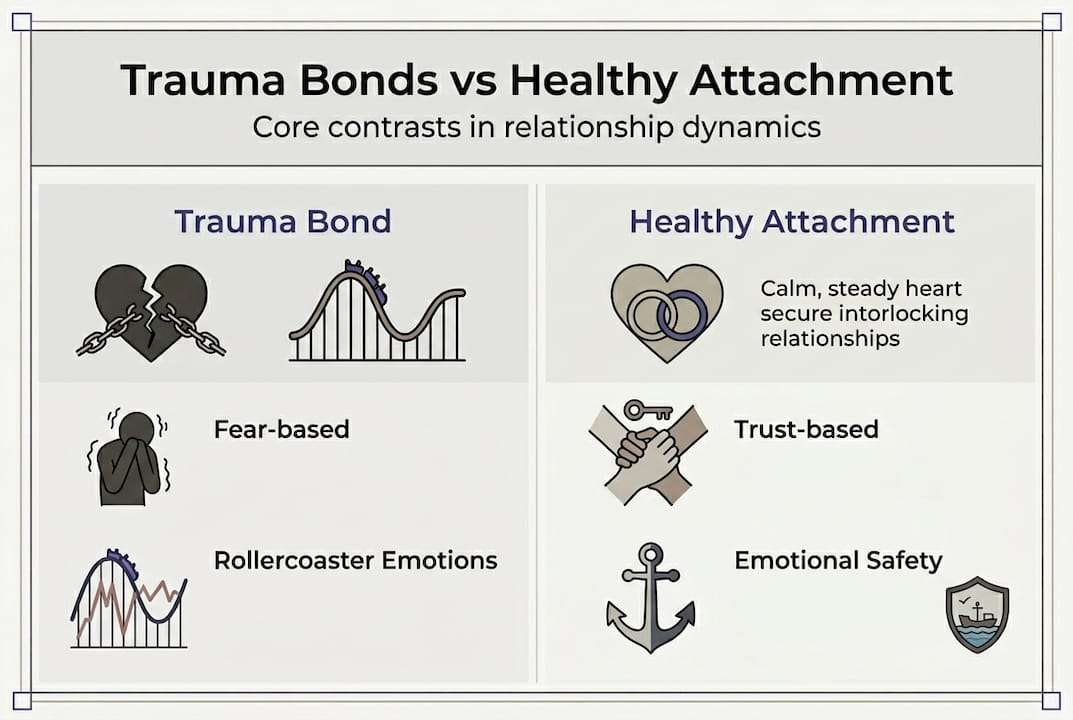
Understanding attachment styles in relationships helps you recognise these patterns in your own connections. Secure attachment develops when both partners consistently show up with honesty and care, creating a foundation of reliability.
Key indicators of healthy attachment include:
- Feeling relaxed and yourself around your partner
- Trusting without constant verification or surveillance
- Resolving conflicts without fear of abandonment
- Supporting each other’s goals and friendships
- Experiencing stability rather than dramatic highs and lows
The concept of psychological safety becomes central to healthy relationships. You should feel free to express thoughts and feelings without anticipating retaliation or emotional manipulation. This safety allows genuine intimacy to develop over time.
Pro Tip: Pay attention to how your body feels during and after interactions. Healthy attachment typically produces feelings of relaxation and contentment, whilst trauma bonds generate anxiety and hyperarousal even during positive moments.
Recognising these differences empowers you to evaluate current relationships and make informed choices about which connections deserve your investment and which require boundaries or distance.
Childhood trauma’s role in attachment: insecurity and relationship satisfaction
Your earliest relationships shape attachment patterns that influence adult romantic connections. Childhood trauma predicts insecure attachment styles that mediate lower romantic satisfaction, with research showing both direct effects and indirect pathways through attachment security.
Children who experience neglect, abuse, or inconsistent caregiving often develop anxious or avoidant attachment styles as adaptive responses. These patterns persist into adulthood, affecting how you approach intimacy, handle conflict, and regulate emotions within relationships. The impact of childhood neglect extends far beyond childhood, influencing partner selection and relationship dynamics decades later.
Insecure attachment styles manifest in three primary forms:
- Anxious attachment involves fear of abandonment, requiring constant reassurance and struggling with independence
- Avoidant attachment leads to emotional distance, discomfort with intimacy, and excessive self-reliance
- Disorganised attachment combines anxious and avoidant patterns, creating confusion between desire for closeness and fear of connection
These styles significantly impact relationship satisfaction. Anxiously attached individuals often experience heightened jealousy and conflict, whilst avoidant partners struggle with emotional expression and commitment. Disorganised attachment frequently correlates with trauma bonds, as the simultaneous craving for and fear of intimacy mirrors abusive relationship dynamics.
| Attachment Style | Childhood Origin | Adult Relationship Impact |
|---|---|---|
| Secure | Consistent, responsive caregiving | High satisfaction, effective communication |
| Anxious | Inconsistent or intrusive care | Clinginess, jealousy, fear of abandonment |
| Avoidant | Neglectful or dismissive care | Emotional distance, difficulty with intimacy |
| Disorganised | Abuse or frightening caregiving | Chaotic patterns, vulnerability to trauma bonds |
Recognising signs of childhood trauma helps you understand current attachment patterns without self-blame. These adaptations served protective functions during childhood, even if they create challenges in adult relationships.
The encouraging news involves attachment plasticity. Research demonstrates that insecure attachment styles can shift towards security through corrective emotional experiences, particularly within therapeutic relationships and healthy romantic partnerships. Your attachment style represents a learned pattern rather than a fixed personality trait.
Understanding this connection between early experiences and current relationship patterns provides insight into why you might repeatedly choose similar partners or encounter familiar conflicts. This awareness creates the foundation for intentional change and healing.
Practical strategies for healing and fostering secure attachment
Moving from insecure attachment or trauma bonds towards healthy connection requires intentional effort and support. Therapy fosters secure attachment whilst social support moderates the trauma-attachment connection, with body awareness serving as a crucial tool for recognising relationship patterns.
Tuning into physical sensations provides immediate feedback about relationship safety. Your body registers threat or security before conscious awareness catches up. Notice whether interactions produce muscle tension, shallow breathing, and racing thoughts, or whether you experience relaxation, deep breathing, and mental clarity. These somatic signals help differentiate trauma bonds from secure attachments.
Several therapeutic approaches specifically target attachment healing:
- Trauma-informed cognitive behavioural therapy addresses thought patterns whilst honouring trauma impacts
- Attachment-based therapy focuses on developing secure relational patterns through the therapeutic relationship
- Somatic therapy helps process trauma stored in the body and restore nervous system regulation
- Group therapy provides corrective social experiences and reduces isolation
Building a supportive social network accelerates healing. Relationships with friends, family members, or support groups offer alternative models of healthy connection. These bonds provide reality checks when you question your perceptions and offer encouragement during difficult transitions.
Pro Tip: Schedule regular check-ins with trusted people who understand your healing journey. These conversations help you maintain perspective and recognise progress that might feel invisible from inside the process.
Understanding trauma bonds as survival strategies rather than personal failures reduces shame and opens space for compassion. You developed these patterns in response to genuine threats, and recognising them demonstrates strength rather than weakness. Trauma-informed CBT approaches honour this reality whilst providing tools for change.
Practical daily strategies include:
- Practising mindfulness to increase body awareness and emotional regulation
- Setting and maintaining boundaries even when uncomfortable
- Challenging beliefs about deserving love only through suffering
- Celebrating small wins in choosing healthy responses
- Seeking professional support from trauma informed therapists specialising in attachment work
Healing occurs gradually through repeated experiences of safety and respect. Each healthy interaction rewires neural pathways, building new templates for relationships. Patience with yourself during this process remains essential, as attachment patterns developed over years require time to shift.
Explore professional support to heal and strengthen relationships
Navigating the journey from trauma bonds to healthy attachment often benefits from professional guidance tailored to your unique experiences. Interactive Counselling offers expert support for individuals working through trauma recovery and attachment challenges across Canada. Our therapists understand the complexities of relationship patterns and provide evidence-based approaches to build secure connections.
Whether you are questioning current relationship dynamics or healing from past trauma bonds, exploring types of therapy explained helps you understand which approach might suit your needs. Our trauma counselling services specifically address the intersection of trauma and attachment, supporting you in developing healthier relationship patterns.
Working with a mental health counselor provides the safe, consistent relationship necessary for attachment healing. Online sessions offer flexibility and accessibility, allowing you to access support from anywhere in Canada whilst maintaining the therapeutic consistency that fosters secure attachment development.
What is the main difference between trauma bonds and healthy attachment?
What is the main difference between trauma bonds and healthy attachment?
Trauma bonds form through fear, control, and cycles of abuse followed by intermittent affection, creating dependency based on survival instincts. Healthy attachment builds on consistent trust, mutual respect, and emotional safety where both partners feel secure expressing themselves. The key distinction lies in whether your nervous system experiences chronic activation and anxiety or regulation and calm.
Can childhood trauma affect my ability to form healthy attachments?
Yes, childhood trauma can lead to insecure attachments that reduce relationship satisfaction in adulthood. Early experiences of neglect, abuse, or inconsistent caregiving shape attachment patterns that influence how you approach intimacy and handle conflict. However, these patterns can shift towards security through therapy, healthy relationships, and intentional healing work.
How can I tell if I am in a trauma bond or a healthy relationship?
Notice emotional patterns like rollercoasters between euphoria and despair versus stable contentment. Trauma bonds involve fear, walking on eggshells, and difficulty leaving despite recognising harm. Healthy relationships allow you to feel relaxed, express needs without punishment, and maintain your identity. Body cues like hyperarousal or relaxation help differentiate these dynamics.
What therapies help break trauma bonds and build secure attachments?
Trauma-informed CBT and professional trauma counselling effectively promote secure attachment development by addressing both thought patterns and trauma impacts. Attachment-based therapy focuses specifically on relational patterns, whilst somatic approaches help process trauma stored in your body. Working with therapists trained in trauma-informed care enhances recovery by providing the safe, consistent relationship necessary for attachment healing.
Recommended
- Understanding attachment styles in relationships (2026)
- How Childhood Emotional Neglect Shapes Adult Attachment: A Guide to Healing
- 10 Common Signs of Childhood Trauma You Might Be Missing
- Why Trauma Responses Make Sense to the Nervous System